Last updated 2026-07-09
TL;DR
A toddler talking to walls at 18 months is often practicing sounds and words in a low-pressure way. That's normal. It can also be echolalia, self-soothing speech, or an early sign of autism or another language difference. If your child is behind on speech milestones AND talks to walls more than to people, request a speech-language evaluation now. Intervention before age 3 gives the strongest outcomes.
What does it mean when an 18-month-old talks to walls?
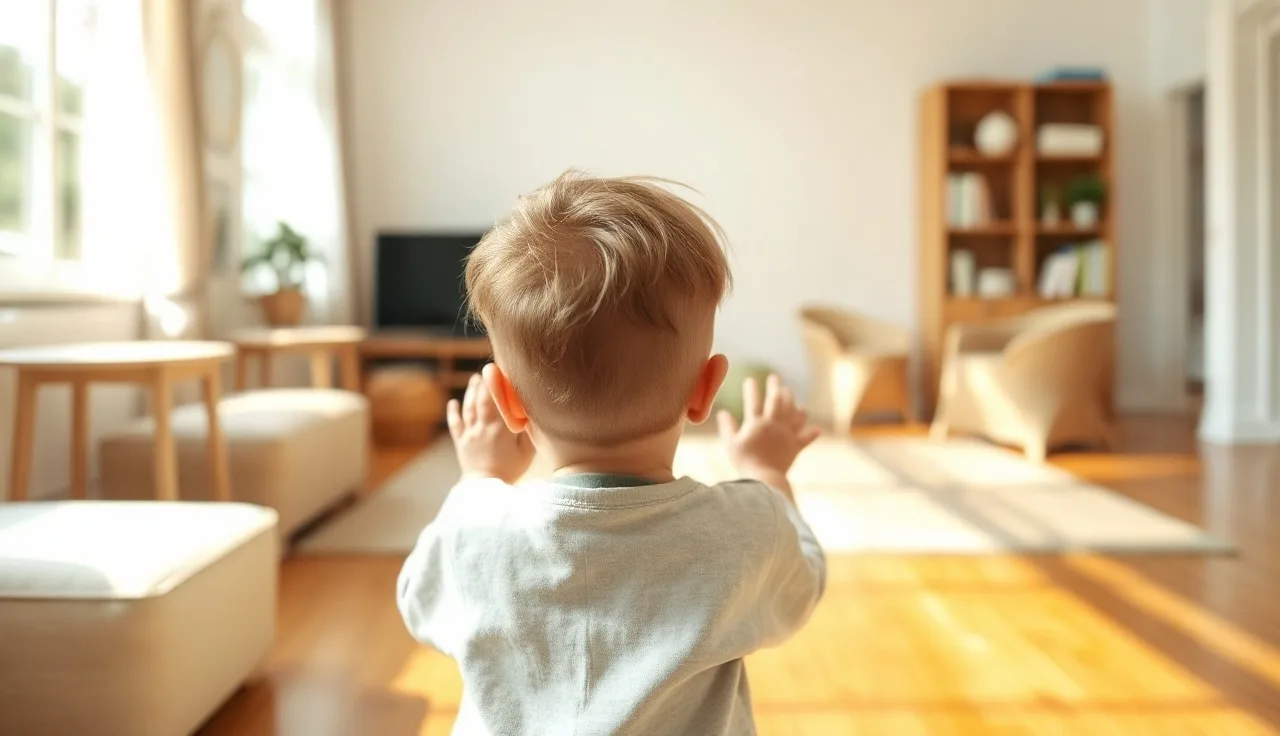
A toddler babbling at a blank wall, narrating to the ceiling, or holding an earnest conversation with a corner can mean almost nothing or something worth a second look. Context decides. That's the honest answer.
At 18 months, kids are inside a language explosion. The American Speech-Language-Hearing Association puts typical 18-month-olds at 10 to 25 words, and the outer edges of normal are genuinely wide [1]. A child with 15 clear words who spends five minutes chatting at the wall while also pointing, making eye contact, and turning when you call their name is almost certainly just practicing. A child who talks fluently to walls but rarely to people, rarely points, and doesn't reliably respond to their name is showing a different pattern. That one deserves a closer look.
There are four common reasons toddlers talk to walls. Solo practice comes first: walls don't interrupt, correct, or expect anything back, so children rehearse new sounds and word combinations in private before trying them out socially. Second is echolalia, where the child replays overheard speech, TV dialogue, or songs, often with no message behind it. Third is self-regulation, because the sound and rhythm of their own voice is calming. Fourth, and less common at this age, a child may struggle to aim social communication at people, which can be an early sign of autism.
These reasons overlap. And none of them can be confirmed by watching the behavior alone.
Is talking to walls normal toddler behavior?
Yes, for plenty of kids. Solitary self-talk shows up across child language research as a typical part of early development. The psychologist Lev Vygotsky described "private speech" in children as young as 18 months, arguing they use it to organize their own thinking and rehearse language before they can manage it in real conversation.
The question that matters clinically is not whether the wall-talk exists. It's whether it's the main way your child communicates. Typical toddlers talk to walls AND to caregivers. They hold your gaze, they gesture, they point at something and then look back at you to share the moment. If wall-talk sits alongside those social behaviors, it's almost certainly harmless.
The American Academy of Pediatrics recommends developmental surveillance at every well-child visit, with formal screening using a validated tool at 9, 18, and 24 or 30 months [2]. If your 18-month visit didn't include a real conversation about language and social development, ask your pediatrician to run the M-CHAT-R/F. It's the standard autism screener for this age. Ten minutes, no cost.
Here's something worth saying plainly: pediatricians vary enormously in how hard they screen. Some raise concerns unprompted. Others say "let's wait and see" when a child is borderline. You're allowed to push back on "wait and see" if your gut says something is off. The earlier intervention starts, the better children do [3].
What are typical speech milestones at 18, 24, and 30 months?
Here's what ASHA counts as typical, in plain language, pulled from their developmental norms [1]:
| Age | Words expected | Other communication markers |
|---|---|---|
| 18 months | 10-25 words | Points to ask for things, waves bye-bye, follows simple 1-step directions |
| 24 months | 50+ words, 2-word phrases | Points to pictures in books, follows 2-step directions, strangers understand ~50% of speech |
| 30 months | 200-300 words, 2-3 word sentences | Asks "why" questions, uses pronouns (I, me, you), strangers understand ~75% of speech |
One caveat runs through all of it: the range around any milestone is real and wide. A child with 8 words at 18 months who gains a new one every week is in a very different spot from a child stuck at 8 words for two months with nothing new.
For boys specifically, there's some evidence they hit expressive language milestones slightly later than girls on average, though the gap is modest and it's a bad reason to skip evaluation [4]. A boy not talking at 18 months, a boy not talking at 24 months, and a boy not talking at 30 months all warrant a look, whatever the sex-based averages say.
The working rule: if your child is more than a month behind on two or more milestones, ask for a referral to a speech-language pathologist (SLP). Don't wait for the next scheduled visit.
Could wall-talking be echolalia, and what does that mean?
Quite possibly. Echolalia is the repetition of words or phrases heard earlier, either right after hearing them or hours and days later (that later kind is called delayed echolalia). It's common in typically developing toddlers in the 18 to 30 month window, and it's also very common in autistic children and in some kids with apraxia.
When a toddler recites a line from a TV show at the wall, or repeats something you said an hour ago with perfect intonation but no obvious purpose, that's delayed echolalia. In typical development it usually fades by age 3 as flexible, self-generated language comes online. In autism it often persists and serves real communicative functions that caregivers learn to read over time.
The echolalia meaning matters here. Prizant and Duchan, in their 1981 study, separated echolalia that is "mitigated" (slightly changed) from "pure" repetition, and found that even pure echolalia often carries communicative intent in autistic children [11]. So a child quoting Bluey at the wall isn't automatically producing noise. It may be processing, self-regulation, or a bid for connection using the only language they have on hand.
The distinction that guides clinical decisions: does the child also have functional communication? Can they get basic needs met, even through unconventional means? A toddler who can reliably signal hunger, comfort, discomfort, and interest, even by pointing and one-word tries, has a more positive outlook than a child with no reliable communicative acts at all.
Is talking to walls an early sign of autism?
It can be one piece of a bigger picture. No single behavior diagnoses autism. The DSM-5-TR requires persistent differences in both social communication and restricted or repetitive behaviors, across multiple settings, before a diagnosis is made [5]. Talking to walls alone doesn't clear that bar.
The behaviors that add up to a reason for screening are well established. The CDC's Learn the Signs. Act Early. program lists these 18-month flags [6]: not pointing to show things, not saying at least 6 words, not noticing when others are hurt or upset, not looking at objects when someone points at them, and losing skills they once had. Wall-talk sits inside that fuller picture, not on its own.
If your child talks to walls AND shows several of those behaviors, request an evaluation. The AAP recommends autism-specific screening at 18 and 24 months [2]. An SLP evaluation, plus a developmental pediatrician or psychologist if needed, can sort out what's going on. An SLP doesn't diagnose autism, but they can document the communication profile in detail and refer you to the right person.
Autism can be diagnosed reliably by age 2 in experienced hands. Many kids get diagnosed at 3 or 4 only because families waited. If you suspect it, pursue evaluation now. Early intervention services under IDEA Part C are available to children under 3, at no cost to families in most states [7].
When should I be worried, and what should I do right now?
Some situations call for action this week, not at the next well-child visit.
Act now if: your child has lost words or skills they used to have (regression is a red flag at any age); they rarely or never respond to their name; they have fewer than 6 words at 18 months or fewer than 50 words at 24 months; they have no two-word combinations by 24 months; they almost never make eye contact or point; or the wall-talk clearly outweighs the people-talk.
What to do, in order. Call your pediatrician and ask for a referral to an SLP for a speech and language evaluation. You do not need a diagnosis to get one. Next, call your state's Early Intervention program directly. Under IDEA Part C, parents can self-refer, so no doctor's note is required to get screened [7]. Find your state's contact through the ECTA Center. Then fill out the M-CHAT-R/F online ahead of time, so you walk into appointments with data in hand. It's free and takes ten minutes.
Don't wait to see if they "grow out of it" once you have multiple concerns. The research on early intervention is steady: services before age 3 produce meaningfully better outcomes than the same services started at 4 or 5 [3]. Every month counts at this age.
What can I do at home to encourage communication?
Home strategies have solid research behind them, and you don't need to be a therapist to run them. These are the approaches SLPs teach parents most often in the 18 to 30 month window.
Get on their level. Sit on the floor. Communication happens more when you're face to face, and this isn't symbolic: parent-implemented intervention studies show joint attention rises when parents physically drop to child eye level.
Follow their lead. If they're fixed on the wall, narrate the wall. "The wall is white. The wall is smooth." You're not reinforcing an odd habit. You're building language inside the focus they already have. That's the core of Responsive Interaction intervention, one of the better-studied parent-led approaches [8].
Expand, don't correct. If your child says "ball," you say "yes, big ball" or "ball rolls." You add one step of complexity and demand nothing back. Clinicians call this expansion or recasting.
Swap questions for comments. "What's that?" is harder for a struggling communicator than "I see a dog." Comments invite a child in without putting them on the spot.
Pause and wait. After you say something, wait 5 to 10 full seconds. It feels uncomfortably long. It gives processing time. A lot of kids who look unresponsive are actually still working on it, and they just need the room.
If your child is getting formal speech therapy, these moves extend what the therapist starts. One hour a week with nothing happening the other 167 hours does far less than that hour plus daily practice at home.
What does a speech-language evaluation actually look like at this age?
An evaluation for an 18 to 30 month old is mostly play-based observation. The SLP watches how your child communicates during natural interaction, runs standardized assessments normed on kids the same age, and takes a detailed history from you.
Standardized tools common at this age include the Preschool Language Scale (PLS-5) and the Bayley Scales of Infant and Toddler Development. These compare your child to a normed sample and produce standard scores. A score more than 1.5 standard deviations below the mean usually qualifies a child for services.
Plan for 45 to 90 minutes. The SLP observes joint attention, play skills, verbal and nonverbal communication, and comprehension. They'll almost certainly hand you a parent report measure like the MacArthur-Bates Communicative Development Inventories (CDIs), a word checklist that captures the vocabulary kids show at home, where they often do more than in a clinic room.
Afterward, you should get a written report with scores, plain interpretation, and specific recommendations. If they recommend therapy, ask about frequency, goals, and exactly how to practice at home. If they say everything looks fine but your gut disagrees, get a second opinion. That's reasonable, and good SLPs expect it.
How does Early Intervention work, and is it free?
Early Intervention (EI) is a federally mandated program under Part C of the Individuals with Disabilities Education Act (IDEA) [7]. It covers children from birth through age 2 years, 11 months who have a developmental delay or a condition likely to cause one.
Services happen in the child's "natural environment," which usually means your home or their childcare, not a clinic. The SLP comes to you. That's deliberate: research shows kids generalize skills better when intervention happens where they actually live.
Cost depends on your state. Federal law requires states to provide services at no cost to families who cannot afford to pay, and many states provide EI free to everyone regardless of income. The ECTA Center keeps state contact information current [7].
At age 3, children age out of Part C and move to Part B services through the school district, if they still qualify. A transition meeting is required by law. Don't skip it. Gaps in service happen when families aren't proactive about that handoff.
For kids who need more than EI provides, or who are already past 3, private SLP services and online speech therapy are options. Insurance coverage varies, so check your policy for "speech therapy" as a covered benefit.
Could this be childhood apraxia of speech instead of autism?
Childhood apraxia of speech (CAS) is a motor speech disorder where the brain has trouble planning and sequencing the movements speech requires. Kids with CAS often had limited babble as infants, make very inconsistent speech errors, and struggle hard to imitate sounds on request. They understand far more than they can say.
A child with CAS might talk to walls because the low-stakes setting drops the motor pressure and performance anxiety that make CAS worse. They may sound clearer when nobody's watching or grading. If your child speaks more clearly during self-talk than in conversation, tell the SLP that directly. It's a clinically useful observation.
CAS is less common than plain language delay. The best prevalence estimates land around 1 to 2 per 1,000 children [9]. It calls for specific therapy (DTTC and ReST have the strongest evidence) that differs from general language therapy. A standard SLP evaluation should catch it, but make sure the evaluating SLP has real experience with motor speech disorders in young children.
CAS, autism, and language delay can co-occur. A child can have more than one, which is exactly why a thorough evaluation beats guessing the label from your couch.
How can Little Words or other tools support communication practice at home?
Once your child is in evaluation or therapy, daily practice at home is where the gains stack up. Apps built for early communicators can add practice time and give kids a no-pressure way to play with language.
Little Words is an AI speech companion made for neurodivergent children and late talkers. It's designed to sit alongside professional evaluation and therapy, not replace them. If you want to see whether it fits your child's current level, there's a short quiz at the start that matches the experience to where they are right now.
For kids not yet using apps, AAC devices are worth knowing about. AAC (augmentative and alternative communication) is not a consolation prize for children who can't talk. Research consistently shows that giving a child an AAC system does not reduce spoken language and often speeds it up [10]. If your child is 18 to 30 months with limited verbal output, asking the evaluating SLP about AAC is an evidence-based question, not a white flag.
For children on the autism spectrum, autism spectrum speech therapy approaches built around autistic communication styles (PECS, LAMP, and naturalistic developmental behavioral interventions) have a stronger evidence base at this age than generic language therapy.
What if my toddler boy isn't talking at 18, 24, or 30 months?
"Late talker" is the label for kids with limited expressive vocabulary but otherwise typical development. It applies to children between 18 and 35 months who produce fewer words than expected for their age with no other developmental concerns. Roughly 10 to 15% of toddlers are late talkers by this definition [4].
Between 50 and 70% of late talkers with no other concerns catch up to peers by age 5 without formal help (the "late bloomer" pattern). The remaining 30 to 50% don't, and go on to have lasting language difficulties [4]. The trouble is that at 18 or 24 months, you cannot reliably tell which group your child lands in.
Boys are somewhat overrepresented among late talkers. The boy-to-girl ratio in late talker studies runs roughly 2 to 3 boys for every girl [4]. So a boy not talking at 18 months, a boy not talking at 24 months, and especially a boy not talking at 30 months should be evaluated, not brushed off with "boys are just slower."
The practical answer: get the evaluation. If everything else looks good and the SLP recommends watchful waiting with a real monitoring plan, that's reasonable, because there's a concrete plan behind it. "Wait until he's 3" with no follow-up on the calendar is not.
Frequently asked questions
Is it normal for an 18-month-old to talk to themselves or walls?
Yes, for many toddlers this is normal private speech or language practice. Children rehearse new words and sounds in low-pressure situations, including at blank walls. It becomes a concern when a child talks to walls more than to people, rarely makes eye contact, and lags on speech milestones. Judge the whole picture rather than the wall-talk in isolation.
My toddler talks to walls but not to me. Should I be worried?
That pattern is worth taking seriously. Typical toddlers use communication mainly to connect with people. If your child's wall-talk is richer or more frequent than their communication with you, and they also don't respond to their name reliably or rarely point and make eye contact, request an evaluation with a speech-language pathologist. It's not a diagnosis, but you get answers faster than by waiting.
What is echolalia and could that explain my child talking to walls?
Echolalia is the repetition of heard speech, from TV, caregivers, or songs. When a toddler recites phrases at the wall with no obvious social purpose, that's likely delayed echolalia. It's common in typical development and very common in autism. Whether it's concerning depends on whether your child also has functional communication: can they reliably signal wants and needs? See echolalia for a fuller breakdown.
How many words should an 18-month-old say?
ASHA's developmental norms put typical 18-month-olds at 10 to 25 words, though the clinical range runs from 6 to 50-plus. What matters as much as the count: are they gaining new words? Do they point? Do they follow simple directions? A child with 8 words who adds new ones weekly is different from one stuck at 8 words for two months.
Could my child be autistic if they talk to walls?
Wall-talk alone doesn't indicate autism. Autism involves persistent differences in both social communication and restricted or repetitive behaviors, across multiple settings. If talking to walls comes with limited eye contact, no pointing, no response to their name, and speech aimed mostly at objects instead of people, that combination warrants screening (the M-CHAT-R/F at 18 months is the standard tool). One behavior is never a diagnosis.
How do I get my toddler evaluated for a speech delay?
Two paths: ask your pediatrician for a referral to a speech-language pathologist, or self-refer to your state's Early Intervention program (no doctor's note needed under IDEA Part C). EI serves children from birth to age 3 and must evaluate within 45 days of referral in most states. Services are often free or low-cost. Find your state's EI contact through the ECTA Center at ectacenter.org.
What is Early Intervention and is it really free?
Early Intervention is a federally mandated program under IDEA Part C for children under age 3 with developmental delays. Services happen in your home or childcare setting. Many states provide EI at no cost to all families; others use a sliding scale. Families cannot be denied services because they cannot pay. Contact your state's EI coordinator to start. No diagnosis is required, only evidence of a delay.
Why do boys talk later than girls, and does that change when I should get help?
On average, boys hit expressive language milestones slightly later than girls, but the gap is modest and the evidence is mixed. Boys make up roughly 60 to 70% of late talker populations in research. That overrepresentation should not mean a longer wait before evaluation. A boy not talking at 24 or 30 months needs the same prompt evaluation as a girl. Use the same milestone thresholds for both.
My toddler repeats TV phrases at the wall. Is that a problem?
Replaying TV dialogue, songs, or adult phrases is delayed echolalia. In typical development it fades by age 3. In autistic children it often persists and can carry real communicative function. The question is whether your child also communicates with people more than with objects. If TV echolalia is their dominant mode and direct communication with people is limited, an SLP evaluation will clarify what's happening.
Will giving my child an AAC device stop them from talking?
No. This worry has a clear research answer: AAC does not reduce speech development and often speeds it up by lowering communication pressure and giving children a reliable way to express themselves. ASHA and the AAP both support AAC for children who need it, including very young children. If your toddler has limited verbal output, asking an SLP about AAC is a well-founded question, not a last resort.
What home strategies actually help a late-talking toddler?
SLPs consistently recommend: get face to face at child level, follow the child's lead in play, expand what they say by one step ("ball" becomes "big ball"), replace questions with comments, and pause 5 to 10 seconds after speaking for processing time. These come from Responsive Interaction and milieu teaching research. They carry therapy gains into the other 167 hours of the week when no therapist is present.
What is the difference between a late talker and apraxia?
A late talker has limited vocabulary but no motor speech issue. Childhood apraxia of speech (CAS) is a motor planning disorder where the brain struggles to sequence mouth movements for speech, causing inconsistent errors and visible effort. Children with CAS often sound clearer in low-pressure settings like self-talk, which is why they may speak more fluently at walls than in conversation. An SLP can tell the two apart with a motor speech assessment. See childhood apraxia of speech.
My child was talking and then stopped. Is that different from never talking?
Yes. Regression is a red flag. Losing words or communication skills a child previously had is specifically listed by the CDC and AAP as a reason to seek evaluation immediately, not at the next scheduled visit. It can point to autism, a medical issue, or a real disruption in development. Don't wait to bring this up with your pediatrician.
At what age is it too late to benefit from speech therapy?
It's never too late for speech therapy to help, but outcomes are strongest when it starts earliest. Research consistently shows that language intervention before age 3 produces better long-term outcomes than the same work at 4 or 5. Meaningful gains still happen at every age. Children starting therapy at 3, 4, or 5 make significant progress. The case for acting early is about maximizing gains, not foreclosing them.
Sources
- American Speech-Language-Hearing Association, Speech and Language Developmental Milestones: Typical 18-month-olds say 10 to 25 words; 24-month-olds say 50 or more words and begin combining two words
- American Academy of Pediatrics, Developmental Surveillance and Screening Policy: AAP recommends autism-specific screening at 18 and 24 months using validated tools like the M-CHAT-R/F at well-child visits
- National Institute on Deafness and Other Communication Disorders (NIDCD), Autism Spectrum Disorder: Communication Problems in Children: Earlier intervention for autism and language delays produces stronger developmental outcomes than later-starting intervention
- Rescorla, L. (2011). Late talkers: Do good predictors of outcome exist? Developmental Disabilities Research Reviews, 17(2), 141-150.: Roughly 10-15% of toddlers are late talkers; 50-70% catch up by age 5 but 30-50% do not; boys are overrepresented at approximately 2-3 to 1 ratio
- American Psychiatric Association, DSM-5-TR: Autism spectrum disorder diagnosis requires persistent differences in both social communication and restricted/repetitive behaviors across multiple contexts
- Centers for Disease Control and Prevention, Learn the Signs. Act Early.: CDC lists 18-month autism red flags including: not pointing to show things, not saying at least 6 words, not noticing when others are hurt or upset, and losing previously acquired skills
- ECTA Center, IDEA Part C Early Intervention Program: Under IDEA Part C, parents can self-refer for Early Intervention evaluation without a doctor's referral; services serve children from birth through age 2 years 11 months
- Yoder, P. & Warren, S. (2002). Effects of prelinguistic milieu teaching and parent responsivity education on dyads involving children with intellectual disabilities. Journal of Speech, Language, and Hearing Research, 45(6), 1158-1174.: Responsive Interaction and milieu teaching approaches show evidence of increasing joint attention and early language in toddlers with developmental delays
- Shriberg, L.D. et al. (2019). Prevalence of speech delay in 6-year-old children and comorbidity with language impairment. Journal of Speech, Language, and Hearing Research.: Childhood apraxia of speech prevalence is estimated at approximately 1 to 2 per 1,000 children in the general population
- American Speech-Language-Hearing Association, Augmentative and Alternative Communication (AAC): AAC does not inhibit speech development and research supports its use in young children with limited verbal output; ASHA endorses AAC as an evidence-based practice
- Prizant, B.M. & Duchan, J.F. (1981). The functions of immediate echolalia in autistic children. Journal of Speech and Hearing Disorders, 46(3), 241-249.: Echolalia in autistic children often carries communicative intent and can be distinguished as mitigated versus pure repetition; even pure echolalia frequently has communicative function
- U.S. Department of Education, Individuals with Disabilities Education Act (IDEA): IDEA Part C mandates early intervention services for eligible children from birth through age 2 and requires states to evaluate within 45 days of referral