Key takeaways
- AAC is communication access, not a sign of giving up on speech. Every autistic child deserves a reliable way to be understood.
- AAC does not stop talking. The research direction is consistent: it supports communication and often supports spoken language.
- Low-tech and high-tech AAC both count. Picture boards, PECS, core word boards, apps, and devices are all valid starting points.
- Choose the system around your child's motor, sensory, and vocabulary needs, then model it yourself rather than handing it over.
- An SLP who does AAC evaluations can help you trial options and pursue funding through insurance or school.
Best next reads
- AAC for autism: PECS vs Proloquo vs LAMPRead the Little Words guide
- AAC and autism myths that need to dieRead the Little Words guide
- Why AAC vocabulary size mattersRead the Little Words guide
- Will AAC stop my child from talking?Read the Little Words guide
- LittleWords vs an AAC deviceRead the Little Words guide
- Apraxia of Speech vs Phonological DisorderFrom this hub
- Childhood Apraxia of Speech: A Parent's Plain-English GuideFrom this hub
- Choosing a Preschool for Your Autistic Toddler: The RealFrom this hub
- Delayed Echolalia: What It Means and What to DoFrom this hub
- DTTC for Apraxia: What It Is and How It WorksFrom this hub
- How Many SLP Sessions Per Week for Apraxia?From this hub
- How to Respond When Your Child Echoes YouFrom this hub
- Is Echolalia Bad? The Honest AnswerFrom this hub
- Montessori for Speech-Delayed Kids: Honest TakeFrom this hub
- PROMPT Therapy: The Tactile Approach to ApraxiaFrom this hub
- Scripting From Movies: What Your autistic child Is Telling YouFrom this hub
- What to Ask on a Preschool Tour (As an ND Parent)From this hub
- Why Does My Child Repeat Everything I Say?From this hub
What is AAC, in plain terms?
AAC stands for augmentative and alternative communication. The phrase covers any tool that adds to or stands in for spoken words so a child can be understood. That includes pointing to pictures, handing over a card, pressing buttons that speak, and tapping words on a tablet app. Augmentative means it adds to whatever speech a child already has. Alternative means it can carry the full message when speech is not available in the moment.
For an autistic child, AAC is a voice, not a crutch. A child who can request a snack, refuse a shirt, ask for help, comment on a dog, and choose between two activities is communicating. The form the message takes, whether spoken, pointed, or tapped, matters far less than the fact that the child is understood and gets a response.
AAC is language, not a last resort
One of the most damaging myths is that families should exhaust speech therapy first and only reach for AAC when nothing else works. That order gets it backwards. Communication access is a starting point, not a consolation prize. A child who waits months or years for a reliable way to be understood spends that time frustrated, and frustration rarely helps language grow.
Presume competence. An autistic child who is not speaking is not necessarily not understanding. Many nonspeaking and minimally speaking autistic people describe understanding far more than they could ever say out loud, and AAC is what finally let them show it. Treat your child as a capable communicator who needs the right tool, not a child who has to earn one.
Does AAC stop a child from talking?
No, and this is the question parents ask most. The research direction is consistent across reviews of AAC use with autistic and other children: AAC does not prevent or delay speech. If anything, studies more often find spoken language holding steady or increasing after AAC is introduced. Giving a child a dependable way to communicate tends to reduce pressure and meltdowns, and it models the connection between a word and its meaning, which can make spoken attempts more likely.
It helps to drop the idea that speech and AAC compete. They are not rivals. A child can point to a picture, tap a word, and say an approximation of that word in the same minute. Each path reinforces the others.
The main types of AAC devices for autism
AAC sits on a range from low-tech to high-tech. None of these is automatically better. The right one is the one your child can access and your family will actually use.
Low-tech AAC
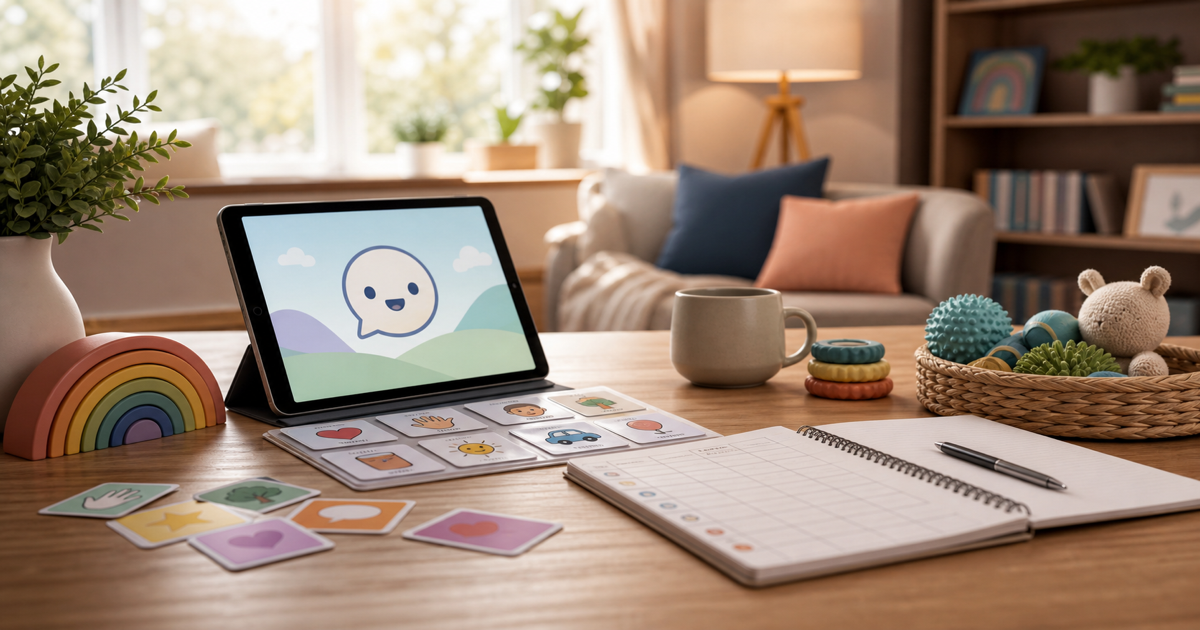
Picture cards, a PECS book, and laminated core word boards need no battery and no setup. They are cheap, durable, and forgiving in messy real-life moments at the park or the dinner table. Many families start here while they figure out what a higher-tech system might add.
High-tech AAC
Speech-generating apps run on a tablet and speak aloud when a child taps words or symbols. Common ones include Proloquo2Go, TouchChat, and LAMP Words for Life. There are also dedicated speech-generating devices built only for communication, which can be more rugged and may qualify for insurance funding. High-tech systems hold far more vocabulary, which matters as a child grows.
Using both
Plenty of families run a low-tech board and a high-tech device side by side. The board covers spills, beaches, and dead batteries. The device carries the deeper vocabulary. There is no rule that says a child has to pick one.
How to choose a system around your child
Resist the pull of the longest feature list. A polished app that overwhelms your child is worse than a simple board your family uses every day. Weigh these together:
- Motor planning. Can your child reliably hit the targets, and does the layout stay consistent so the motor pattern can become automatic?
- Visual scanning and sensory load. Some children do better with fewer, larger symbols, others with a busier grid. Watch what calms versus what overloads.
- Vocabulary depth. Look for core words your child can recombine, not just nouns. Core words like more, stop, go, help, and want carry most of daily communication.
- Durability and cost. Tablets break. Dedicated devices are sturdier and may be funded. Low-tech is cheap to replace.
- School and therapy support. A system everyone around the child can model will travel farther than the fanciest app no one else uses.
A speech-language pathologist who does AAC evaluations can let your child trial a few systems before you commit, and can help you pursue funding through insurance or the school.
How to help your child use AAC at home
AAC usually stalls when adults hand over a device and wait for output. It works when adults use the system themselves, out loud, in real moments. This is called modeling, and it is the single most useful thing you can do.
Model without demanding
Press more on the board while giving more crackers. Press go before you push the swing. Press help while opening a stuck container. You are showing your child what the tool does, not quizzing them. Avoid say it or show me the word. Comment more than you question.
Treat every attempt as real
When your child presses a word, respond to the message even if the timing or word is not what you expected. Honoring the attempt teaches the most important lesson of all: communication works and gets a response.
Keep it everywhere
A communication system the child can only reach at a desk is not reliable. AAC should stay within reach across home, school, therapy, and the community so it is available the moment your child has something to say.
Buddy is a voice-first speech companion your child actually talks to, made for late talkers and neurodivergent kids. It supports spoken practice alongside a child's AAC, never in place of it. It is free to download on the App Store.
Download on the App StoreWhere Little Words fits
Little Words can support spoken practice and give parents insight, but it is not an AAC system and will never replace one. If your child needs a reliable communication method, AAC should remain available across every setting. Think of Little Words as low-pressure practice that sits alongside your child's AAC, not a substitute for it.
Frequently asked questions
What is AAC for autism?
AAC stands for augmentative and alternative communication. It is any tool that gives an autistic child a reliable way to communicate beyond spoken words, from low-tech picture boards, PECS, and core word boards to high-tech speech-generating apps and devices. It is a way to be understood, not a replacement for the child's voice.
Will AAC stop my autistic child from talking?
No. Research consistently shows AAC does not prevent or delay speech. For many autistic children it supports communication and is linked to equal or better spoken language. A reliable way to be understood tends to lower frustration and make spoken attempts more likely.
What are the main types of AAC devices for autism?
AAC ranges from low-tech to high-tech. Low-tech includes picture cards, PECS, and laminated core word boards. High-tech includes speech-generating apps such as Proloquo2Go, TouchChat, and LAMP Words for Life, and dedicated devices. Many families use both a board and a device.
How do I choose an AAC system for my child?
Match the system to your child, not to the longest feature list. Consider motor planning, visual scanning, sensory load, vocabulary depth, durability, cost, and what school and therapy can support. A simple board your family uses daily beats a polished app that overwhelms your child. An SLP who does AAC evaluations can help you trial options.
At what age should an autistic child start AAC?
There is no minimum age and no need to wait. If your child is not yet using enough spoken language to be reliably understood, AAC can begin now, including in toddlerhood. Early access gives a child a way to communicate while speech is still developing.
How do I help my child actually use AAC at home?
Model the system yourself instead of handing it over and waiting. Press words as you talk, like more while giving more crackers or help while opening a container. Keep pressure low, follow your child's interests, and treat every press as real communication. Consistent modeling across settings helps most.
Is Little Words an AAC app?
No. Little Words is speech practice and parent support. It is not an AAC system and should not replace a child's AAC. If your child needs a reliable communication method, AAC should stay available across home, school, therapy, and the community.
Sources
Primary sources for this topic. Little Words Editorial verified each link on August 10, 2026. See how we check claims in our editorial standards.
- ASHA: Augmentative and Alternative Communication (parent guide). Accessed August 10, 2026.
- ASHA Practice Portal: Autism Spectrum Disorder. Accessed August 10, 2026.
- U.S. Department of Education: Individuals with Disabilities Education Act (IDEA). Accessed August 10, 2026.