Last updated 2026-07-09
Most 2-year-olds have at least 50 words and are starting to put two of them together, things like "more milk" or "daddy go." By 2 and a half, that vocabulary usually grows to somewhere around 200 to 300 words, and sentences stretch to three words. Strangers who don't spend much time with your child should be able to make out about half of what a 2-year-old says. If your child isn't hitting these marks yet, it doesn't automatically mean something's wrong, but it's a good enough reason to have them evaluated.
What speech milestones should a 2-year-old hit?
By age two, most kids can say at least 50 words, start combining two of them ('big dog,' 'no more,' 'mommy up'), and be understood by a familiar adult roughly half the time. Both the American Speech-Language-Hearing Association and the American Academy of Pediatrics use these as the benchmarks for the 24-month mark: ASHA lists the 50-word count, early two-word combinations, and 50% intelligibility with familiar listeners [1], and the AAP checks for the same things at the 24-month well-child visit, flagging fewer than 50 words or no two-word phrases as reasons to refer a child for further evaluation [2].
Keep in mind these are floors, not averages. Typical development covers a wide range: some children have 200 words by their second birthday, while others reach 50 words right at the two-year mark and are doing just fine. The word count itself matters less than the direction things are moving. Is the child picking up new words most weeks? Have they started putting words together, even clumsily?
There are a few other things worth watching alongside vocabulary size. At this age, kids should be able to point to named pictures in a book, follow a two-step instruction like "get your shoes and bring them here," and reach for words rather than gestures when they want something. A child who's still mainly pulling a caregiver's hand or pointing instead of attempting to say what they want is worth paying attention to.
Something a lot of parents overlook: talking is only one side of the picture. What a child understands usually runs about six months ahead of what they can say out loud. So a child who clearly understands a great deal but doesn't say much is in a very different spot than a child who seems to understand little and says little. Both are worth attention, but the second pattern is generally the one that raises more concern.
What are the speech milestones at 2.5 years old?
The halfway point between second and third birthdays is worth paying attention to on its own. Language moves fast in this window, and the 2.5-year benchmarks give you a checkpoint before the bigger 36-month evaluation comes around.
By 30 months, ASHA's developmental norms put typical vocabulary at roughly 200 to 300 words, with children using two- and three-word phrases regularly and being understood by strangers about half to three-quarters of the time [1]. Grammar starts showing up too: plurals (adding an "s"), possessives ("daddy's car"), and the present progressive ("she's running") should all be making an appearance [3].
One study in the Journal of Speech, Language, and Hearing Research found that vocabulary size at 24 months predicted sentence complexity at 36 months better than any other single factor. That's a big part of why clinicians pay so much attention to whether a child hits 50 words on time [4]. A child who missed that 50-word mark at 24 months and is still well under 200 words at 30 months fits a pattern that calls for an evaluation, not more waiting.
Beyond vocabulary counts, a 2.5-year-old should be asking simple questions ("where go?", "what that?"), naming familiar objects around them without prompting, and managing a back-and-forth exchange for at least two or three turns. If your child is still mostly using single words at this age, that's worth a call to the pediatrician now, rather than saving it for the next scheduled visit.
How many words should a 2-year-old say?
At exactly 24 months, the expectation is at least 50 words, and that's a floor, not a ceiling [1][2].
Word counts at this age are tricky because parents often undercount, unsure what actually "counts" as a word. Any sound or approximation the child uses consistently to mean the same thing counts, whether that's "ba" for bottle, "duh" for dog, or "muh" for more. Nobody needs correct pronunciation at this stage.
By 30 months, most children have somewhere between 200 and 300 words. By 36 months, that range climbs to between 500 and 1,000 [3]. The growth curve from 24 to 36 months is steep, and that's exactly why a gap at 24 months tends to widen rather than close on its own.
On the subject of "late talkers": research by Rescorla and colleagues found that around half of children who are late talkers at 24 months catch up on their own by age 3, without any formal intervention. The other half don't, and there's no reliable way right now to tell in advance which group a particular child will fall into [5]. Taking a "wait and see" approach can be reasonable, but it works best as a choice made alongside a speech-language pathologist after a real screening, not as a hope that things sort themselves out.
What does a 2-year-old's speech actually sound like?
Expect it to be imperfect. Very imperfect.
At 24 months, kids are usually understood by familiar listeners, parents and caregivers, about half the time, and by strangers or a new babysitter noticeably less than that [1]. By 36 months, intelligibility to strangers should climb to around 75%. By age 4, most people should be able to follow what a child is saying without much trouble.
Speech sounds come in roughly in order. At 2, kids are expected to have sounds like 'p,' 'b,' 'm,' 'h,' 'w,' and 'n' down. Trickier sounds such as 'r,' 'l,' 'th,' 's,' and 'z' aren't expected until somewhere between age 4 and 8, depending on the sound [3]. So a 2-year-old saying "wabbit" for rabbit is right where they should be. If parents themselves can only make out a quarter or less of what their 2-year-old says, that's worth having checked out. Toddlers also repeat sounds, throw in filler syllables, and interrupt themselves mid-sentence a lot. Most of this is ordinary disfluency, the kind that shows up while a child's language and motor control are still catching up to each other. If stuttering hangs on for more than a few weeks, or comes with visible strain (grimacing, eye blinking, tensing up), mention it to a pediatrician or speech-language pathologist.
You might also notice echolalia at this age: the child repeats phrases they've heard instead of putting together their own words. Some of this is normal for toddlers. But when it's still the main way a child communicates well past age 2, it can point to autism or a language processing difference, and it's worth bringing up with a professional.
What are red flags in a 2-year-old's speech?
A handful of signs mean it's time to call your pediatrician or ask directly for a referral to a speech-language pathologist, rather than waiting to see what happens: fewer than 50 words at 24 months [1][2], no two-word combinations by that age [1], or the loss of words or skills the child once had (regression is always worth acting on, never something to sit on). Other signs include not pointing to share interest ("look at that dog!") by 18 months, not following simple two-step directions by 24 months, speech that parents understand less than half the time, leaning on gestures or pulling adults around instead of using words, and no back-and-forth communication (babbling, gesturing, words) by 12 months. Regression deserves quick attention. If a child had 30 words and then loses them, that's not a plateau, it's a signal. The AAP recommends evaluation any time a child loses previously acquired speech or language skills, at any age [2]. This is also the age window where autism spectrum disorder often becomes detectable. The hallmark isn't necessarily silence. It's reduced joint attention (pointing, showing, following a gaze), repetitive patterns, and limited social back-and-forth. If you're noticing those patterns alongside a speech delay, ask your pediatrician about a developmental evaluation and look into what early intervention services are available near you. The sooner an evaluation happens, the sooner support can start.
How does speech development compare at 24 vs. 30 months?
Six months makes a huge difference at this age, and it helps to see the two checkpoints side by side.
| Skill | 24 months (2 years) | 30 months (2.5 years) |
|---|---|---|
| Vocabulary (minimum) | ~50 words | ~200 words |
| Vocabulary (typical range) | 50 to 300 words | 200 to 400 words |
| Sentence length | 2-word combinations | 2 to 3 word phrases |
| Stranger intelligibility | ~25 to 50% | ~50 to 75% |
| Grammar markers | Emerging | Plurals, possessives beginning |
| Question-asking | 'What that?' just beginning | 'Where,' 'what,' 'who' questions |
| Following directions | Simple 2-step | More complex 2-step |
Sources: ASHA developmental norms [1], NIDCD milestones [3]
This stretch between two and two-and-a-half is one of the steepest climbs in early language growth. A child who's barely hitting the 24-month marks will often catch up by 30 months, but usually only with plenty of talking, reading, and back-and-forth interaction along the way, and sometimes with help from a speech therapist. That's exactly why the 30-month mark is worth paying attention to: it's a natural point to check whether the gap has actually closed or is still there.
What causes speech delays in 2-year-olds?
There's rarely just one reason a 2-year-old isn't talking much, and several causes can overlap in the same child.
Hearing loss is the first thing any evaluation should rule out, because a child who can't hear sounds clearly can't learn to produce them accurately. ASHA estimates that 1 to 3 out of every 1,000 children in the United States are born with detectable hearing loss, and more acquire it in early childhood through ear infections or other causes [1]. A hearing screening belongs at the start of the process, not as an afterthought.
Developmental language disorder (DLD) is one of the most common reasons speech and language delays stick around. It isn't hearing loss, autism, or an intellectual disability. It's a specific difficulty learning language that affects roughly 7-8% of children and tends to run in families [6].
Autism spectrum disorder (ASD) often comes with speech and language delays too, and the language profile can look similar to other delays at first glance. But it usually has its own signature: echolalia, unusual rhythm or intonation in speech, and trouble with the back-and-forth of conversation rather than just a vocabulary gap. Parents weighing this possibility can look at autism spectrum speech therapy to see what evaluation and support actually involve.
Childhood apraxia of speech (CAS) is less common than DLD and works differently: it's a motor speech disorder, so the child knows what they want to say but struggles to coordinate the mouth movements to say it. Kids with CAS tend to make inconsistent errors, grope visibly for sounds, and understand far more than they can express. The pages on apraxia of speech and childhood apraxia of speech cover the specific signs an SLP looks for.
And sometimes a child is just a late talker with nothing else going on: good comprehension, appropriate pointing and gestures, and a good chance of catching up by age 3 or 4. Still, about half of these kids don't catch up without help, so it's worth having an SLP monitor progress rather than simply waiting it out.
When should you worry and ask for a speech evaluation?
Don't get hung up on finding the exact right age to contact someone. What matters is that you make the call.
In the United States, children under age 3 are covered by the Individuals with Disabilities Education Act (IDEA) Part C, which provides free developmental evaluations and early intervention services through your state's early intervention program [7]. You don't need a pediatrician referral to request this evaluation; you can contact your state's program directly.
ASHA recommends that parents seek evaluation if their child is not meeting typical milestones, if the parent has a concern, or if there is any regression in skills [1]. The AAP takes a similar stance: pediatricians should screen at 9, 18, and 24-30 months using validated tools, and refer any child who doesn't pass [2].
Here's the practical part: if you're reading this article, you already have a concern. That instinct is worth trusting enough to make one phone call, either to your pediatrician or straight to your state's early intervention program. If your child is already 3 or older, the path runs through the public school system under IDEA Part B, which also offers free evaluations [7].
Speech therapy tends to work better and faster the earlier it starts. The old "wait and see" advice, holding off until age 3 or 4, doesn't hold up anymore. Research on early intervention keeps pointing the same direction: earlier support leads to better outcomes, and getting an evaluation costs you nothing even if your child turns out to be developing right on track.
What can parents do at home to support speech at age 2?
Quite a lot, as it turns out. Formal therapy matters, but language really gets built in the hours between sessions, and those hours belong to you.
The single biggest thing you can do is talk more, and talk differently. The 1995 Hart and Risley study found that the quantity and quality of language a child hears in the early years predicts vocabulary and language outcomes years later [8]. More recent work has refined that finding: what matters isn't just how much language surrounds a child, but how much back-and-forth conversation happens. Talking at your child counts for less than talking with your child.
A few habits speech-language pathologists tend to recommend at this age. Try narrating what you're doing ("I'm cutting the apple") and what your child is doing ("you're stacking the blocks"), with no pressure on them to respond, just steady exposure to words. When your child says "dog," you can expand it rather than correct it: "yes, big dog!" or "the dog is running," adding one small piece rather than turning it into a lesson. Offering choices works well too: instead of asking "do you want a snack?" try "do you want crackers or banana?" since naming the options nudges them toward using words themselves.
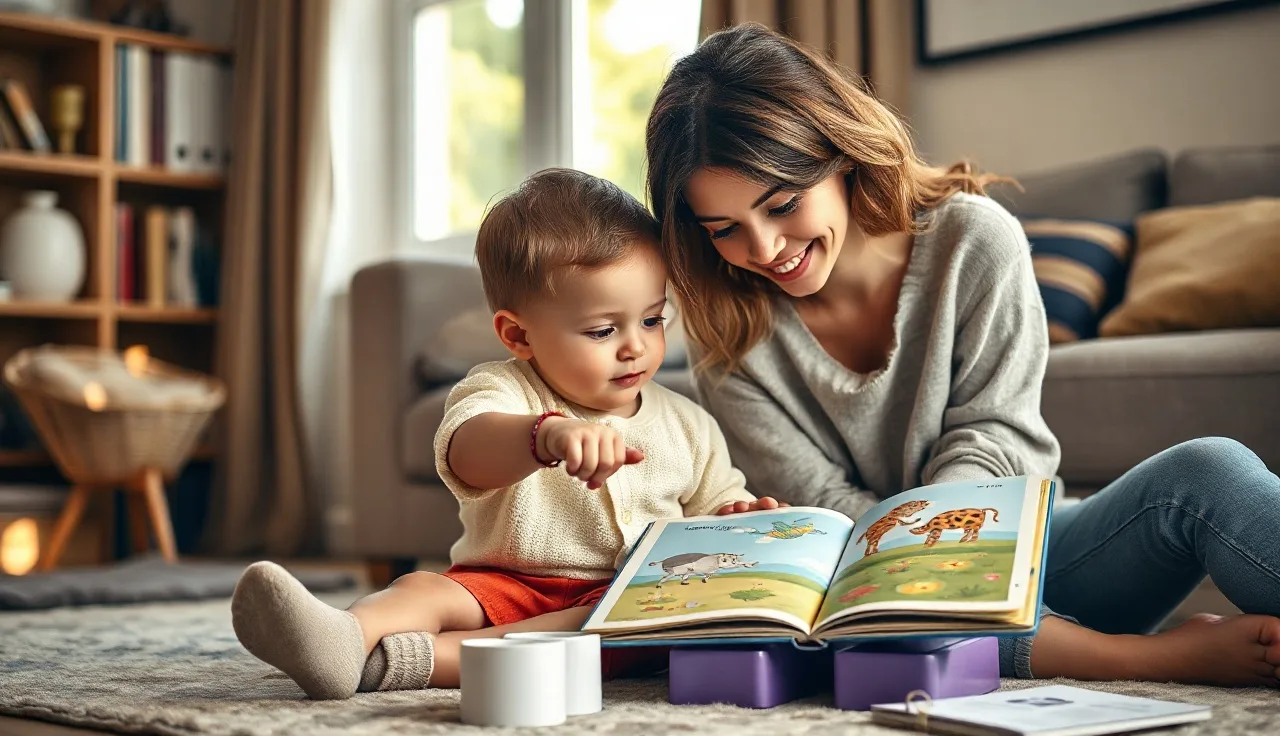
Reading together every day helps as much as anything else, whether it's picture books, board books, or whatever's on hand. Point at pictures, name them, and let your child turn the pages themselves. Shared book reading is one of the most consistent predictors of language development in the research [9].
Screen time is worth watching too. The AAP recommends no solo screen time (other than video chatting) before age 2, and limited, high-quality, co-viewed content between ages 2 and 5 [2], mainly because passive screen time crowds out the back-and-forth exchanges that actually build language.
If you'd like something more structured at home, Little Words offers guided activities and tracks your child's progress between therapy appointments. It won't replace an SLP, but it can make practice more consistent and give you a framework to follow. Their quiz is a quick way to see whether it fits your situation.
What happens in a speech-language evaluation for a 2-year-old?
A lot of parents put off booking an evaluation simply because they don't know what it involves. So here's a rundown.
A formal evaluation for a toddler usually runs 60 to 90 minutes. The speech-language pathologist will watch your child communicate during play, use standardized tools built for this age group (things like the Preschool Language Scales or the MacArthur-Bates Communicative Development Inventories come up often), ask you what your child does at home, and often do or review a hearing screening [10].
The evaluation covers what the child says (expressive language) and what they understand (receptive language), along with how clearly they produce speech sounds and how they use communication in social situations.
You'll come away with a report showing whether your child's skills fall within the expected range, below it, or well below it. If the SLP recommends services, they'll lay out a therapy plan. Under IDEA Part C, this is free if your child qualifies, and therapy happens in the child's natural environment, which for most families means at home [7].
If you want to know what therapy sessions actually look like and how to track down a therapist, the piece on speech therapy covers that in more depth, and if scheduling or location is an issue, online speech therapy has become a solid option for families in rural areas or juggling busy calendars.
Does bilingual or multilingual exposure delay speech in 2-year-olds?
No, not in any meaningful way. That said, the full picture takes a bit more explaining than a flat yes or no.
Bilingual children sometimes have smaller vocabularies in each individual language than their monolingual peers do at age 2, but when you add up what they know across both languages, the total is comparable [3]. That's the number that actually matters: total conceptual vocabulary across every language a child is learning, not how many words they have in just one of them. Any SLP evaluating a bilingual child should be assessing both languages together, not judging one in isolation.
The American Speech-Language-Hearing Association has reviewed the research on this and confirmed that bilingualism doesn't cause speech or language disorders, and it doesn't create clinically meaningful delay on its own [1]. A child raising two languages who has fewer than 50 words total (combining both) at age 2 still meets the threshold for a speech delay evaluation, same as a monolingual child would. But a toddler with 30 English words and 30 Spanish words is likely sitting right in the typical range once you count everything they can say.
Worth knowing: if you're looking for an SLP, ask specifically for one who speaks your child's home language or has real experience with bilingual assessment. Testing a Spanish-dominant toddler only in English can easily give you a misleading result.
This article is for general information and isn't a substitute for an evaluation by a qualified speech-language professional.
My 2-year-old understands everything but barely talks: what's going on?
This is a common situation, and it's a confusing one for parents. The child follows directions, points at exactly the right thing, laughs when something's actually funny, makes eye contact, clearly gets what's happening around them. The words just aren't there yet.
Strong comprehension paired with limited speech can mean a few different things. Some children are quietly building up a large store of understood language and will suddenly start talking in a burst once they're ready. Others understand fine but have a motor-speech difficulty getting in the way of production, like childhood apraxia of speech. In some children, it lines up with selective mutism instead.
Good comprehension is a reassuring sign, and it does rule out some of the more complex developmental profiles. That said, it doesn't mean you can skip an evaluation if expressive milestones are running significantly behind. The 50-word mark and the point where kids start combining two words apply no matter how well a child understands language [1][2].
An SLP can figure out whether a child is simply choosing not to talk yet (or hasn't found much reason to), whether speech itself is physically hard to produce reliably, or whether there's a wider language profile that needs addressing.
Frequently asked questions
How many words should a 2-year-old say?
ASHA and the AAP both put the minimum at 50 words by 24 months, and that's a floor, not a typical number. Plenty of kids this age have 100 to 300 words. Any sound or approximation a child uses consistently to mean the same thing counts as a word, even if it doesn't come out clearly.
Is it normal for a 2-year-old not to talk?
Having fewer than 50 words at 24 months, or no two-word phrases yet, falls outside typical development. It could mean a late talker, a language disorder, a hearing problem, or something else entirely. Roughly half of late talkers catch up by age 3, but the other half don't, and there's no way to know in advance which group a particular child belongs to without getting an evaluation.
What are the red flags for autism in a 2-year-old's speech?
Beyond a plain speech delay, pay attention to whether your child points to share interest, makes eye contact, responds to their name, relies mainly on echolalia to communicate, has lost words they once had, or speaks with an unusual rhythm (flat, robotic, or sing-song). It's the combination of these signs that calls for a developmental evaluation, not speech delay by itself.
What are 2.5-year-old speech milestones?
By 30 months, most kids have 200 to 300 words, string together two- and three-word phrases, start using plurals and possessives, and get understood by strangers roughly half to three-quarters of the time. They should be asking things like "where go?" and "what that?" Language grows fast between 24 and 30 months, so if that growth stalls, it's worth a closer look.
Should I be worried if my 2-year-old only says 20 words?
Yes, that's worth checking out. Twenty words at 24 months is well under the 50-word benchmark from ASHA and the AAP. Call your pediatrician or reach out to your state's early intervention program yourself. Under IDEA Part C, children under 3 can get a free developmental evaluation, and you don't need a doctor's referral to ask for one.
How can I help my 2-year-old talk more at home?
Talk through what you're doing and what they're doing during ordinary routines. When they say something, add just one more word to it instead of correcting them. Give them choices between two things so they have a reason to use words, read picture books together every day and point at the pictures, and cut back on passive screen time. The aim is more conversational back-and-forth, not just more words directed at the child.
Does bilingual exposure cause speech delay in toddlers?
No. ASHA is clear that bilingualism doesn't cause speech or language disorders. A bilingual 2-year-old might know fewer words in each individual language, but add both languages together and their total vocabulary matches monolingual peers. If you're checking a bilingual child for delay, count the words across all their languages, and use a speech-language pathologist familiar with bilingual assessment if you can.
When should a 2-year-old start combining words?
Two-word combinations, things like "more milk," "daddy go," "big dog," should show up by 24 months. They don't need to be grammatically correct: any two different words put together on purpose to express one idea counts. If a child has no two-word phrases by their second birthday, that's a reason to seek a referral.
How do I get a free speech evaluation for my 2-year-old?
Any child under 3 in the US qualifies for a free developmental evaluation through their state's early intervention program, under IDEA Part C. No pediatrician referral is required, though your pediatrician can also send you there directly. Search for your state's program by name, like "California Early Start" or "New York Early Intervention."
What is the difference between a late talker and a speech disorder?
A late talker has delayed expressive language but normal understanding, normal social skills, and nothing else of concern going on developmentally. A speech disorder, such as childhood apraxia of speech or an articulation disorder, involves trouble producing speech sounds specifically. A language disorder, like DLD, affects grammar and vocabulary more broadly. Telling these apart reliably takes an evaluation from a speech-language pathologist.
My 2-year-old understands everything but doesn't talk. Is that okay?
Good comprehension is a reassuring sign and rules out some of the more complicated developmental profiles. That said, it doesn't erase the need for an evaluation if expressive language is far behind. The 50-word and two-word thresholds still apply no matter how well a child understands. A motor-speech issue, selective mutism, or a straightforward late-talker profile can all present this way.
How clear should a 2-year-old's speech be?
Parents and regular caregivers should be able to understand about half of what a 2-year-old says; strangers will understand less. Many sounds aren't expected until age 4 to 8, so "wabbit" for rabbit is completely normal right now. If parents themselves understand less than a quarter of what their child says, that's worth having checked.
What speech sounds should a 2-year-old be able to say?
By age 2, kids should accurately produce "p," "b," "m," "h," "w," and "n." Sounds like "r," "l," "th," "s," and "z" aren't expected until age 4 to 8, so mispronouncing those now is entirely normal. Consistent errors on the earlier sounds, like "m" or "b," are more worth noting.
Does screen time affect speech development in 2-year-olds?
The AAP recommends no solo screen time before age 2, and only limited, co-viewed, high-quality content between 2 and 5. The issue isn't that screens themselves are harmful, it's that passive viewing takes the place of the back-and-forth talk that actually builds language. A child watching two hours of TV a day has two fewer hours available for that kind of exchange.
Sources
- American Speech-Language-Hearing Association (ASHA), Speech and Language Developmental Milestones: At 24 months, children should use at least 50 words and begin two-word combinations; intelligibility is ~50% for familiar listeners
- American Academy of Pediatrics (AAP), Developmental Surveillance and Screening: AAP recommends developmental screening at 9, 18, and 24-30 months; fewer than 50 words at 24 months warrants referral; no screen time before age 2 recommended
- National Institute on Deafness and Other Communication Disorders (NIDCD), Speech and Language Developmental Milestones: By 36 months vocabulary reaches 500-1000 words; bilingualism does not cause speech delay; speech sound acquisition norms by age
- Journal of Speech, Language, and Hearing Research, Vocabulary size at 24 months predicts sentence complexity at 36 months: Vocabulary size at 24 months was the strongest single predictor of sentence complexity at 36 months
- Rescorla, L., Late-talker outcomes: Journal of Speech, Language, and Hearing Research: Approximately 50% of children identified as late talkers at 24 months catch up by age 3 without formal intervention; the other 50% do not
- Developmental Language Disorder (DLD), Bishop et al., Journal of Child Psychology and Psychiatry: Developmental language disorder affects approximately 7-8% of children and has a significant familial/genetic component
- U.S. Department of Education, IDEA Individuals with Disabilities Education Act, Part C (Infants and Toddlers): IDEA Part C provides free developmental evaluations and early intervention services for children under age 3; Part B covers ages 3 and up through the school system
- Hart, B. & Risley, T.R. (1995) Meaningful Differences in the Everyday Experience of Young American Children, referenced via ERIC/ASHA: Quantity and quality of language a child hears in early years predicts vocabulary and language outcomes years later
- AAP, Literacy Promotion: An Essential Component of Primary Care Pediatric Practice: Shared book reading is one of the most consistent predictors of language development in young children
- ASHA, Late Language Emergence Practice Portal: Speech-language evaluation for toddlers includes standardized assessment (e.g., Preschool Language Scales), parent interview, play observation, and hearing screening; evaluations typically 60-90 minutes
- CDC, Learn the Signs Act Early: Developmental Milestones: Revised 2022 CDC milestones include 50 words and two-word phrases as 24-month benchmarks; regression at any age is flagged as a red flag
Little Words is a voice-first app where your child talks and plays with Buddy, building first words through gentle games you can start today. It is free to download.
See your child's planor download on the App Store