Last updated 2026-07-09
TL;DR
By age 2, most kids have around 50 words in their vocabulary, start putting two words together (things like "more milk" or "daddy go"), and can be understood by a stranger roughly half the time. If your child has fewer than 50 words, isn't combining words yet, or has actually lost language they once had, that's worth acting on now rather than waiting for the next well-child visit.
What speech skills should a 2-year-old have?
Around 50 words, plus the beginning of two-word phrases: that's the benchmark. It comes from the American Speech-Language-Hearing Association (ASHA), which sets 50 words and word combinations as the marker for 24 months [1], and the American Academy of Pediatrics (AAP) uses the same threshold in its developmental surveillance guidelines [2].
Those 50 words don't need to come out clearly. A 2-year-old who says "wa-wa" for water every time counts, and so does "buh" for bus, as long as your child means it and uses it consistently for the same thing. What matters at this age isn't clean pronunciation. It's whether your child is communicating on purpose.
Beyond the word count, a few other things tend to show up around the same time. Vocabulary is usually near 50 words and can climb to 200 or more by 30 months [3]. Kids start putting two words together, like "big dog," "mommy up," or "no more." They'll point to pictures in a book when you name them, and they can follow a two-step direction such as "get your shoes and bring them here." Familiar caregivers understand a good deal of what the child says, while strangers typically catch only about half of it [1]. And words start to take over from gestures as the main way to ask for things.
None of this comes down to one number. It's a group of skills that tend to develop together, so a child with 60 words who never puts two of them together is still worth a closer look.
What counts as a word for a 2-year-old?
A word counts if your child uses it on their own, means something specific by it, and says it more or less the same way each time. That's a stricter bar than a lot of parents assume, which is why word counts tend to run high or low depending on what a parent thinks should make the list.
So real words like "dog," "mama," or "juice" count, but so do consistent approximations: "daw" for dog, "ju" for juice. An animal sound counts too, if your child uses "moo" to label a cow rather than just making noise [1]. Names count as well, whether it's "Dada," "Elmo," or a sibling's name.
What doesn't count is a word your child only produces on cue (you say "say dog," they say "dog"), something said once and never again, or sounds made during play that aren't actually labeling anything.
Echolalia fits into this same question. Some children, particularly those on the autism spectrum, repeat back words and phrases they've heard without using them to communicate anything of their own. If your child echoes "do you want juice?" right back at you and it isn't functioning as a request, that's not the same as having "juice" in their working vocabulary. This distinction is worth keeping straight, both for your own word count and for what you tell the pediatrician your child "says." For a deeper look at what this pattern can mean, the echolalia meaning explainer covers it in more detail.
What are the 2-year speech milestones by month? (18 to 30 months)
Speech changes so quickly between 18 and 30 months that pinning everything to "the second birthday" doesn't really capture what's happening. It's more useful to look at how milestones unfold across that whole stretch, based on ASHA's developmental norms and the CDC's milestones published in 2022 [3][4]:
| Age | Words | Phrases | Understood by strangers |
|---|---|---|---|
| 18 months | ~10-20 words | Single words only | ~25% |
| 21 months | ~20-50 words | Starting to combine | ~35% |
| 24 months | 50+ words | Two-word combinations | ~50% |
| 27 months | 100-200+ words | Two to three words | ~60% |
| 30 months | 200-400 words | Two to three word phrases | ~75% |
These numbers come from population studies, and there's real spread within them. A child at the 10th percentile for vocabulary at 24 months might have around 30 words, while a child at the 90th might have 200. What actually gets flagged clinically is falling below 50 words at 24 months, not simply having a smaller vocabulary than the neighbor's kid [1][2].
Somewhere between 18 and 24 months, a lot of children go through what researchers call a "vocabulary burst," when new words show up fast, sometimes several in a single day. That doesn't happen for every child, though. A slower, steadier climb can be just as typical, as long as your child gets to roughly 50 words by around the second birthday.
What are the signs of a speech delay at age 2?
Some red flags mean a skill is simply missing when it should be there by now. Others are patterns that raise a question even if the word count itself looks fine.
By 24 months, a child should have more than 50 words, should be combining two words together, and strangers should understand at least half of what they say [1][2][3]. A 2-year-old should also manage simple two-step directions. The one that matters most, though, is losing words or skills they used to have: that's the sign that shouldn't wait.
Beyond those, there are patterns worth mentioning to a doctor even if they don't clear the bar above: relying on gestures instead of words, echoing phrases without really using them to communicate, sticking to just a handful of consonant sounds, being hard for even close family to understand, or getting frustrated often because they can't make themselves understood.
Regression is the one that deserves a call that week rather than a wait-and-see approach. If your child had 20 words and now has 5, that kind of loss can point to autism spectrum disorder, a neurological issue, or other conditions that need prompt evaluation [2]. The AAP is clear on this: language regression should be evaluated right away, not monitored from a distance.
If several of these signs fit your child, the next step is a referral to a speech-language pathologist, not more waiting. Early intervention services are built for children under 3, and it's worth learning what they offer now rather than later.
Is my 2-year-old a late talker, or is something else going on?
A late talker is a child between 18 and 30 months who has a smaller vocabulary than expected and isn't yet combining words much, but everything else is on track: understanding, play, social back-and-forth, hearing, and neurological development all look typical [5]. It's a precise term from speech-language research, not just a casual way of describing a quiet toddler.
About 13 to 17 percent of 2-year-olds fit this description [5]. Roughly half of them catch up to their peers by age 4 or 5 with no intervention at all, and people tend to call these kids "late bloomers" after the fact. The other half don't catch up on their own, and here's the hard part: at age 2, there's no reliable way to tell which group a child belongs to.
That uncertainty is exactly why most speech-language pathologists and the AAP recommend getting an evaluation rather than waiting to see what happens. Getting assessed doesn't mean you're signing up for therapy. It just means you'll actually know where your child stands instead of guessing.
A speech disorder is a different matter entirely. This category includes things like childhood apraxia of speech, which disrupts the motor planning behind speech sounds, or apraxia of speech in its broader forms. A child with a disorder isn't just starting slow: there's an underlying issue driving the speech difficulty, and that changes everything about how it should be treated, since the two paths of intervention look nothing alike. An SLP can usually tell the difference quickly. A parent, however worried and observant, usually can't, which is another reason not to wait.
Does being bilingual affect 2-year-old speech milestones?
Yes, but not in the way most parents worry about. Bilingual children often have smaller vocabularies in each individual language at age 2, but that's only half the picture. If you count words across both languages (SLPs call this "total vocabulary" or "conceptual vocabulary"), bilingual children tend to hit the 50-word mark at roughly the same rate as monolingual kids [6].
So if your 2-year-old says "agua" in Spanish and "water" in English, that's two words attached to one concept, and both should count. Many speech-language pathologists will ask you to tally vocabulary across both languages for this reason. If you fill out a checklist using only one language, you could end up with a number that badly underrepresents what your child actually knows.
Bilingual children aren't more prone to speech disorders than anyone else. And code-switching, that natural habit of mixing languages within a sentence, is completely normal. It's not a sign of confusion or delay. A speech-language pathologist who has experience with bilingual kids will look at both languages during an assessment, or point you toward someone who can.
One thing worth knowing: most milestone norms were built by studying monolingual English-speaking children. Norms for specific language pairs haven't been studied nearly as much, and the total vocabulary approach, while it's used widely in clinics, doesn't have as much published validation behind it as the monolingual norms do. If your SLP isn't asking about both of your child's languages, it's worth bringing up yourself.
When should I be worried and call a speech therapist?
Call before the second birthday if something feels off, and call right after it if your child is 24 months old and falling below the usual benchmarks. That's really the whole answer.
ASHA recommends evaluation if a child isn't meeting milestones or if a parent has concerns, and it doesn't require the child to 'fail' some fixed number first [1]. Parental concern counts as a real clinical signal here, not just a hunch. Research on parent report tools like the MacArthur-Bates Communicative Development Inventories (MB-CDI) shows parents are actually quite accurate at reporting their children's vocabulary [7].
Don't wait for your pediatrician to bring it up first. Well-child visits are short, and a lot of developmental surveillance depends on what you tell the doctor. If you're worried, just say so directly: tell them you're concerned about your child's speech and you'd like a referral to a speech-language pathologist. You're allowed to ask for that.
In most states you can also go straight to an SLP without getting a physician referral first, though what your insurance covers will vary. If your child is under 3, contact your state's early intervention program yourself. Under the Individuals with Disabilities Education Act (IDEA) Part C, states are required to provide early intervention services to eligible children from birth to age 3, often at no cost to the family [8]. You don't need a diagnosis in hand to request an evaluation. You just need to make the call.
For families who want professional guidance but run into barriers getting to in-person appointments, online speech therapy has become a common option for young children and tends to work well for this age group.
How is a speech delay at age 2 evaluated and diagnosed?
A licensed speech-language pathologist is the one who should evaluate a suspected speech delay, and it's not a quick test you pass or fail. Expect something like 60 to 90 minutes: observation, a few structured tasks, a conversation with you about your child's history, and sometimes a standardized assessment on top of all that.
For a 2-year-old, the SLP will usually start with a detailed case history, covering pregnancy and birth, hearing, family history, and which languages get spoken at home. From there they'll watch your child in free play and in more structured interaction, and they'll often give a standardized vocabulary or language test built for toddlers, like the Preschool Language Scales (PLS-5) or the Receptive-Expressive Emergent Language Test (REEL-4). A good chunk of the questions will focus on what your child understands, not just what they say out loud, since comprehension tends to tell you more at this age. Somewhere in the process, hearing gets checked too, either through a screening or a referral to an audiologist (the SLP evaluates language, but an audiologist is the one who actually tests hearing). That hearing piece matters more than people expect. Even mild hearing loss that comes and goes, the kind caused by ear infections, can quietly hold a child back on language. Getting an audiology evaluation done before or alongside the SLP visit is standard practice [2].
By the end of the evaluation, the SLP should be able to tell you whether your child qualifies for services under your state's or insurance's criteria, what their particular strengths and needs look like, and what a reasonable next step is. Make sure to ask for the written report. Don't skip this part.
If you go through your state's early intervention program, the evaluation is typically free. Private evaluations tend to run about $200 to $500 out of pocket depending on where you live, though many insurance plans will cover the cost with a referral [8].
What does speech therapy for a 2-year-old actually look like?
It looks like play, and that's not a soft-pedal, it's the method. Play-based therapy is the evidence-supported approach for toddlers because it matches how children this age actually learn language [9].
A skilled SLP working with a 2-year-old gets on the floor and follows the child's lead. If the child says "ball," the therapist might expand that to "red ball" or "throw ball." She'll model a target word or phrase over and over in natural context, or use aided language stimulation, pointing to symbols or pictures while speaking, which is the basis of augmentative and alternative communication (AAC). Another common technique is recasting: repeating the child's attempt back in the correct form without ever telling the child they got it wrong.
Parent coaching is one of the most effective parts of early intervention for late talkers [9]. The SLP teaches you to use these same moves during ordinary moments, bath time, meals, the car ride, because that's where most language learning actually happens. One weekly session matters far less than what you do with the other 167 hours in the week.
For children whose delays are more significant, or who aren't yet using much speech at all, AAC devices sometimes enter the picture. The research is clear that AAC does not reduce a child's motivation to talk; it supports communication while speech develops [10].
When a child's delay connects to autism, the approach shifts in real ways, especially around social communication and pragmatics, which is worth knowing if that's your situation; you can read more about autism spectrum speech therapy specifically.
If you want something to fill the gap between sessions, the Little Words app offers structured, research-informed language activities for neurodivergent toddlers, built to run during the real routines you already have. You can start with the quiz at littlewords.ai/start to see whether it fits.
Can I help my 2-year-old's speech at home? What actually works?
Yes, and the research backing this up is genuinely strong. A 2019 Cochrane review of parent-mediated interventions for language delay found meaningful improvements in expressive language from parent training programs [11]. You don't need a degree to use techniques that actually move the needle.
Start by following your child's lead. Whatever they're into right now, that's the best topic for language learning: get down next to them, watch what they're looking at, and talk about that thing.
Narrating helps too. Describe what you're doing ("I'm washing the cup, soap, water, rinse") and what your child is doing ("you're pushing the truck, vroom"). This floods their world with language attached to things they can see and touch right in front of them.
When your child talks, expand on it slightly rather than jumping way ahead. If they say one word, you say two. If they say two, you say three. Stay one step ahead, not five.
It also helps to ask fewer questions. Parents of late talkers tend to fire off a lot of them ("What's that? What color? Can you say cup?"), and questions put kids on the spot, often producing silence or a rote answer instead of real conversation. A simple comment like "oh, a big red truck" tends to do more work than a quiz.
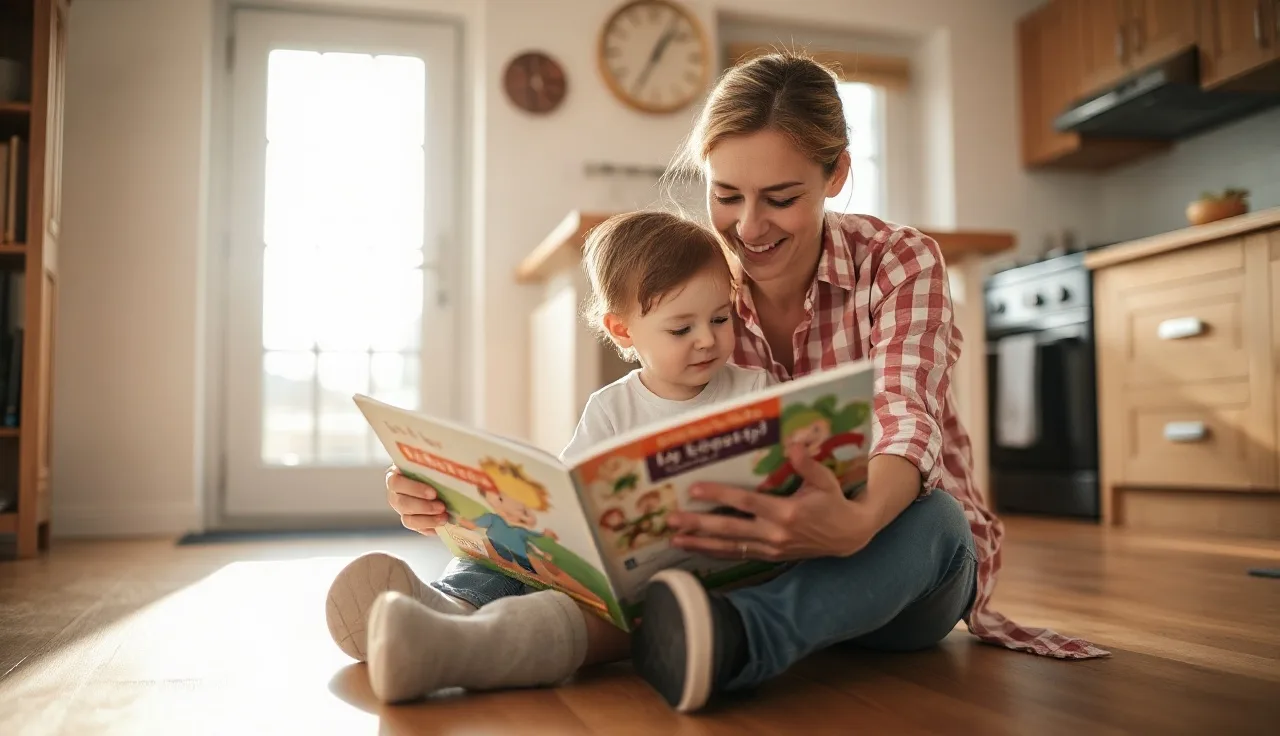
Reading together every day matters as well. Shared book reading is one of the best-studied inputs for vocabulary growth in toddlers [12]. Point at the pictures, label things, let your child turn the pages, and follow wherever their gaze goes.
Screen time is worth watching too. The AAP recommends no more than one hour a day of high-quality programming for children ages 2 to 5, watched together with some discussion [2]. Passive screen time doesn't build language; interaction does.
None of this replaces a speech-language pathologist's evaluation if your child is significantly delayed. Think of these strategies as the home half of a plan that also includes professional guidance.
What if my 2-year-old understands everything but doesn't talk much?
Parents describe this constantly, and it usually comes wrapped in reassurance from someone, a relative, a friend, sometimes even a pediatrician who's rushed. It's worth a closer look anyway.
Strong comprehension really is a good sign. It means the language system is taking in information the way it should. Children who understand well at 2 tend to do better over time than children who are delayed in both understanding and speaking [5].
That said, good understanding doesn't cancel out the concern. A child who follows everything but says almost nothing still has an expressive language delay, and that delay has a cause worth finding: temperament, a motor planning issue, hearing that dips in and out, differences in social communication, or just a late-talker pattern that resolves on its own. An evaluation is really the only way to tell which one you're dealing with.
It's also easy to overestimate how much a young child understands. Kids read context, routine, faces, and gesture far better than we give them credit for. Your child may seem to "understand" you asking them to get their shoes mostly because you always walk toward the door when you say it, bag already in hand. A speech-language pathologist uses tasks stripped of those context clues to get a truer read on comprehension.
So take the "understands everything" observation as a genuinely encouraging sign. Just don't let it talk you out of getting things checked.
How does autism affect speech at age 2?
Autism spectrum disorder shows up as differences in social communication, not just in speech itself. Some autistic 2-year-olds have large vocabularies. Others are minimally verbal. What matters more for diagnosis than vocabulary size is the social-communicative picture: whether a child shares attention with others, points to share interest rather than just to request, responds to their name, or shows objects to people around them.
The early language signs most linked with autism at age 2 include[2][3]:
- No words by 16 months, or no two-word phrases by 24 months (the same thresholds used for general delays)
- Loss of language a child had already acquired
- Echolalia that isn't used to communicate functionally
- Very limited eye contact or shared attention during communication
- Pointing to request but not to show interest
If your child's speech delay comes along with any of these social-communication differences, mention it to your pediatrician directly and ask for a developmental evaluation rather than, or in addition to, an SLP evaluation. The M-CHAT-R/F (Modified Checklist for Autism in Toddlers) is a standardized screen pediatricians can use at the 18- and 24-month well-child visits[2].
A diagnosis of autism doesn't close the door on speech progress. With the right support, including early and intensive intervention, many autistic children go on to develop functional spoken language. Some do well with AAC devices, used either as their main way of communicating or alongside speech. AAC isn't a competing alternative to speech: the two can work together.
The honest answer is that outcomes are mixed, and anyone who gives you a confident yes-or-no on this is oversimplifying things. The most-cited figure is that roughly 50 percent of late talkers "resolve" by school age without any formal help [5]. That number comes from longitudinal research, including work by Rescorla and colleagues who followed late talkers into adolescence. But the same studies found that even the kids who "caught up" sometimes still showed subtle language differences on harder, more complex tasks compared to peers who were never delayed in the first place. Some late talkers are less likely to resolve on their own: those with low comprehension, fewer consonant sounds, a small range of gestures, or a family history of language or reading trouble [5]. Nobody can predict with certainty at 24 months which path a child will take. What the research does support is that early intervention, when a child qualifies for it, improves outcomes and has essentially no downside. That's the reasoning behind the IDEA Part C system: Congress built it because "early intervention services can have a significant impact on the ability of infants and toddlers with disabilities to develop and learn" [8]. So the practical move is not to gamble on being in the lucky 50 percent. Get your child evaluated. If they don't need services, the speech-language pathologist will say so and hand you a plan to use at home. If they do need help, you'll have started early, and earlier is almost always better. If you're trying to figure out how this process actually works, the speech therapy and speech therapist guide walks through how to find and work with an SLP, including what to look for in someone who has real experience with toddlers.Frequently asked questions
How many words should a 2-year-old say?
ASHA and the AAP put the bar at 50 words by 24 months, but the number by itself doesn't tell you everything. A child at this age should also be putting two words together, things like "more milk" or "daddy go," and using words to actually communicate rather than just echoing what they've heard. Approximations count too: if your child says "moo" for cow every time, that's a real word in the tally. Falling short of 50 words at 24 months is the threshold clinicians use to recommend an evaluation.
What are the red flags for autism in a 2-year-old's speech?
Watch for no two-word phrases by 24 months, losing words the child used to say, little or no pointing to share interest (versus pointing to request something), not responding to their name, and echolalia that isn't being used to communicate. Most of these overlap with the general signs of a speech delay. If you notice any of them, ask your pediatrician for an M-CHAT-R/F screen and a developmental referral rather than just a referral to an SLP.
My 2-year-old only says 10 words. Is that a speech delay?
Yes. Ten words at 24 months is well under the 50-word threshold and it's worth getting evaluated by a speech-language pathologist along with a hearing test. You can contact your state's early intervention program (the IDEA Part C system) yourself, no doctor's referral needed, to request a free evaluation. It's still worth seeing your pediatrician in parallel to talk through the concern and rule out hearing problems.
Should I wait and see if my 2-year-old catches up on their own?
The evidence doesn't back that approach. Roughly half of late talkers do catch up without any formal help, but at age 2 there's no good way to tell whether your child is one of them. IDEA Part C offers free evaluations for children under 3, and kids who start intervention earlier tend to do better than those who start later. There's really no cost to getting evaluated: if your child turns out not to need services, that's what you'll hear.
How do I get a speech evaluation for my 2-year-old?
There are two paths. You can call your state's early intervention program directly. Under IDEA Part C, every state is required to evaluate children under 3 who might have a developmental delay, free of charge; the CDC or ASHA's website can point you to your state's program. Or you can ask your pediatrician to refer you to a speech-language pathologist. Many SLPs will also take self-referrals, so it's worth calling local practices to ask how their intake works and what insurance they accept.
Does watching TV or videos affect a 2-year-old's speech development?
Passive screen time doesn't build language, and it can crowd out the back-and-forth conversation that does. The AAP suggests no more than an hour a day of high-quality programming for kids 2 to 5, ideally with a caregiver watching alongside them and talking about what's happening. Even background TV that a child isn't actively watching has been linked, in several studies, to less verbal interaction between parent and child.
Can a bilingual child be delayed in one language but not the other?
Yes, and it happens often. Bilingual children may have a smaller vocabulary in each language on its own, but hit milestones once both languages are added together. An SLP who understands bilingual development will look at both languages, or send you to someone who can. If your child's SLP is only counting English, it's worth asking them to count across both languages instead. Being bilingual doesn't cause speech delays or disorders.
What is the difference between a speech delay and a language delay?
Speech is the physical act of producing sounds and words. Language is the system underneath it, meaning, grammar, how communication is structured. A child with a speech delay might understand plenty but struggle to produce clear words. A child with a language delay struggles more with meaning and structure itself. Plenty of children have some of both, and an SLP evaluation looks at each dimension separately to see which is affected.
How often should a 2-year-old with a speech delay attend speech therapy?
It depends on how severe the delay is and which treatment approach is used. Many toddlers go once or twice a week. But parent coaching, where the SLP teaches caregivers strategies to use during everyday routines, is considered a core piece of effective early intervention. What happens in the other 165-plus hours of the week seems to matter as much as, or more than, the therapy session itself.
Will my 2-year-old need AAC if they're not talking?
Not necessarily, but it's worth knowing what it is. AAC (augmentative and alternative communication) includes picture boards, apps, and speech-generating devices. Research shows using AAC doesn't reduce a child's drive to speak, and it often helps spoken language along. An SLP will suggest it only if your child's communication needs call for it. It isn't a last resort: it can be brought in early and phased out as speech develops.
What should I do if my pediatrician tells me to wait and see?
You can still refer yourself to early intervention. Under IDEA Part C, parents can contact their state's program directly, no physician referral required, to request a free evaluation. If your pediatrician brushes off your concern but your child has fewer than 50 words or isn't combining words at 24 months, you're entitled to get a second opinion or go straight to an SLP. A parent's concern counts as real clinical information, and ASHA's guidelines support evaluating on that basis alone.
What consonant sounds should a 2-year-old be using?
By age 2, kids typically have the early sounds down: p, b, m, n, d, t, h, and w. Sounds like s, z, l, r, and th aren't expected for a while yet (anywhere from age 3 to 7 depending on the sound), so mispronouncing them at 2 is completely normal. The thing to watch for is a very limited range of consonant sounds overall, not a mangled "r" or "s."
Is it normal for a 2-year-old to repeat words over and over?
Some of this is completely normal: toddlers rehearse new words and love repetitive books and songs. Echolalia, repeating phrases heard from someone else or from a show, either right away or after a delay, shows up more in autistic children but also happens in typical development and with other language delays. What matters is whether the repetition is being used to communicate something or not. An SLP can help you figure out which it is.
Sources
- American Speech-Language-Hearing Association (ASHA), Speech and Language Milestones: 50 words and two-word combinations are the benchmark at 24 months; strangers understand approximately 50% of a 2-year-old's speech; animal sounds used as labels count as words
- American Academy of Pediatrics (AAP), Developmental Surveillance and Screening: 50-word vocabulary and two-word combinations as 24-month thresholds; language regression should be evaluated promptly; screen time guidance of 1 hour per day for ages 2-5; M-CHAT-R/F recommended at 18- and 24-month visits
- CDC, Learn the Signs, Act Early: Developmental Milestones (2022 revision): Vocabulary of 50+ words and two-word phrases by 24 months; up to 200 or more words by 30 months; early language signs associated with autism at age 2
- CDC, Developmental Milestones: 2 Years: Specific 24-month milestones including word combinations and intelligibility norms
- Rescorla, L. (2011). Late Talkers: Do Good Predictors of Outcome Exist? Developmental Disabilities Research Reviews, 17(2), 141-150: Roughly 13-17% of 2-year-olds are late talkers; approximately 50% resolve without intervention; children with low comprehension, fewer consonants, or family history have worse prognosis
- Hoff, E. et al. (2012). Dual language exposure and early bilingual development. Journal of Child Language, 39(1), 1-27. Cambridge University Press.: Bilingual children meet vocabulary milestones when both languages are counted together; bilingualism does not cause speech disorders
- Fenson, L. et al. MacArthur-Bates Communicative Development Inventories (MB-CDI). Paul H. Brookes Publishing.: Parent report tools show parents are accurate reporters of toddler vocabulary; parental concern is a valid clinical signal
- U.S. Department of Education, IDEA Part C: Early Intervention Program for Infants and Toddlers with Disabilities: Under IDEA Part C, states must provide early intervention to eligible children birth to age 3, often at no cost; 'early intervention services can have a significant impact on the ability of infants and toddlers with disabilities to develop and learn'
- Roberts, M.Y., & Kaiser, A.P. (2011). The effectiveness of parent-implemented language interventions. American Journal of Speech-Language Pathology, 20(3), 180-199.: Parent coaching is among the most effective components of early intervention for late talkers; play-based therapy is evidence-supported for toddlers
- Millar, D.C., Light, J.C., & Schlosser, R.W. (2006). The impact of augmentative and alternative communication intervention on speech production in individuals with developmental disabilities. Journal of Speech, Language, and Hearing Research, 49(2), 248-264.: AAC does not reduce motivation to speak and often supports spoken language development
- Cochrane Review: Parent-mediated intervention for language delay in young children (2019). Cochrane Database of Systematic Reviews.: Parent-mediated interventions showed meaningful improvements in expressive language for children with language delay
- Mol, S.E., & Bus, A.G. (2011). To Read or Not to Read: A Meta-Analysis of Print Exposure From Infancy to Early Adulthood. Psychological Bulletin, 137(2), 267-296.: Shared book reading is one of the best-studied inputs for vocabulary growth in toddlers
Little Words is a voice-first app where your child talks and plays with Buddy, building first words through gentle games you can start today. It is free to download.
See your child's planor download on the App Store