Last updated 2026-07-11
If your child doesn't yet have the words to say what's wrong at night, augmentative and alternative communication (AAC) can genuinely turn bedtime around. A visual schedule, a small core vocabulary board, or a speech-generating device gives a child a way to signal pain, fear, or a need before it turns into a meltdown. Families who stick with a consistent, AAC-supported routine tend to see fewer bedtime blowups within a few weeks.
Consider what a child actually needs to say in the half hour before lights out. They're tired and out of sorts. Something might hurt. They're worried about the dark, or about you leaving the room. And often they just don't have the words for any of it. For a child who relies on AAC, that gap is exactly what turns an ordinary bedtime into a full meltdown.
There's a real link between sleep trouble and communication difficulties in autistic children and late talkers. A 2019 review in Sleep Medicine Reviews found that between 40% and 80% of autistic children have significant sleep problems, compared to 25% to 40% of neurotypical children [1]. Poor sleep then drags down daytime communication, attention, and behavior, which feeds right back into more bad nights.
The real issue is access. During the day, a child might have a speech-generating device clipped to a wheelchair, a communication board on the kitchen table, or a tablet within reach. At night, all of that disappears along with the light in the room and the visual anchors the child normally leans on. A child who already struggles with spoken words is left with no way to say "I need water," "I'm scared," or "my stomach hurts." Solve the access problem and you've solved most of the bedtime problem. It's really that direct.
The right tool depends on the child's current communication level, motor skills, and whatever they're already using during the day, but a handful of options come up again and again in clinical practice and the research. Visual schedules are the backbone of bedtime AAC for most kids. A simple strip of pictures, bath, pajamas, teeth, book, lights out, sleep, gives a non-speaking or minimally verbal child a script for what's coming next. The American Academy of Pediatrics recommends consistent bedtime routines as a first-line approach to sleep problems in kids, and a visual schedule is what makes that routine concrete instead of just something you say out loud [2]. You don't need software for this: a strip of laminated photos velcro'd to the wall by the bed does the job.
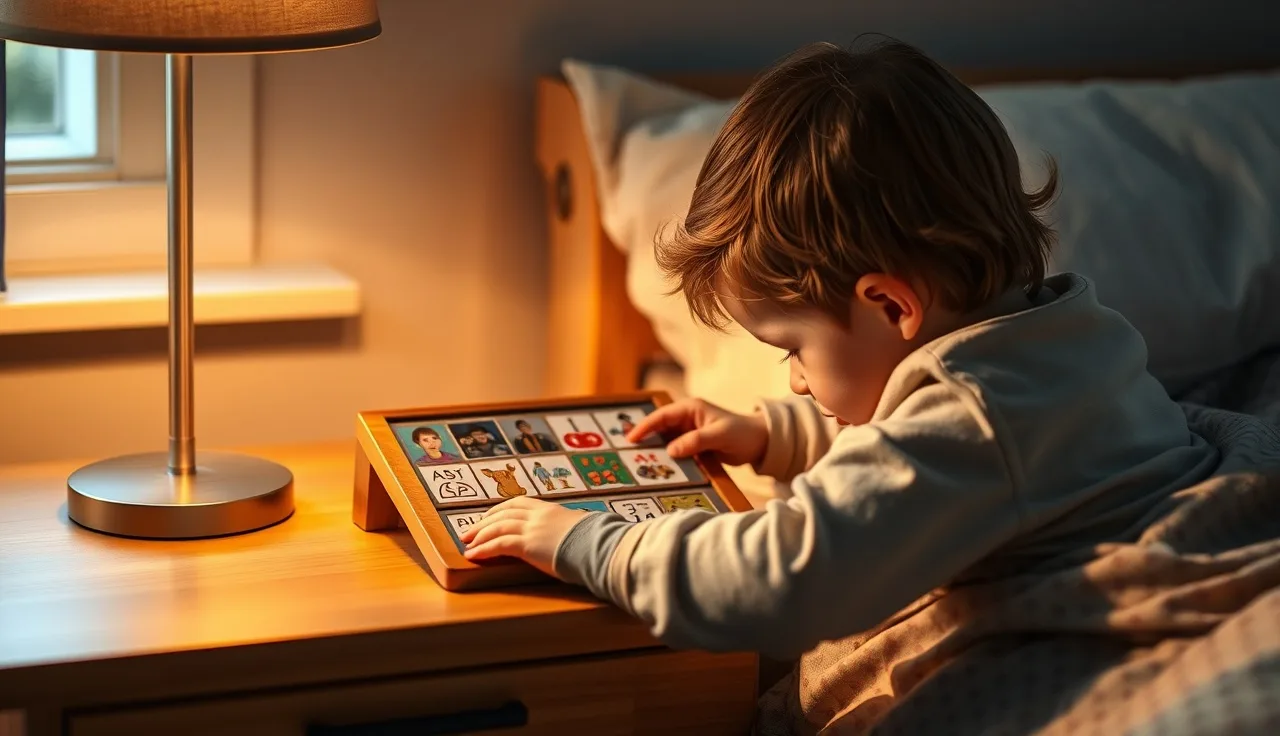
A small core vocabulary board, a 4x4 or 6x6 grid of high-frequency words kept on the nightstand, lets a child communicate in the dark without needing a full sentence. Worth including: more, stop, no, yes, help, hurt, want, drink, scared, wait, done, again. Add whatever matters for your particular kid on top of that: a lovey's name, a comfort song, a specific fear.
None of this works if the child can't see the board. Print on light backgrounds, keep a small LED nightlight nearby, or use a gloss laminate finish that catches whatever ambient light is in the room. Some families put glow-in-the-dark labels on the most-used symbol spots so they're findable at a glance.
If your child already uses a speech-generating device during the day, it should be within reach at night too, not put away like a toy. Most modern devices have a low-light or night mode, and it can sit on a bedside table, mount on an arm, or rest on a wedge pillow. The only real requirement is that the child can reach it without waking an adult first. ASHA's evidence-based AAC guidance says communication access should be available "across environments and times of day," and that includes sleep [3].
For kids who need something simpler, single-message voice output cards (sometimes sold as BigMacks) hold one recorded message and give even very young or motorically limited children an emergency line to a parent. A card by the bed that plays "I need help" or "I need Mom" when pressed doesn't require any tech skill to set up, and these run about $20 to $60 each.
The table below matches tools to communication levels.
| Communication level | Recommended bedtime AAC | Cost range | Key benefit |
|---|---|---|---|
| Pre-intentional / emerging | Single-message voice output device | $20-$60 | One-touch access to "help" |
| Early symbolic (1-2 symbols) | 4-6 symbol core board + visual schedule | Under $10 DIY | Routine predictability |
| 20-50 symbol user | Full core board + fringe page | $10-$30 DIY | Express specific needs |
| AAC device user (day) | Day device at bedside + backlit screen | Device already owned | Consistent vocabulary |
| Emerging literacy | Text-based overlay + symbols | Under $20 | Bridges to reading |
The right bedtime AAC setup depends on where your child already is, not on buying something new and complicated. A child who is pre-intentional, meaning they don't yet reliably use symbols to communicate, still gains from low-tech tools. A single-message button that says "I need help" isn't too simple for this stage: it's the right fit, and for a family where nighttime distress had no outlet before, it changes things. If your child already uses a full-featured AAC device during the day, the main job at night is making sure it stays physically within reach. Don't pack it away, and don't leave it charging in another room; put it where your child can grab it from bed. Kids with apraxia of speech often find nighttime AAC especially helpful too, since fatigue makes motor planning for speech even harder late in the day, and pointing to a symbol asks far less of the body than producing a word.
Building the routine
Start well before the first night you actually try this. Introduce any new board or device during the day, in a calm, low-stakes moment, not at 8:30 PM when everyone's exhausted. Show your child what the pictures mean, model using the board yourself, and keep doing that for at least a week before you expect any nighttime use from them.
Speech-language pathologists commonly recommend a sequence like this, based on principles from the Rehabilitation Engineering Research Center on Communication Enhancement (AAC-RERC) implementation guidance [4]. Start by making the schedule visible: hang a 4 to 6 step visual strip where your child can see and touch it during the routine. Some families use a first-then board for younger kids (first bath, then book), and simpler is better when you're just starting out.
Next comes modeling, and lots of it. Point to each symbol as you do each step. Say "bath" while you point to the bath picture. Say "done" when the bath ends, then move or flip the card. This is aided language stimulation, and it's one of the most evidence-supported strategies in AAC [5].
Set up whatever tools your child will need before they get into bed, whether that's a core board, a device, or a single-message button, and make sure there's enough light for them to actually see it. Rather than trying to cover everything at once, teach one or two bedtime-specific phrases first. Think about the two most common nighttime needs for your child: are they scared, do they want water, does their stomach hurt? Pick a specific symbol or spot on the board for those two things and practice during the day, when nobody's tired or upset.
Then respond every single time, which is the part parents tend to underestimate. If your child touches "scared" and you ignore it because you suspect they're stalling, you've just taught them the board doesn't work. Respond every time, at least for the first month, and deal with the stalling question separately.
Expect some regression along the way. The first week often looks worse than baseline, because you're adding something new into an already hard moment. Stick with it anyway.
What vocabulary should I put on a bedtime AAC board?
Keep it small. A bedtime board isn't meant to copy your child's whole communication system, and cramming everything onto it just makes it harder to use in the dark at 2am. It only needs to cover the most common reasons a child wakes up or can't settle.
A few words show up on almost every bedtime board that works: help, no/stop/all done, yes/want, hurt (with body parts nearby if you can fit them), scared, drink/water, more (more music, more rocking), sleep/bed, and the caregiver's name. Beyond that core set, add words specific to your child: the name of a comfort object like a blanket or a particular stuffed animal, sensory words like hot, cold, itchy, or loud, specific fears such as the dark or a door being open or a noise, and routine requests like song, hug, or one more book.
ASHA's practice portal for AAC says vocabulary selection should be "functional, motivating, and based on the individual's environments and communication partners" [3]. Bedtime is its own environment with its own demands, so a board built just for it isn't overkill. It's the point.
Print the board in at least 2-inch symbols, and use the same symbol set your child sees during the day (PCS, Boardmaker, or Snap Core, whatever matches what they already know). Keeping symbols consistent across settings speeds learning, according to research on AAC symbol acquisition [6].
Some kids lean on echolalia at night, quoting a line from a familiar bedtime book or show when they actually mean something else. A bedtime board gives them another way to get the message across, and our piece on what echolalia means goes into more depth if that pattern sounds familiar.
Waking at 2am and dreading bedtime are different problems
Trouble falling asleep and waking in the middle of the night aren't the same problem, and AAC tackles them differently.
When a child can't make the jump from awake to asleep, a visual schedule does most of the heavy lifting. It takes the guesswork out of the routine. "What's happening next?" is a stressful question for a lot of autistic and sensory-sensitive kids, and a routine they can see answers it before it turns into distress.
Waking overnight is usually about one of three things: physical discomfort, fear, or an unmet sensory need. A bedside board gives the child a way to point to which one it is, so you're solving the actual problem instead of just riding out a meltdown.
A 2021 study in the Journal of Autism and Developmental Disorders looked at parent-reported outcomes after families set up structured bedtime routines with visual supports for autistic children aged 4 to 10. Over six weeks, parents reported real drops in both sleep-onset latency (how long it takes to fall asleep) and how often kids woke at night [7]. The study didn't test AAC on its own, but visual supports were at the center of the routine.
Sleep anxiety tends to respond well to pairing a visual schedule with some way to say "I'm scared." A "scared" symbol on the bedside board, paired with a caregiver response the child can count on (one hug, lights on for two minutes, then back to the routine), can stop a spiral before it really gets going.
Families who've already gone through early intervention will probably recognize a lot of this. The nighttime piece rarely gets covered in therapy sessions, mostly because your therapist isn't in your house at 11pm.
Does AAC actually cut down on bedtime meltdowns?
Often, yes, but with a catch worth being honest about: AAC helps with behavior that stems from communication frustration. It does nothing for behavior that comes from somewhere else, like sensory overload, a medical issue, anxiety, or a habit that's taken hold for reasons unrelated to communication.
That distinction matters because parents often put together a thoughtful bedtime AAC system, only to feel discouraged when the meltdowns keep happening. If a child is overwhelmed by the tag in their pajamas, a communication board isn't going to solve that. But if the meltdown happens because they have no way to tell you the blanket feels itchy or the hallway light is too bright, giving them a way to communicate solves exactly that problem.
The research on AAC and challenging behavior backs this up fairly consistently. A meta-analysis in Research in Autism Spectrum Disorders found that AAC interventions reduced challenging behaviors in most included studies, with the strongest effects showing up for behaviors that functioned as requests or protests [8]. Bedtime behaviors that fall into those categories, things like "come back," "I need water," "I'm not ready," or "I'm scared," are exactly what AAC tends to handle well.
If sleep anxiety or more entrenched behavior patterns are also part of the picture, it's worth talking to a speech therapy specialist with experience in both AAC and sleep, and possibly a pediatric psychologist or behavioral sleep specialist as well. AAC gives a child a way to communicate. It isn't a behavior plan by itself.
Introducing AAC to a child who fights anything new at bedtime
Bedtime resistance to anything new is common, especially in autistic kids who rely on rigid routines. Drop an unfamiliar tool into a moment that's already tense, and it tends to backfire fast.
What works better is easing the board in gradually, well before it ever gets near the bed. Bring it out during a calm daytime activity, in a playful way: "Here's a board we're going to start using at night. Let's look at it now." Let the child touch it, explore it, ask about it however they communicate. Do this for several days before it shows up at bedside at all.
Once it does appear at bedtime, make it boring. Set it on the table without comment, and don't prompt the child to use it. Just let it sit there. After a few nights of it existing with no pressure attached, start modeling instead: touch "sleep" and say "sleep time," touch "help" and say "I need help with the covers." That shows what the board is for without asking the child to perform on cue.
Some therapists working with kids on the autism spectrum who resist change strongly will pair the new board with something the child already loves, like a favorite stuffed animal. The board sits right next to it, and both come out at bedtime together. Over time, the board borrows some of that good feeling.
If the resistance is severe and nothing seems to move it, loop in your SLP or ask about a consult with a behavioral sleep medicine specialist. You don't have to work through this alone.
Setting up the physical board or device
The physical setup is where good intentions collapse. A board buried under a pillow, or a device locked and in sleep mode across the room, isn't accessible. It might as well not be there.
Here's what actually works. Place the board or device within arm's reach of the child in their sleeping position. If your child uses a bed rail, mount a lightweight board to it with velcro. On a mat or floor bed, just put the board on the floor where they can reach it easily.
Light matters more than people expect. A small plug-in nightlight works for most kids (skip anything too bright if yours is light-sensitive). You can also print the board on a light background with high-contrast dark symbols, or set a device to its dimmest brightness with auto-sleep turned off so it doesn't lock itself away mid-request.
For kids with motor impairments, don't assume their daytime motor abilities carry over to lying down. Reaching and pointing work differently on a mattress than in a chair, so it's worth working with your SLP or OT on positioning. A wedge pillow is a simple fix for kids who do better slightly propped up.
If you're using a speech-generating device, charge it during the day so it's full at bedtime, or run a charging cord long enough to reach the bedside table so it can stay powered while in use.
Keep the nighttime version simpler than the daytime one: fewer symbols, higher contrast, easier motor access. Everyone's tired at that hour, kid and parent both, so lean beats complete.
If you want an easy way to build vocabulary practice into everyday routines, including bedtime, the Little Words app offers consistent tools for that, and a short quiz can tell you whether it fits your child's current stage.
How do I teach caregivers and teachers about the bedtime AAC system?
If more than one adult puts your child to bed, whether that's both parents, grandparents, a respite worker, or an overnight nurse, they all need to respond the same way. An AAC board only works if every caregiver reacts consistently. One person who ignores the board, or doesn't know what a symbol means, can undo weeks of progress in a single night.
The fix is a one-page reference sheet, kept as simple as possible. List each symbol next to the expected response: "If child touches SCARED: one hug, quiet reassurance, leave the nightlight on, do not extend the routine." "If child touches HURT: point to body parts on the board to find where, then respond to the need." Put this sheet on the fridge, in the respite binder, and anywhere else a caregiver will actually see it.
For teachers or school staff covering nap or rest time, hand over a simplified version of the visual schedule along with the most important vocabulary. IDEA (the Individuals with Disabilities Education Act) requires AAC systems to be written into a child's IEP when they're a needed support, and the requirement that supports be "appropriate across settings" covers communication access during rest or nap time at school [9].
It's also worth asking your SLP to write a short communication passport: a document explaining your child's AAC system, their current level, and how adults should respond. Many speech therapy practices do this routinely, and it makes handing your child off between caregivers much smoother. For a broader sense of what that process looks like, our overview of speech therapy walks through it.
When should I bring in a professional?
Get someone involved from the start if you haven't already, but a few signals mean it's time to move quickly.
Talk to your child's SLP if the daytime AAC system isn't being used consistently, if nighttime regression hasn't improved after 4 to 6 weeks, if your child seems to be in pain or distress the current system can't pin down, or if bedtime behavior has gotten severe enough to threaten your family's safety or sleep.
See a pediatrician if the sleep problems look medical rather than communication-related: heavy snoring, gasping, night sweats, sleepwalking, or heavy daytime sleepiness. Sleep apnea, for instance, shows up more often in children with Down syndrome and some other conditions that also involve communication differences, and no amount of AAC fixes a physiological sleep problem [10].
A behavioral sleep specialist is the right call when the pattern looks learned rather than medical or communicative: a two-hour bedtime routine, say, or a child who can only sleep with a parent in the room and panics otherwise. Behavioral sleep interventions work well alongside AAC, but they draw on a different skill set entirely.
The AAP recommends a multidisciplinary approach for children with neurodevelopmental conditions and significant sleep problems [2], which might mean an SLP, a pediatrician, and a behavioral specialist all working together. That's not overkill. It's just appropriate care.
If getting to an in-person SLP is hard, look into online speech therapy, since plenty of telehealth SLPs support AAC setup and implementation at home.
Frequently asked questions
At what age can a child start using AAC for bedtime routines?
There's no minimum age for AAC. Visual schedules and simple symbol boards can start in toddlerhood, even before age 2, as part of a predictable routine. Single-message voice output devices suit infants with significant communication needs. Earlier is generally better: ASHA notes there is no evidence that AAC inhibits speech development, and waiting has real costs.
My child throws their AAC device at night. What should I do?
Throwing is usually a communication act, not device rejection. It often means "I'm frustrated" or "this isn't working." First, make sure the vocabulary they need is actually on the device and easy to find. Second, use a ruggedized case (most major brands sell them). Third, check whether the device is positioned right for nighttime use. Ask your SLP about a lower-tech backup for nights while the device stays nearby.
Does AAC work for nonverbal children who have never used it before?
Yes. Fully nonverbal children are often the ones who gain the most from AAC. Bedtime is a reasonable place to start with low-tech AAC like visual schedules and core boards, because the routine is predictable, the vocabulary is limited, and the stakes are high enough to motivate learning. Start simple: a 4 to 6 step visual schedule plus a 6-symbol core board covers most bedtime communication for a beginner.
What symbols should I use: photos, line drawings, or something else?
Use whatever symbol system your child already recognizes. If they use PCS (Picture Communication Symbols) or Boardmaker images during the day, use those at night too. Consistency across settings speeds learning. Photos work well for younger children or those very early in AAC. The keys are high contrast and enough size: at least 2-inch symbols for nighttime boards, where visibility drops.
How do I handle a child who uses AAC requests to stall at bedtime?
This is real, and it's actually a sign AAC is working: your child has learned the tool gets a response. Don't ignore the communication. Instead, have a predictable, limited response protocol. One drink of water. One hug. One check of the body-parts board for hurt. Then the routine resumes. Consistency from every caregiver is what makes it stick. Work with your SLP to write a specific protocol if stalling is significant.
Can I use an iPad app instead of a printed board for bedtime AAC?
Yes, with caveats. iPad-based AAC apps (like Proloquo2Go or TouchChat) work at night if the device is mounted or positioned within reach, the brightness is turned down, and auto-lock is disabled or set long. The risk is the child uses the tablet for other things (YouTube, games) and the line between AAC device and screen time blurs. A dedicated device or a printed board sidesteps that entirely.
Will insurance cover AAC equipment used at night?
If a speech-generating device is medically necessary and covered under Medicaid or private insurance, coverage doesn't exclude nighttime use, because it's the same device. The friction comes with requesting a second device or mount just for bedtime. Medicaid's AAC coverage falls under assistive technology provisions, and justification comes from an SLP evaluation showing need. Ask your SLP about documentation. Basic low-tech boards are usually out of pocket and cheap, often under $30.
How long does it take for bedtime AAC routines to make a difference?
Most families see some change in the first 2 to 4 weeks with consistent use. Expect a rocky first week; you're adding novelty. Week two usually shows the child starting to interact with the board. Meaningful communication and less bedtime resistance often show up by weeks 3 to 6. Six weeks is a fair initial trial. If nothing has improved after six weeks of consistent use, revisit it with your SLP.
What if my child's sleep problems are medical, not communication-related?
AAC won't fix a medical sleep problem. Signs of a medical cause include heavy snoring, mouth breathing, gasping or pausing in breathing, heavy daytime sleepiness, or night sweats. These warrant a pediatric evaluation, possibly a sleep study. Some conditions that involve communication differences, including Down syndrome and Prader-Willi syndrome, have elevated rates of sleep apnea. Get the medical piece checked first, then layer in communication supports.
Should my child's IEP include AAC support for bedtime routines?
IEPs govern school settings, so home bedtime routines aren't directly in scope. But if the school has rest or nap time, AAC access during that period should be in the IEP. More usefully, ask the team to add carryover goals that support home routines, and ask the SLP to provide parent training for home AAC. IDEA requires the IEP team to consider whether a child needs assistive technology, including AAC, to receive a free appropriate public education.
Are there AAC strategies that work specifically for children with autism?
Yes. For autistic children, predictability matters a lot, so visual schedules tend to work especially well. Aided language stimulation, where the adult models using the board constantly without demanding the child do the same, is one of the most evidence-supported strategies for autistic AAC learners. Many autistic kids also respond well to a "finished" or "all done" symbol at the end of each step, a clear signal that the transition is complete. See our piece on autism spectrum speech therapy for more.
What do I do if my child's SLP has never addressed nighttime AAC use?
Bring it up directly. Say: "My child's hardest communication time is bedtime. Can we work on a system for that?" Most SLPs will welcome the specificity. If your SLP isn't familiar with AAC in home settings, ask for a referral to an SLP with AAC specialization, or request a home visit or telehealth session focused on bedtime. ASHA's Find a Professional tool can help you locate AAC specialists near you.
How do I make a visual schedule for bedtime without spending a lot of money?
Photos of your actual child doing each step (in the real bath, in the real pajamas) mean more than clip art and cost nothing. Print them at a pharmacy photo counter for about 25 cents each. Laminate at a school supply store for a dollar or two per sheet. Attach with velcro strips to cardboard or a fabric strip on the wall. Total cost under $10. This DIY version often beats expensive purchased systems because the images are familiar and specific.
Sources
- Malow et al., Sleep Medicine Reviews, 2019: prevalence of sleep problems in autism: 40-80% of autistic children have significant sleep problems, compared to 25-40% of neurotypical children
- American Academy of Pediatrics, Healthy Children: sleep guidelines and bedtime routines: AAP recommends consistent bedtime routines as a first-line approach to pediatric sleep problems; recommends multidisciplinary approach for neurodevelopmental conditions with sleep problems
- American Speech-Language-Hearing Association, AAC Practice Portal: Communication access should be available across environments and times of day; vocabulary selection should be functional, motivating, and based on the individual's environments and communication partners
- AAC-RERC (Rehabilitation Engineering Research Center on Communication Enhancement), AAC implementation guidance: Evidence-based implementation sequence for AAC including aided language stimulation and environment-specific communication supports
- Drager et al., Augmentative and Alternative Communication Journal: aided language stimulation evidence: Aided language stimulation (adult models pointing to symbols while speaking) is one of the most evidence-supported strategies in AAC implementation
- Schlosser & Wendt, Augmentative and Alternative Communication: symbol consistency and AAC learning: Consistency of symbols across contexts speeds up AAC symbol acquisition
- Johnson et al., Journal of Autism and Developmental Disorders, 2021: structured bedtime routines with visual supports: Parents reported significant reductions in sleep-onset latency and night wakings over a 6-week visual support bedtime intervention for autistic children aged 4-10
- Ganz et al., Research in Autism Spectrum Disorders: AAC interventions and challenging behavior meta-analysis: AAC interventions reduced challenging behaviors in the majority of included studies, with strongest effects for behaviors functioning as requests or protests
- U.S. Department of Education, IDEA (Individuals with Disabilities Education Act), 20 U.S.C. § 1414: IDEA requires IEP teams to consider whether a child needs assistive technology including AAC; AAC systems must be available across appropriate settings
- American Academy of Pediatrics, technical report on sleep-disordered breathing in children with Down syndrome: Sleep apnea is more common in children with Down syndrome and some other conditions that also involve communication differences
- ASHA, Find a Professional: locating AAC-specialized SLPs: ASHA maintains a directory of speech-language pathologists including those with AAC specialization
- Centers for Medicare and Medicaid Services, Medicaid coverage of assistive technology and AAC devices: Medicaid AAC coverage requires SLP evaluation documenting medical necessity; coverage does not restrict use to specific times of day