Last updated 2026-07-09
TL;DR
Most toddlers start putting two words together somewhere between 18 and 24 months, and by age 3 they're stringing together simple three-word sentences. The quickest way to get there is lots of back-and-forth talk during the day, repeating and building on whatever the child already says, and play routines that give them a reason to want to talk. None of this is guesswork: it's what speech-language research actually shows helps at home.
What does it actually look like when a toddler is ready to make sentences?
Before a toddler puts two words together, they've usually built up a bank of somewhere between 50 and 200 single words they use consistently. The American Speech-Language-Hearing Association puts the two-word combination milestone at around 18-24 months, with simple three-word phrases expected by 36 months [1]. That's a wide window, and where your child lands inside it matters far less than whether they're moving forward at all.
A few things tend to show up right before combining starts. The child points at something and names it at the same moment. They fill in the last word of a phrase you leave hanging, the one you say the same way every time. They start pairing two different ideas even in loose babble, like "more ball" or "big dog." And they use words to ask for something or turn something down, not just to label what they see. Any of this suggests the language system is getting ready for the next jump.
If your toddler is past 24 months and still only using single words, or past 30 months and not yet stringing three words together, it's worth getting a speech-language pathologist to take a look. Support tends to work better the sooner a delay is caught, so don't wait it out if something feels off. Our guide to early intervention walks through what that evaluation process actually involves and what to ask for once you're in it.
Why do some toddlers stall at single words even when they clearly understand a lot?
Understanding and talking work on separate tracks in a young brain. A toddler might understand 500 words while only saying 30 of them, and up to a point that gap is completely ordinary. But it also means that "he understands everything I say" isn't proof there's no expressive delay. The two skills just don't move at the same speed.
A few different things can hold sentence building back. Motor planning problems, like the ones behind childhood apraxia of speech, make it hard to string sounds together in order even when a child clearly knows the words she wants. Autism can shift how language gets used socially, sometimes leading to repeated scripted phrases (what's called echolalia) rather than sentences the child builds herself. And sometimes it's simply that nothing in daily life is pushing the child to talk more: if the adults around her guess every need before she asks, or accept pointing as good enough forever, there's no real reason to reach for two- and three-word combinations.
None of this means you should try to diagnose your child off a list of possibilities. What it does mean is that knowing the range of reasons behind a stall helps you pick an approach that actually fits the problem, instead of repeating something that clearly isn't moving the needle.
What is the single most effective strategy parents can use every day?
Expansion. It's not a flashy technique, but the research backing it is remarkably consistent.
Expansion means taking whatever your child says and repeating it back in a slightly longer, grammatically complete form, without correcting them, quizzing them, or asking them to repeat it. Child says "more juice," you say "you want more juice" or "yes, more apple juice." Child says "doggy run," you say "the doggy is running fast."
A 2017 review in the Journal of Speech, Language, and Hearing Research found that naturalistic language intervention strategies, including expansion and recasting, produced consistent gains in mean length of utterance (MLU, the standard measure of how long a child's sentences are) in toddlers and preschoolers with language delays [2]. The word that matters most in that research is "naturalistic": this works best folded into real moments, not turned into a drill.
Aim for something like 20 to 30 times a day. That number sounds daunting until you start counting the small windows where it fits: snack time, getting dressed, bath time, reading together. You don't need to carve out special practice sessions. You just need to change how you respond during the time you're already spending with your child.
Which specific activities help toddlers move from words to sentences?
These aren't crafts for a rainy afternoon. They're structured interactions you repeat over and over, because repetition is how language sticks.
Start with sabotage play, sometimes called communication temptations. Give your child a container of something they love, with the lid too tight to open. Or blow bubbles, then put the cap back on and wait. Or hand them one piece of a puzzle they want to finish. Say nothing. When they reach or fuss, model a two- or three-word phrase: "open please," "more bubbles," "I need help." Don't ask them to repeat it after you. Just model it, then give them what they want, and repeat the whole thing next time. The American Academy of Pediatrics points to communication temptations as one of the most direct ways to build real communicative intent in toddlers [3].
Book sharing works too, if you pause at the right moments. Pick a board book your child knows well enough to anticipate. Read it, but stop right before the last word of a repeated phrase and look at them expectantly. "Brown bear, brown bear, what do you..." and wait. You're not after a perfect sentence, just the experience of finishing the language themselves. Once they're reliably filling in single words, start pausing earlier: "Brown bear, brown bear..." and wait for the whole "what do you see." Bit by bit, they take over more of the line.
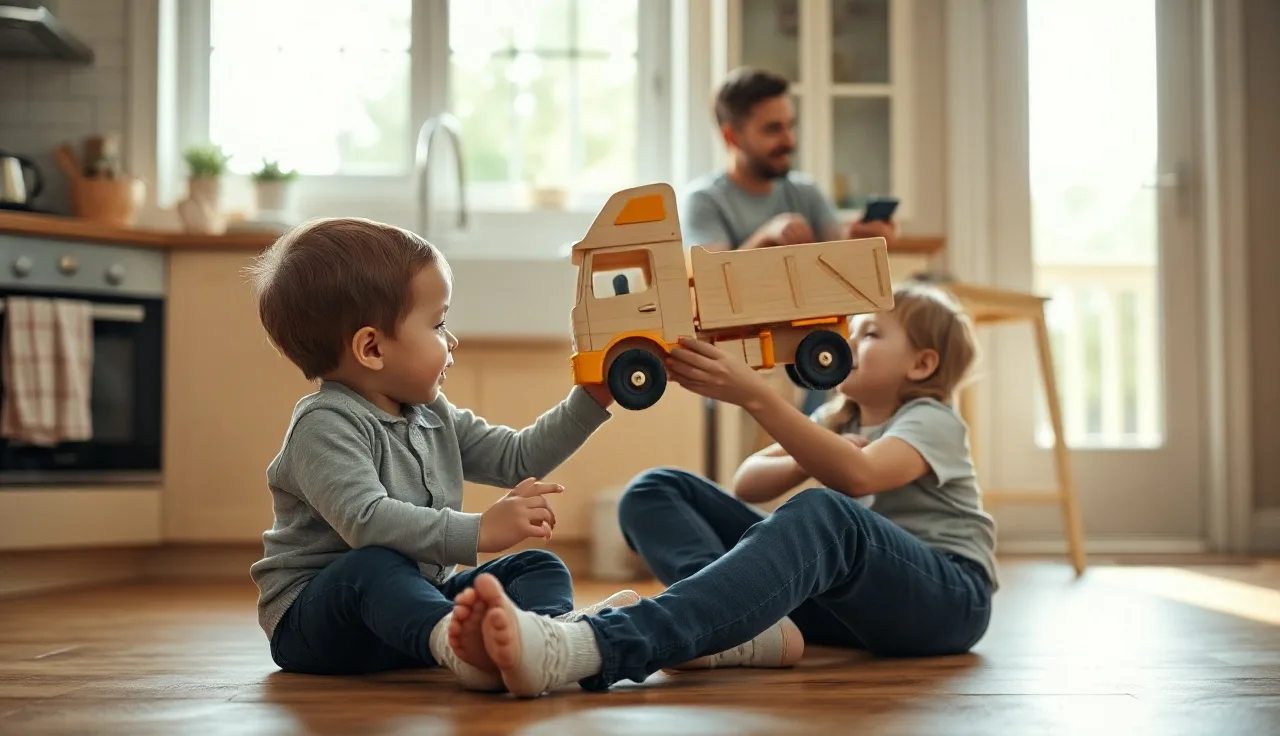
During play, try sitting beside your child rather than across from them (across feels like a test) and narrate what they're doing in short, clear sentences: "You're pushing the truck. The truck is going fast. Oh, it crashed!" You're not talking at them so much as giving them a running model of what language sounds like for this exact moment. Keep your sentences at or just one step above where they currently are. If they're using two-word phrases, aim for three.
Daily routines are a gift here because they repeat themselves: bath time, meals, getting dressed. Use the same phrases in the same order every time. "Time to wash hands. Turn on the water. Get the soap. Rub rub rub." After a few weeks of this, leave out a word, or a whole step, and wait. The predictability does the work, leaving a gap the child can fill with the missing word. This tends to land especially well with children who like routine and structure.
Pretend play helps too, once you bring in a third character. Two-year-olds are just starting to use language to run pretend scenarios. Give them two stuffed animals and play out a simple scene yourself: "Bear is hungry. Bear wants a cookie. Give bear a cookie." Then hand them one of the animals and see if they carry the story forward. Pretend play and language are closely linked: children who do more symbolic play tend to have bigger vocabularies and longer sentences [4].
Singing works on the same principle as the repeated books: children learn what word comes next, and the melody gives them a scaffold to produce it. Songs like Wheels on the Bus or Old MacDonald are useful because they're predictable and have natural slots for single words like animal names or sounds. Sing slowly, leave out the last word or the key word, and let the child fill it in. Then expand on what they give you: if they say "moo," you say "the cow says moo."
How much screen time is okay if you want to support sentence building?
The honest answer is that less screen time means more sentence growth, and zero is what actually moves the needle fastest. That sounds harsh, but it's what the evidence points to.
The AAP recommends no digital media at all for children under 18 months, aside from video chatting, and for 18 to 24 month olds, only high-quality programming watched together with an adult who talks through what's happening on screen [3]. This isn't about moral panic over devices. It comes down to how kids actually learn language: passive screen exposure just doesn't transfer the way live interaction does. A well-known set of studies found that toddlers couldn't pick up new words from video at the same pace they learned them from a live person doing the identical thing, a pattern researchers named the "video deficit effect" [5].
If your toddler is already watching more than the AAP suggests, there's no need to panic about it. Put your energy into adding more back-and-forth conversation rather than fixating on cutting screens out. And when a show is on, sit with your child and talk about it with them: "Look, the dog found the ball. What is the dog doing? He's running." Watching together and narrating like this won't erase the gap entirely, but it does soften it.
Does the number of words parents say actually matter?
Yes, but the quality of those words matters more than the raw count.
The widely cited Hart and Risley study from 1995 documented a 30-million-word gap in words heard by age 3 between children in different income environments [6]. That figure has been critiqued and only partly replicated over the decades, and researchers now treat it with some skepticism. What holds up is this: conversational turns predict language outcomes better than word count does. A 2018 study in Psychological Science found that the number of back-and-forth exchanges between parent and child at age 4-6 predicted language scores and brain activity in language areas, regardless of socioeconomic status [7].
So it isn't about narrating everything you do all day. It's about responding when your child says something, inviting them to keep going, and actually waiting for their turn to talk. A 10-turn back-and-forth about where the dog went is worth more than a five-minute monologue about what's for dinner.
What if your toddler echoes phrases instead of making original sentences?
Echolalia, repeating heard language rather than generating new sentences, shows up in a lot of toddlers, and it's especially common in autistic children. It isn't a dead end. For many kids, the echoed phrase is a genuine attempt to communicate, and the meaning is usually there if you pay attention to the context it happened in.
The approach shifts a bit here. You're not trying to stop the echoing. Instead, you're giving the echoed language somewhere to land and gently offering another way to say it. If a child says "do you want a cracker?" when what they actually want is a cracker (this is direct echolalia, borrowed straight from something they've heard), treat it as a request: hand over the cracker, then say "I want a cracker" yourself without asking the child to repeat it back. Over time, their own version of the phrase tends to edge out the echoed one.
If you want to go deeper on how this works and how to support it at home, our pieces on what echolalia actually means and on speech therapy approaches for autistic kids cover both in more detail.
How long should you actually wait after asking a child a question?
Most parents pause for about a second before jumping back in. Research suggests kids working on language actually need something closer to five to ten seconds [8].
Ten seconds of silence feels unbearable when you're the one sitting in it. Parents rush to fill the gap because the quiet feels awkward and they want to be helpful, but that silence is exactly where the work happens. The child is retrieving the word, figuring out how to physically produce it, and deciding whether to take a turn in the conversation. Jump in too soon and you take that moment away from them, teaching them (without meaning to) that someone else will always do the talking.
Try counting to seven in your head after you ask something or leave a pause. Keep your face interested and expectant. Don't repeat yourself, don't rephrase, just wait. If nothing comes by the time you hit seven, go ahead and say the word or phrase yourself, then move on. No pressure, no disappointment. Another chance to try will come along in a couple of minutes anyway.
Are there toys that genuinely help toddlers build sentences?
The toy industry will sell you a lot of things claiming to boost speech, and most of them are a waste of money.
The toys that actually help share a few things in common. They need a partner to be interesting, so self-entertaining electronic toys are out. They lend themselves to simple stories. And they invite comments about what's happening, why something worked, why something didn't. Often the cheapest options on the shelf do this best.
| Toy type | Why it helps sentences | What to avoid |
|---|---|---|
| Simple figures and animals | Supports pretend play narratives | Figures with built-in sounds (child just presses button) |
| Stacking and building sets | Creates failure moments that prompt requesting | Elaborate sets with too many pieces |
| Basic board books | Predictable language, expectant pausing | Interactive books that talk on their own |
| Balls and simple movement toys | Shared attention, action commentary | App-connected or screen-based |
| Pretend kitchen/food | Natural language about want, more, done | Solo play setups with no adult interaction designed in |
Research keeps landing on the same point: open-ended play that depends on a partner produces more language than solo electronic play does [4]. Whatever toy ends up in the bin, you're still the thing that matters most in that exchange.
When should you bring in a speech therapist instead of trying activities alone?
Home activities genuinely help, but they're not a substitute for a professional evaluation when one is warranted. Get a speech-language pathology evaluation if your toddler isn't combining two words by 24 months, if they lose language skills they used to have (at any age), if family members still struggle to understand them past age 3, or if your gut tells you something's off and the activities aren't budging things.
A pediatrician referral works, but so does going straight to your school district's early intervention program. In the US, children under 3 may qualify for free services through IDEA Part C, and kids 3 and older through IDEA Part B [9]. You don't need a diagnosis in hand to request an evaluation, just the willingness to ask for one.
For a sense of what that first appointment actually looks like, our speech therapy overview walks through it, and the early intervention guide explains how to start the referral yourself instead of waiting on your pediatrician to set things in motion. If in-person services are hard to come by where you live, online speech therapy now has a growing evidence base for toddlers and preschoolers.
Can a parent realistically do this without any professional training?
Yes, with some honest limits.
Parent-implemented language intervention has a solid evidence base. A 2019 Cochrane review found that parent-delivered language interventions improved language outcomes for children with primary language delays, with effects strongest when parents received guidance on the specific strategies to use [10]. That phrase, guidance on specific strategies, is the whole story. Parents who learned what to do got better results than parents who just spent more time with their kids.
You don't need a graduate degree for this. You need a handful of strategies that actually move the needle, things like expansion, expectant pausing, and communication temptations, plus the discipline to use them during ordinary daily routines. That's what this article is for.
The limits show up with certain conditions. If your child has a specific motor speech disorder like apraxia of speech, home strategies alone usually won't cut it. Apraxia calls for intensive, specific motor learning work that only a trained therapist can guide properly. And if you've been consistent for two to three months and progress has stalled anyway, take that as your cue to bring in professional eyes.
Tools like the Little Words app (start at littlewords.ai/start) can help bridge the gap between therapy sessions and home practice, giving parents daily activities calibrated to where their child actually is.
What does a good "talking day" actually look like for a toddler?
You don't need a schedule. Toddlers hand you 30 to 50 chances to build language every day without you having to plan a thing. It's really about noticing the moments that are already there and using them a little differently.
Take the morning routine. While you're dressing them, narrate it slowly: "Shirt goes over your head. Your head! Where's your head? There it is. Now the arm goes in. Which arm? This arm." Leave gaps. Wait a beat before you fill them in yourself.
At breakfast, put the cereal box where your child can see it but not reach it, then wait. When they ask for it, model the fuller phrase, hand it over, and expand on what they said: "Cereal please. You want the cereal. Here's your cereal."
During play, get down on the floor and follow their lead instead of directing it. Just comment on what's happening: "You put the block on top. That's a tall tower. Uh oh, it's falling!"
Outside, narrate what you're both looking at: "A big truck! The truck is so loud. Where is the truck going?" You're not quizzing them, you're showing them how language attaches to the world around them.
Bath time works well as a predictable routine with the same phrases and a pause where your child can jump in: "Time to wash your... (wait) ...feet!" And at bedtime, read a familiar book slowly, leaving the last word of repeated lines for them to fill in.
That's really all it takes. No apps, no special toys, just paying attention to the moments you already have. If you'd rather have a plan built around exactly where your toddler is right now, Little Words can generate activity sets matched to their current level.
Common questions parents ask
At what age should a toddler start talking in two-word sentences?
Most toddlers combine two words somewhere between 18 and 24 months, according to ASHA milestones. Three-word sentences typically show up by 36 months. These are averages, not deadlines, but if a child has no two-word combinations by 24 months, it's reasonable to get an evaluation from a speech-language pathologist.
What activities actually help a toddler start combining words?
A few things have real research behind them: communication temptations (handing a child something they can't open on their own and waiting to see what they do), pausing expectantly during a familiar book instead of reading straight through, talking through what your child is doing as they play, and sticking to predictable, scripted routines. What ties these together is that they all create a real reason to communicate, and then you model the language without asking the child to repeat it.
How can I get my toddler using more words without hiring a therapist?
Try expansion: when your child says something, repeat it back in a slightly longer form. Let them lead the play instead of directing it yourself. Build in pauses where talking becomes the easiest way to get what they want. Keep your own sentences short, just one step longer than theirs. None of this requires special time; it fits into meals, bath, dressing, the normal stuff of a day, and it's backed by evidence.
Is it normal for a 2-year-old to only say single words?
Some kids developing typically are still at single words at 24 months, especially boys and those with older siblings who tend to talk for them. Still, ASHA lists two-word combinations as an expected milestone by 24 months, so a toddler past that point using only single words is worth at least a conversation with the pediatrician, and ideally a screening with a speech-language pathologist.
What if my toddler understands everything but won't talk?
This is common, and it doesn't mean anything is necessarily wrong, though it also doesn't rule out an expressive delay. Try building situations where talking pays off: temptation activities, offering a choice between two items so they have to name the one they want, games that only continue with a verbal response. If a month or two of consistent effort brings no change, it's time for a professional evaluation.
Can reading books every day teach my toddler to say sentences?
Daily reading helps, but how you read matters more than how often you do it. Interactive reading, where you pause before a predictable word and let the child fill it in, builds more language than reading straight through. Once they fill in the word, expand on it: if they say "dog," you say "the dog is sleeping."
Does too much screen time really delay talking?
The evidence points to yes, especially under age 2. The AAP recommends no solo screen media before 18 months. The issue isn't really the content on the screen, it's that a screen doesn't respond to what a child does, and that back-and-forth is how language gets learned. Watching together and narrating what's happening helps some, but it doesn't replace real interaction.
What toys help toddlers talk more?
The ones that need a partner to be fun: simple figures, balls, basic blocks, pretend food and kitchen sets, board books. Skip the electronic toys that push their own buttons and narrate themselves, since they leave nothing for the child to say. Open-ended toys that create little cause-and-effect surprises tend to prompt requests and comments, and that's exactly the kind of exchange where new sentences show up.
My toddler repeats phrases from TV instead of making up their own sentences. Is that a problem?
Repeating phrases they've heard, known as echolalia, is common in toddlers and especially common in autistic children. It isn't automatically a red flag. Plenty of toddlers use echoed phrases to communicate and shift toward original sentences as their language develops. If it's still the main way a child communicates past age 3, or if it doesn't seem to serve any function, that's worth an evaluation.
How do I know if my toddler needs speech therapy or is just a late talker?
There's no clean line separating "late talker" from "needs therapy," and honestly, that distinction matters less than just getting a professional opinion early. A speech-language pathologist can tell whether a delay falls within typical variation or points to something needing direct help. Roughly 70-80% of late talkers catch up on their own, but there's no way to know in advance which ones without an evaluation [1].
How long before I see progress from language activities at home?
It varies quite a bit, honestly. Some kids start combining words within four to six weeks of consistent expansion and temptation activities. Others need three to six months of home effort along with professional support. Usually the first sign of progress is more word variety and longer utterances, and new sentence types follow after that. If nothing has changed after two or three months of daily effort, loop in a professional.
Should I use baby talk or full sentences with my toddler?
Use child-directed speech, sometimes called "parentese": a slower pace, higher pitch, exaggerated intonation, short clear sentences. That's different from mispronouncing words on purpose. "Doggy" is fine, but say "dog," not "woof-woof," as the actual word. Aim for sentences one step longer than what your child produces: if they're using two words, you use three. That small gap is where the learning happens.
What if my toddler gets frustrated and melts down during these activities?
Stop right away. Communication practice should never push a child into distress. If a temptation activity ends in a meltdown, you waited too long or the gap between what you're asking and what they can do is too big. Back off to just modeling language with no expectation that they respond. Let them hear you talk without needing to perform. Learning happens when things are calm; frustration shuts that window.
Sources
- ASHA (American Speech-Language-Hearing Association), Speech and Language Developmental Milestones: two-word combinations expected by 18-24 months, three-word sentences by 36 months, and roughly 70-80% of late talkers catch up on their own
- Journal of Speech, Language, and Hearing Research, 2017 systematic review on naturalistic language intervention: naturalistic strategies such as expansion and recasting lead to consistent gains in mean length of utterance for toddlers and preschoolers with language delays
- American Academy of Pediatrics, Media and Children Communication Toolkit: the AAP advises no solo screen time under 18 months, co-viewed high-quality programming with adult interaction from 18-24 months, and recommends communication temptations as a way to build communicative intent
- Child Development, meta-analysis on symbolic play and language development: children who engage in more symbolic play tend to have larger vocabularies and longer mean length of utterance
- Developmental Science, Kuhl et al., video deficit effect in infant word learning: toddlers didn't learn new words from video at the same rate as from a live person doing the exact same thing, a pattern known as the video deficit effect
- Hart & Risley (1995), Meaningful Differences in the Everyday Experience of Young American Children, Paul H. Brookes Publishing: documented a 30-million-word gap in words heard by age 3 across different socioeconomic environments, with conversational turns predicting later language outcomes
- Psychological Science, Romeo et al., 2018, conversational turns and language brain development: the number of back-and-forth exchanges at age 4-6 predicted language scores and language-area brain activation, regardless of socioeconomic status
- ASHA, Practice Portal: Late Language Emergence: an extended wait time of 5-10 seconds is recommended to give children with language delays room to process and respond
- U.S. Department of Education, IDEA (Individuals with Disabilities Education Act) Part C and Part B: children under age 3 may qualify for free early intervention under Part C, and those 3 and older under Part B, with evaluation available even without a prior diagnosis
- Cochrane Database of Systematic Reviews, 2019, parent-implemented early intervention for language delays: parent-delivered interventions improved language outcomes for children with primary language delays, with the strongest effects when parents were guided on specific strategies
Little Words is a voice-first app where your child talks and plays with Buddy, building first words through gentle games you can start today. It is free to download.
See your child's planor download on the App Store