Last updated 2026-07-10
TL;DR
AAC devices give nonspeaking and minimally verbal autistic people a dependable way to communicate. Options range from low-tech picture boards to high-tech speech-generating devices costing $300 to $8,000 or more. Research consistently shows AAC doesn't suppress speech and often supports it. Insurance, Medicaid, and school IEPs can all help pay for a device.
What is AAC and who uses it for autism?
Augmentative and alternative communication (AAC) covers any method a person uses to communicate outside of natural speech: picture exchange systems, communication boards, dedicated speech-generating devices, or app-based systems on a tablet. "Augmentative" means it adds to whatever speech a person already has. "Alternative" means it takes the place of speech when speech is absent or unreliable.
The American Speech-Language-Hearing Association (ASHA) defines AAC as covering "all forms of communication other than oral speech" and notes it's appropriate across the full age and ability range [1]. AAC isn't something you turn to only after every other intervention has failed. It's simply a communication method, no more a last resort than a wheelchair is for someone who can't walk.
Autism is the diagnosis most often linked to AAC use in children, largely because somewhere between 25% and 30% of autistic people are estimated to be minimally verbal (fewer than 30 functional words) or nonspeaking. Those figures come from older studies, though, and the real number is genuinely uncertain [2]. Plenty of autistic people who do have speech still use AAC, because their spoken language becomes unreliable under stress, fatigue, or sensory overload. AAC gives them a channel that keeps working when speech doesn't.
It's also used for apraxia of speech and childhood apraxia of speech, along with other motor speech disorders, and some children carry more than one diagnosis at once. Which device or system someone ends up with depends far more on their motor skills, language level, and daily environment than on the autism label itself.
Does AAC actually work for autistic children?
Yes, and there's solid research behind that answer. A 2012 systematic review in the Journal of Autism and Developmental Disorders looked at 24 studies of AAC interventions with autistic participants and found gains in requesting, labeling, and social communication across device types [3]. A 2014 meta-analysis by Ganz and colleagues focused on speech-generating devices specifically and found moderate-to-large effects on communication outcomes for most participants.
The question parents ask most is whether handing a child a device will make them give up on talking. The research doesn't back that worry up. The American Academy of Pediatrics and ASHA both say AAC doesn't get in the way of speech development and can actually support it [1][4]. Several studies have tracked children picking up new spoken words after starting AAC, likely because the device takes the pressure off and gives them a model for language to work from.
Nobody has clean numbers on exactly how many AAC users go on to rely less on their device as speech improves. The closest thing we have is a 2011 PECS follow-up that found meaningful spoken word gains in a subset of preschoolers. Honestly, outcomes vary a lot from child to child, AAC helps communication in the here and now, and there's no evidence pointing to long-term harm.
One more thing worth saying plainly: a child using a device to communicate is communicating. That matters in itself, whether or not spoken words show up later.
What are the main types of AAC devices for autism?
AAC splits into unaided options (sign language, gestures, nothing to buy) and aided options (which need some kind of equipment). When people talk about AAC for autism, they almost always mean the aided side, and that breaks down into a handful of practical categories.
Low-tech picture systems sit at one end: PECS (Picture Exchange Communication System), communication boards, and choice boards. They cost next to nothing to print, never need charging, and work in any setting. PECS has a well-replicated evidence base going back to Bondy and Frost's original 1994 study. There's a ceiling on how complex the language can get, but plenty of children start here, and some stick with it for good.
A step up are mid-tech devices: voice output communication aids (VOCAs) that hold a fixed number of recorded messages, like a GoTalk or a BIGmack button. They're durable, easy for a parent or teacher to program, and run $50 to $400. They suit structured routines and specific requests well, but you can't navigate between pages, so they stay simple by design.
High-tech speech-generating devices (SGDs) are dedicated hardware, things like the Prentke Romich Company (PRC) Accent series, Tobii Dynavox devices, or the Saltillo NOVA. They run full vocabulary software (LAMP Words for Life, Snap Core First, TouchChat) and can hold thousands of words organized in motor-based or grid-based layouts. Retail price before insurance runs $3,000 to $10,000 [5].
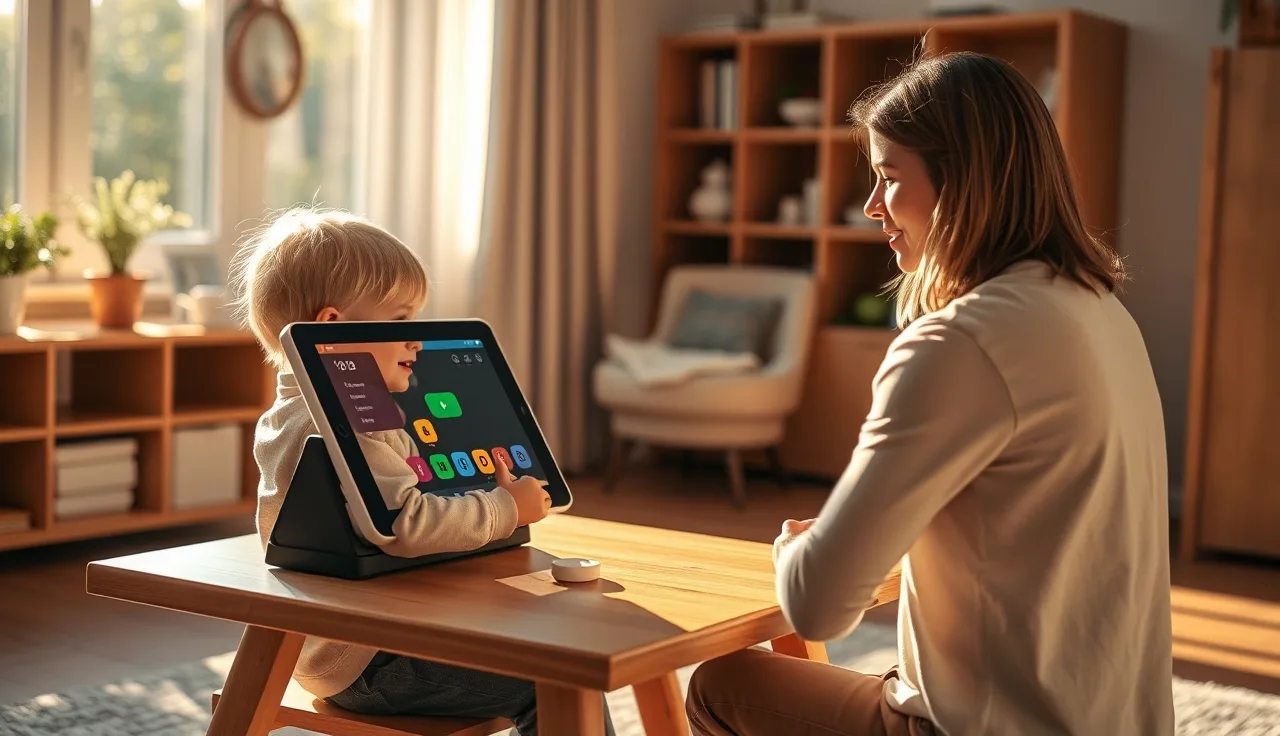
App-based AAC on ordinary tablets is the budget alternative: Proloquo2Go, TouchChat HD, Cough Drop, and LAMP WFL are iOS or Android apps that run on an iPad or Android tablet. The apps run $200 to $350, and the tablet itself is often already in the house, or costs $300 to $700 new if not. Total cost lands well below dedicated hardware. What you give up is durability (a dedicated SGD is built to survive drops and drool) and insurance coverage, since most dedicated SGDs qualify as durable medical equipment while a tablet usually doesn't.
For children with significant motor impairments, eye-gaze and switch-access systems let AAC be controlled through eye tracking hardware mounted to a screen, with Tobii Dynavox making the most widely used eye-gaze SGDs. These sit at the top of the price range and need careful fitting by an SLP trained in assistive technology.
| Device type | Example products | Approximate cost | Best for |
|---|---|---|---|
| Low-tech picture boards | PECS cards, Boardmaker sheets | $0, $150 | Early communicators, all environments |
| Mid-tech VOCAs | GoTalk 9+, BIGmack | $50, $400 | Structured routines, simple requesting |
| Dedicated SGD | PRC Accent, Tobii Dynavox TD | $3,000, $10,000 | Full vocabulary, insurance coverage |
| App on tablet | Proloquo2Go, TouchChat HD | $500, $1,000 total | Lower cost, flexible vocabulary |
| Eye-gaze SGD | Tobii Dynavox I-Series | $8,000, $15,000 | Motor impairment, limited hand access |
How do you choose the best communication device for autism?
There's no single best device, and you should be wary of anyone who tells you otherwise. The right fit depends on a mix of factors that only a proper AAC evaluation can sort through.
The gold standard is a full AAC evaluation by a licensed speech-language pathologist with specific AAC training, ideally alongside an occupational therapist if motor access is a concern. ASHA recommends feature matching: systematically comparing a person's skills and environment to what a device actually offers, rather than reaching for whatever happens to be popular [1]. The evaluation looks at current communication abilities, motor skills (pointing accuracy, hand strength, eye-gaze control), language level, literacy, family comfort with technology, and where the device will actually be used day to day.
A few things worth keeping in mind as you go through this process. Pick a system that has room to grow with the child. Specific fringe vocabulary has its place, but it's core vocabulary, the 50 to 200 high-frequency words that carry most of everyday communication, that gets a child actually talking in the moment. Words like "more," "stop," "go," "I want," and "help" come up constantly no matter where a child is.
Consistent motor patterns tend to matter more than how a layout looks. Motor-based AAC systems like LAMP (Language Acquisition through Motor Planning) rest on the idea that a consistent, memorable motor sequence reduces the cognitive load of communicating. There's solid clinical reasoning behind this, particularly for autistic children who have motor differences.
Try before you buy. Most AAC vendors, and many SLPs, can arrange trials, and insurance companies increasingly want trial documentation before they'll approve a high-cost speech-generating device. Take that trial period seriously rather than treating it as a formality.
And the family needs to be able to use the device too, not just the therapist. A system so complex that only the SLP can program it will sit unused at home, so it's worth being honest with yourself about setup demands before committing.
If you're still early in the early intervention process, starting with a low-tech system while the evaluation is underway makes sense. Low-tech and high-tech aren't an either-or: plenty of experienced AAC users carry both.
What does the research actually say about AAC systems?
Most AAC research is small-N or single-case design, and that's worth naming upfront. Large randomized controlled trials are rare partly because withholding communication from a control group is ethically hard. Keep that in mind when anyone, vendor or skeptic, cites statistics with a lot of confidence.
PECS (Picture Exchange Communication System) has the most replicated evidence base among children with autism. The original Bondy and Frost study (1994) and multiple follow-ups showed gains in spontaneous requesting, and in a subset of participants, spoken words emerged. A 2002 study by Charlop-Christy and colleagues replicated the spontaneous communication gains in three children and documented speech increases in two of them.
LAMP (Language Acquisition through Motor Planning) is newer, with solid theoretical grounding in motor learning research but fewer large studies behind it than PECS. Clinical reports from PRC, which publishes the LAMP WFL software, show consistent gains, but that's manufacturer data, not independent verification. Independent peer-reviewed LAMP studies are accumulating, but they're still limited as of this writing.
Core vocabulary approaches, regardless of device type, rest on a meaningful body of research showing that the 50 most common words account for roughly 80% of words used in everyday conversation [6]. That single finding drives most modern SGD vocabulary organization.
For children who also have echolalia, AAC can work alongside natural language development rather than against it. Echolalic speech, which we cover in more depth in our piece on what echolalia means, sometimes reflects a child's attempt to communicate through memorized scripts, and AAC can hand them something more flexible and generative to use alongside that.
The broader takeaway: AAC works. The evidence for any one specific system is thinner than vendors like to suggest, and an experienced SLP's judgment about matching features to the child in front of them matters more than any single study.
How much do autism communication devices cost?
The price range here is enormous, roughly a hundred-fold gap between the cheapest and most expensive options, so it's worth walking through what you actually get at each level.
On the low end, PECS starter kits run $30 to $200. If you want to build custom picture communication boards, Boardmaker software costs about $400 a year for a home license, though free options like SymbolStix Online exist if budget is tight.
Mid-tech voice output devices span a wide range too: a single BIGmack button is around $50, while a GoTalk 32+ runs closer to $400.
App-based AAC adds another layer of cost. Proloquo2Go costs $249.99 on the App Store (as of 2024), and TouchChat HD with WordPower runs $299.99. Neither app works without a tablet, and the iPad itself adds $329 for the 10th generation model up to $700 or more depending on specs. Altogether, plan on $600 to $1,100 for a complete tablet-based setup. Dedicated speech-generating devices are where the real money is. A PRC Accent 1400 retails around $7,000 to $9,000, and a Tobii Dynavox T15 lands in the $7,000 to $10,000 range, with eye-gaze systems climbing even higher. The good news buried in these numbers: these devices count as Durable Medical Equipment under Medicare and most state Medicaid programs, and that classification is what actually opens the door to funding [5]. What most comparisons leave out is the cost of the speech-language pathologist's time. A proper AAC evaluation can run $500 to $2,000 or more out of pocket if insurance doesn't cover it, and programming the device plus ongoing training takes real hours on top of that. It's a common, frustrating situation: a family gets the device funded, but not the therapy needed to actually use it well.
Does insurance or Medicaid cover AAC devices for autism?
Usually, yes, though it takes paperwork and persistence to get there.
Medicaid tends to be the most dependable payer for dedicated speech-generating devices. Under federal Medicaid rules, these devices are covered as durable medical equipment once a licensed SLP documents medical necessity [7], though the exact rules shift from state to state. California's Medi-Cal, for instance, has covered SGDs for decades. That coverage traces back to a 1993 federal policy clarification (HCFA Transmittal 1490), which established that SGDs could count as DME, and most states have since built their own rules around that same framework.
Private insurance is far less consistent. The Affordable Care Act requires plans to cover habilitative services, but each state decides what that actually includes, and insurers tend to treat "device" coverage differently from "therapy" coverage. Some plans will pay for an SGD under the DME category without a fight; others deny the claim and force families into an appeal. A knowledgeable SLP, or a funding specialist at an AAC vendor (most of the major ones have someone in this role), can be a real help when that happens.
Public schools have their own obligation here. Under the Individuals with Disabilities Education Act (IDEA), schools must provide assistive technology, including AAC devices, whenever the IEP team decides a child needs one to access their education [8]. The catch is that the school owns the device: it may not go home with the child, since school-based funding is tied to educational access rather than medical necessity. That's why many families end up chasing two tracks at once, school funding for the classroom device and Medicaid or insurance for a second one to keep at home.
Expect the whole process, from evaluation to device in hand, to take somewhere between three and nine months. That's a normal timeline, frustrating as it is, and worth factoring in early if a child's communication needs feel urgent right now.
If your funding situation feels tangled, speech therapy providers who specialize in AAC often know the local Medicaid landscape inside and out, and so do state assistive technology programs: every state has one, funded under the AT Act of 2004 [9].
How do schools support AAC use under IDEA?
Under the Individuals with Disabilities Education Act (IDEA), schools have to consider assistive technology for every child with an IEP [8]. AAC counts as assistive technology, and the law requires the IEP team to ask "whether the child needs assistive technology devices and services" at every IEP meeting.
That said, getting real AAC support at school usually comes down to how prepared the parents are. You can ask the district for an AAC evaluation at no cost to you, and it's worth putting that request in writing. Once you do, the district has a timeline (typically 60 days under IDEA) to finish the evaluation and hold an IEP meeting.
A few things worth pushing for once you're in that meeting: language in the IEP that names the specific device or system rather than a vague line like "AAC will be considered," speech-language services that involve actual modeling and training with the device (not sessions where it stays in a bag), goals that tie directly to AAC use such as spontaneous communicative turns or vocabulary growth, training for staff, especially the para-educators who spend the most one-on-one time with your child, and a home-school plan so the vocabulary on the device matches what's used at home.
One gap shows up often: schools sometimes hand a child a low-tech picture system when the evaluation actually points to something higher-tech. If your child's evaluation supports a speech-generating device and the school proposes a picture board instead, that's a decision worth challenging with the evaluation data in hand.
Families working through autism spectrum speech therapy in the school system often find that private and school-based SLPs need to stay in close contact for AAC to actually work across settings, rather than functioning differently at home versus at school.
What is PECS and how does it compare to high-tech AAC?
PECS (Picture Exchange Communication System) was developed by Andy Bondy and Lori Frost, who first described it in the peer-reviewed literature in 1994. It teaches communication through a six-phase training protocol that starts with handing over a single picture to request something wanted, and builds up to multi-symbol sentences and answering questions.
By design, PECS stays low-tech: physical picture cards exchanged between the child and a communication partner. In the early phases it needs a trained partner on the other end, which cuts both ways. It builds intentional, relationship-based communication, but it's less independent than a device the child could pick up and use on their own at any moment.
How does it stack up against speech-generating devices? PECS has more independent research behind it specifically for autism, while SGDs let a child communicate more independently since they don't have to wait for a partner to notice them, and SGDs offer a much higher vocabulary ceiling. On the practical side, PECS wins on convenience: it works anywhere, never needs charging, and costs very little. A lot of children move from PECS to an SGD as their language grows, and the skills they built with PECS tend to carry over reasonably well.
So "PECS or a device" is the wrong framing. They're not competing systems, and plenty of children who use AAC end up using both. PECS often serves as the starting point for kids who are very young or haven't had a full AAC evaluation yet. When it's time to think about moving toward a device, an experienced SLP with AAC devices expertise is the right person to guide that decision.
Can adults with autism benefit from AAC devices too?
Yes, and this is one of the more overlooked corners of AAC support. There's no age at which augmentative communication stops working or stops being appropriate, though the research on adult AAC users with autism is much thinner than what exists for children.
Adults arrive at AAC for different reasons. Some were diagnosed late and spent years getting by with speech that wasn't reliable. Others had solid speech as children but lost or reduced it during periods of burnout or mental health struggles, something sometimes called "speech shutdown" or regression in autistic adults. And some were simply never offered AAC growing up, because of outdated ideas about what a child had to demonstrate first.
The path to getting a device doesn't change much with age: a formal AAC evaluation from a licensed SLP is still the starting point. Funding gets trickier once school-based IDEA support is no longer in the picture, but adult Medicaid, Medicare (for adults 65 and up, or younger adults with a qualifying disability), and private insurance still work through the same durable medical equipment framework.
Speech therapy for adults on the spectrum often looks quite different from pediatric sessions, and adult AAC users frequently get as much value from peer networks and communities of other AAC users as from clinical support, learning directly from people who already use their devices fluently.
How do you get started with AAC at home before seeing a specialist?
You don't need a formal evaluation before you start. Low-tech strategies are available right now, and using them won't interfere with a later high-tech evaluation.
A good place to begin is a core vocabulary board. ASHA and Tobii Dynavox both offer free printable versions you can download and put somewhere your child sees often. Model its use during your normal routines: point to "more" when your child wants more of something, point to "stop" when an activity ends. You're showing your child that symbols carry meaning before you ever expect them to use one on their own.
This approach has a name, Aided Language Input (or Aided Language Stimulation), and it's well supported in the AAC literature. The logic is simple: the adult models the AAC system by using it during natural interaction, much like a hearing parent models spoken words for a baby who can't talk yet. If you model 10 to 20 AAC symbols a day during everyday routines, that's meaningful, real work, even if it feels small.
If your child already has a tablet, free trials of most major AAC apps, Proloquo2Go, TouchChat, Cough Drop, let you try out the vocabulary layout before committing to one.
Some families want more structure while they wait for an evaluation or between therapy sessions. Little Words (littlewords.ai) is an AI speech companion app built for neurodivergent kids that guides parents through daily communication activities, and you can take the start quiz to see whether it matches where your child is right now.
But the single best thing you can do starting today is simpler than any app or board: accept every communication attempt your child makes and respond to it the same way each time. A point, a pushed picture, a sound, a tap on a device, it doesn't matter which. Every one of those acts gets stronger the more reliably it gets a response.
What should you look for in an SLP who specializes in AAC?
Not every SLP has real experience with AAC, and that gap matters. An evaluator who hasn't done this work often enough can recommend the wrong device, miss a motor access issue, or hand a family low-tech supports when the child is actually ready for something more.
A few questions are worth asking directly. Find out whether they've completed an AAC evaluation in the past year: an active caseload tells you more than a course taken five years back. Ask if they use feature matching as their evaluation framework, since that's the approach ASHA prefers. Ask which vocabulary systems they're comfortable programming and training families on, because a clinician who only knows one system may default to it whether or not it's the right fit for your child. And if your child has motor impairments, ask about experience with motor-based access, things like switch scanning or eye gaze. The Assistive Technology Industry Association (ATIA) and ASHA both keep resources for locating AAC-trained clinicians, and some states run AAC specialist networks through their state AT program [9].
Teletherapy AAC services have expanded a lot since 2020, and online speech therapy can work reasonably well for AAC training and follow-up. The initial hardware fitting for an eye-gaze device still tends to go better in person, but for families in rural or underserved areas, telehealth AAC services are a genuine option rather than a fallback.
Frequently asked questions
At what age can an autistic child start using an AAC device?
There's no minimum age. Evaluation and introduction can happen as early as 12 to 18 months, once communication concerns show up. Early intervention research consistently points to better long-term outcomes when AAC starts early, and ASHA is explicit that a child needs no prerequisite skills before beginning. Plenty of toddlers as young as 18 months have taken to picture-based AAC systems without trouble.
Will using an AAC device stop my child from learning to talk?
No, and this is probably the fear parents raise most often. ASHA and AAP both say AAC doesn't suppress speech development and may actually help it along, since it takes the pressure off communicating and gives the child language models to work from. Several studies have documented children gaining new spoken words after they started using AAC. The goal is communication; how a child gets there matters less.
What is the difference between AAC and PECS?
PECS (Picture Exchange Communication System) is one specific AAC method: physical picture cards exchanged between a child and whoever they're talking to. AAC is the umbrella term, covering PECS along with communication boards, speech-generating devices, tablet apps, and more. PECS is low-tech and has solid research behind it for autism. High-tech AAC devices offer more vocabulary and let a child communicate more independently, but they cost a lot more.
How do I get an AAC device funded through Medicaid?
Dedicated speech-generating devices count as Durable Medical Equipment under federal Medicaid rules, a status that goes back to a 1993 HCFA policy clarification. You'll need a licensed SLP to complete a formal evaluation documenting medical necessity, and most major AAC vendors have funding specialists who handle the Medicaid submission for you. Expect the whole process to take three to nine months, and check your own state's DME coverage since rules vary by state.
Can my child's school be required to provide an AAC device?
Yes, under IDEA. Schools have to consider assistive technology, AAC included, for every child with an IEP, and must provide it when the IEP team decides the child needs it to access their education. Put your request for an AAC evaluation to the school district in writing. Keep in mind the school-provided device usually stays at school, which is why many families pursue separate Medicaid funding for a device to use at home.
What is the best AAC app for autism?
There isn't a single best one. Proloquo2Go (iOS, $249.99) is widely used and has a large support community behind it. TouchChat HD with WordPower ($299.99) offers flexible vocabulary frameworks. Cough Drop is free and open-source, which helps families on a tight budget. LAMP Words for Life organizes vocabulary around motor patterns and has strong clinical reasoning behind it. Which one fits best depends on your child's motor skills and language level, not on which app is most popular.
What is core vocabulary and why does it matter for AAC?
Core vocabulary is the small set of words people use most, across almost any context. Research puts it at around 200 words making up roughly 80% of everyday conversation. For an AAC user, quick access to words like "more," "stop," "go," "help," "want," and "like" matters more than having hundreds of specific nouns available. Good AAC systems keep core vocabulary right on the home page, in consistent motor locations, instead of burying it inside category menus.
What is aided language stimulation and how do parents do it?
Aided Language Stimulation (ALgS) means the communication partner models AAC use during ordinary interaction, pointing to or activating symbols while talking. You use the device or board yourself so your child can see what each symbol means in context. Research backs this up: kids whose parents model AAC symbols consistently show faster vocabulary growth. Even modeling just 10 to 20 symbols a day during everyday routines makes a measurable difference.
Are there AAC devices for autistic adults?
Yes, AAC works at any age. Adults may need a device because of a late diagnosis, because speech becomes unreliable under stress or burnout, or simply because they never had access to AAC as children. Funding for adults runs through adult Medicaid, Medicare, or private insurance rather than the school-based IDEA route. Adult AAC users tend to do best with peer communities and SLPs who have experience with adult autism specifically, since therapy goals look pretty different from the pediatric approach.
How long does it take to learn to use an AAC device?
It varies a lot. Some children start making requests within days of getting a device. But building fluent, generative language on AAC is a matter of months to years, not unlike typical spoken language development. Consistent daily modeling from family and school staff is the strongest predictor of faster progress, and regular access to SLP support for programming and training also makes a real difference in how quickly a child becomes a functional communicator.
What is the difference between a dedicated SGD and an AAC app on an iPad?
A dedicated speech-generating device (SGD) is purpose-built hardware running AAC software, built to hold up under daily use, and it qualifies for Medicaid DME funding. An AAC app on an iPad costs far less (under $1,000 total), but it's less durable, may not count as DME for insurance purposes, and shares the device with every other app on it. Plenty of families start with a tablet app while they work on getting insurance funding for a dedicated SGD.
Does AAC work for minimally verbal autistic children?
Yes. Minimally verbal autistic children (fewer than 30 functional words) are actually the group with the most consistent gains in AAC research. A 2012 systematic review in the Journal of Autism and Developmental Disorders found communication gains across 24 studies of AAC use with autistic participants. Starting early, modeling consistently, and using a full vocabulary system rather than a limited choice board gives these children the best shot at good outcomes.
What is LAMP and is it better than other AAC approaches?
LAMP stands for Language Acquisition through Motor Planning. It organizes vocabulary so every word has the same motor sequence every time, which lowers cognitive load through muscle memory. It draws on motor learning research and tends to suit autistic children who struggle with motor-based language, like those with apraxia. Whether it's "better" than other approaches really depends on the child. It isn't universally superior, but it's often the preferred choice for kids with motor planning challenges.
How do I find an SLP who specializes in AAC near me?
Start with ASHA's Find a Certified SLP tool at asha.org and filter for AAC. Your state's assistive technology program (funded under the AT Act of 2004) keeps referral lists of AAC specialists, and major vendors like PRC-Saltillo and Tobii Dynavox run their own clinical consultant networks. When you reach out to an SLP, ask directly how many AAC evaluations they've done in the past year and which device systems they know well.
This list draws on a mix of clinical guidance, research, and industry sources. ASHA's Augmentative and Alternative Communication (AAC) Practice Portal defines AAC as covering every form of communication other than oral speech, and notes it's appropriate across the full age and ability range, with no prerequisite skills required before a child can start using it. On prevalence, Autism Speaks estimates that 25-30% of autistic people are minimally verbal or nonspeaking, though the organization notes real uncertainty in the research behind that figure. A systematic review by Ganz and colleagues (2012) in the Journal of Autism and Developmental Disorders looked at 24 studies and found AAC interventions led to gains in requesting, labeling, and social communication among autistic participants. The American Academy of Pediatrics has stated plainly that AAC does not inhibit speech development and can actually support it, a point worth repeating to any parent worried that a device will replace talking. On vocabulary, Beukelman and Mirenda's Augmentative and Alternative Communication (4th edition, Paul H. Brookes Publishing) notes that around 200 core words make up roughly 80% of what people actually say in everyday conversation, which is why so many AAC systems build around a compact core vocabulary rather than an exhaustive one. Funding and legal backing come from several directions. CMS guidance confirms speech-generating devices are covered as durable medical equipment under federal Medicaid rules once a speech-language pathologist documents medical necessity. Separately, IDEA's assistive technology requirements (34 CFR 300.105) require IEP teams to consider whether a child needs assistive technology devices or services, and schools must provide them when they're needed for the child to access their education. On top of that, the Assistive Technology Act of 2004 funds a program in every state offering device demonstrations, loans, and help finding funding. For the PECS approach specifically, the original study by Bondy and Frost (1994) documented communication gains and, in a subset of preschoolers with autism, the emergence of spoken words. A later replication by Charlop-Christy and colleagues (2002) in the Journal of Applied Behavior Analysis confirmed spontaneous communication gains in three children and recorded speech increases in two of them. Finally, on cost: Tobii Dynavox's product pages show that dedicated speech-generating devices, including eye-gaze systems, run from around $7,000 to more than $15,000, which is part of why the funding pathways above matter so much for families.Little Words is a voice-first app where your child talks and plays with Buddy at home, low-pressure practice that sits alongside their device. It is free to download.
See your child's planor download on the App Store