Last updated 2026-07-10
TL;DR
Children with Asperger's syndrome usually have average or above-average vocabulary but real trouble with pragmatic language: reading social cues, taking turns, catching sarcasm, adjusting tone. Speech therapy for this group works on social communication, not basic word production. The strongest evidence backs Social Communication Intervention, video modeling, and the UCLA PEERS program, and starting early beats waiting.
What speech problems do kids with Asperger's actually have?
Vocabulary is rarely the problem. Most children with Asperger's syndrome (folded into autism spectrum disorder, level 1, since the DSM-5 came out in 2013 [1]) arrive at school already knowing plenty of words, sometimes far more than their peers. The trouble shows up in how they use language with other people, a skill set speech-language pathologists call pragmatic language.
Pragmatic language covers knowing when to start and stop talking, staying on a topic your partner actually cares about, picking up on hints that someone's bored or lost, and shifting your words and tone depending on whether you're talking to a teacher or a friend. That's where Asperger's creates friction.
A few patterns show up again and again in the research: pedantic or one-sided speech, where a child lectures at length on a favorite topic without noticing the other person checked out [2]; literal reading of figurative language (a child told to "keep an eye on the door" may look confused); prosody differences, meaning the rhythm, pitch, and stress of speech can sound flat, robotic, or oddly formal; trouble with the small mid-conversation adjustments speakers make when a message doesn't land; and difficulty reading or using nonverbal cues like eye contact, gesture, and facial expression in sync with words.
Some children also have echolalia, repeating phrases from TV or past conversations, though that's more common in kids with higher support needs. A smaller group diagnosed with Asperger's also has motor speech difficulties. If you're seeing sound errors or effortful, groping speech layered on top of the social language picture, it's worth asking about apraxia of speech too.
Is Asperger's still an official diagnosis, and does it change what therapy looks like?
Not in the United States, not since 2013. When the DSM-5 came out that year, "Asperger's syndrome" stopped being a separate category and got folded into autism spectrum disorder (ASD), with severity marked by support level, 1 through 3 [1]. Plenty of adults and teens diagnosed before 2013 still use the Asperger's label, and many clinicians still find it descriptively useful.
For therapy, the name change matters less than it sounds. Strong structural language paired with weak pragmatic language is a real profile no matter which word sits on the report. A speech-language pathologist assesses your child's actual skill areas and builds therapy around that profile, not around a label.
What the shift did change is eligibility paperwork in some districts. If your child got an Asperger's diagnosis under DSM-IV and your district is now pushing back because they want an ASD level-1 designation, take that up with your diagnosing clinician. The Individuals with Disabilities Education Act (IDEA) lists autism as one of its 13 disability categories, and a child whose communication profile fits should qualify no matter which edition of the DSM the original diagnosis came from [3].
What does speech therapy for Asperger's actually focus on?
It looks nothing like the flashcard, "say it again" articulation therapy most parents picture. A good program for this profile is built around social communication from the start.
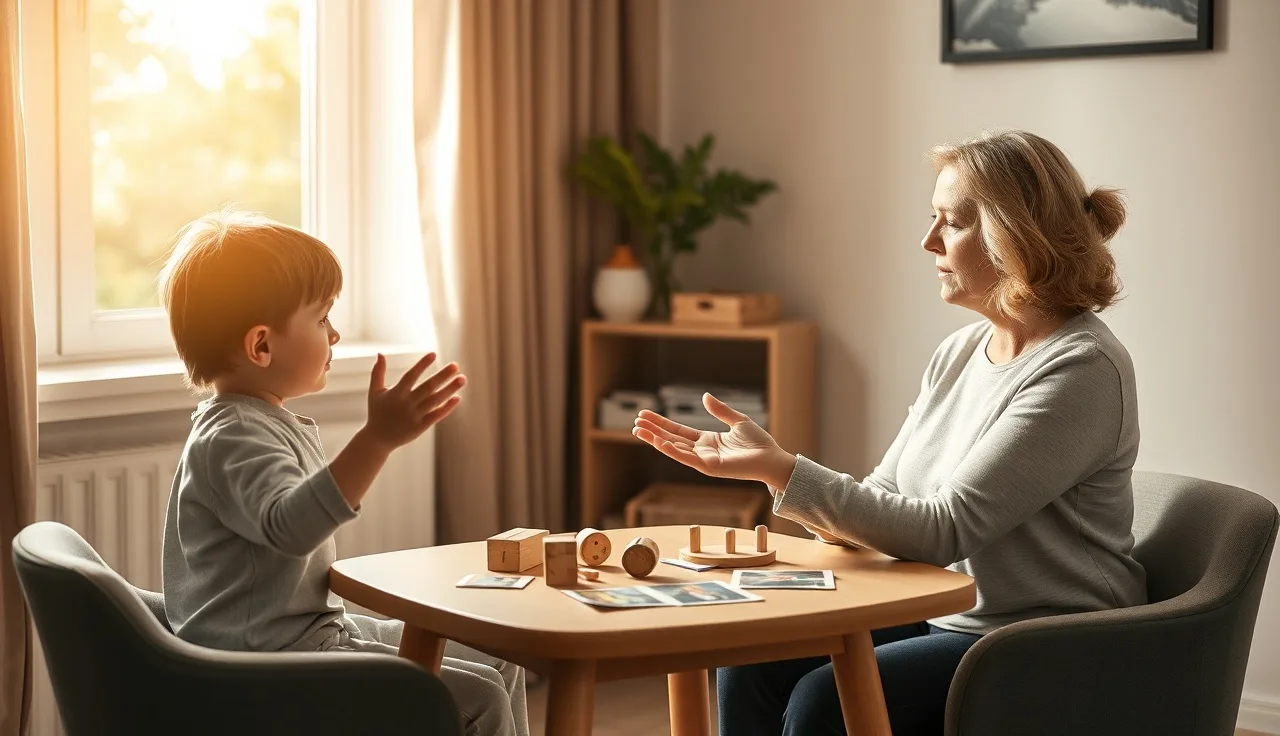
The American Speech-Language-Hearing Association names pragmatic language as a core practice area for SLPs working with autism: using language for different purposes, changing language for the listener, and following the rules of conversation [4]. In a real session, that turns into several things at once. The child practices topic management: noticing when a subject has run long, asking a question back, shifting to something new without a jarring stop. There's perspective-taking work, sometimes called Theory of Mind, which is simply understanding that other people know and want different things than you do; therapists build it with video clips, role play, or stories. If a child's voice sounds monotone or stresses land in odd places, an SLP works on prosody directly using audio feedback and modeling. Some clinicians start with explicit scripts for common moments, like greeting a classmate or asking to join a game, then vary those scripts on purpose so the skill generalizes rather than staying stuck to one scenario. Reading other people's faces and body language, and sending clearer signals yourself, gets practiced in structured ways too. Social narratives and video modeling both have decent evidence behind them for autism [5], with video modeling backed by several randomized studies specifically for social communication targets. Frequency varies. Many children with the Asperger's profile are seen once or twice a week for 30 to 60 minute sessions, one-on-one or in small social communication groups. Groups often work better here because they hand the child real conversation partners to practice with.
What does the research say works for social communication in autism?
The evidence base is uneven, and I'd rather say that plainly than oversell any single method. The strongest support for social communication outcomes in autism, including the Asperger's profile, clusters in a handful of categories [5][6].
| Approach | Evidence level | What it targets |
|---|---|---|
| Social Communication Intervention (SCI) | Strong (multiple RCTs) | Reciprocal conversation, joint attention, topic maintenance |
| Video modeling | Moderate to strong | Social scripts, conversational turns |
| Social skills training (group format) | Moderate | Peer interaction, reading social cues |
| PEERS program (UCLA) | Moderate to strong for adolescents | Friendship skills, conversation, conflict resolution |
| CBT paired with SLP | Moderate | Emotional regulation plus communication |
| Play-based intervention | Moderate for younger children | Joint engagement, spontaneous communication |
The PEERS (Program for the Education and Enrichment of Relational Skills) program at UCLA has been studied specifically in adolescents with ASD, including the Asperger's profile. A randomized controlled trial published in 2012 found significant gains in social knowledge and parent-reported social skills against a waitlist control [6]. PEERS now runs at dozens of sites across the country.
Social thinking frameworks (like Michelle Garcia Winner's work) are everywhere in schools and clinics, but the published evidence for those specific curricula is thinner than for PEERS or video modeling. That doesn't make them useless, it means the research hasn't caught up to the popularity. Many SLPs borrow concepts from them inside a broader, evidence-supported plan.
One honest caveat: most studies here are small, short, and built around outcomes that are easy to measure in a lab. Generalization to real friendships is harder to measure and harder to get. The research supports targeted intervention, but it doesn't promise that six months of weekly therapy will show up directly on the playground. Even so, early and steady intervention still produces better outcomes than waiting [11].
When should speech therapy start for a child with Asperger's?
As soon as you have a concern. The classic Asperger's presentation slips past early screening because language milestones look fine: words on time, sentences on time. The social gaps get visible around ages 4 to 7, when peer play gets complex and the unwritten rules of friendship stop being something a kid can guess at by instinct.
Earlier identification is happening more often now, and early intervention before age 5 consistently produces better outcomes across the spectrum than starting later [11]. Even if your child wasn't diagnosed until 8 or 10, starting then is still worth it. Social communication keeps developing through the teen years and into early adulthood, so there's no point where therapy stops making sense.
For school-age kids, speech therapy through the school system is one route. Under IDEA, if communication difficulties adversely affect educational performance, the district must provide services at no cost to the family [3]. School SLPs carry big caseloads and short session times, though, so some families run private therapy alongside, especially for intensive social communication work.
Adults aren't left out, either. These challenges don't vanish at 18, and speech therapy for adults with ASD level 1 or a legacy Asperger's diagnosis is real and useful, especially around workplace communication, managing conversations, and self-advocacy.
How do you find a speech therapist who actually knows this area?
Not every SLP has real depth with autism-spectrum social communication. Many are strong on articulation, fluency, or language delay in young kids but have had limited training in pragmatic work for cognitively able children with ASD. A few questions before you book can save you months.
ASHA runs a public ProFind directory of certified SLPs at asha.org [4]. When you reach a potential therapist, ask what share of their caseload has autism or ASD level 1, what pragmatic language programs or frameworks they use, whether they offer social communication groups alongside individual sessions, how they measure progress on social goals, and whether they coordinate with the school team or other providers.
If they can't answer the questions about frameworks and progress measurement clearly, take that as your signal. Measuring social communication progress is genuinely harder than scoring articulation accuracy, but a good SLP has a system: standardized measures like the Social Responsiveness Scale [7] or the Children's Communication Checklist, plus direct observation and parent report.
If you live somewhere with thin SLP access, online speech therapy is a legitimate option for this group. Pragmatic language work, video modeling, and social narratives all translate reasonably well to a video platform, especially for older kids who can handle structured screen-based activities. The evidence base for telehealth SLP services has grown a lot since 2020.
What can parents do at home to support speech goals?
You don't need a degree to help. The most useful thing you can do is run the same targets your SLP is working on, in real moments, every day. Generalization, moving a skill out of the therapy room and into life, is where Asperger's intervention tends to stall, and daily home practice is the main way to close that gap.
Watching social scenes together and talking about them works well: pause a show and ask what a character's face is telling you, or what she might be feeling. You build perspective-taking without the pressure of a live person waiting on a reply. Your child's own interests make a good entry point too. If it's trains, talk about trains, then practice turn-taking inside that topic: you share a fact, they share one, you ask a question. The target is turn structure, not topic variety. It also helps to rehearse the conversations that feel pointless to your child: greetings, weather small talk, "how was your weekend." Role-playing them at home makes them feel less alien in public. And where a neurotypical kid might pick up social rules from subtle cues, a child with Asperger's usually needs the rule said out loud: "When you interrupt three times in a row, it feels like their words don't matter to you. Let's try again." Whatever you're working on, pick one target per interaction. Chasing topic maintenance, prosody, and eye contact all at once turns dinner into a test.
If your SLP doesn't send home specific activities, ask. That collaboration is part of what you're paying for, or part of what the district owes you under IDEA [3].
Apps built for social language practice can fill the gaps between sessions. Little Words, an AI-based speech companion for neurodivergent kids, gives conversational practice shaped around a child's profile. A short quiz at littlewords.ai/start tells you whether it fits your child's goals.
How does IEP speech therapy for Asperger's work in school?
If your child qualifies, speech-language therapy through an Individualized Education Program is free to the family under IDEA [3]. Eligibility runs through a multidisciplinary evaluation, and the school SLP typically assesses communication as part of it.
For a child with the Asperger's or ASD level-1 profile, IEP speech goals should target pragmatic areas, not articulation unless that's also a genuine problem. Some school SLPs default to articulation goals because they're easier to write and measure. If a draft IEP says "will produce /r/ correctly" when your child's real problem is interrupting classmates and steamrolling conversations, push back. Ask for goals tied to conversational skill, topic management, and peer interaction. IDEA requires that IEP goals be measurable [3], so for social communication you want something like: "Student will maintain a peer-initiated topic for at least 3 conversational turns in 4 out of 5 observed opportunities." A goal that just says "will improve social skills" is too vague to track or enforce.
School sessions usually happen once or twice a week, often in a pull-out model where the child leaves class to see the SLP. Push-in models, where the SLP works with the child in the classroom or lunchroom, generalize better but take more coordination. It's worth asking whether push-in is on the table.
Does speech therapy address sensory or emotional regulation, or just communication?
Communication and regulation are more tangled than people expect. A child drowning in sensory input in a loud cafeteria will not practice social skills in that cafeteria, period. SLPs who work with ASD often coordinate with occupational therapists right on this overlap. Strictly speaking, sensory processing sits in OT's lane, and emotional regulation lives in the space shared by psychology, SLP, and school counseling. But an SLP doing good pragmatic work handles the communication side of regulation: how to say "I need a break," how to signal distress before it climbs to a shutdown or meltdown, how to rejoin a group after being overwhelmed.
Some children with Asperger's also carry anxiety that blocks skills they technically already have. They know the greeting script cold. They freeze anyway. In those cases, pairing SLP services with a psychologist doing CBT often beats either one alone [5]. If your SLP and your child's therapist aren't talking to each other, you're leaving results on the table.
What about echolalia and scripted language in Asperger's?
Echolalia, repeating words or phrases verbatim from TV, books, or past conversations, is most common in children with higher support needs, but it shows up in some kids with the Asperger's profile too, especially younger ones or during stress [2].
For a closer look at what this looks like and how to respond, this article on echolalia meaning is worth reading alongside this one. The short version: scripted phrases are usually communicative. A child who yells "To infinity and beyond!" when he wants to run outside is using that phrase with intent, even though it's borrowed. In therapy the goal is usually to build flexibility around the scripts, not stamp them out.
Many children with Asperger's who script aren't doing it because they're short on words. They do it because the script is socially safe, emotionally comfortable, or just faster than generating fresh language under pressure. Figuring out the function behind the scripting is what lets an SLP write useful goals around it.
How long does speech therapy take, and what does it cost?
There's no clean duration answer, because it depends on the child's starting point, how intensive the services are, and the specific goals. Some children make strong pragmatic gains over 6 to 12 months of weekly therapy. Others keep benefiting from periodic booster rounds through adolescence as social demands ratchet up.
Private speech therapy in the United States generally runs $100 to $250 per hour, with real variation by region and therapist experience (some specialty providers charge more). School-based services under IDEA are free [3]. Many private health plans cover speech therapy for autism under state parity laws or ACA essential health benefits, though the details swing hard by state and plan. Medicaid covers speech therapy for children with ASD in most states, so it's worth checking your state Medicaid agency for specifics.
If you're working through coverage, ASHA maintains guidance on insurance and funding for speech services, and it's a practical place to start [4]. The Little Words app is a lower-cost option some families use between sessions to keep skills fresh, and the quiz at littlewords.ai/start matches your child's profile to activities that fit.
Are there specific programs that target Asperger's communication?
A few structured programs carry the most evidence and name recognition in this space. PEERS (Program for the Education and Enrichment of Relational Skills) was built at UCLA for teens and young adults with ASD: a 16-session manualized program with a caregiver component, backed by multiple RCTs [6], offered at university clinics, private practices, and some districts. You can find certified providers through the UCLA PEERS clinic. SCERTS (Social Communication, Emotional Regulation, and Transactional Support) is a framework rather than a scripted curriculum, used by SLPs and educators to build social communication and regulation in natural settings, with a moderate evidence base [5]. Comic Strip Conversations and Social Stories, developed by Carol Gray, are widely used, low cost, and good for spelling out social situations and rules; the evidence is softer than PEERS, but they're practical and many kids respond well to the visual format. Unstuck and On Target focuses on cognitive flexibility and planning, often co-run by SLPs and school psychologists, with moderate evidence for school-age children [5].
For the wider view of how these fit together, autism spectrum speech therapy covers the full range from early intervention through adolescence. And if there are motor speech concerns layered on top of the social picture, it's worth ruling out childhood apraxia of speech, a separate condition that sometimes co-occurs.
A kid who never stops talking can still need speech therapy, because talking a lot and communicating well aren't the same skill. Many children with Asperger's have a large vocabulary but stall on the back-and-forth parts of conversation: listening, responding to what the other person actually said, staying on a shared topic. Those reciprocal, pragmatic skills are what therapy targets, and a big vocabulary doesn't mean social communication is working underneath it. The flat or robotic-sounding speech some people notice is also treatable. Prosody, the rhythm and pitch pattern of speech, is a direct target for speech-language pathologists, who use recording, feedback, and modeling to help a child vary stress and tone. It's real progress but it comes slowly. Some older teens and adults keep working on it on their own with voice recording apps once they know what to listen for. There's no wrong age to start. Early intervention before age 5 has the strongest evidence behind it for long-term outcomes across the spectrum, but kids diagnosed at 8, 10, or in their teens still gain a lot from therapy, since social communication keeps developing well past early childhood. Starting later doesn't mean starting too late. People often ask how speech therapy differs from a social skills group, and honestly the line is blurry. Social skills groups are frequently run by speech-language pathologists and overlap heavily with pragmatic language work. The real difference is setting: one-on-one therapy lets the therapist drill into a specific child's targets, while a group hands that child real peers to practice on. Families who can do both usually find they complement each other. On funding: if a school evaluation finds that communication difficulties affect educational performance, IDEA requires the district to provide speech-language services at no cost. That phrase, "adversely affects educational performance," covers social participation with peers, not just academics. If the district pushes back on eligibility, parents have procedural rights under IDEA, including the right to an independent evaluation. Progress gets tracked with real tools, not guesswork: the Social Responsiveness Scale (SRS-2), the Children's Communication Checklist (CCC-2), and direct observation during structured interactions are all common. A good therapist also writes measurable IEP goals with specific criteria so you can see movement session to session. If yours can't explain concretely how they're tracking progress, ask them to walk you through it. Telehealth works for most of this. Video modeling, social narrative work, conversation practice, and prosody training all translate reasonably well to a screen, and some kids actually do better there, since the frame cuts out some of the ambient social pressure of an in-person room. Telehealth speech services have expanded a lot since 2020 and plenty of insurance plans now cover them. Therapy shifts in adulthood rather than disappearing. Adults spend more time on workplace communication, professional conversation norms, interviews, and self-advocacy than children do. The PEERS for Young Adults curriculum was built for exactly this transition period. Adult services are usually private pay or insurance-based, since school-based entitlement under IDEA ends at 21 or graduation, whichever comes first. It's also worth asking about occupational therapy alongside speech therapy, especially if sensory or fine motor issues show up too. Communication and sensory regulation are tangled together: a child overwhelmed by noise in a classroom isn't going to use their social language skills well in that moment. Speech and occupational therapists who coordinate around shared goals tend to get better results than either working alone. On PEERS specifically: it stands for Program for the Education and Enrichment of Relational Skills, a structured 16-session social communication program developed at UCLA. A 2012 randomized controlled trial found real gains in social knowledge and caregiver-reported social skills compared with a waitlist group. It's built for teens and young adults, and certified providers run it through university clinics and private practices around the country; the UCLA PEERS clinic keeps a directory. Reading and writing can carry the same pragmatic gaps as speech. Some children with ASD show hyperlexia, strong decoding paired with weaker comprehension, and written work can miss the reader's perspective the same way conversation does. A speech-language pathologist can assess written language pragmatics and work it into therapy if it's affecting school or social life. It's a separate target from spoken conversation, but it draws on the same perspective-taking skills. Therapy for the Asperger's profile also looks different from therapy for other autism profiles. Children with higher support needs often work on foundational communication like functional requests, joint attention, or AAC. Kids with the Asperger's profile usually have those foundations already and instead need work on higher-level conversation, prosody, and unspoken social rules. The intervention models overlap (video modeling, social narratives, SCERTS), but the content and difficulty level differ quite a bit. A solid assessment from a speech-language pathologist should clarify which tier of skills needs the most attention.Sources
- American Psychiatric Association, DSM-5 (2013): Asperger's syndrome was subsumed into autism spectrum disorder in DSM-5, published 2013
- National Institute of Neurological Disorders and Stroke, Autism Spectrum Disorder information: Pedantic or one-sided speech and difficulty with conversational reciprocity are characteristic of the Asperger's communication profile; echolalia can appear under stress
- U.S. Department of Education, Individuals with Disabilities Education Act (IDEA): IDEA requires free appropriate public education including speech-language services for children whose disability adversely affects educational performance; entitlement ends at age 21
- American Speech-Language-Hearing Association (ASHA), Autism practice portal: ASHA identifies pragmatic language (using language for purposes, changing language for listener, following conversational rules) as a core SLP practice area for autism
- Wong et al., 'Evidence-Based Practices for Children, Youth, and Young Adults with Autism Spectrum Disorder', Journal of Autism and Developmental Disorders, 2015: Video modeling, social narratives, SCERTS, and social communication intervention have evidence support for autism spectrum social communication outcomes
- Laugeson et al., 'Evidence-Based Social Skills Training for Adolescents with Autism Spectrum Disorders: The UCLA PEERS Program', Journal of Autism and Developmental Disorders, 2012: PEERS randomized controlled trial found significant gains in social knowledge and parent-reported social skills in adolescents with ASD compared to waitlist control
- Constantino & Gruber, Social Responsiveness Scale (SRS-2), Western Psychological Services: Social Responsiveness Scale (SRS-2) is a standardized tool used by SLPs to measure social communication impairment and progress in autism
- Centers for Disease Control and Prevention, Autism Spectrum Disorder data and statistics: ASD prevalence and diagnostic patterns, including timing of diagnosis and range of communication profiles across the spectrum
- American Academy of Pediatrics, autism screening guidance: AAP recommends developmental surveillance at every well-child visit and autism-specific screening at 18 and 24 months; early identification supports earlier intervention
- Kasari et al., 'Communication Interventions for Minimally Verbal Children with Autism', Journal of Child Psychology and Psychiatry, 2014: Early and intensive social communication intervention produces better long-term outcomes than later-starting intervention across autism profiles