Last updated 2026-07-10
TL;DR
The exercises that move the needle for autistic children target joint attention, functional requesting, and turn-taking, and they work best woven into daily routines rather than run as drills. Model language at or just above your child's current level, use AAC alongside speech rather than instead of it, and follow the child's lead. Most kids make measurable gains with 20 or more minutes of this kind of practice worked into an average day, at home and at school.
What are you actually working on?
Before picking an exercise, figure out what you're trying to move. Autism-related communication differences aren't one thing. Some kids understand plenty but have almost no expressive words. Some talk a lot but struggle with the back-and-forth of conversation. Some lean on echolalia, repeating phrases they've heard, as their main tool. The right exercise depends entirely on where your child is right now.
The American Speech-Language-Hearing Association groups communication goals into three areas: form (sounds, words, grammar), content (meaning and vocabulary), and use (the social function of language, also called pragmatics) [1]. Most autistic children need work across all three, but the balance is different for every kid. A child who repeats TV scripts word for word already has the form down; the goal is expanding what they do with it. A minimally verbal child may need AAC and a completely different starting point.
Speech-language pathologists describe a child's "communication stage": pre-intentional, intentional pre-symbolic, symbolic, and multi-word. Exercises pitched one stage above where a child currently sits tend to produce the fastest growth. Pushing two or three stages ahead just frustrates everyone. That's why the exercises below are organized by communication level, not age.
Why routines beat drill sessions
Naturalistic, routine-based intervention beats clinic-style drills on generalization, plainly stated. A 2013 Cochrane review of parent-mediated early intervention for autism found parent-implemented naturalistic strategies improved communication outcomes across multiple randomized trials [2]. Kids learn to communicate so they can get things they want, refuse things they don't, and connect with people they like. Drills don't copy that. Routines do.
Breakfast, bath time, the car ride to school, getting dressed: these are already happening, already have predictable sequences your child can anticipate, and can eventually be filled in by your child. A parent who models language for 10 minutes at dinner and 10 minutes during play banks more practice reps in a week than two clinic sessions provide, simply because it happens every single day.
None of this makes speech therapy optional. It means the work your child does with a speech therapist should be built to spread into your home, not stay in the therapy room. Good SLPs write home programs for exactly this reason. If yours hasn't, ask directly: "What should we be doing at dinner this week?"
Joint attention: where most therapists start
Joint attention is the ability to share focus on an object or event with another person. You look at the dog, I look at the dog, we both know we're looking at the same dog. Sounds simple. For many autistic children it's one of the hardest things to do, and it predicts later language development more reliably than almost any other early skill [3].
The good news is you can build it at home with nothing but your attention.
Try following your child's lead, sometimes called floor time. Sit at your child's level, watch what they're interested in, and don't redirect or prompt. Comment on what they're doing in simple language: "Rolling the car. Car goes fast." When they look at you, even briefly, treat it as gold: smile, get animated. Early on, the whole point is to increase how often those looks happen. Aim for 10 to 15 minutes, twice a day if you can manage it.
Sabotage routines sound mean and they work. Put a favorite snack in a container you know your child can't open. Blow a bubble, then hold the wand without blowing. Wind up a toy, let it run down, then wait. These "communication temptations" create a reason to look at you and communicate [4]. When your child looks, model the word ("Open. Open please.") and then hand over what they want immediately, so the request itself gets reinforced by the payoff.
Parallel play narration works differently: sit near your child while they play and run your own version of the same activity, commenting on what you're doing without demanding they join. This side-by-side presence builds comfort with shared space and often pulls a child's attention on its own, without the pressure of face-to-face interaction.
Joint attention at 18 months is among the strongest early predictors of vocabulary size at age 3, according to research from the NICHD Early Child Care Research Network [3].
Turn-taking practice for a child who doesn't talk yet
Turn-taking is the backbone of conversation, and you can practice it long before a child has words. The structure is simple: I do something, pause, you do something, pause, back and forth. That rhythm is what you're teaching, not the content.
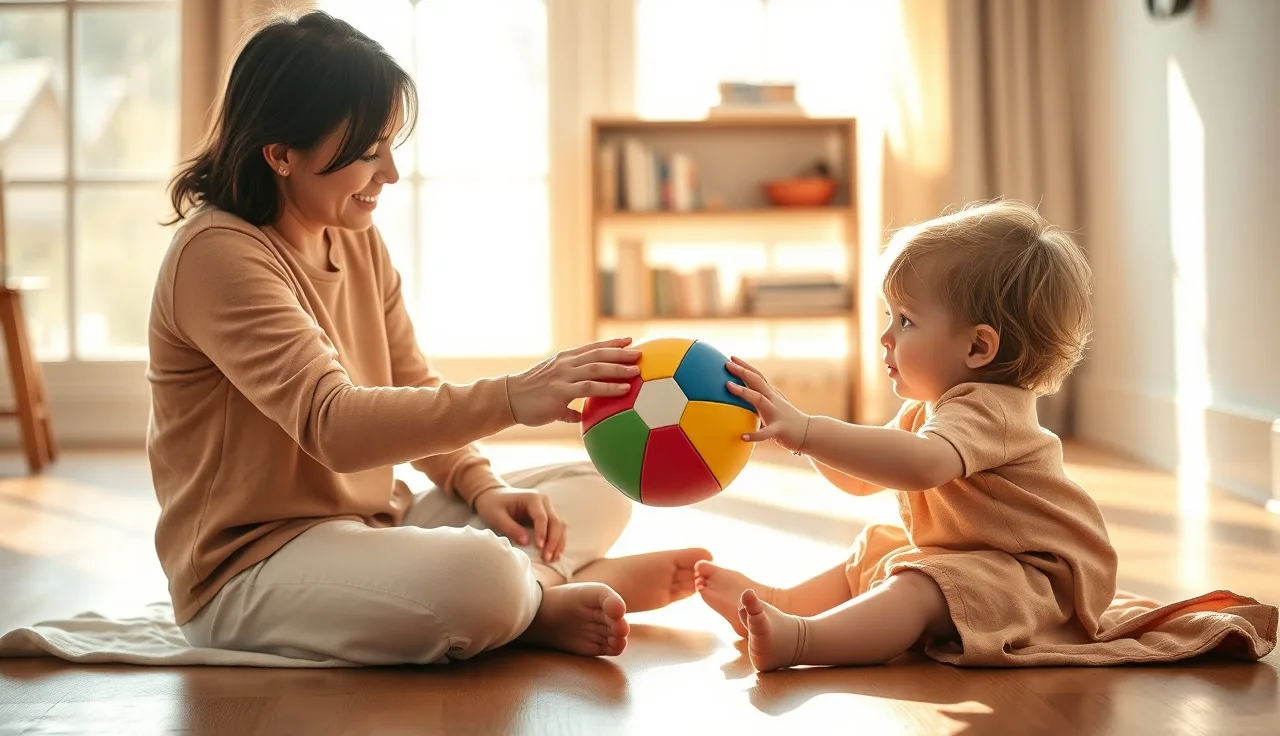
Start with physical turn-taking. Roll a ball back and forth. Stack one block, then pause and wait. Bang a drum twice, hand it over. The pause is the whole thing here: most parents rush to fill the silence, but resist it. Give your child 5 to 10 seconds to respond before you prompt. That silence is what tells them a turn is expected.
Once the physical back-and-forth is steady, add sound. Hum, then pause. Make a silly noise and wait for one back, any noise at all. Imitation in this direction, you copying your child, is especially strong: research on reciprocal imitation training shows it increases spontaneous social engagement in young autistic children [5]. When your child bangs the table, you bang the table. When they make a sound, you echo it. You become interesting because you're responsive.
For older kids who are verbal but stumble on conversational turn-taking, structured games help. Board games with strict turn structures (Uno, Connect Four) give a concrete framework. Social scripts help too, and teaching explicit phrases like "My turn," "Your turn," and "What do you think?" isn't fake or robotic: it hands a child a scaffold to lean on until the pattern goes automatic.
Using AAC at home
AAC, augmentative and alternative communication, isn't a last resort for kids who've failed at speech. It's a real communication method, and research consistently shows it does not slow speech development and often supports it [6]. If your child is minimally verbal or clearly frustrated trying to communicate, AAC deserves a serious look; our AAC devices overview walks through specific tools.
At home, the most useful thing you can do is model AAC yourself. This is called "aided language input" or "aided language stimulation." If your child uses a speech-generating device or a PECS book, use it too when you talk to them. Point to the symbols while you say the words. You're not drilling them, you're showing them how the system works by using it in front of them.
Research by Romski and Sevcik found that children whose parents were trained in augmented language input made significantly more communication gains than children who got speech-output devices without any parent training [6]. The device alone doesn't do the work. The modeling does.
A few practical ways to work this in at home:
- During meals, model requesting by touching the food symbols before you put food on the plate.
- During play, narrate on the device: touch "more" before you push the swing again.
- At book time, pause on familiar pages and wait for your child to activate a symbol before you turn the page.
- Build a small, high-contrast display for the most frequent requests in your home: "more," "stop," "help," "eat," "drink," "play."
If your child has an SLP, ask them to help map your home vocabulary onto whatever AAC system you use. Generic vocabulary sets often miss the specific words that carry the most weight in your child's actual life.
Play-based speech exercises for toddlers and preschoolers
Play is how young children process language. It isn't a break from learning, it's the learning itself. The ideas below suit children roughly 18 months to 4 years old, though where a child is developmentally matters more than their actual age.
One of the simplest and most effective things you can do is expand on what your child already says. They say "ball," you say "red ball" or "throw ball." They say "more juice," you say "more apple juice please." You're modeling the next step up in complexity without correcting them, a technique called expansion, and it's one of the most evidence-backed parent strategies in early language research [4].
Rhymes, songs, and made-up silly words build phonological awareness, the ability to hear and play with the sounds inside words, which feeds both reading and vocabulary later on. Your child doesn't need to produce the sounds yet; just hearing them counts. Sing the same songs over and over. Repetitive, predictable language is easier for a young child to process and copy.
Pretend play is often delayed in autistic children, so it's worth building on purpose rather than waiting for it to appear. Start small: pretend to sip from an empty cup, feed a stuffed animal, drive a toy car around. Narrate what you're doing in short phrases, and don't require your child to join in; just model it next to them. When they start mirroring your play or adding their own touch, that's a real milestone in communication. Board books with repetitive lines, like "Brown Bear" or "Each Peach Pear Plum," work well for the same reason. Read the same ones again and again. Pause right before the last word of a familiar line and wait for your child to fill it in. Plenty of kids who won't produce a word out of nowhere will supply it from a favorite book, and that's a genuine act of communication that builds expressive vocabulary over time.
Communication exercises for older autistic kids and teens
Most resources on autism and communication are written for young children, but older kids and teens need their own strategies, and those look quite different.
For school-age kids who talk but struggle socially, the work usually shifts toward pragmatic language: catching sarcasm, reading cues in conversation, knowing when to change the subject. The PEERS program (Program for the Education and Enrichment of Relational Skills), developed at UCLA, has the strongest evidence base for social skills in autistic teenagers. A 2012 randomized controlled trial found real improvements in social skills knowledge and social responsiveness after 14 weeks [7]. It's a clinical program, not something you run at home, but many SLPs use its framework, and some of it translates to family life.
At home, older kids often benefit from watching videos of conversations and breaking down afterward what each person did and why; many autistic teens find analyzing a conversation easier than being inside one. Real conversations about topics your child genuinely cares about tend to build more transferable skill than staged role-play. Spelling out body language and tone directly, "when I say 'fine' in this tone, what do I mean?", is something many autistic teens actually want and find useful rather than patronizing. And building scripts ahead of specific situations, like calling a doctor's office, ordering food, or handling a conflict with a classmate, gives them a scaffold that lowers anxiety enough to let the conversation actually happen.
For teens who still use AAC or are minimally verbal, the goals of autism spectrum speech therapy tend to shift toward independence, self-advocacy, and getting through daily life in the community. Work with an SLP so the goals reflect what your teen actually needs.
How does early intervention change communication outcomes?
Substantially, and in ways you can measure. The AAP recommends developmental screening at 9, 18, and 24 or 30 months, and autism-specific screening at 18 and 24 months, precisely because catching things early leads to earlier support [8]. The brain is most plastic in the first three years, and intervention started in that window tends to produce bigger effects than the same intervention started at age 5 or 6.
The Early Start Denver Model (ESDM), one of the most studied early autism interventions, was tested in a 2010 randomized controlled trial by Dawson and colleagues. Children who got 20 hours a week of ESDM between 18 and 30 months showed significantly greater gains in IQ, language, and adaptive behavior than children who got community treatment instead [9]. Those gains held up at the two-year follow-up.
You don't need 20 hours a week at home to see progress, but the study shows a real dose-response pattern: more intentional, responsive language interaction leads to better outcomes. In the U.S., early intervention services under Part C of IDEA are free from birth through age 2 for children who qualify [10]. If your child is under 3 and you're concerned, call your state's early intervention program directly; most states don't require a doctor's referral first.
After age 3, services shift to the school system under Part B of IDEA, and the bar to qualify can be higher, which is genuinely frustrating for families. Private speech therapy can fill that gap, and telehealth has opened up access considerably: online speech therapy is now covered by most major insurers for autism-related services, though coverage details vary by state.
What exercises help with echolalia specifically?
Echolalia, repeating words or phrases picked up from people or media, isn't a mistake that needs stamping out. For many autistic children it's functional communication: a child who says "Do you want a drink of water?" when they're thirsty is using that phrase to express a real need. Suppress it without giving them something better and you take away their voice.
The goal instead is to gently shape echolalia toward more flexible, spontaneous language over time. Our echolalia meaning article covers the topic in more depth, but a few exercises are built around this idea. When your child uses an echolalic phrase, respond to what they mean rather than the literal words: if they quote a cartoon line that seems to signal distress, answer the distress ("you're upset, it's hard"), and over time pair simpler language alongside the script ("upset, you feel upset").
Building routines with predictable fill-in slots also helps: say "time to eat..." and wait, or "ready, set..." and wait. Many children who use delayed echolalia will start dropping these familiar frames in on their own, which is often where more flexible language begins. It's also worth working with an SLP to identify the functional phrases your child already uses most, and then help them recombine the pieces: if "Do you want to play?" is how they request play, teach them "I want to play" and "play please" using the same words. You're not taking the script away, you're adding to what they have. For more on what echolalia is and why it happens, see our echolalia article.
How do I know if the exercises are working?
Progress in early communication is easy to miss because it doesn't move in a straight line and the milestones aren't always obvious. A child who picks up three new ways of requesting things over two months has made real progress, even without a single new word. Worth tracking: how often your child starts any kind of communication in a day, whether they're using it only to request things or also to protest, comment, share, and greet, whether they're initiating on their own or only responding when prompted, and how often they imitate your words or actions.
Keep a simple log for two weeks before you try a new strategy and two weeks after. Nothing fancy, a tally sheet on the fridge works fine. You need a baseline to know if anything has actually shifted.
If nothing changes after 6 to 8 weeks of consistent daily practice, that tells you something too. It might mean the exercise isn't the right fit for where your child is right now, or it might point to something motoric, like apraxia of speech, that needs a specialist's assessment. Childhood apraxia of speech shows up alongside autism more often than in the general population, and it calls for a different approach to treatment.
A tool like Little Words can help you stay consistent between therapy sessions: it offers structured communication activities matched to your child's current level based on a short quiz, so you're not guessing what to work on next. It won't replace an SLP, but it can take some of the overwhelm out of daily practice. You can start the quiz to see which exercises fit where your child is right now.
ASHA's scope of practice document is clear that speech-language pathologists are the clinical experts for autism communication intervention [1]. If you haven't connected with one yet, that's the step to take first. Home exercises support therapy; they don't stand in for it.
What should parents realistically expect from home exercises?
Let's be honest: home practice isn't a substitute for qualified clinical care, and any website telling you otherwise deserves some skepticism. What home exercises do well is raise the dose and generalization of skills your child is already working on, and build the responsive, language-rich environment development depends on.
Don't expect dramatic change in weeks. Most clinically meaningful language gains in autism research show up over 3 to 6 months minimum. Some children take off quickly with naturalistic strategies, while others plateau and need a different approach; nobody has clean data on who responds to what, and any practitioner who claims otherwise is overstating the evidence. Your consistency matters more than technical perfection, too: an imperfect exercise done daily beats a perfect one done twice. And it's worth saying plainly that some communication differences are lasting and significant. AAC and other supported communication systems may be long-term tools rather than temporary scaffolds. That's not failure, it's meeting your child where they are.
The families who tend to see the most progress build practice into things they're already doing, stay curious about what their child is communicating even without words, and keep a close working relationship with an SLP who adjusts goals as the child grows. That's the real system. The exercises are just the pieces inside it.
Frequently asked questions
At what age should I start communication exercises for an autistic child?
As soon as you have concerns, which can be as early as 9 to 12 months. The AAP recommends autism-specific screening at 18 and 24 months, and Part C of IDEA provides free early intervention services from birth through age 2. The brain is most plastic in the first three years, so earlier support produces larger effects. If your child is older, starting now still matters: it's never too late to improve the quality of their communication environment.
Can I do these exercises without a speech therapist?
You can start naturalistic strategies like following your child's lead, sabotage routines, and expansion on your own. They're low-risk and evidence-supported. But a speech-language pathologist will spot goals you'd miss, catch motor speech issues like apraxia early, and keep you from accidentally reinforcing unhelpful patterns. Think of home practice as amplifying professional therapy, not replacing it. If cost or access is a barrier, online speech therapy has expanded a lot and is often covered by insurance.
What communication exercises work for nonverbal autistic children?
Joint attention building, aided language input using AAC, sabotage routines to create communication motivation, and reciprocal imitation are the strongest starting points. AAC modeling, where a parent uses the device or symbol system alongside speech, matters most. Research by Romski and Sevcik shows AAC does not prevent speech development and often supports it. Start with a small, high-contrast core vocabulary board covering the most frequent functions: more, stop, help, eat, drink, play.
How long should I do communication exercises each day?
There's no single perfect number, but the ESDM trial that showed the strongest gains used about 20 hours of intervention per week, most of it embedded in daily routines rather than formal sessions. At home, two to three focused 10 to 15 minute interaction periods per day, plus ongoing responsive interaction during meals, bath, and play, is a reasonable target. Consistency across days matters more than duration in any single session.
Is echolalia a problem that should be stopped?
No. Echolalia is often functional communication, and suppressing it without giving a child a better alternative removes a tool they're using to get needs met. The goal is to gradually shape echolalic phrases toward more flexible, spontaneous communication by mapping meaning onto scripts, building fill-in routines, and teaching recombination of familiar words. A speech-language pathologist familiar with autistic communication styles will know how to work with echolalia rather than against it.
What is joint attention and why does it matter for communication?
Joint attention is the ability to share focus on the same object or event with another person: you look at the dog, I look at the dog, and we both know it. It's one of the strongest early predictors of later vocabulary development. Autistic children often develop joint attention differently or later. Following the child's lead, communication temptations, and parallel play narration all build it, and gains in joint attention typically produce gains in expressive language.
Do AAC devices slow down speech development?
The evidence consistently says no. Multiple studies, including research by Romski and Sevcik published in peer-reviewed journals, show that AAC does not reduce speech development and often supports it by lowering communication frustration and modeling word association. The American Speech-Language-Hearing Association endorses AAC as appropriate for children across the speech ability range when communication needs support. Early introduction is generally better than waiting.
How do I help an autistic child understand sarcasm and figurative language?
Direct, explicit instruction works better than hoping it gets picked up naturally. Watch clips together, pause, and ask what the person meant versus what they literally said. Use social stories that describe figurative phrases in plain language. Practice with low-stakes, familiar examples from your family's actual conversations before moving to abstract ones. For teens, the PEERS program at UCLA has randomized trial evidence supporting its social language curriculum, and many SLPs incorporate its methods.
What is the ESDM and is it something parents can use at home?
The Early Start Denver Model is a naturalistic, play-based early intervention for children with autism aged 12 to 48 months. It was developed at UC Davis and tested in a 2010 randomized controlled trial that showed significant gains in language and adaptive behavior after 20 hours per week of intervention. Parents can be trained in ESDM principles, and many certified providers offer parent coaching. The full model requires professional training, but the core strategies of following the child's lead and embedding learning in routines are directly usable at home.
What's the difference between a speech delay and an autism communication difference?
Speech delays generally involve slower acquisition of words and sentences but typical social use of communication: eye contact, pointing to share interest, taking turns. Autism communication differences often include differences in joint attention, social reciprocity, and pragmatic use of language even when vocabulary is present. Many autistic children have both. A speech-language pathologist can assess both dimensions, and some children have both autism and a separate motor speech disorder like apraxia, which needs its own specific treatment approach.
How do I get my school to do more communication work with my autistic child?
Start with the IEP process. Under IDEA Part B, children who qualify receive a free appropriate public education including speech-language services if communication is an area of need. Request an IEP meeting and ask specifically what communication goals are written, how progress is measured, and what the school SLP recommends for home carryover. If you disagree with the school's assessment of your child's needs, you have the right to request an independent educational evaluation at public expense. The IDEA statute is the governing document.
Can video modeling help autistic children learn communication skills?
Yes. Video modeling, watching recordings of target behaviors then practicing them, has a solid evidence base for social and communication skills in autistic children and teens. It works partly because the format lowers the social pressure of face-to-face observation and allows repeated viewing. It's especially useful for teaching conversational scripts, emotion recognition, and pragmatic routines. Many SLPs use it, and some AAC apps include video modeling components. It works best as a supplement to, not a replacement for, live practice.
Are there communication exercises specifically for autistic girls?
The exercises themselves aren't gendered, but it's worth knowing that autistic girls are often diagnosed later than boys, partly because they more frequently mask social communication differences, mimicking neurotypical behavior at the cost of significant mental effort. That means their underlying communication needs can be underestimated. If your daughter seems socially fluent but is exhausted after social interaction, leans hard on rigid scripts, or struggles in unstructured social situations, her pragmatic language needs may be greater than they look on the surface.
Sources
- ASHA, Scope of Practice in Speech-Language Pathology: ASHA defines communication goals across form, content, and use (pragmatics) and designates SLPs as clinical experts for autism communication intervention
- Cochrane Database of Systematic Reviews, Oono et al. 2013, Parent-mediated early intervention for young children with autism spectrum disorders: Parent-implemented naturalistic strategies improved communication outcomes for autistic children in multiple randomized trials
- NICHD Early Child Care Research Network, published in Child Development, joint attention as predictor of vocabulary: Joint attention skills at 18 months are among the strongest early predictors of vocabulary size at age 3
- ASHA, Evidence Maps: Language Intervention for School-Age Children with Language Disorders: Expansion and communication temptation strategies are evidence-based parent-implemented language interventions
- Ingersoll, B. (2010). Reciprocal imitation training for young children with autism. Journal of Positive Behavior Interventions.: Reciprocal imitation training increases spontaneous social engagement in young autistic children
- Romski, M. & Sevcik, R. research on augmented language input, published in peer-reviewed journals: Children whose parents were trained in augmented language input made significantly more communication gains than children given speech-output devices without parent training; AAC does not reduce speech development and often supports it
- Laugeson, E.A. et al. (2012). Evidence-based social skills training for adolescents with autism spectrum disorders: The UCLA PEERS program. Journal of Autism and Developmental Disorders.: The PEERS program showed significant improvements in social skills knowledge and social responsiveness after 14 weeks in a randomized controlled trial
- American Academy of Pediatrics, Autism Spectrum Disorder Screening and Diagnostic Tools: AAP recommends developmental screening at 9, 18, and 24 or 30 months and autism-specific screening at 18 and 24 months
- Dawson, G. et al. (2010). Randomized, controlled trial of an intervention for toddlers with autism: the Early Start Denver Model. Pediatrics.: Children receiving 20 hours per week of ESDM from ages 18 to 30 months showed significantly greater improvements in IQ, language, and adaptive behavior versus controls; gains persisted at 2-year follow-up
- IDEA, Individuals with Disabilities Education Act, Part C and Part B: Part C of IDEA provides free evaluations and services from birth through age 2; Part B covers services for children age 3 and up through the school system
- ASHA, Augmentative and Alternative Communication practice portal: ASHA endorses AAC as appropriate across the speech ability range when communication needs support