Last updated 2026-07-09
TL;DR
Autism communication tools range from paper picture boards and sign language to high-tech speech-generating devices and apps. Research consistently shows that giving a nonspeaking or minimally verbal autistic person a reliable way to communicate reduces frustration and supports language development. No single tool fits everyone. The right choice depends on the person's motor skills, literacy level, age, and daily environment.
An autism communication tool is anything a person uses to get a message across when spoken words aren't available, aren't reliable, or aren't enough. That covers a huge range: a laminated card with three pictures on it, a dedicated iPad app with thousands of vocabulary symbols, a wearable device that turns eye gaze into synthesized speech.
The American Speech-Language-Hearing Association (ASHA) groups these under Augmentative and Alternative Communication, or AAC, which it defines as "all forms of communication (other than oral speech) that are used to express thoughts, needs, wants, and ideas," including facial expression, gesture, symbols, writing, and speech-generating devices [1].
Autism doesn't automatically mean AAC. Some autistic people speak fluently but still lean on visual supports during stressful or sensory-heavy moments. Others are minimally verbal and rely on a device as their primary voice. Plenty of people, kids and adults alike, move along a spectrum of support depending on the situation. One thing the research is clear on: introducing AAC does not reduce a person's motivation to speak. A 2015 systematic review in the American Journal of Speech-Language Pathology found that "AAC intervention did not inhibit speech production and, in most cases, was associated with gains in natural speech" in children with autism [2]. That finding has been replicated enough times that ASHA and the American Academy of Pediatrics (AAP) both treat it as settled guidance.
The main categories of tools
It helps to think in three tiers: unaided, low-tech aided, and high-tech aided. Unaided tools need no equipment at all: sign language, key word signing (using a simplified sign for the most important word in a sentence), and natural gestures. They're always available and never run out of battery, but the listener also has to know the system.
Low-tech aided tools are physical objects, usually paper or plastic. The most common:
- Picture Exchange Communication System (PECS): a structured protocol where the person hands a picture card to a partner to make a request. PECS was developed in 1985 by Andy Bondy and Lori Frost and has one of the strongest evidence bases of any autism communication intervention [3].
- Visual schedules: a sequence of pictures or symbols showing what comes next in the day, which eases anxiety and supports transitions.
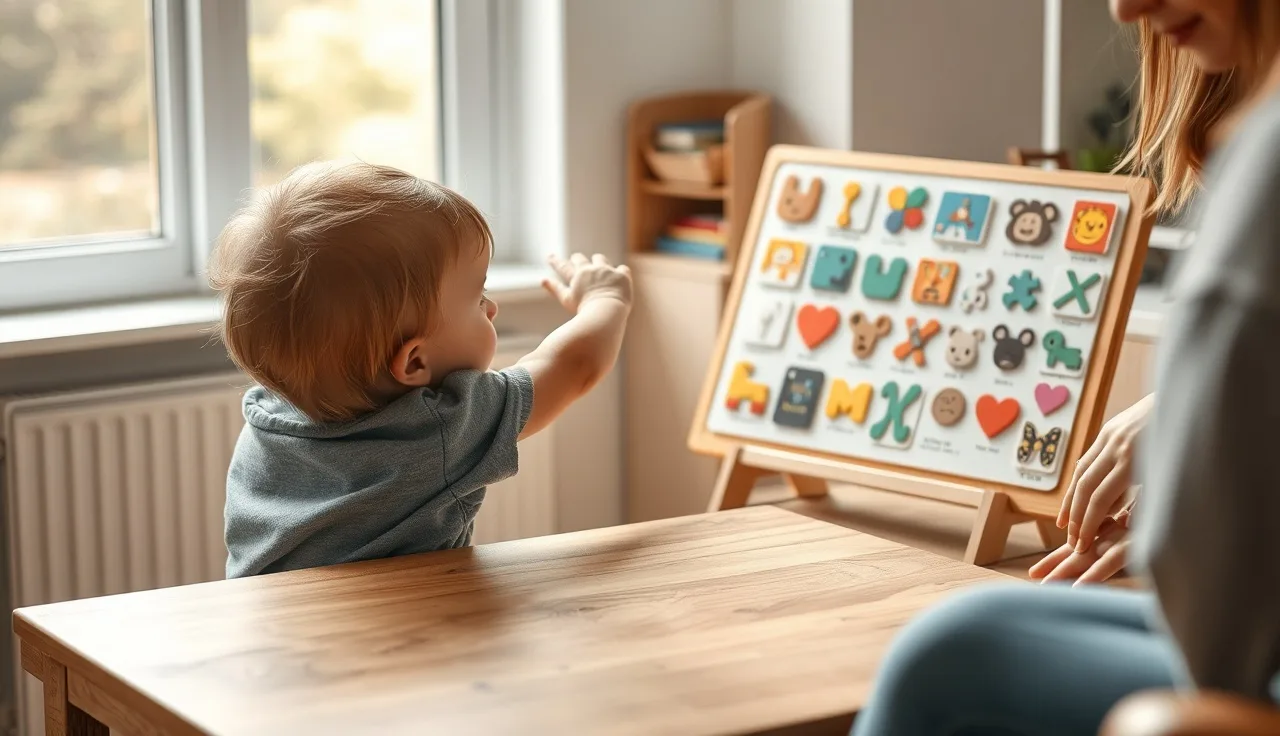
- Communication boards: a grid of symbols, photos, or words a person points to.
- Choice boards: a stripped-down version with two to six options, good for early communicators.
High-tech aided tools are electronic: speech-generating devices (SGDs), also called voice output communication aids (VOCAs), ranging from simple single-message buttons to dynamic display devices with thousands of vocabulary items; AAC apps on tablets or phones, including Proloquo2Go, TouchChat, Snap Core First, and LAMP Words for Life; and eye-gaze systems for people with significant motor challenges, where the device tracks where someone looks and activates vocabulary. For a deeper look at how dedicated hardware compares to app-based options, see our guide to AAC devices.
Which tools have the strongest evidence behind them
Evidence in this field is graded on the National Autism Center's National Standards Project levels, from Established to Emerging to Unestablished. As of the most recent report, AAC as a category is classified as an Established treatment for improving communication in autistic individuals [4]. Within AAC, specific approaches vary quite a bit.
| Tool / Approach | Evidence level | Notes |
|---|---|---|
| PECS | Established | Strong RCT evidence for requesting; weaker for generalization [3] |
| SGDs / VOCAs | Established | Cochrane-level reviews support use across ages [2] |
| Visual supports / schedules | Established | Consistent effect on behavior and transitions [4] |
| Aided language modeling (ALM) | Emerging to Established | Growing RCT base since 2015 |
| Key word signing | Emerging | Good case-series data; fewer RCTs |
| Facilitated communication | Unestablished | Multiple controlled studies found no evidence; ASHA, AAP, and APA have issued statements against it [5] |
That last row matters. Facilitated communication, where a helper physically supports the communicator's hand or arm, has been studied extensively and hasn't held up. The AAP's 2018 policy statement on AAC explicitly states it "does not support the use of facilitated communication" [5]. If someone recommends it, raise that with your speech-language pathologist.
Aided language modeling is worth a mention because it's now widely used and the research is catching up to the practice. In ALM, the communication partner models vocabulary on the same AAC system the person uses, narrating activities by touching symbols while talking. A 2021 study in Augmentative and Alternative Communication found significant gains in symbol comprehension and use in young autistic children who received ALM compared to controls [6].
Kids versus adults
The underlying tools are often the same: a dynamic display AAC app works for a six-year-old and a sixty-year-old. What changes is the vocabulary, the setting it gets used in, and who pays for it.
For children, early introduction matters a lot. The AAP recommends referring any child with communication concerns for evaluation by 18 months, and research on early intervention shows that starting support before age three produces the largest functional gains [7]. Kids' AAC setups tend to prioritize core vocabulary (high-frequency words like "want," "go," "stop," "more") over topic-specific fringe vocabulary, since core words make up roughly 80 percent of everything anyone says.
For autistic adults, the picture looks different. Some were never evaluated as children, or had their communication needs dismissed. Some developed speech that works fine in low-stress situations but fails under anxiety, illness, or sensory overload, a pattern sometimes called situational mutism or unreliable speech. For these adults, a communication tool isn't a replacement for speech but a backup system for the moments when speech drops out.
Communication apps for adults also need to handle adult vocabulary and social contexts: job interviews, medical appointments, dating, bureaucratic forms. Apps like Proloquo4Text (text-based rather than symbol-based) or simply the built-in text-to-speech function on any phone can be enough for adults with strong literacy skills. Adults who never developed reading benefit more from symbol-based systems. Access is different too. Where children often get services through school or early intervention, adults typically need to go through a private SLP, a disability services agency, or Medicaid-funded waiver programs for speech therapy for adults, and both the wait times and the costs tend to be higher.
What these tools actually cost
This is where the range gets enormous, and where funding strategy ends up mattering as much as the tool itself.
Low-tech tools, printed picture cards, PECS binders, visual schedule sets, cost anywhere from essentially nothing (print them at home using free resources from ASHA or Teachers Pay Teachers) to around $200 to $500 for a commercially produced system. AAC apps on a tablet run $250 to $500 for the app license, plus the tablet itself (an iPad starts around $330 new), so most families end up spending $600 to $900 total for an app-based setup. Dedicated SGDs, the hardware built specifically for AAC, cost $2,000 to over $10,000. The most widely used devices, Tobii Dynavox, PRC-Saltillo, and Lingraphica products, typically fall in the $6,000 to $9,000 range without insurance. Medicare classifies SGDs as Durable Medical Equipment (DME), so they can be covered under Part B for eligible adults [8]. Medicaid coverage varies by state but is often available, especially for children. The Individuals with Disabilities Education Act (IDEA) requires schools to provide AAC devices as part of a free and appropriate public education if an IEP team determines it's necessary [9], which is a legal entitlement, not a favor the school grants. Private insurance coverage for AAC is patchwork: most states have autism insurance mandates, but they differ in whether they explicitly include SGDs. The AAC Institute and ASHA both maintain funding guidance pages worth checking for your specific state [1].
How do you choose the right communication tool for an autistic child?
No app store review or comparison chart replaces a proper AAC evaluation by a licensed speech-language pathologist, ideally one with specific AAC training. But here's what a good evaluation actually looks at.
Motor access comes first. Can the person reliably point to a target with a finger, or do they need a stylus, a keyguard, switch access, or eye gaze? The tool has to be physically usable before anything else matters.
Cognitive and literacy level shapes the vocabulary system next. Symbol-based systems with photographs or line drawings (like the PCS symbols used in Boardmaker) work for people who aren't yet reading, while text-based systems need functional literacy. Some systems combine both.
Environment matters more than people expect, too. A child who communicates at school needs something portable. A child who loses devices often might do better with a sturdy low-tech backup. An adult working somewhere loud might need a louder speaker, or the option to just show the screen to someone.
Vocabulary organization is a live debate in the field. There are two main philosophies: grid-based systems where vocabulary is organized by category, and motor-planning systems like LAMP (Language Acquisition through Motor Planning), where each word always lives in the same spot so the person builds muscle memory. Neither wins out for every user, but motor-planning approaches have growing evidence for people with motor difficulties, including apraxia of speech [10]. If your child also shows patterns of echolalia (repeating phrases heard elsewhere), mention it specifically to the SLP. It changes how vocabulary targets get chosen and how you model language.
Aided language modeling: the one thing worth doing at home
Once a child has an AAC system, aided language modeling (ALM) is probably the single most useful thing a parent can do. The idea is simple: when you talk to your child, you also touch the symbols on their device or board to show what the words look like in their system.
You're not drilling them. You're narrating your day the way you would with any baby learning language, except the language is also showing up on the device. "Want juice" gets modeled by touching "want" and then "juice" while you say the words. "That was fun" means finding those words on the board and touching them as you speak.
Research consistently shows that the amount of aided input a child receives predicts how much AAC output they produce. The 2021 study in Augmentative and Alternative Communication cited above found gains after as few as 12 sessions of ALM-based intervention [6].
Most families start with five to ten core words that matter most day to day, "want," "stop," "go," "more," "help," "no," "yes," "eat," "play," "all done," and model them constantly across every routine. You don't need to be perfect, and you don't need to touch every word you say. Partial modeling still beats none.
Speech therapists often use the phrase "presume competence," meaning assume the person understands more than they can currently show, and model accordingly. This matters most for minimally verbal autistic children, who often have receptive language well ahead of what their expressive output suggests.
Can autistic people who already speak benefit from communication tools?
Yes, and this is one of the most underappreciated areas in autism communication support.
Many autistic people speak in most situations but lose reliable speech under certain conditions: sensory overload, medical appointments, emotional distress, or the social demands of an unfamiliar setting. Having a backup ready, even something as simple as the notes app on a phone or a laminated card in a wallet, can make those moments much safer and less distressing.
Text-based tools help here. Someone who speaks comfortably at home may prefer to type during a doctor's visit. Some people use a text-to-speech shortcut on their phone for high-pressure moments. Others carry a small card that says something like "I am autistic. I communicate best in writing. Please give me extra processing time."
Autistic adults have written extensively about having unreliable speech and how communication tools changed their daily lives. That lived-experience perspective has increasingly shaped clinical practice, pushing the field away from a purely deficit-based framing toward one that treats communication as a right regardless of modality.
ASHA's position on this is explicit: "The goal of AAC is to help the individual express thoughts, needs, wants, and ideas," and that applies across the lifespan whether or not the person also has speech [1].
Autistic adults looking into self-advocacy and workplace supports can find more in speech therapy for adults, which covers realistic goals and how to find SLPs with adult caseload experience.
How do schools handle AAC under IDEA?
Under the Individuals with Disabilities Education Act (IDEA), if a child with a disability needs assistive technology, including AAC devices, to receive a free appropriate public education (FAPE), the school must provide it at no cost to the family [9]. That's federal law, not a courtesy.
Getting this written into an IEP can still take advocacy. Schools sometimes push back by suggesting a child is "not ready" for AAC or should wait until they're more verbal. That position has no support in the research: the National Joint Committee for the Communication Needs of Persons with Complex Communication Needs has stated clearly that there are no prerequisite skills required before AAC can be introduced [4].
Request an assistive technology evaluation in writing. That request triggers timelines the school must follow. If the evaluation recommends an AAC device, it goes into the IEP as a required support, and if the school fails to implement it, that's a denial of FAPE and grounds for a due process complaint.
Some families also pursue private evaluations from an AAC specialist SLP, which can carry real weight in IEP meetings. Expect to pay $500 to $2,000 for a private AT evaluation depending on region.
To see how school-based services compare with private therapy, autism spectrum speech therapy breaks down both tracks and what each one actually covers.
What apps and tools are actually worth trying?
Here's an honest rundown of the most widely used options as of 2025. They aren't ranked, because the best one is the one your child actually uses.
Proloquo2Go (AssistiveWare, iOS, $249.99): one of the most studied AAC apps, symbol-based with a large vocabulary. It's studied enough that ASHA-affiliated research specifically cites it, though the setup learning curve is real.
TouchChat HD with WordPower (iOS and Android, $149.99 to $299.99 depending on vocabulary set): widely used in schools and clinics. WordPower pages are particularly strong for people developing literacy.
Snap Core First (Tobii Dynavox, iOS and Android, subscription $360/year or included with Dynavox hardware): strong visual supports and good AT integration, better if you're already in the Dynavox ecosystem.
LAMP Words for Life (PRC-Saltillo, iOS, $299.99): built specifically around the motor-planning approach. The consistent motor patterns can help children with co-occurring childhood apraxia of speech.
Proloquo4Text (AssistiveWare, iOS, $119.99): text-based, for literate users, good for autistic adults who type faster than they speak in some contexts.
LetMeTalk (Android, free): open-source and PECS-inspired. Vocabulary is limited compared to paid options, but it's genuinely free and functional as a starting point.
If you want to try a tool before committing, many SLPs can run a device trial through their clinic loan library, or through state assistive technology programs (most states have one through their AT Act program, funded by the Assistive Technology Act of 2004) [8].
Little Words is an AI-based speech companion app built for neurodivergent kids. It's a different category from full AAC systems, but it can work as a useful daily practice tool between therapy sessions, especially for children building core vocabulary. You can take a short quiz to see if it fits your situation.
For children who need more intensive speech therapy alongside any tool, remember that no app replaces a licensed SLP who knows your child.
What do autistic people themselves say about communication tools?
Autistic self-advocates have said this loudly and consistently for years: communication tools aren't a fallback option. They're a valid, complete way of communicating, and treating spoken speech as the only worthwhile goal misses the point for a lot of people.
The Autistic Self Advocacy Network (ASAN) supports the full range of AAC and pushes back on any approach that treats talking as the only acceptable outcome. Autistic AAC users writing under their own names, including researchers like Amy Sequenzia and Mel Baggs (whose work circulated widely before her death in 2020), have argued that the real question isn't how to get someone talking, it's how to make sure that person can communicate at all.
That shift in framing changes what you actually do. It means putting functional communication ahead of speech for its own sake. It means finding a system your child can genuinely control, not one that happens to look impressive to onlookers. And it means respecting whatever modality a person chooses, even if they have some spoken words too.
For families new to this, it can feel like a lot to take in. Many parents have heard, directly or between the lines, that using AAC means giving up on speech. The research says the opposite. And the autistic adults who rely on AAC as their main way of communicating are telling us, plainly, that it works.
Getting started when your child has no communication system yet
Ask for a speech-language pathologist referral today, if you can. If your child is under three, call your state's early intervention program: this is a federal entitlement under Part C of IDEA, and the evaluation is free [9]. If your child is three or older, the school district's special education office handles evaluations, also at no cost.
Evaluations can take weeks to schedule, but you don't have to wait to start. Print a simple choice board with two or three pictures of things your child likes, hold it up, and wait. Model pointing to a picture yourself. It costs nothing, and it starts building the idea that pointing at a symbol gets a response.
Our piece on early intervention goes into why acting quickly matters so much. And if you have access to online speech therapy, it can shorten the wait considerably: teletherapy SLPs can run an informal AAC screen over video and help you pick something to try.
Don't hold out for the "right" system before you begin. An imperfect tool your child actually uses beats the perfect one you're still researching six months from now.
Frequently asked questions
At what age should an autistic child start using a communication tool?
There's no minimum age. ASHA guidance and IDEA support introducing AAC as soon as a communication need shows up, sometimes as early as 12 to 18 months. Research consistently shows early introduction supports natural speech rather than delaying it. Waiting for a child to "show readiness" isn't backed by evidence, and it costs time that matters.
Will using an AAC device stop my child from learning to talk?
No. A 2015 systematic review in the American Journal of Speech-Language Pathology found AAC intervention was linked to gains in natural speech, not decreases. ASHA and the AAP both say AAC doesn't inhibit speech. Children who get AAC early often end up producing more spoken words, not fewer, because their frustration around communicating drops.
What is the difference between PECS and a high-tech AAC device?
PECS is a low-tech, paper-based protocol: the person physically hands a picture card to someone. A high-tech AAC device produces synthesized speech when the person touches a symbol or screen. PECS has strong evidence behind it for teaching early requesting. High-tech devices support more complex, spontaneous language across more settings, but they take more setup and cost more.
Does insurance cover AAC devices for autistic people?
It depends. Medicare Part B covers speech-generating devices as Durable Medical Equipment for eligible adults. Medicaid covers them in most states, especially for children. Most states have autism insurance mandates for private insurance, but coverage of speech-generating devices specifically varies. Schools must provide AAC devices at no cost under IDEA if the IEP team decides it's necessary for a free appropriate public education.
What communication tools work best for minimally verbal autistic adults?
Many do well with dynamic display AAC apps like Proloquo2Go or Snap Core First, or dedicated hardware from companies like Tobii Dynavox or PRC-Saltillo. The right fit depends on motor access, literacy level, and environment, so an AAC-trained SLP evaluation is the place to start. For adults with functional literacy, text-to-speech on a standard smartphone is a low-cost option.
Can autistic adults who speak use communication tools?
Yes. Plenty of autistic adults have reliable speech in some situations but lose access to it under stress, sensory overload, or in medical and bureaucratic settings. A backup tool, a text-based AAC app, typed notes, even a laminated card, can make those moments far less distressing. Communication tools aren't just for people who never speak at all.
What is aided language modeling and does it actually work?
Aided language modeling is when the communication partner touches symbols on the AAC device or board while talking, so the child sees what language looks like in their own system. A 2021 study in Augmentative and Alternative Communication found significant gains in symbol comprehension and use among young autistic children who received it. Parents can do this at home, not just during therapy.
How is facilitated communication different from AAC?
Facilitated communication, where a helper physically supports the communicator's hand or arm, has been tested repeatedly in controlled studies and hasn't been shown to produce genuine independent communication. ASHA, the AAP, and the American Psychological Association have all issued statements against it. Standard AAC, by contrast, requires and supports the person's own independent access to their device or board.
What free or low-cost communication tools are available for autism?
LetMeTalk on Android is free and open-source. You can make printed picture cards at home from free symbol sets like Mulberry (open license) or from ASHA's resource pages. Most states run an AT Act-funded assistive technology program that loans devices for free trials, and some AAC companies offer free trial periods for their apps. School districts are legally required to provide AAC devices at no cost if the IEP team decides they're needed.
What is the difference between core vocabulary and fringe vocabulary in AAC?
Core vocabulary is the set of high-frequency words that show up in almost every situation: about 200 to 400 words like "want," "go," "stop," "help," and "more," which make up roughly 80 percent of what anyone says. Fringe vocabulary is topic-specific: names, objects, and activities tied to a particular person's life. Most AAC systems lead with core vocabulary and add fringe vocabulary on top.
How long does it take to see results from AAC intervention?
There's no single timeline. The 2021 ALM study saw measurable gains after 12 intervention sessions. PECS research often shows early requesting behaviors within a few weeks of starting Phase 1. Generalizing that into spontaneous communication usually takes longer. Consistency across home, school, and therapy is the biggest predictor of how quickly things click.
What should I look for in an SLP who specializes in autism communication?
Look for an ASHA-certified SLP (the CCC-SLP credential) with specific experience in AAC and autism. Ask whether they've done any AAC-specific training, such as the ASHA AAC certificate program, LAMP training, or the Hanen More Than Words program, and ask how they run an AAC evaluation. A good evaluator spends more time assessing motor access, vocabulary needs, and communication environments than administering a standardized test.
Are there communication tools designed specifically for autistic people who are literate?
Yes. Proloquo4Text is a text-based AAC app built for literate users who benefit from speech generation. Many autistic adults also use the standard text-to-speech features built into iOS and Android, or predictive text apps and custom phrase banks in their keyboard. For those whose main challenge is social communication rather than word-finding, visual social scripts and conversation frameworks can help too.
What is the role of visual schedules in autism communication?
Visual schedules lay out the sequence of a day or routine using pictures, symbols, or words. They cut down anxiety by making the unpredictable predictable, and the National Standards Project classifies them as an established intervention for autistic individuals. They're not exactly a communication output tool, but they support communication indirectly, by reducing the disruption that comes from uncertain transitions and leaving room for actual communication to happen.
Here's something parents hear constantly and worry about for no reason: giving a child an AAC device or picture system will not stop them from talking. If anything, the research points the other way. A systematic review by Ganz et al., American Journal of Speech-Language Pathology, 2015, 'The Impact of AAC on Social Interaction and Speech Production for Individuals with ASD' found that AAC intervention did not get in the way of speech production, and in most cases went along with gains in natural speech for children with autism. ASHA, Augmentative and Alternative Communication overview backs this up too: AAC covers every form of communication besides oral speech that a child might use to express thoughts, needs, wants, or ideas, and using it doesn't hold speech back. You also don't need to wait for a child to hit certain milestones before trying AAC. According to the National Autism Center, National Standards Project Phase 2 Report, 2015, AAC and visual supports are classified as Established treatments, and the National Joint Committee on Complex Communication Needs is clear that no prerequisite skills are required before introducing AAC. The American Academy of Pediatrics, Policy Statement on AAC for Children with Disabilities, 2018, Pediatrics takes a similar stance, backing evidence-based AAC for kids with complex communication needs while stopping short of supporting facilitated communication. PECS, the picture exchange system, has been around since 1985 and carries one of the strongest evidence bases of any autism communication approach, especially for teaching a child to request things, as described in Bondy & Frost, Behavior Modification, 2001, original PECS description and evidence summary. More recent work on aided language modeling tells a similar story: Sennott & Bowker, Augmentative and Alternative Communication, 2021, aided language modeling RCT found real gains in symbol understanding and AAC use among young autistic children, with changes showing up after roughly 12 sessions. For children who also have childhood apraxia of speech, motor-planning approaches like LAMP have growing support too. Childes & Strand, Language, Speech, and Hearing Services in Schools, 2022, LAMP and motor planning in autism and CAS found that consistent motor patterns help these kids retrieve words more reliably. Zooming out, the ASHA, AAC evidence map, peer-reviewed summary of AAC efficacy across populations confirms AAC as an established intervention with positive results across communication skills for autistic people of all ages. Timing matters more than people realize. The AAP, Developmental Surveillance and Screening Policy Statement, Pediatrics, 2020 recommends referring any child with communication concerns by 18 months, since intervention before age three tends to produce the biggest functional gains. If you're worried about cost or access, there are more paths than most families realize. Speech-generating devices count as Durable Medical Equipment under Medicare Part B, per the Medicare, Durable Medical Equipment coverage overview, which makes them coverable for eligible beneficiaries. Schools have obligations here too: under the U.S. Department of Education, IDEA Part B and Part C overview, they must provide AAC devices at no cost as part of a free appropriate public education if an IEP team decides it's needed, and Part C guarantees free early intervention evaluation for children under three. On top of that, the Assistive Technology Act of 2004 funds state programs with device loan libraries, and per Assistive Technology Act of 2004, 29 U.S.C. 3001, most states now offer free AAC device trials through these programs. This article is meant to give you a clearer picture of what the research says, not to replace advice from your child's speech-language pathologist or pediatrician, who can look at your child's specific situation.