Last updated 2026-07-10
TL;DR
Autistic people struggle to communicate for a range of reasons, and those reasons aren't interchangeable. Motor planning differences, sensory overload, language processing delays, or simply not having a reliable way to get words out yet, each one calls for a different kind of support. About 25-30% of autistic individuals are minimally verbal into adulthood, though that number moves quite a bit once the right intervention is in place.
Why communication breaks down differently for different kids
From the outside, communication trouble in autism can look like one problem: the words don't come, or they come out in ways that confuse people, or they show up in some settings and vanish in others. Underneath, though, several different mechanisms can be at work, and they call for different responses.
Some autistic kids have language fully formed in their heads and just can't get it out reliably, because of motor planning differences in the speech system. That's childhood apraxia of speech, and researchers currently estimate it co-occurs with autism at rates between 50 and 65 percent in some minimally verbal populations, though the exact overlap is still being studied [1]. The brain knows what it wants to say; the pathway that coordinates the muscles of the mouth and breath just doesn't execute on demand.
Other kids have language that's partly assembled or delayed because of how the language system itself developed. Vocabulary can be strong in one area and nearly absent in another. Some children rely on echolalia to communicate, repeating phrases from memory because those phrases get processed as whole units rather than built word by word. Echolalia isn't meaningless noise. It's often functional communication that just looks strange if you don't know how to read it [2].
Then there's the load problem. Plenty of autistic people have strong language in calm, low-sensory settings and nearly lose access to speech under stress, noise, or pressure to respond. Some call this situational mutism or a demand-based shutdown. The words don't just get harder to find; they become inaccessible at a neurological level. Parents often describe their child "going silent" during meltdowns or medical appointments, even kids who talk plenty the rest of the time.
None of this means a child has nothing to say. It means the child needs a different way to get it out.
How common is it to be nonverbal or minimally verbal?
About 25-30% of autistic individuals are minimally verbal, roughly defined as fewer than 20 meaningful words at age five [3]. That figure comes from broader, more recent samples. An older number that circulated widely, 40-50%, has fallen as diagnostic criteria widened.
The CDC's 2023 autism prevalence data puts the overall autism rate at 1 in 36 children in the United States [4]. Apply that 25-30% figure and you get a very large number of kids who need communication support that most schools and therapy settings aren't fully equipped to provide.
The figure also carries real uncertainty, since studies define "minimally verbal" differently: some use word count at a specific age, others use functional communication measures, others rely on parent report. The National Institute on Deafness and Other Communication Disorders notes that communication challenges vary widely even within autism, and that many people who were nonverbal as young children go on to develop speech with the right intervention [5].
Age isn't destiny here. There are documented cases of autistic people who were nonverbal through age 10 or 12 and later developed functional speech or found reliable AAC communication. The old clinical assumption that a child who hadn't spoken by five probably never would has been largely abandoned in current speech-language pathology practice.
The different shapes communication challenges take
It's more useful to sort this by type than to think of it as one line running from "verbal" to "nonverbal." Here's what actually shows up in clinical practice.
With expressive language delay, the child understands more than they can produce: vocabulary is there, but retrieval is slow or inconsistent, and sentences run shorter or simpler than their comprehension would suggest. Pragmatic language differences look different: the mechanics of speech work fine, but the social use of it doesn't come naturally, so turn-taking is hard, topics drift, volume doesn't match context, or language gets read very literally in ways that cause mix-ups.
Motor speech disorders are a separate category again: speech is effortful, inconsistent, or absent because of how the motor planning system works, not because of vocabulary or comprehension gaps. This is where apraxia of speech shows up; apraxia of speech and childhood apraxia of speech cover those mechanics in more depth.
Processing delays are different still: the child needs more time than a typical conversation pace allows to decode what's coming in and form a response, and pushing for a quick answer often produces nothing, because the window the child needed has already closed. Situational mutism or shutdown means speech is present in some settings and inaccessible in others, usually tied to stress, sensory load, or pressure to perform. It's not the same as selective mutism, though the two can overlap.
And then there are augmentative and alternative communication needs: some autistic people communicate most effectively through a speech-generating device, a picture system, or typing, whatever the underlying reason their speech is limited. That's not a fallback. For some people it's simply the better channel [6].
Can autistic kids be early talkers, not delayed at all?
Autism doesn't always come with speech delay, which is part of why it goes undiagnosed in some children for years. A child can have a large vocabulary and speak fluently and still have real autism-related communication differences. Those differences tend to show up in pragmatics: the why and how of talking, not the mechanics of it.
Some autistic children are hyperlexic: they read early and have advanced vocabulary, but struggle to use language flexibly or back-and-forth. Others hit every speech milestone on time and then plateau, or develop speech and lose it somewhere between 18 and 24 months, a recognized pattern parents often describe as their child "losing" words they used to have [4].
The American Academy of Pediatrics recommends developmental surveillance at every well-child visit, formal developmental screening at 9, 18, and 30 months, and autism-specific screening at 18 and 24 months [7]. A child who's talking right on schedule can still benefit from screening, because the communication differences that matter most in autism often don't show up in a simple word count.
Pragmatic language evaluation, which looks at how a child uses language rather than just what words they know, catches a different picture entirely. If your child talks constantly but conversations feel one-directional, or quotes scripts fluently but freezes on an unexpected question, that's worth raising with a speech-language pathologist [11].
What the research actually says about AAC
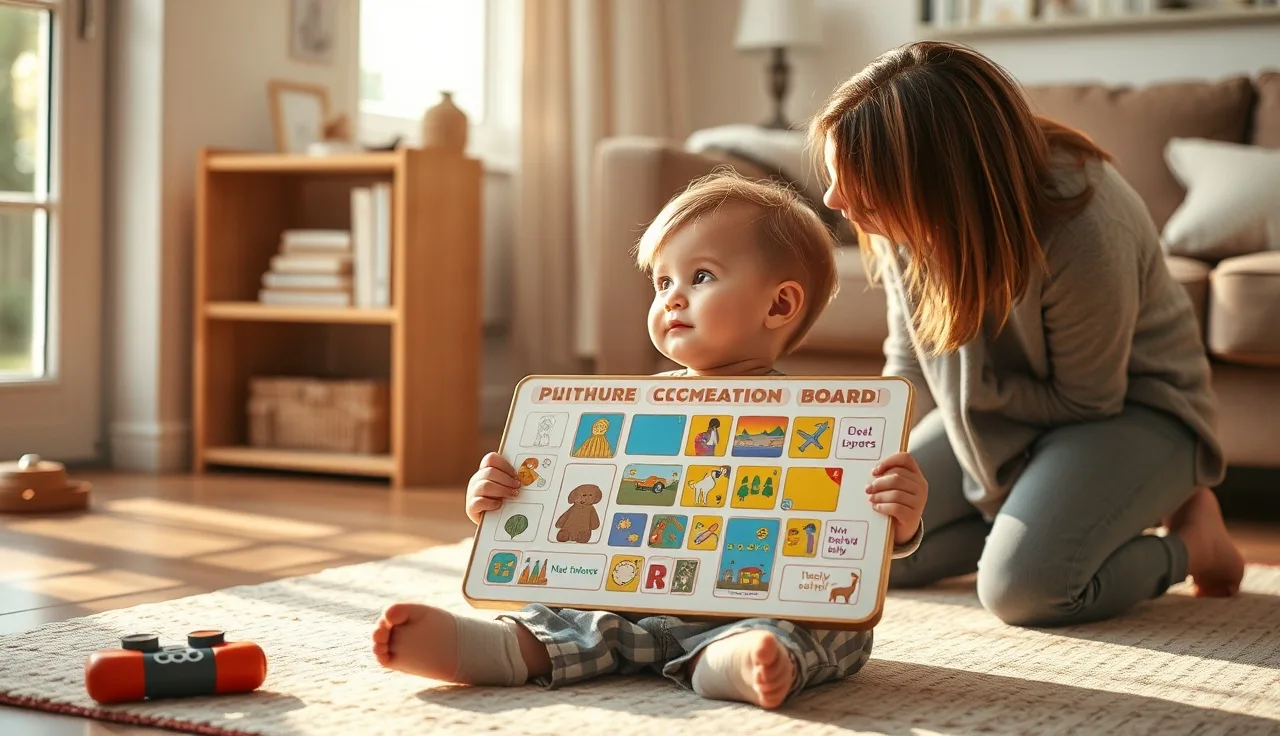
The most persistent myth here is that giving a child an AAC device or picture system will make them less motivated to speak. This has been studied directly, and the evidence doesn't support it. A 2012 meta-analysis in the American Journal of Speech-Language Pathology found that AAC interventions didn't inhibit speech development, and in many cases were linked to speech gains [10]. ASHA's position is plain: "AAC does not hinder speech development." Their practice portal states that for individuals with autism, AAC should be considered whenever functional speech isn't sufficient for communication needs, regardless of age, cognitive ability, or severity [6]. Why does the myth stick around? Probably because handing a child an alternative to speech can feel like giving up on speech. It isn't. Speech is just one output channel. For some kids it gets more reliable once the pressure to use it exclusively is lifted. For others, AAC becomes the primary channel and speech stays limited, and that's still a functional, valid outcome. The range of AAC options is wider than most parents expect the first time they hear the term: low-tech picture boards you can print for free, mid-tech devices like the GoTalk series, and high-tech speech-generating devices. AAC devices walks through those options in more detail. One number worth knowing: the average wait time from AAC recommendation to actually getting a device in publicly funded systems in the US can run 3 to 6 months, sometimes longer [8]. Starting with low-tech options during that wait isn't wasted time. It builds the habit of using an external system to communicate, and that habit carries over to whatever device arrives later.
Early intervention works, and the evidence for it is about as solid as anything in pediatric developmental research gets. Children's brains are unusually plastic during the first three years of life, and communication interventions started before age three consistently produce bigger, faster gains than the same interventions started later [9]. In the United States, the Individuals with Disabilities Education Act (IDEA) Part C guarantees free early intervention services from birth to age three for children with developmental delays, communication delays included. A child doesn't need a formal autism diagnosis to qualify: a documented delay in communication is enough [9]. That matters because autism diagnosis before age two, while it happens, isn't universal, and waiting for one before seeking services just costs months you won't get back. After age three, services shift to IDEA Part B, which covers school-age children and requires a free appropriate public education that includes speech-language services when they're written into the child's individual education program [9]. There's a full early intervention guide elsewhere on this site, but the short version is: get an evaluation the moment you're concerned. It's free under IDEA, and you don't need a diagnosis, a referral, or a pediatrician's sign-off. You just call your state's early intervention program directly. What happens inside the intervention matters just as much as when it starts. Naturalistic developmental behavioral interventions, a family of approaches that includes JASPER, ESDM, and PRT, currently have the strongest evidence for improving communication in young autistic children [11]. ABA that leans heavily on rote drills without naturalistic practice has a shakier record for communication specifically, even in cases where behavioral compliance improves. Parents are the most consistent communication partner a child has, and it's worth pushing back on the idea that progress only happens at therapy appointments. Research on parent-implemented strategies is genuinely encouraging, and a handful of core moves show up across most evidence-based programs. Follow the child's lead: comment on what they're already looking at or doing instead of directing their attention ("You have the red truck" beats "What color is that?"). Cut back on questions, since a steady stream of them puts the child in a respondent role; narration and parallel talk deliver language without demanding performance. Match what they say and add just a little: one word back becomes two, two becomes three, rather than jumping five levels ahead. Slow down after you speak and actually wait, ten seconds or more if needed, since most adults fill silence before the child has had a chance to process it. And make communication worth attempting without making it stressful: keep a favorite item in sight but out of reach, pause a fun activity, look expectant, but back off if frustration builds, because a dysregulated child isn't in a position to learn. Little Words offers a home practice companion for families who want a structured way to track what's working, with activities built for everyday routines instead of set-aside "therapy time." For a broader look at professional support, this site also covers speech therapy and autism spectrum speech therapy. The evaluation you get is only as good as the questions you walk in with. Ask directly whether you're looking at a language issue, a motor speech issue, or both, since that distinction changes everything about the treatment approach. If motor planning is involved, the child needs practice with motor patterns more than vocabulary exposure, and a PROMPT-trained or apraxia-informed SLP will run sessions very differently from one focused purely on language. Ask whether functional communication has been assessed alongside standardized scores: those tests are normed on neurotypical children and often underestimate what an autistic child can actually do in natural settings, so a dynamic assessment or play-based observation often tells you more. Ask what the plan is if speech progress is slow, and if AAC isn't mentioned as an option from the start, ask why not; current best practice treats AAC as a parallel tool, not a last resort. Ask how the family will be involved between sessions, since children make more progress when strategies carry over into daily life, and a model built around "I work with the child for 45 minutes while you wait in the lobby" is weaker than one that coaches parents directly. And ask what outcome measures will be tracked. You should know at each re-evaluation whether things are working, and "I think she's making progress" isn't a measure, but mean length of utterance, spontaneous communicative acts per minute, or device use frequency are. Online speech therapy has widened access for families in rural areas or without much local SLP availability, and telehealth delivery of parent coaching models in particular has solid research behind it. "Nonverbal" technically means without language, but many autistic people who don't speak have full, complex language: they think in words, write, type, and have rich inner monologs. Calling them nonverbal erases that. "Nonspeaking" is the more accurate term for people who have language but don't use speech as their main output, and autistic self-advocates have pushed for this distinction consistently. "Minimally speaking" gets used for people who have some speech, just not enough to reliably meet daily communication needs. This isn't just a terminology preference; it changes clinical decisions. If a child is nonspeaking but has language, the work is about finding an output channel, not building language from scratch. If both speech and language are limited, both need attention, but in different ways. Some nonspeaking autistic adults have written extensively about their experience, and a recurring theme is that they understood everything happening around them long before the adults in their lives believed they did. Assuming low comprehension because speech is absent is a real clinical mistake, one with consequences for how goals get set and how much autonomy a child is given. ASHA's practice guidelines for augmentative and alternative communication specifically warn against using scores from verbal-response tests as a ceiling for AAC access, since those tests can't measure what a nonspeaking person actually understands [6]. Most communication differences in autism unfold slowly enough that there's time to work through normal evaluation channels, but a few patterns call for faster action. Language regression, a child losing words or communicative behaviors they reliably had, should always trigger a medical evaluation, not just a developmental one. Regression is documented in autism, but it can also signal other neurological conditions, and AAP guidance recommends prompt evaluation for any regression in language or social behavior [7]. Likewise, a child over 12 months with no babbling or pointing, over 16 months with no single words, or over 24 months with no two-word spontaneous phrases (echolalia doesn't count) meets red-flag criteria that ASHA and the AAP both say warrant immediate referral, without waiting to see if the child catches up [5][7]. Frustration-driven behavior, aggression or self-injury tied to communication failure, is another signal worth taking seriously: behavior becomes communication when no other reliable channel exists, and treating the behavior without addressing the underlying communication gap doesn't hold up long-term. And if your child is school-age, already receiving services, and you feel the communication goals have stalled, you have the right under IDEA to request an independent educational evaluation at public expense if you disagree with the school's assessment. That's a formal right, not a favor [9].What does progress actually look like, and how long does it take?
Honest answer: it varies more than any chart or timeline can capture, and anyone who gives you a confident prediction is overstating what the research supports.
What the research does show is that earlier intervention produces faster gains on average, that intensity matters (more hours per week is associated with better outcomes up to a point, after which fatigue and generalization become limiting factors), and that parent involvement amplifies outcomes significantly [9].
For children who receive intensive early intervention (25 or more hours per week of structured programming) starting before age three, some studies show a meaningful subset, roughly 20-30% depending on study design, reach outcomes in the near-typical range for communication and adaptive behavior by school age [9]. That is not a prediction for any individual child. It is a population average.
For minimally verbal children who start later, progress is slower on average but still documented. Research on late-emerging language in autism, notably work by Mabel Rice and colleagues at the University of Kansas, showed language development continuing in autistic children through adolescence and into early adulthood, which contradicted the old five-year ceiling assumption [5].
Progress in AAC looks different from progress in speech. A child might go from zero reliable communicative acts per day to 20 or 30 within a few months of getting an appropriate device and good modeling. That is enormous functional progress even if no new speech words appear.
The most useful measure isn't a test score. It's whether the child can get their needs met, make choices, reject things they don't want, and connect with people they care about. Communication is the goal. Speech is one possible tool for it.
Frequently asked questions
Can autistic children who are nonverbal at age 5 ever learn to speak?
Yes. Research by Mabel Rice and others has documented language development in autistic individuals through adolescence and into adulthood, well past the old clinical assumption that age five was a ceiling. About 20-30% of autistic children who are minimally verbal at age five develop functional speech later, and many more develop effective communication through AAC. Earlier intervention improves the odds, but later starts are not hopeless.
What is the difference between autism speech problems and a stutter or lisp?
Stuttering and lisps are fluency and articulation disorders that can affect anyone, autistic or not. Autism-specific communication challenges are broader: pragmatic language differences, processing delays, motor planning issues like apraxia, and situational access to speech. An autistic child can have a stutter or lisp on top of those challenges. A speech-language pathologist can assess all of these separately because the treatment approaches differ.
Does giving a child a picture board or AAC device mean giving up on speech?
No. ASHA's position is that AAC does not hinder speech development. Multiple studies have found that introducing AAC is associated with speech gains or no change, not with speech loss. AAC removes the pressure of speech as the only output channel, which sometimes makes speech easier to access. Think of it as adding options, not removing them.
How do I know if my autistic child understands me even if they don't respond?
Comprehension and expression are separate systems. Many nonspeaking autistic people understand far more than their speech output reflects. Indicators include following instructions without visual cues, responding to their name consistently, anticipating routines from verbal cues alone, or showing emotional reactions to what's said. A formal comprehension assessment by an SLP using nonverbal response tasks gives the clearest picture.
Why does my autistic child talk fine at home but go silent at school?
This is situational mutism driven by sensory load, demand, and unfamiliarity. The neurological cost of managing a school environment (noise, unpredictability, social demands) is higher for many autistic children than the same environment costs neurotypical kids. That cost depletes the resources needed for speech. It is not defiance or manipulation. Reducing environmental demands, using AAC as a backup channel, and building familiarity with the setting all help.
What therapies have the best evidence for improving speech in autistic children?
Naturalistic developmental behavioral interventions (NDBIs) including JASPER, ESDM, and PRT have the strongest current evidence for improving communication in young autistic children. For motor speech issues, PROMPT and the Nuffield Dyspraxia Programme-3 have emerging support. For AAC, careful implementation with good modeling matters more than which device brand you pick. ASHA's practice portal is the best current reference for evidence ratings across approaches.
Is echolalia a sign that a child will never develop real language?
No. Echolalia is a stage of language development, not a ceiling. Many autistic children use echolalia functionally and then gradually shift toward more flexible, generative language with the right support. Researcher Barry Prizant's work established that echolalia serves communicative purposes and should be supported rather than suppressed. Some people use a mix of echolalia and generated speech their whole lives, and that is a valid communication style.
At what age should I be worried about a speech delay that might be autism?
The AAP recommends autism-specific screening at 18 and 24 months. Red flags that warrant immediate evaluation regardless of age: no babbling by 12 months, no single words by 16 months, no two-word spontaneous phrases by 24 months, or any regression in language or social behavior at any age. You do not need a diagnosis to request early intervention services under IDEA; developmental delay alone qualifies a child from birth to age three.
Can autistic adults who struggle to communicate benefit from speech therapy?
Yes. Speech-language pathology services are not only for children. Autistic adults may benefit from work on AAC setup, pragmatic skills for specific environments like workplaces, voice or motor speech issues, or strategies for high-demand situations. Access is harder because adult SLP services are less consistently covered by insurance and less systematically available than school-based services. See speech therapy for adults for more on finding that support.
How is autism communication difficulty different from a language disorder?
Developmental language disorder (DLD) affects language structure: grammar, vocabulary, sentence processing. Autism communication differences can include a language disorder but also include pragmatic differences, social communication differences, and sensory or motor barriers to speech that are independent of language knowledge. A child can have DLD without autism, autism without DLD, or both. The distinction matters because treatment targets differ. An SLP experienced in both areas should assess which combination is present.
What rights do parents have if they disagree with their school's speech services for an autistic child?
Under IDEA, parents have the right to request an independent educational evaluation (IEE) at public expense if they disagree with the school's evaluation. They can request IEP meetings, participate fully in goal-setting, and dispute goals or placement through mediation or due process hearings. The school must obtain parental consent before evaluating and before changing services. Parent Training and Information Centers, funded by the US Department of Education, provide free guidance on these rights.
Does signing help autistic children who are not yet talking?
Sign language and simplified key-word signing (like Makaton) can bridge the communication gap for some children, particularly those with better motor control in their hands than in their mouth. It is a form of AAC. The same evidence that applies to other AAC applies here: it does not reduce motivation to speak and can support language development. Some children use a small number of signs and then transition primarily to speech; others find signs less accessible than picture-based systems.
Sources
- Tierney C, et al., Journal of Child Neurology, 2015: CAS prevalence in nonspeaking autism: Childhood apraxia of speech co-occurs with autism at estimated rates between 50-65% in some minimally verbal populations
- Prizant BM, 'Uniquely Human' and earlier research on functional echolalia in autism: Echolalia in autism is often functional communication, not meaningless repetition
- Tager-Flusberg H & Kasari C, Seminars in Speech and Language, 2013: minimally verbal autism definition and prevalence: Approximately 25-30% of autistic individuals are minimally verbal, defined as fewer than 20 meaningful words at age five
- CDC, Autism and Developmental Disabilities Monitoring Network, 2023 (prevalence 1 in 36): CDC's 2023 data puts autism prevalence at 1 in 36 children in the United States; language regression between 18-24 months is a recognized autism pattern
- National Institute on Deafness and Other Communication Disorders, Autism Spectrum Disorder: Communication Problems in Children: Communication challenges vary widely within autism; many children nonverbal when young develop speech with intervention; language can emerge past early childhood
- ASHA, Practice Portal: Augmentative and Alternative Communication: AAC does not hinder speech development; AAC should be considered whenever functional speech is insufficient regardless of age or ability; cognitive test scores from verbal tasks should not cap AAC access
- American Academy of Pediatrics, Developmental Surveillance and Screening Policy Statement: AAP recommends autism-specific screening at 18 and 24 months; any regression in language or social behavior should be evaluated promptly
- Moorcroft A, et al., Disability and Rehabilitation: Assistive Technology, 2019: AAC wait times in publicly funded systems: Average wait time from AAC recommendation to device receipt in publicly funded systems can run 3 to 6 months or longer
- US Department of Education, IDEA (Individuals with Disabilities Education Act) overview and Part C/B provisions: IDEA Part C guarantees free early intervention from birth to age 3 for developmental delays without requiring a diagnosis; Part B covers school-age children with FAPE including speech-language services; parents may request IEE at public expense
- Ganz JB et al., American Journal of Speech-Language Pathology, 2012 meta-analysis: AAC and speech outcomes in autism: Meta-analysis found AAC interventions did not inhibit speech development and were in many cases associated with speech gains in autistic children
- ASHA, Practice Portal: Autism Spectrum Disorder, communication assessment and intervention guidance: Pragmatic language evaluation captures communication differences in autism that word-count milestones miss; NDBIs including JASPER, ESDM, and PRT have strong evidence for communication outcomes