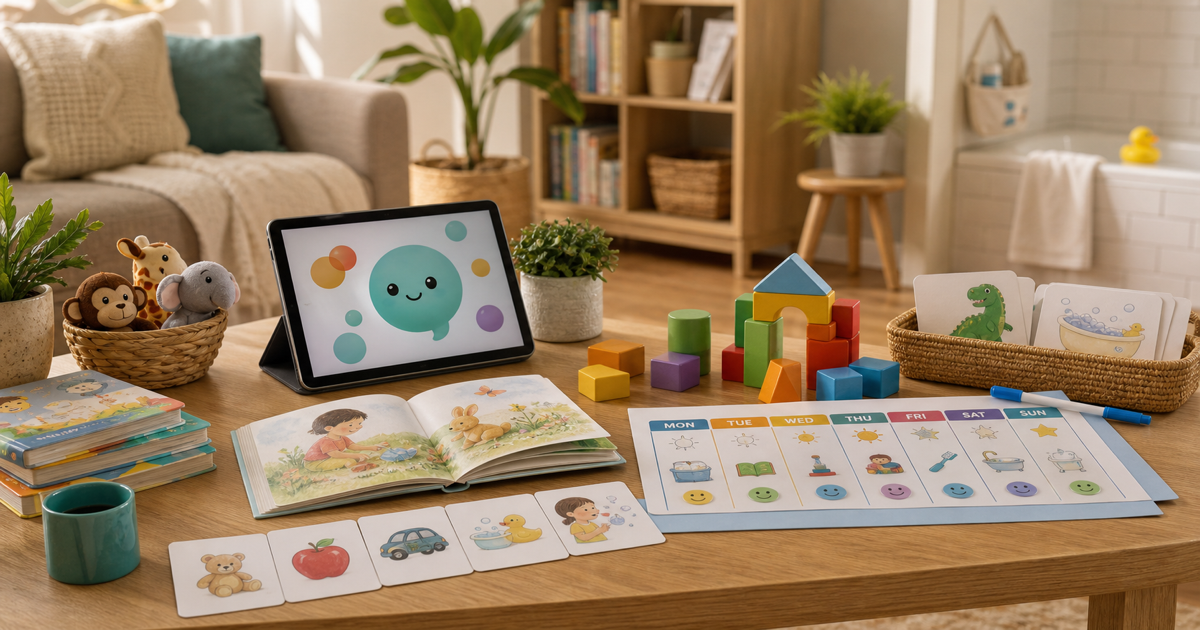
If you're hunting for books to help a 2-year-old move from single words into two-word phrases, the best ones don't ask your child to perform. They just give you the same chances, again and again, to model simple language in a low-pressure way. Look for predictable pages, strong pictures, and room for pauses and silly repetition. That matters far more than reading every word on the page.
In fact, reading less text than the page offers you is usually the right move. Point at things, pause, comment, then wait. Let your child turn the pages, label what they see, repeat a script, gesture, or use AAC if that's part of your routine. The back-and-forth is the point, not getting to the last page.
When you're picking books, favor ones with repeated phrases, clear actions, emotions, and choices, along with pictures that make a child want to comment. Skip anything that only works if your child sits still and answers questions on cue.
A simple way to use whatever you choose: pick one book and stick with it for the week. Settle on three target phrases and use them every single time you read. And stop while your child still wants more; ending on that note keeps them coming back to the book (and to you).
For more structure around this kind of practice, the daily speech routines hub is a good next stop, and if you want more ideas specific to this age, there's a full collection of speech help for 2-year-olds as well as broader parent guides covering other stages and topics.
Little Words is meant as educational support for practice at home. It isn't a medical device, an AAC replacement, or a substitute for a licensed speech-language pathologist, pediatrician, early intervention program, school team, or developmental evaluation.