Last updated 2026-07-10
TL;DR
If your toddler throws every communication tool you hand them, you still have good options. Low-tech AAC that survives throwing includes floor and wall-mounted choice boards, laminated card rings clipped to furniture, foam-core communication books, and body-based systems like signs and core vocabulary gestures. None of these need a screen, a battery, or a $300 device. The fix is usually the format, not the child.
What is low-tech AAC, and does it actually work for toddlers?
Low-tech AAC is any communication support that runs on no power at all. Picture cards, choice boards, communication books, object symbols, and sign language all count. High-tech devices get most of the attention, but low-tech is where nearly every speech-language pathologist starts with toddlers, and for good reason.
AAC stands for augmentative and alternative communication. The American Speech-Language-Hearing Association describes it as including "all of the ways we share our ideas and feelings without talking," and puts low-tech tools like picture boards and communication books right alongside high-tech speech-generating devices [1]. The American Academy of Pediatrics 2020 clinical report on AAC says plainly that "there is no minimum age for AAC," and that early introduction does not delay speech development, which is the worry most parents bring to the table first [2].
For most toddlers, low-tech is the right starting point whether or not they throw. It's cheap to replace, easy to customize, and there's no login. Throwing just makes you pickier about which low-tech format you reach for.
Why do toddlers throw AAC tools, and does it mean they're rejecting communication?
Almost never. Throwing is developmentally normal between 12 and 36 months. It's a motor skill a toddler is practicing, and it's often a bid for your attention or a signal of frustration when the words aren't available yet [3]. Here's the irony: the child who flings their picture card is frequently the same child who needs a system most, because the frustration is building and there's no other release valve.
Sensory differences and motor planning trouble, both common in autistic kids and children with apraxia, can make holding a small card feel wrong or unpredictable [4]. The card feels off in the hand. They drop it or throw it.
So throwing is rarely a rejection of communication itself. It's a rejection of this format, or this moment, or this much frustration. Change the format. Don't abandon the tool.
If your child throws specifically during structured communication attempts, that's useful data for an SLP. If you haven't found one yet, early intervention services can get you an evaluation at no cost before age 3 in every U.S. state.
Which low-tech AAC formats actually survive a toddler who throws?
Here's the honest breakdown by format. Some survive throwing. Some don't.
| Format | Survives throwing? | Best for | Rough cost |
|---|---|---|---|
| Floor/wall velcro board | Yes, it's mounted | Kids who clear every surface | $10-30 DIY |
| Laminated card ring on furniture clip | Mostly yes | Portable core vocab | $5-15 |
| Foam-core communication book | Yes, it's heavy | Structured routines | $15-40 DIY |
| Standard paper cards | No | Nothing, if they throw | Cheap to replace |
| Fabric/cloth symbol sets | Yes | Sensory-sensitive kids | $20-60 |
| Object symbols (real objects) | Sometimes | Very early communicators | Free-low cost |
| Sign language / gestures | Yes, nothing to throw | Any toddler | Free |
The single biggest shift is moving the tool off the child's hands and onto a fixed surface. If they can't reach it to throw it, the whole problem disappears. That's not a trick. It's good positioning.
For a look at what higher-tech options become as kids get older, see the guide to AAC devices.
What is a floor-mounted or wall-mounted choice board, and how do I set one up?
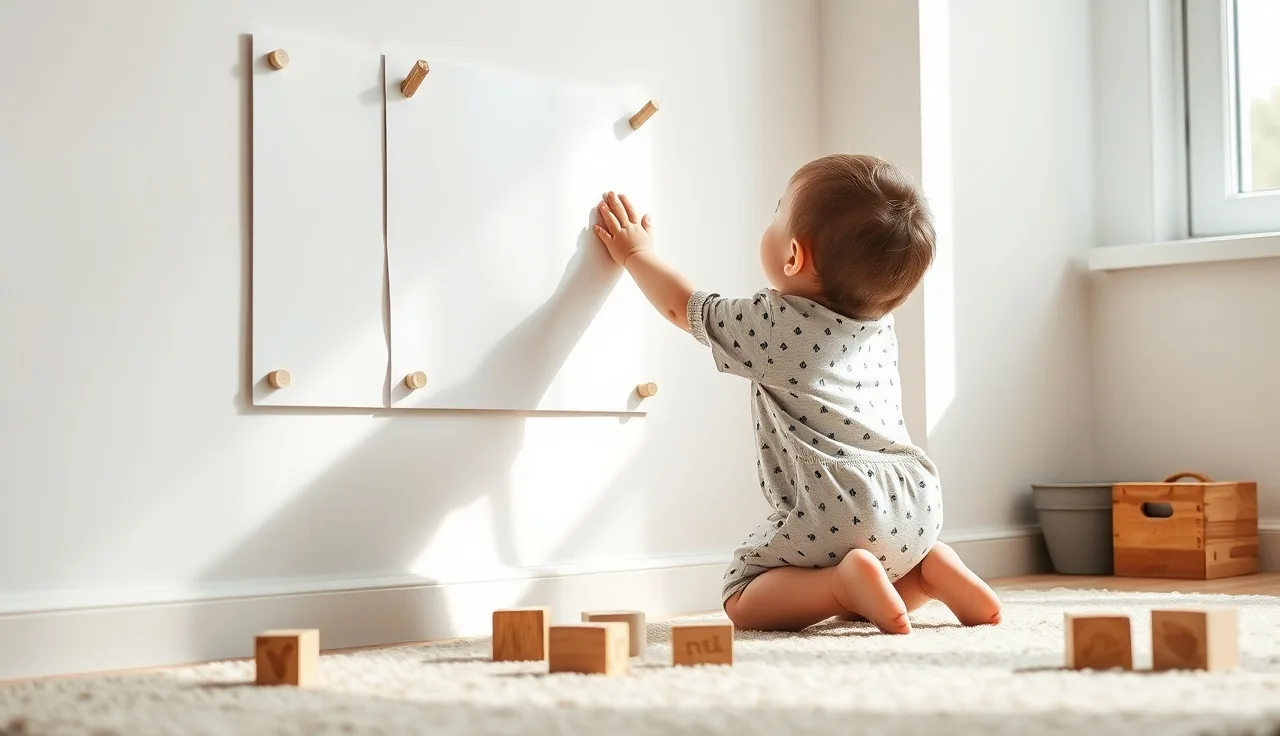
A choice board is a display of picture symbols showing the options your child can pick from, like "eat," "play," "help," "more," or "stop." Mount it to a wall at toddler eye level, or lay it flat on the floor in a consistent spot, and there's nothing to throw.
You build one from foam core board, velcro strips, and laminated symbols. Print symbols from a free source. Mulberry AAC symbols are licensed free for personal and educational use, and your child's SLP can usually print Boardmaker or Picture Communication Symbols sheets for you [5]. Laminate everything, or seal it in clear contact paper.
For a toddler who's just starting, keep it to two to four symbols. "Want" plus two activity options. "All done" and "more." You're teaching one idea: touching a symbol makes something happen. For a child who's been stuck without reliable communication, that discovery lands like a light switch.
The board doesn't need to look nice. A piece of foam core taped to the baseboard with four laminated pictures is a real communication system. Your SLP or early intervention team can help you pick vocabulary that matches your child's goals.
What are core vocabulary boards, and why do SLPs keep recommending them?
Core vocabulary is the small set of words that make up most of what anyone says, in any situation. Words like "more," "stop," "go," "help," "want," "no," "yes," "I," "you," "like," and "different." Research on everyday language use shows that roughly 200 to 400 words account for about 80 percent of what people say, and core vocabulary captures the most frequent of those [6].
A core vocabulary board puts those high-frequency words on one display, so a toddler doesn't have to hunt through a category-organized book. For a thrower, a core board fixed to the floor, the highchair tray, or the wall beats a portable book they'll launch across the room.
Aided Language Stimulation, also called modeling, is the adult pointing to or touching symbols on the board while talking, showing the child how the system works without demanding they use it [7]. The evidence for modeling is solid. A 2006 study by Drager and colleagues found that toddlers learned symbol meaning faster when adults pointed to symbols while speaking, and that same principle carries into AAC teaching [7].
You don't have to wait for a formal AAC evaluation to start. Download a free core board, mount it where your child can see it, and start pointing today. You're not replacing therapy. You're extending it into the kitchen.
Can object symbols work for very young or sensory-sensitive toddlers?
Yes, and people forget about them. Object symbols are real objects, or pieces of them, that stand for an activity or routine. A bar of soap by the bathroom. A small cup near snack time. A scrap of blanket at rest time. The child touches or picks up the object to make a choice.
For very early communicators, the physical reality of an object is easier to process than an abstract picture on a card. That matters for autistic toddlers who are still building symbolic understanding. Objects are also harder to throw in frustration, because they carry meaning and feel familiar in the hand.
Object symbols aren't a forever system. They're a bridge toward picture-based or text-based AAC as symbolic understanding grows. Your speech therapy team can help you pick which symbols to start with based on your child's routines.
One caution. Choose objects that won't become a hazard if they get thrown. Heavy or sharp items are obvious no's. Small soft pieces, sealed laminates, or short textured strips are the safe bets.
Is sign language a form of low-tech AAC, and should I try it with a thrower?
Sign language is absolutely AAC. Nothing gets thrown. Nothing breaks. And the evidence for starting basic signs with pre-verbal toddlers is genuinely good.
Baby sign research by Acredolo and Goodwyn, along with later studies, shows that teaching functional signs to pre-verbal children does not delay spoken language and often cuts down on frustration behaviors [8]. For autistic children, signs can bridge the gap before speech arrives or while an AAC device is being funded and fitted.
You don't need fluent ASL. A handful of functional signs, "more," "all done," "eat," "drink," "help," "open," "stop," can drop the number of meltdowns that come from a child having no way to be understood.
The main limit is motor planning. Kids with childhood apraxia of speech often have motor coordination differences that make clear signs hard to produce. If your child attempts signs but they come out inconsistent or hard to read, tell your SLP. That's a meaningful clinical observation, not a dead end.
What materials make the most durable picture cards and communication books?
Standard printer paper, even laminated once, does not survive a determined toddler. Here's what holds up.
Go heavier on lamination. 10 mil laminate pouches are twice as thick as the standard 5 mil and much harder to bend or peel at the corners. Or print onto cardstock, laminate, then edge-seal with clear packing tape. It's tedious. The cards last months instead of days.
For communication books, foam core is the right base. It's stiff, light, and shrugs off drops. Bind the pages with a loose-leaf ring and hang the book on a wall hook at your child's level. Bring it to them when it's time to use it. Put it back when the session ends. Less time in their hands means less time in the air.
Some families slide symbols into clear vinyl page protectors inside a standard binder. The symbols come out for editing, and the whole book is heavier and less throwable than a card ring.
Fabric-backed symbols, sold by specialty AAC suppliers, are soft, quiet, and won't hurt anyone when thrown. Some sensory-seeking kids find the fabric texture more motivating than slick laminate.
How do I position AAC tools so they're accessible but not throwable?
Position is the most underrated part of AAC setup for toddlers who throw. Most families hand the tool to the child, which drops it straight into the throwing hand. There are better ways.
Highchair tray mounting. A velcro strip on the tray holds a small core board flat and sticky enough that the average toddler can't peel it off fast. Buy commercial velcro tray clips or use heavy-duty adhesive velcro.
Wall mounts at eye level. A laminated board at toddler eye height on the kitchen or bedroom wall is always there for pointing and never there for throwing. Kids learn quickly to walk over or gesture toward it.
Floor positioning. For a child who plays on the floor, a laminated board in a fabric sleeve set in front of them is hard to fling, because it starts at their lowest point. A frustrated shove sends it six inches, not across the room.
Laptray for children who use mobility aids. If your child uses a wheelchair or adaptive seating, an AAC mount arm keeps the board steady and at the right angle. The SLP or occupational therapist on your child's team can advise on positioning for their postural control.
None of this needs special gear. Velcro, binder rings, and a wall hook solve most positioning problems for under $10.
What vocabulary should a toddler's first AAC board include?
Keep the first board tiny. Two to four words, maximum. At the start you're not after expressiveness. You're teaching one lesson: touching a symbol makes something meaningful happen.
Good starting words from core vocabulary research include "more," "all done," and "help," plus one or two highly preferred items or activities specific to your child. If they love a particular book or toy, that goes on the board. Motivation drives everything for early AAC learners [9].
Expand slowly. Add one or two symbols every week or two, once your child reliably uses what's already there. Move too fast and the useful words get buried under a pile of unused ones.
Vocabulary selection is something your SLP will have opinions about, based on your child's profile. If you haven't connected with a speech-language pathologist yet, autism spectrum speech therapy and early intervention programs both include vocabulary guidance as part of their services.
One number worth keeping: a 2022 study in the American Journal of Speech-Language Pathology found that AAC intervention built on functional core vocabulary produced significantly greater gains in communication rate than fringe vocabulary approaches in young AAC users [9].
What about digital apps on a locked-down tablet? Is that low-tech or high-tech?
A tablet running an AAC app is high-tech AAC. But it comes up all the time in throwing conversations, because parents assume a screen is safer than paper. It isn't. A thrown tablet is a far worse outcome than a thrown card.
If you're set on a tablet, two things matter: a heavy-duty case (OtterBox Defender-class or better) and a floor or table-level mount so it can't become a projectile. Snap Core First, TouchChat, and Proloquo2Go are the apps SLPs use most, but each one needs a device that runs $300 to $1,000 or more [10].
For most families at the toddler stage, a floor-mounted paper core board costs about $10 and teaches the same foundational skill. You're not missing anything by starting there. Lasting communication growth comes from the tool that gets used every day, not the one with the longest feature list.
If you want a structured way to practice vocabulary and track what your child is communicating at home between sessions, the Little Words app is built for that daily carry-over work.
How do I get my child's SLP to help me set up the right low-tech system?
Ask directly. SLPs who work with toddlers hear this question all the time and have real preferences about formats, symbol sources, and positioning. If your child is in early intervention, AAC planning is a standard part of building the IFSP (Individualized Family Service Plan).
Here's what to ask:
- "Can we make a core board together at our next session?"
- "What vocabulary should I start with for our daily routines?"
- "Can you show me how to model the board while we talk?"
- "What format survives the way my kid handles things?"
Most SLPs will have strong opinions and will be glad you asked. If yours brushes off low-tech AAC in favor of waiting for speech to develop, get a second opinion. ASHA's position is clear that AAC "does not prevent speech development," and that early communication support is appropriate [1].
If your child is over 3 and aging out of early intervention, a school district evaluation or a private SLP can carry the work forward. Online speech therapy is a real option when in-person access is limited.
What if my child ignores the AAC board entirely?
Ignoring it is normal at first. It doesn't mean the system will fail. Most toddlers take weeks to start using a new tool, especially if nobody has shown them how it works.
The research-backed move is to model the board 20 to 30 times a day in natural moments, with no demand that the child respond [7]. You point to "more" when you want more. You point to "help" when you're wrestling with something. You point to "all done" when dinner ends. The child watches. Eventually they try it.
If weeks go by with no engagement at all, bring it to your SLP. The vocabulary might not be motivating enough, the board might not be visible at the right moment, or there could be a processing or motor issue worth evaluating. Steady avoidance of a communication tool is clinical information, not a verdict on your kid.
For context on what's happening linguistically when a child isn't using language, understanding echolalia and how it relates to AAC use is a useful companion read.
Frequently asked questions
At what age can a toddler start using low-tech AAC?
There's no minimum age. The American Academy of Pediatrics states that AAC can be introduced to any child who needs it, regardless of age. In practice, SLPs often start simple picture symbols or object symbols between 12 and 18 months once a child shows signs of delayed communication. Earlier exposure gives more time to learn the system, so there's no reason to wait for a birthday.
Will using AAC stop my toddler from learning to talk?
No. This is the fear parents raise most, and the research is consistent: AAC use does not prevent speech and frequently supports it. The AAP's 2020 clinical report on AAC states there is no evidence that AAC inhibits spoken language. Giving a child a reliable way to communicate usually lowers frustration and creates the conditions where speech is more likely to come out.
My toddler throws everything and also bites and hits. Is this an AAC problem?
It may be partly a communication problem. Many aggressive behaviors in toddlers with language delays are driven by frustration when they can't express a need or feeling. An SLP, and a behavior analyst if one is involved, can help you figure out whether the behaviors serve a communicative function. AAC that gives the child a clear way to say 'stop,' 'help,' or 'all done' often reduces these behaviors over time.
What's the cheapest way to make a core vocabulary board at home?
Print Mulberry AAC symbols (free to download), cut them to card size, laminate them with a $30 home laminator, stick velcro on the back, and attach them to a foam-core board with matching velcro. Total cost is under $20 if you already own a printer. Mulberry symbols are licensed free for personal and educational use and are clean line-art symbols used by SLPs worldwide.
Where can I download free picture symbols for AAC?
The Mulberry AAC Symbol Set is free and licensed for personal and educational use. The Noun Project has free icons that work for simple boards. Many SLPs have access to Boardmaker and can print sheets for families. Your early intervention or school team may also provide printed symbol sets at no cost as part of your child's services, so ask before you buy anything.
Should I use photos of real objects or drawn symbols on the AAC board?
For very early communicators, photos of the actual items in your home (your child's own cup, their specific toy) often work better than generic drawings, because they're easier to recognize. As symbolic understanding grows, line-art symbols like Mulberry become more practical, since you can make symbols for abstract concepts like 'help' and 'more' that don't photograph well. Ask your SLP which stage your child is at.
How many symbols should a toddler's first AAC board have?
Start with two to four. That feels like almost nothing, and that's correct. The goal at the start is teaching that touching a symbol makes something happen, not handing over a big vocabulary. Add one or two symbols every week or two once your child reliably uses what's there. Move too fast and the useful words get buried under ones the child doesn't yet know what to do with.
My child only uses the AAC board to demand one thing. Is that a problem?
No, it's a start. Using any symbol intentionally and consistently to get a result is a real communication act. It shows the child understands the link between symbol and outcome, which is the foundation the whole system rests on. From there you expand the vocabulary and teach that different symbols lead to different results. Sticking to one request is normal in early AAC learners.
Can an occupational therapist help with AAC positioning for a toddler who throws?
Yes, and they're often the right person for this exact problem. Occupational therapists who work with young children understand positioning, fine motor skills, and sensory processing in ways that directly affect how a child handles any physical object. They can assess whether your child's throwing is sensory-driven, motor-driven, or behavioral, and recommend seating and mount solutions built for your child's body and environment.
What's the difference between low-tech AAC and no-tech AAC?
No-tech AAC needs nothing external at all: signs, gestures, facial expressions, and vocalizations. Low-tech AAC uses a physical object or display that doesn't need power: picture cards, communication books, choice boards, and object symbols. Both are legitimate and often used together. Many children use signs as no-tech backup while learning a picture board, so they always have something available even when the board isn't nearby.
My child's preschool says they don't use AAC boards in the classroom. What can I do?
If your child has an IEP, AAC supports can be written in as a required accommodation, and the school must provide them. If your child has a 504 plan or no plan yet, request an evaluation from the school's SLP. You can also send a home communication board to school and ask the team to model it during the day. IDEA (the Individuals with Disabilities Education Act) requires schools to consider AAC for any child with a communication disability.
Is there research showing low-tech AAC works for toddlers with autism?
Yes. A 2018 systematic review in the journal Augmentative and Alternative Communication found positive communication outcomes for young AAC users, including autistic children, across multiple formats. The research base for AAC in autism is among the strongest in early intervention. ASHA's evidence maps on AAC rate the evidence for picture-based systems and core vocabulary approaches as moderate to strong for young children with autism spectrum disorder.
Sources
- ASHA, Augmentative and Alternative Communication overview page: ASHA describes AAC as including all ways of sharing ideas and feelings without talking, including low-tech picture boards and communication books alongside high-tech devices
- American Academy of Pediatrics, Pediatrics journal, 2020 clinical report on AAC: AAP states 'there is no minimum age for AAC' and that AAC introduction does not delay speech development
- CDC, Developmental Milestones: 1-2 years: Throwing objects is developmentally typical behavior between 12 and 36 months and is a motor skill in active development
- ASHA, Autism Spectrum Disorder: Intervention page: Sensory differences and motor planning difficulties are common in autistic children and can affect how children interact with physical communication tools
- Mulberry AAC Symbol Set, Straight Street AAC project: Mulberry AAC symbols are licensed free for personal and educational use and are used by SLPs worldwide
- Beukelman & Mirenda, Augmentative and Alternative Communication (textbook, 4th ed.), citing core vocabulary research: Approximately 200 to 400 words account for roughly 80 percent of what people say in everyday conversation, forming the basis of core vocabulary AAC approaches
- Drager et al., 2006, Augmentative and Alternative Communication journal, aided language stimulation study: Toddlers learned symbol meaning faster when adults pointed to symbols while speaking; the same aided language stimulation principle is foundational to AAC modeling approaches
- Acredolo & Goodwyn, baby sign research on pre-verbal children: Teaching functional signs to pre-verbal children does not delay spoken language development and often reduces frustration behaviors
- American Journal of Speech-Language Pathology, 2022, core vocabulary AAC intervention study: AAC intervention focused on functional core vocabulary produced significantly greater gains in communication rate than fringe vocabulary approaches in young AAC users
- ASHA, AAC Evidence Maps: High-tech versus low-tech devices: High-tech AAC tablets and devices with AAC software cost between $300 and $1,000 or more depending on device and software
- IDEA, Individuals with Disabilities Education Act, 20 U.S.C. § 1401: IDEA requires schools to consider AAC as an assistive technology for any child with a communication disability under an IEP
- Augmentative and Alternative Communication journal, 2018 systematic review of AAC in autism: A 2018 systematic review found positive communication outcomes for young AAC users, including autistic children, across multiple low-tech and high-tech formats