Last updated 2026-07-09
TL;DR
The toys that most reliably build language in speech delayed toddlers are cheap and simple: bubbles, cause-and-effect toys, pretend play sets, books with repeating text, and shape sorters. Research points to child-led, low-distraction play with a responsive adult as the real driver of gains. The toy is just a prop. Your interaction is the therapy.
Why some toys help and most don't
Most toy guides for late talkers get this backwards. The toy itself almost never causes language to grow. What grows language is what happens between a child and a caregiver during play. A 2021 review in the Journal of Speech, Language, and Hearing Research found that parent responsiveness during play, specifically following the child's lead and commenting on what the child already looks at, produces significantly more vocabulary than any single toy category [1].
Still, some toys open more of those moments than others. A good toy for a speech delayed toddler tends to share a few traits: a clear, predictable outcome (the ball goes down the ramp, the bubble pops), little need for reading or instruction, room for repetition without going stale, side-by-side play rather than solo play, and a natural verbal beat built in, like the pause before you blow the bubble or the "ready, set, go" before you push the car.
Talking toys, flashcard apps, and electronic learning systems rarely do any of this. They do the talking for the child instead of leaving room for the child to try. The American Speech-Language-Hearing Association's guidance on early language development says interactive, responsive communication beats passive exposure every time [2].
What speech-language pathologists actually reach for
Bubbles sound too simple to matter, but they build an anticipation loop: the child sees you pick up the wand, wants more, and has to communicate that want. Blow one, then stop. That pause is where language happens. You model "more" or "pop" or "blow," and the child has a real reason to try it. Bubbles cost almost nothing, reset instantly, and every pop is a tiny reward, which is probably why so many SLPs call them their most-used tool with early communicators.
Cause-and-effect toys work the same way: a ball drop, a pop-up toy, a simple drum. The child learns something predictable happens, wants it to happen again, and a communicative opening appears. Research on joint attention development shows that shared attention to a predictable object event is one of the earliest scaffolds for intentional communication [3].
Pretend play sets, doll houses, play kitchens, farm sets, toy garages, set a stage for language rather than causing it directly. Pretend play and expressive language grow together: a 2019 study in Infant and Child Development found that symbolic play complexity predicted vocabulary size at 24 months even after controlling for parent education and earlier language ability [4]. You don't need a fancy set. A few plastic animals and a cardboard box work just as well. The child is running a little world, even without words at first, and you get to put words to it.
Shared book reading is one of the most studied early language interventions there is. For a speech delayed toddler, pick books where the text repeats on every page ("Brown Bear, Brown Bear" is the classic example). Repetition lets the child fill in the word before you say it, and that anticipatory fill-in, called a cloze prompt, is a standard speech therapy technique [2].
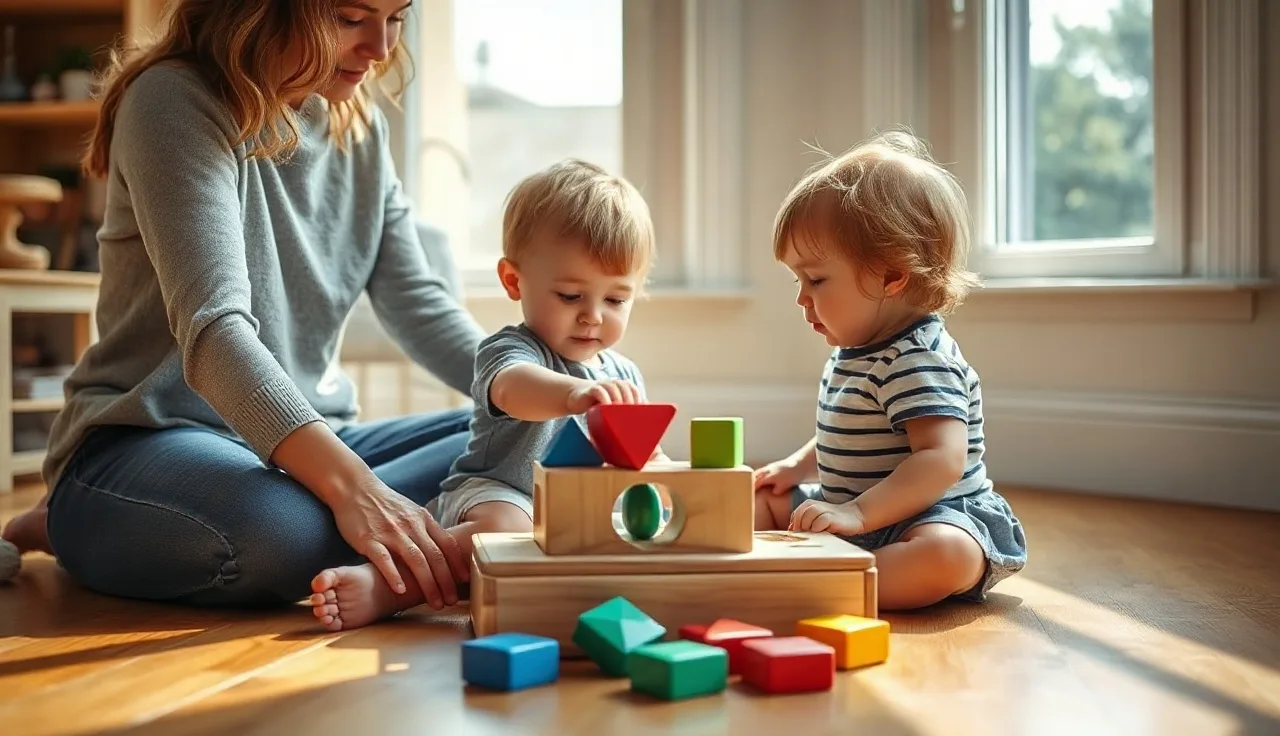
Shape sorters and simple puzzles give you a name for each shape and a small event worth narrating every time a piece goes in. Natural naming moments, over and over, plus the fine motor practice that matters for kids whose speech delay ties into broader motor coordination differences.
And don't overlook ball play. Rolling or throwing a ball back and forth is turn-taking with no words required to start, and turn-taking is the skeleton of conversation. Before a child can do it with words, they need to feel it with objects, and simple back-and-forth play teaches that in a way a toddler can grab onto.
What the research says about toy features
A 2019 JAMA Pediatrics study by Sosa looked straight at how different toy types changed parent-child talk during play. The result was blunt: electronic toys (talking farms, musical devices, tablets) produced the fewest parent words, the fewest child vocalizations, and the fewest conversational turns compared to traditional toys and books [5]. The study's stated conclusion was that "electronic toys may not be the best choice if the goal is to promote early language development."
That's a direct quote from a peer-reviewed study, and it's about the cleanest piece of evidence in the whole toy-and-language literature. Electronic toys that do the talking pull attention onto the device and away from the person the child is supposed to be communicating with.
The same research does support a few things: open-ended materials like blocks, playdough, and water and cups pull more varied language out of adults because there's no script to follow; low-piece-count toys keep joint attention on one thing at a time, which is easier for toddlers who struggle to focus; and familiar, routine-based toys, a toy toothbrush, a pretend phone, give children words they'll actually use in real life.
Nobody has good data on how specific brands compare for speech outcomes. The closest research compares broad categories (electronic vs. traditional vs. books), never specific products. Ignore any product that claims a study proves its brand works.
How to actually play with these toys
The toy sets up the chance. What you do with it decides whether language grows. The best-supported approach for parents is "responsive interaction," sometimes called child-directed interaction, and the Hanen Centre's research-based parent programs boil it down to a handful of concrete habits [6].
Follow the child's lead: if your child drifts from the shape sorter to a toy car, go with them, because language lands best on what the child already cares about, and dragging them back to your toy just adds friction. Then wait. This is the hard one. After you model a word or action, stop talking and give the child 5 to 10 seconds of silence. That silence is gentle pressure to communicate, and most parents fill it in after two.
Comment instead of quizzing. Instead of "What's that?" try "Oh, a truck!" or "Truck goes fast." Questions put a child on the spot, while comments model language without demanding a reply, which lowers the stakes and, over time, pulls out more attempts to talk. Match your language level too: if your child says zero words, model single words; if they use single words, model two-word combinations. AAP guidance on early language development backs meeting the child where they are instead of reaching too far ahead [7].
And repeat things, a lot. Kids need to hear a new word somewhere between 10 and several hundred times before they say it themselves, and the research range really is that wide depending on the child. Repetition during play racks up those exposures without feeling like a drill.
Toys worth skipping
A few categories are worth pushing to the back of the shelf. Talking tablet apps sold as speech therapy are one: there's a real gap between an evidence-based AAC system, which is a legitimate therapeutic tool, and a tablet game that claims to build vocabulary, and most of these games have no published efficacy data at all. If your child is nonverbal or minimally verbal and needs a communication tool, that's a conversation for a licensed SLP about AAC devices, not a $4.99 app. Complex multi-step toys tend to backfire too. A toy that needs adult assembly, ships with dozens of pieces, or has three modes you toggle between mostly creates frustration, not language. Toddlers, especially those with speech delays, do better with a simple cause and a simple effect. Any toy your child ignores is also a dead toy no matter what the box promises, since interest drives attention and attention drives learning. And expensive sound-based learning systems, the electronic phonics gadgets marketed as speech accelerators, probably don't help and may actually cut the conversational turns that do, according to the Sosa 2019 findings [5]. Save the money and put it toward bubbles instead.
Toys for late talkers versus toys for autistic kids: is there really a difference?
Less than you'd think. A child can have a speech delay without autism, and plenty of autistic children are also late talkers, so the toy and play strategies that support language end up nearly identical across both groups. The mechanism, more chances to communicate with a partner who responds, doesn't change with a diagnosis.
What does differ is what actually holds a child's attention. Some autistic toddlers gravitate toward sensory-rich play: water, sand, lights, spinning objects. Leaning into those interests is still the right move even when they don't look like "speech toys," because engagement has to come before communication. You can narrate and model language around anything your child genuinely likes.
Autism spectrum speech therapy often builds on a child's specific interests more deliberately, and may work on joint attention before expressive vocabulary comes in. A spinning toy your child adores is a perfectly valid starting point.
Some children with bigger communication challenges also benefit from AAC devices alongside play, and an SLP can tell you whether that fits your child. Starting early intervention sooner tends to lead to better outcomes.
When to start
As early as you can. The stretch from 12 to 36 months is when language architecture builds fastest, and play-based interaction supports that whether or not a delay is present.
The AAP recommends screening children for speech and language delays at 18 months, with re-checks at 24 and 30 months [7]. Fewer than 50 words by 24 months, or no two-word combinations by 24 to 30 months, is a threshold for referral to a speech-language pathologist.
You don't need a diagnosis or a referral to start using these play strategies; they're good practice for any toddler. But if you're worried, get an early intervention evaluation. In the US, Part C of the Individuals with Disabilities Education Act entitles children under age 3 to a free evaluation and, if they qualify, free or low-cost services [8]. You can refer your own child yourself, no doctor's permission needed.
For kids from 3 to school age, Part B of IDEA provides similar protection through the public school system [8]. Early speech therapy through these programs, paired with good play habits at home, is about the best investment you can make.
Which toys actually earn their keep
The table below compares common toy categories on what matters most for speech delayed toddlers. "Language turns per play session" is a rough relative proxy drawn from the Sosa 2019 findings and SLP-reported clinical experience, not a measured number from one single study.
| Toy category | Typical cost | Language turns (relative) | Adult involvement needed | Best for age |
|---|---|---|---|---|
| Bubbles | $1-3 | Very high | High (you blow them) | 12-36 mo |
| Simple cause-and-effect (ball drop, pop-up) | $8-20 | High | Medium | 12-24 mo |
| Pretend play set (kitchen, farm) | $15-60 | High | Medium | 18-48 mo |
| Repetitive-text board books | $5-12 | High | High (read together) | 6-36 mo |
| Shape sorter / simple puzzle | $8-25 | Medium-high | Medium | 12-36 mo |
| Open-ended blocks / Duplo | $15-50 | Medium-high | Low-medium | 18 mo+ |
| Traditional ball | $3-10 | Medium | Medium | 12 mo+ |
| Electronic talking toy | $20-80 | Low (per Sosa 2019) | Low | any |
| Tablet language app (non-AAC) | $0-50 | Very low | Very low | not recommended |
Bubbles win, full stop. An SLP running a $150-an-hour session will happily spend 10 minutes of it with a $2 bottle of bubbles.
Are the toys marketed as "speech therapy toys" worth it?
Be skeptical. There's no regulated category called "speech therapy toy," so any product can slap that phrase on the box. What matters is whether the toy creates real back-and-forth, not whether the packaging has a speech bubble printed on it.
Some products in therapy supply catalogs (Super Duper Publications, Lakeshore Learning) are designed with SLP input and do get used in clinics. They're usually fine and rarely magical. A set of realistic animal figures from a dollar store does the same job as the branded version for most purposes.
One thing worth flagging separately: if your child is nonverbal or has very limited functional communication, a low-tech AAC board (a laminated sheet of picture symbols) can matter more than any toy. These get called PECS materials or core word boards. An SLP can set one up for your child specifically, or you can find free printable resources through groups like PrAACtical AAC [9]. That's not a toy, but it belongs in this same conversation.
If you want a structured way to practice language at home between sessions, the Little Words app was built for that: it adapts to your child's language level and coaches you on how to respond during everyday play. Take a short quiz to see if it fits your child.
How to tell if it's working
Progress in early language is slow and jumpy. A child who starts saying a new word might not use it again for weeks, and that's normal, not a setback.
A few things you can track at home without any training: how many different words your child says spontaneously in a week (not prompted, not an echo of your own words), how many communicative acts show up in a 10-minute play session (pointing, reaching, vocalizing, and eye contact count, not just words), and whether your child stays in a play interaction longer than they did four weeks ago.
If after 6 to 8 weeks of consistent daily play with these strategies you see no movement on any of that, it's useful information for an SLP, not a sign you failed. It likely just means your child needs more support than home play alone can give.
Speech therapy and home play aren't either/or; they work best together. The therapist targets specific skills, and you create the daily exposure that makes those skills stick.
For children with apraxia of speech, the picture changes. Childhood apraxia involves motor planning for speech, and toy-based play alone usually isn't enough without intensive, structured therapy. If your child produces very few sounds or has highly inconsistent speech, ask for an evaluation specifically for childhood apraxia of speech.
Where screens fit
The AAP recommends no screen time except video chatting for children under 18 months, and for 18 to 24 months, only high-quality programming watched alongside a parent who's actively talking about it [7]. For ages 2 to 5, the AAP caps it at one hour a day of high-quality content.
For a child who already has a speech delay, solo screen time is a particular worry because it eats into the interactive, responsive time that actually grows language. The child gets exposure to words but no conversational turns, and the turns are the whole mechanism.
That doesn't make video chat or parent-watched video harmful. Live video chat with a responsive, engaged grandparent has been shown to produce some language learning, unlike passive TV [10]. A responsive partner on the other end is what makes the difference, screen or no screen.
If your child has echolalia (repeating words or phrases from TV shows), it's worth reading that behavior in context rather than assuming the worst. Echolalia can be a real part of language development for some children rather than a sign of too much screen time, and an SLP can help you tell which it is.
Getting professional help, and what it costs
If you're in the US and your child is under age 3, start with your state's Early Intervention program. Under IDEA Part C, the evaluation is free [8], and services, if your child qualifies, are free or low-cost on a sliding scale. You can find your state's program through the CDC's Learn the Signs Act Early resources [11].
For children over 3, contact your local public school district's special education coordinator. Districts are required to evaluate any child suspected of a disability, including a speech-language delay, at no cost to the family [8].
Private speech therapy usually runs between $100 and $250 per session depending on location and setting, and many insurance plans cover SLP services when there's a documented delay or diagnosis [12]. Online speech therapy has grown a lot and can cost less, with some telehealth SLP services running $60 to $150 per session.
The Little Words app extends the work of therapy into daily home play, giving parents structured coaching between sessions. It's not a replacement for an SLP, but it can be a bridge for families who can only get to therapy once a week or less. Take the quiz to see whether it fits.
If something feels off about your child's development, trust that instinct and get an evaluation. Parents who push early tend to get services early. Waiting to see if a child "catches up" is the most common regret among parents whose children later get a diagnosis.
Frequently asked questions
What are the best toys for a 2-year-old who isn't talking yet?
Bubbles, simple cause-and-effect toys (ball drops, pop-up toys), pretend play sets, and board books with repetitive text are the categories SLPs recommend most for 2-year-olds with delayed speech. The toy matters less than how you use it: follow your child's lead, wait for them to communicate, and comment on what they're doing instead of quizzing them.
Do electronic learning toys help with speech delays?
The evidence says no, and possibly the opposite. A 2019 JAMA Pediatrics study by Sosa found electronic toys produced the fewest parent words, fewest child vocalizations, and fewest conversational turns compared to traditional toys and books. They do the talking for the child instead of leaving room to communicate. Traditional toys and books consistently beat them for language outcomes.
How many words should a 2-year-old have?
Most 2-year-olds have at least 50 words and are starting to combine two of them ("more milk," "daddy go"). The American Academy of Pediatrics flags fewer than 50 words at 24 months, or no two-word combinations by 24 to 30 months, as thresholds for referral to a speech-language pathologist. These are guidelines, not hard cutoffs. If you're worried at any point, get an evaluation.
Are bubbles really useful for speech therapy, or is that just a gimmick?
They're one of the most useful tools SLPs use with early communicators. Bubbles build an anticipation loop: the child wants more, needs to communicate that want, and you get to model words like "more," "pop," or "blow" in a highly motivated moment. The pause before you blow is a built-in wait time that pulls out communication attempts. For the cost, nothing beats it.
Should I get an AAC device instead of toys?
These aren't competing choices. AAC devices and low-tech picture boards are communication tools. Toys are the context for using them. For nonverbal or minimally verbal children, an AAC system used during play can sharply increase communication chances. A speech-language pathologist should guide that decision. Toys and play stay important alongside any AAC system, not instead of it.
What toys help with joint attention in toddlers?
Toys with a clear, predictable, shared event work best: bubbles, ball drops, wind-up toys, and simple musical instruments. The moment when both child and adult look at the same thing at the same time (the bubble floating up, the ball rolling down) is joint attention in action. Simple, predictable toys make those moments happen more reliably than complex or electronic ones.
How do I play with my late talker to help them talk more?
Follow their lead to whatever they're already looking at. Comment on what they're doing instead of asking questions. Wait 5 to 10 seconds after you model a word or action before filling the silence. Match your language to theirs: if they say nothing, model single words; if they use single words, model short phrases. These responsive interaction strategies have the strongest evidence base for early language gains.
Can too much screen time cause a speech delay?
Heavy solo screen time can cut the interactive communication time that grows language, but it's rarely a single cause of delay. The AAP recommends no solo screen time under 18 months and no more than one hour daily of high-quality content for ages 2 to 5. For a child already showing a delay, reducing solo screen time and adding responsive play is a reasonable first step alongside professional evaluation.
What is the difference between a speech delay and autism?
A speech delay means a child's language is developing slower than expected for their age. Autism is a broader neurodevelopmental difference that often includes language differences but also involves social communication patterns, sensory processing, and behavior. A child can have a speech delay without autism, and many autistic children are late talkers. Only a qualified clinician can differentiate them. Toy and play strategies overlap heavily for both groups.
What does early intervention mean for a toddler with a speech delay?
Early intervention refers to services for children under age 3 through IDEA Part C, a federal law guaranteeing free evaluation and, if the child qualifies, free or low-cost therapy delivered at home or in childcare. For speech delays, this often means visits from a speech-language pathologist who coaches parents on interaction strategies and works with the child directly. Parents can refer their own child, no doctor needed.
How long does it take to see progress from toy-based play strategies?
Most speech-language pathologists suggest giving consistent daily practice 6 to 8 weeks before judging whether home strategies alone are producing change. Progress is slow and jumpy. Watch for more communicative acts (not only words), longer engagement in play, and new words appearing even inconsistently. If nothing shifts after 6 to 8 weeks of steady effort, that's information for an SLP, not a reason to give up.
Are there free resources for parents of speech delayed toddlers?
Yes. IDEA Part C guarantees free evaluation and often free services for children under 3 through your state's Early Intervention program. The CDC's Learn the Signs Act Early program has free developmental monitoring tools. The Hanen Centre publishes parent-friendly summaries of its research. Many SLPs also share strategies on public social media. An ASHA-certified SLP is always the right source for individualized guidance.
Should I be worried if my toddler repeats words from TV shows instead of using their own words?
Repeating words or phrases from TV (echolalia) is common in some late talkers and autistic children and isn't automatically a red flag. In some children it's an early step toward functional language. In others it points to a need for more targeted support. An SLP can help you understand what the echolalia means for your specific child and whether it's communicative.
Sources
- Journal of Speech, Language, and Hearing Research, 2021, parent responsiveness review: Parent responsiveness during play, following the child's lead, produces significantly more vocabulary gains than any particular toy category
- American Speech-Language-Hearing Association, Early Language Development guidance: Interactive, responsive communication beats passive exposure; cloze prompts during book reading are a known speech therapy technique
- ASHA, Joint Attention and Early Communication resources: Shared attention to a predictable object event is one of the earliest scaffolds for intentional communication
- Infant and Child Development, 2019, symbolic play and vocabulary study: Symbolic play complexity predicted vocabulary size at 24 months even after controlling for parent education and prior language ability
- Sosa AV, JAMA Pediatrics, 2019, electronic toys and parent-child verbal interaction: Electronic toys produced the fewest parent words, fewest child vocalizations, and least conversational turns; study concluded 'electronic toys may not be the best choice if the goal is to promote early language development'
- Hanen Centre, It Takes Two to Talk parent program research base: Responsive interaction strategies including following the child's lead and commenting rather than questioning produce language gains in late talkers
- American Academy of Pediatrics, Language Development and Literacy policy guidance: AAP recommends evaluating for speech and language delays at 18, 24, and 30 months; fewer than 50 words at 24 months is a referral threshold; screen time limits: none under 18 months, 1 hour daily for ages 2-5
- U.S. Department of Education, Individuals with Disabilities Education Act, Part C and Part B: IDEA Part C entitles children under age 3 to free evaluation and low-cost services; Part B provides similar protections through the public school system for ages 3 and up
- PrAACtical AAC, free AAC resources for families: Free printable AAC materials including core word boards are available for families of nonverbal and minimally verbal children
- AAP Council on Communications and Media, screen time and language policy statement: Live video chat with a responsive adult can produce some language learning unlike passive TV watching; the responsive communication partner is the mechanism
- CDC, Learn the Signs Act Early program: Free developmental monitoring tools and state Early Intervention program locators are available through CDC Act Early
- American Speech-Language-Hearing Association, private practice billing and insurance information: Private speech therapy typically costs between $100 and $250 per session; many insurance plans cover SLP services for documented delays or diagnoses