Last updated 2026-07-09
TL;DR
Good speech therapy books fall into two camps: ones you read with your child to build language (repetitive, predictable text and rich pictures), and ones written for parents and SLPs to explain technique. Under age 3, shared reading with verbal play beats any flashcard. For school-age kids, books built around phonological awareness are the evidence-backed choice.
Why books matter here at all
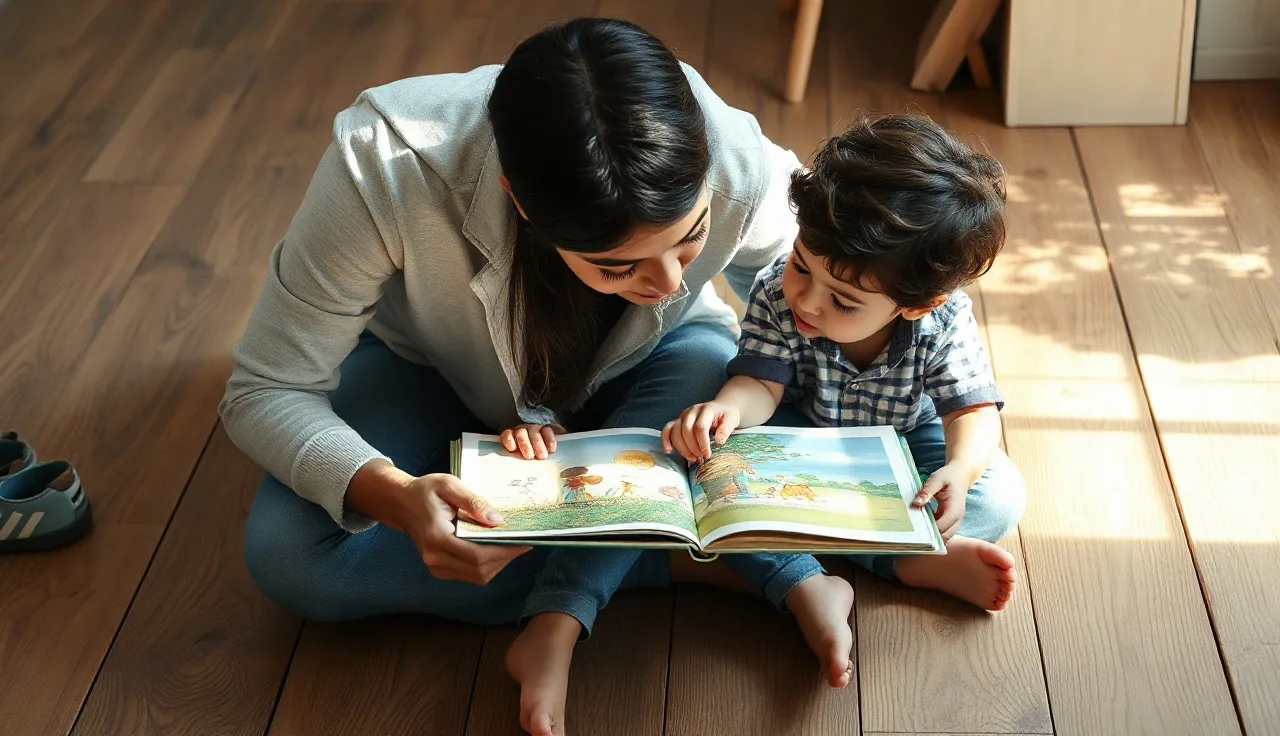
Books aren't magic on their own. A child sitting with a picture book while a parent scrolls a phone gets almost nothing out of it linguistically. What works, consistently, is shared reading: an adult and child on the same page, the adult narrating, commenting, pausing, asking questions, following where the child's eyes go.
The American Academy of Pediatrics recommends reading aloud from birth, not because books themselves are therapeutic but because shared reading creates the back-and-forth conversation turns that build language [1]. Every time you pause on a page and wait, you're handing your child a chance to communicate. That's the same principle a speech-language pathologist uses in a session.
For kids with speech delays, late talkers, or autism, that interaction layer matters even more. A 2019 systematic review in the Journal of Speech, Language, and Hearing Research found that shared storybook reading showed consistent positive effects on vocabulary and narrative language skills for children with developmental language disorder [2]. The books themselves varied widely. It was the technique, not the title, that drove the gains.
So when someone asks what books work for speech therapy, there are really two answers: books whose structure invites interaction (repetition, rhythm, predictable refrains), and books that teach the adult how to interact. You need both. Neither does much alone.
What makes a book good for a child with a speech delay?
Structure is everything. Repetitive, predictable text is far easier for a child with limited language to join than dense prose. Once a child has heard "Brown bear, brown bear, what do you see?" enough times, they fill in the next word before you say it, and that successful prediction is a language win you can build on.
A few things SLPs look for when picking books for sessions: repetitive refrains (think Eric Carle, Bill Martin Jr., Sandra Boynton), where the same phrase on every page lets a child anticipate and join in without producing new language on the spot. Clean, simple illustrations matter too. A busy, cluttered page pulls attention in too many directions, while a clear image helps a child with attention or processing differences stay with you. Sound play helps as well: words like "moo," "woof," "splat," and "pop" are often a child's first words, so books that lean into sound effects hand you built-in chances for vocalizing. Text length matters more than people think. For a late talker, a page with five hundred words is a wall, while two to five words per page is a much better starting point. And familiar topics, like food, animals, bedtime, or bath time, help because a book about something the child has no frame for stacks a comprehension problem on top of the language problem. One thing that gets overlooked constantly: your child's own interests beat any "best books" list. A truck-obsessed kid who's spent 40 sessions with a mediocre truck book will outperform a kid handed the SLP-favorite board book they don't care about. Follow the child.
Best board books and picture books for late talkers (by age and skill)
This is a practical list, not an exhaustive one. These titles come up again and again in SLP communities and research contexts, though availability shifts, so check your library before you buy.
For 0 to 18 months (early vocalizations, joint attention)
- "Brown Bear, Brown Bear, What Do You See?" by Bill Martin Jr. and Eric Carle. The gold standard for repetitive refrain books. Every page follows the same structure, and it's easy to add animal sounds.
- "Moo, Baa, La La La!" by Sandra Boynton. Short, funny, pure sound play. Kids with very limited speech often vocalize along with the animal sounds before they produce real words.
- "Where's Spot?" by Eric Hill. The flap-lifting mechanic demands a response, which generates communication turns naturally.
For 18 months to 3 years (first words, two-word combinations)
- "The Very Hungry Caterpillar" by Eric Carle. Good for counting, color naming, food vocabulary. Repetitive structure with slight variation.
- "Goodnight Moon" by Margaret Wise Brown. Naming objects and then "saying goodnight" to them is a built-in vocabulary exercise.
- "Go, Dog. Go!" by P.D. Eastman. Spatial language (up, down, in, out), color words, and a recurring "Do you like my hat?" line kids love to join.
- "Duck and Goose" series by Tad Hills. Back-and-forth dialogue between two characters, easy for a child to role-play.
For 3 to 5 years (sentence building, narrative, phonological awareness)
- "Click, Clack, Moo: Cows That Type" by Doreen Cronin. A full narrative arc, great for story retelling practice.
- "Each Peach Pear Plum" by Janet and Allan Ahlberg. Rhyme and prediction. Children fill in rhyming words naturally.
- "The Snowy Day" by Ezra Jack Keats. Simple, beautiful narrative. Good for describing and sequencing.
For phonological awareness specifically (pre-reading, ages 4 to 7)
- "Hop on Pop" and "Fox in Socks" by Dr. Seuss. Yes, the old ones. Rhyme production and manipulation are among the strongest predictors of reading readiness, and phonological awareness is part of what speech therapists work on [3]. These are genuinely useful tools, more than nostalgia.
- "Dr. Seuss's ABC" for letter-sound correspondence.
For children with autism or significant language differences
- "The Feelings Book" by Todd Parr. Simple language about emotions, useful for kids working on emotional vocabulary.
- "All Cats Have Asperger Syndrome" by Kathy Hoopmann. Better for older children (6 and up) and often used in therapy to discuss identity and difference.
- Books from the "I Can" series, which use very simple, literal text that supports comprehension for kids who process language concretely.
If your child uses AAC devices, picture books with clear, one-concept-per-page spreads also work well as low-tech communication supports during reading time.
Best books for parents and caregivers doing this work at home
This is the most valuable category, and the most ignored one. A parent who understands language development strategies is worth more than any stack of perfectly chosen board books.
"It Takes Two to Talk" by Jan Pepper and Elaine Weitzman (The Hanen Centre) is probably the most widely recommended parent guidebook in early speech therapy. It's grounded in the Hanen Program, which has a solid research base, and its core idea is that parents are the primary language teachers: responsiveness, following the child's lead, and expanding on what the child says are the strongest tools available. The Hanen Centre has published research showing their parent-training programs improve child language outcomes [4], and the book is essentially the accessible version of that training.
"The Late Talker" by Marilyn Agin, Lisa Geng, and Malcolm Nicholl is a practical guide written for parents rather than clinicians. It covers evaluation and red flags and what to do in the meantime, which makes it useful for parents stuck wondering whether they're looking at a real delay or normal variation.
"Helping Your Child with Language-Based Learning Disabilities" by Daniel Franklin is more relevant for school-age kids, especially where a speech delay has rippled into reading and writing. It's full of evidence-based strategies parents can actually run at home.
"The Out-of-Sync Child" by Carol Stock Kranowitz isn't a speech book, but sensory processing difficulties ride alongside speech delays often enough that many SLPs recommend it anyway. Understanding why a child is dysregulated helps explain why they're not available for communication practice in that moment.
"No-Drama Discipline" by Daniel J. Siegel and Tina Payne Bryson isn't a speech book either, but a dysregulated child doesn't learn language well. Cutting behavioral friction during communication practice is real support: a calm interaction beats ten flashcard drills.
For parents dealing with apraxia of speech, look to the Apraxia Kids organization rather than a single book. Their site offers professional guidance and parent resources that stay more current than anything printed on the topic.
What do SLPs actually use in therapy sessions?
Clinical speech therapists treat books as tools, not as ends in themselves. A book in a session is usually a vehicle for a specific target: a phoneme, a vocabulary set, a narrative structure, or a social exchange.
For articulation work, SLPs pick books heavy in the target sound. A child working on /s/ gets books stuffed with "snake," "sun," "stop." Commercially published books are built this way (sometimes called "articulation stories"), packing high concentrations of specific sounds across word positions. They aren't great read-alouds by literary standards, but they do their job.
For narrative language, research on "story grammar" (setting, characters, problem, resolution) translates directly into book-based therapy. A 2004 study by Justice and Ezell found that print referencing during shared reading, where adults explicitly draw attention to words on the page, significantly improved children's print awareness [5]. SLPs use this exact technique.
For vocabulary, SLPs run a three-part sequence: pre-teach target words before reading, meet them in context during reading, then review them afterward. That pattern is backed by word-learning research.
If your child is working with an SLP, ask what book to read at home and what to do while you read it. That answer beats any list.
Are there books written specifically to help autistic kids communicate?
Yes, though "written for autism" covers a lot of ground, from books meant to be read to children to books about autism written for children themselves.
With younger autistic children, the same structural features matter: repetition, simple illustrations, predictable text. There's a wrinkle, though: many autistic children have strong visual processing and engage more with an illustration-driven book than a text-heavy one. Wordless picture books, where you narrate together, can run more flexible and more personalized than fixed text.
"Diary of a Wimpy Kid" and other graphic novels have hooked older autistic children who never took to text-heavy books. The visual-verbal format matches how some kids process information. There's no randomized trial on this specific question, but the clinical observation is consistent enough that many SLPs suggest trying it.
For kids who use echolalia, books can be a surprising asset. Echolalic children often memorize whole books and later pull phrases from them into real conversations. That's called delayed echolalia, and it's a legitimate early stage of language learning for many kids, not something to stamp out. Understanding the echolalia meaning and how it functions helps parents see book repetition differently.
Some books written for autistic children, to help them understand their own identity, include:
- "My Awesome Autistic Brain" by Rida Eddo
- "The Reason I Jump" by Naoki Higashida (written by a 13-year-old autistic author, translated by David Mitchell)
- "All the Weight of Our Dreams" (an anthology by autistic authors)
Parents looking at communication support alongside reading will find that autism spectrum speech therapy approaches often fold naturalistic, book-based activities into a wider communication plan.
How does reading aloud support early intervention goals?
Early intervention services for children under 3 with developmental delays are federally required under the Individuals with Disabilities Education Act, Part C [6]. Speech-language therapy is one of the most commonly provided early intervention services, and what happens at home between sessions, including shared reading, is a major factor in outcomes.
How often families do language-rich home activities, reading included, is tied to better outcomes in children receiving early intervention services [7]. The technical term is "parent-implemented intervention," and it isn't supplemental. For kids under 3, it's often where most of the actual learning happens: therapy sessions run 30 to 60 minutes a week, while children are awake and interacting roughly 70 to 80 hours a week. Do that math and the home hours dwarf the clinic hours by a wide margin.
If you're working with an early intervention team, ask them to write reading goals into your child's IFSP (Individualized Family Service Plan). That makes reading part of the official plan rather than a nice extra.
ASHA recommends that SLPs coach caregivers on how to interact during book reading, more than on which books to pick [7]. If your child's SLP hasn't done this, ask for it. A 20-minute coaching session on how to read together can move language outcomes further than any stack of materials.
Which books help with phonological awareness and pre-reading speech skills?
Phonological awareness is the ability to hear and manipulate the sound structure of language, rhymes, syllables, individual phonemes. It's separate from reading itself, but it predicts reading success strongly and is a core target in speech therapy for many children [3].
Books that support this skill tend to share a few traits: obvious, predictable rhyme; wordplay like alliteration and nonsense words; and room for kids to join in rather than just listen.
The research on rhyming books holds up well. A 2008 study in the Journal of Educational Psychology found that phonological awareness training, which rhyming book reading approximates informally, had significant effects on early reading outcomes for children at risk for reading difficulties [8]. Dr. Seuss books, whatever your literary opinion of them, are phonological awareness machines.
For children in speech therapy for articulation or phonological processes (fronting, stopping, cluster reduction), books that spotlight specific sound contrasts help. Clinical materials like the Phonological Awareness Literacy Screening (PALS) and SLP-designed storybook curricula exist, but for home use, a good children's librarian can point you toward books heavy in whatever sounds your child is targeting.
Families using online speech therapy often find book-based activities the easiest to run remotely, since the parent does the reading and the SLP coaches by video.
Matching book types to speech and language goals
Not every book works for every goal. Here's a plain breakdown of book types mapped to common speech-language targets:
| Book Type | Examples | Best For |
|---|---|---|
| Repetitive refrain books | Brown Bear, Moo Baa La La La | First words, vocabulary, participation |
| Rhyming books | Dr. Seuss, Each Peach Pear Plum | Phonological awareness, sound play |
| Narrative/story books | Click Clack Moo, The Snowy Day | Story retelling, sequencing, grammar |
| Wordless picture books | Pancakes for Breakfast (dePaola) | Language generation, conversation turns |
| Articulation storybooks | SLP-published materials | Target sound practice in context |
| Social-emotional books | The Feelings Book, Jabari Jumps | Emotional vocabulary, social cognition |
| Identity/difference books | The Reason I Jump, My Awesome Autistic Brain | Self-understanding (school age+) |
| Parent guidebooks | It Takes Two to Talk, The Late Talker | Caregiver strategy, home practice |
A child in speech therapy for multiple goals might work through several of these in the same week. A kid targeting both articulation and narrative language won't get that combination from a single title.
Do apps and digital books work as well as print?
This is the question that needs the most honest hedging. Research on e-books and apps for language development is mixed, and quality varies enormously by product.
A 2015 meta-analysis in Reading Research Quarterly found that shared reading with e-books produced vocabulary gains similar to print books when the e-book had no distracting interactive features, but e-books loaded with sound effects, animations, and games produced worse outcomes than print [9]. The "enhanced" features pulled children's attention away from the text and the adult reading with them.
So a plain digital text read aloud on a tablet is probably fine. An app that's really a game in book-shaped packaging probably isn't doing much for language.
For speech-specific practice, some apps go further than books can: tools built for home speech practice can model specific sounds, give feedback, and track progress in ways a printed book simply can't. If you're exploring technology alongside books, the Little Words app is built specifically for neurodivergent kids and uses AI-guided interaction to support communication practice at home. It's not a replacement for an SLP, but it's designed to carry what happens in therapy into daily life. A short quiz at littlewords.ai/start can show whether it fits your child's current goals.
For children who use AAC, some dedicated AAC apps and devices have companion story features or vocabulary sets built around popular children's books. Pairing a book with matching AAC vocabulary can work well.
Here's the rewritten article:How to actually read a book with a child in speech therapy
The book is just the prop. What you do while reading it is the actual intervention. Here's what SLPs coach caregivers to do during shared reading, drawn from the Hanen Program and ASHA guidance on caregiver-implemented intervention [4][7].
Start by watching, waiting, and listening before jumping in with language. See what your child is looking at, pause with an expectant look (raised eyebrows, leaning in), and respond to whatever they produce, whether it's a word or a sound. This one shift alone tends to increase how often a child takes a "turn" in the exchange. When your child does say something, expand it rather than correct it: if they point at the dog and say "daw," you say "yes, dog!" instead of "say dog." Model the right form and keep moving. Corrections during reading break the conversational feel and can shut a child down fast. Try commenting more than you question. A stream of "What's that? What color is it? What's he doing?" turns the book into a quiz. A comment like "Oh, the bunny is scared!" invites a response without demanding one. Ask real questions too, just aim for roughly two comments for every question.
Follow your child's gaze rather than the page order. If they're staring at a bus in the background instead of the main illustration, talk about the bus. You can always circle back to the story. And don't be afraid to read the same book over and over, even though it bores most adults. Each repetition, a child joins in a little more, and by the tenth read they may be filling in words before you say them. That's exactly the point. When you hit a repetitive refrain, pause and leave a blank for your child to fill, even if a nonverbal child only fills it with a gesture or a sound. That still counts.
If your child has childhood apraxia of speech, shift the goal slightly: instead of pushing for production during the book, use repeated exposure to build familiarity with target words, so there's more vocabulary to draw on when it's time for focused practice.
Finding books without spending much
Therapy materials add up fast, but books don't have to. Your public library is the obvious first stop and it's genuinely underused: most run digital lending (Libby, Hoopla) with audiobooks and e-books, and some have toy libraries with board books and sensory books. Dollar Tree and similar stores reliably carry Sandra Boynton and Dr. Seuss titles for $1 to $1.25, identical to the full-price versions. That's not a coupon trick, it's a real budget strategy. Bob Books and similar early-reader sets often run $15 to $25 for 12 books, which is reasonable for the volume you get. For parent guidebooks like "It Takes Two to Talk" ($30 to $50 new), ask whether your child's SLP has a lending library. Many clinics do, and if not, an interlibrary loan can usually get you a copy within a week. Facebook groups for parents of kids with speech delays often run book swaps too. You won't find clinical articulation storybooks there, but board books and picture books circulate freely. And if cost is a real barrier and your child qualifies for early intervention or school-based services, ask your SLP coordinator whether reading materials can be built into the service plan. Some programs allow it.
Frequently asked questions
What is the single best book for a 2-year-old late talker?
There's no single best book, but ask most SLPs and they'll land on "Brown Bear, Brown Bear, What Do You See?" The repetitive refrain, simple vocabulary, and animal sounds give a late talker a good shot at joining in. That said, any book your child will actually sit for beats the "perfect" book they ignore. Follow their interest.
Can reading at home replace speech therapy sessions?
No. Shared reading at home can powerfully extend what happens in speech therapy, but it can't replace an SLP's assessment, individualized goals, and clinical technique. Think of it as daily practice between sessions, not a substitute. The American Academy of Pediatrics recommends professional evaluation for any child not meeting language milestones, no matter how much reading happens at home.
How many times should I read the same book?
As many times as your child wants. Repetition isn't a problem in early language learning, it's the mechanism. With each re-read, children join in more, fill in more words, and show deeper comprehension, which is why SLPs deliberately return to the same books across sessions. If your 3-year-old wants "Goodnight Moon" every night for two months, that's excellent, not concerning.
Are wordless picture books useful?
Very. Books like Mercer Mayer's "A Boy, a Dog, and a Frog" or Tomie dePaola's "Pancakes for Breakfast" let you and your child build the language together, with no printed text to follow. That tends to produce more natural conversation, and you can pitch the vocabulary right at your child's level. SLPs use wordless books specifically for narrative language and conversation practice.
My child has echolalia and memorizes every book. Is that a problem?
For most children, no, it's helpful. Memorized phrases from books often become the seeds of functional language. A child who echoes "I do not like them, Sam-I-am" from Dr. Seuss may later use "I do not like" as a frame for real communication. This is scripting, or delayed echolalia, and it's a legitimate path to language for many children. See the full explainer on echolalia for more.
What books do SLPs recommend for articulation work?
For home use, any Dr. Seuss book works well for general sound play. For specific sounds, SLPs turn to published "articulation story" books or materials they've built themselves, loaded with target words. Ask your child's SLP which sound they're working on and request a recommendation for that sound. There are also print-on-demand resources on Teachers Pay Teachers with sound-specific storybooks.
Are there books about speech delays for older kids to read themselves?
A few. "The Someday Birds" by Sally J. Pla features a protagonist with autism and communication differences, and "Fish in a Tree" by Lynda Mullaly Hunt covers learning differences more broadly. For kids with speech differences specifically, the shelf is thin. Your child's SLP may have clinic-specific stories or short reads for kids who are aware of and processing their own speech differences.
My child refuses to sit for books. What can I do?
Start shorter, even just one page, then stop. Add a page the next day. Let your child hold the book, choose it, or turn the pages themselves. Try reading during other moments, like bath time or waiting in the car, and see if audiobooks work better while they play. If sitting still seems tied to a sensory or attention issue, mention it to your SLP. A child who refuses every book may still tolerate one built around their specific obsession.
Which parent books do SLPs recommend most?
"It Takes Two to Talk" from the Hanen Centre comes up more than any other; it's the companion book to the most-researched parent training program in early speech therapy. "The Late Talker" by Agin, Geng, and Nicholl is probably the most practical read for parents in the assessment and early-intervention phase. For parents of school-age kids with language-based learning differences, Daniel Franklin's guide gets referenced often.
Do e-books work as well as print books?
Plain e-books, without animations or interactive effects, produce vocabulary outcomes comparable to print. E-books loaded with games and sound effects actually do worse than print, according to a 2015 meta-analysis in Reading Research Quarterly. What matters most is the interaction between adult and child during reading; format is secondary. If an e-book is what keeps your child engaged, use it and put your energy into the quality of your interaction.
What books help kids learn to sequence and tell stories?
Narrative structure (setting, problem, resolution) is a therapy target for many school-age children. Books like "Click, Clack, Moo" and "The Snowy Day" have clear, simple arcs that are great for retelling practice. After reading, ask your child to retell the story, using picture sequence cards or just turning the book face-down and narrating together. This retelling exercise is a common SLP technique for narrative language.
How do I know if my child needs speech therapy rather than just more books?
It's not either-or. If your child isn't meeting language milestones, no babbling by 12 months, no single words by 16 months, no two-word phrases by 24 months per AAP guidelines, get a professional evaluation. More books at home doesn't substitute for that. Early intervention services for children under 3 are free in the U.S. under federal law, so contact your state's early intervention program.
Are there books specifically for children who use AAC devices?
Not many are published specifically for AAC users, but any picture book with one clear concept per page works well alongside an AAC system. Some SLPs build companion boards that map a book's vocabulary onto a child's device so they can "read along" using their own system. Ask your SLP about book-based AAC vocabulary sets; some AAC app providers also publish vocabulary pages built around popular children's books.
Sources
- American Academy of Pediatrics, Reading Aloud Policy Statement (Pediatrics, 2014): AAP recommends reading aloud to children from birth to build language and literacy
- Justice LM et al., Journal of Speech, Language, and Hearing Research (2019) - shared storybook reading systematic review: Shared storybook reading interventions showed consistent positive effects on vocabulary and narrative language for children with developmental language disorder
- ASHA, Phonological Awareness technical report: Phonological awareness is a core speech-language therapy target and a strong predictor of reading readiness
- The Hanen Centre, Research Summary for It Takes Two to Talk: Hanen parent-training programs have a published research base showing improvements in child language outcomes
- Justice LM & Ezell HK, Language, Speech, and Hearing Services in Schools (2004) - print referencing: Print referencing behaviors by adults during shared reading significantly improved children's print awareness
- U.S. Department of Education, Individuals with Disabilities Education Act Part C: Part C of IDEA requires free early intervention services including speech-language therapy for eligible children under age 3
- ASHA, Parent-Implemented Intervention guidance: ASHA recommends SLPs coach caregivers on shared reading interaction techniques as part of early intervention
- National Reading Panel / Journal of Educational Psychology (2008), phonological awareness training meta-analysis: Phonological awareness training had significant effects on early reading outcomes for children at risk for reading difficulties
- Takacs ZK et al., Reading Research Quarterly (2015), e-book meta-analysis: E-books with distracting interactive features produced worse literacy outcomes than print books; plain e-books were comparable to print
- American Academy of Pediatrics, Developmental Milestones: AAP milestones include no single words by 16 months and no two-word phrases by 24 months as indicators for professional evaluation