Speech Activities by Age

10-Minute Speech Practice That Doesn't Require Sitting Still

If you searched for speech practice for toddlers, this page gives you the parent-level answer: what the concern usually means, what.

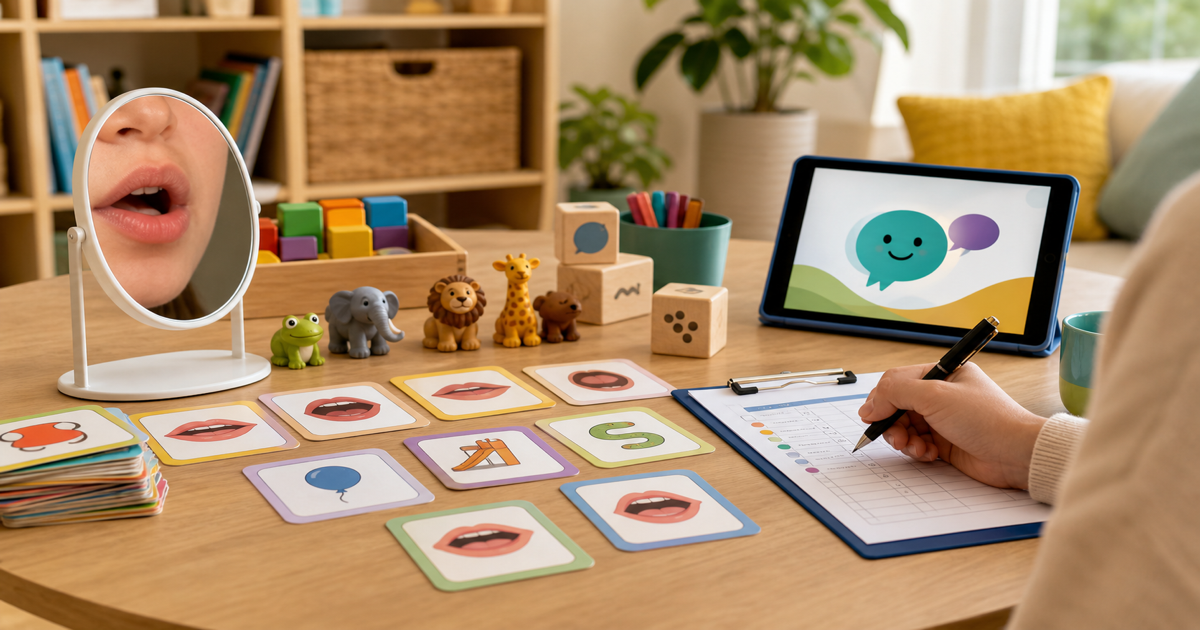
Young child in speech therapy session with adult therapist at a wooden table

Last updated 2026-07-09

TL;DR

Childhood apraxia of speech (CAS) is a motor speech disorder. The brain struggles to plan and sequence the movements speech needs, even though the muscles work fine. About 1 to 2 children per 1,000 have it. It responds to intensive, motor-based therapy, especially DTTC and PROMPT. Early diagnosis and frequent practice matter more than almost anything else.

What is childhood apraxia of speech?

Childhood apraxia of speech is a neurological motor speech disorder. The child's brain has trouble planning the precise movements the lips, tongue, and jaw need to make sounds and words, even though the muscles themselves are not weak or paralyzed. That distinction changes everything about how therapy works.

The American Speech-Language-Hearing Association defines CAS as "a neurological childhood (pediatric) speech sound disorder in which the precision and consistency of movements underlying speech are impaired in the absence of neuromuscular deficits." [1] That phrase, "in the absence of neuromuscular deficits," is what separates apraxia from dysarthria, which is an actual muscle control problem.

A child with CAS often knows exactly what they want to say. The message from the brain just doesn't make it reliably to the muscles. Sounds and syllables come out differently from one attempt to the next, even on the same word. The child isn't being careless. The motor plan is inconsistent.

CAS is not a language disorder, though many children with CAS also have language delays. It's not an articulation disorder, where a child consistently substitutes or distorts one sound. And it's definitely not a behavior problem. It's a planning and sequencing problem at the motor level.

You'll sometimes see it called childhood apraxia of speech, developmental apraxia of speech, or verbal dyspraxia. ASHA and most U.S. clinicians now prefer "childhood apraxia of speech" because it doesn't imply the child will grow out of it the way "developmental" sometimes suggests. [1]

How common is childhood apraxia of speech?

Prevalence estimates vary, partly because CAS is genuinely hard to diagnose and partly because studies use different criteria. The figure that shows up most often in peer-reviewed work is roughly 1 to 2 children per 1,000, though some estimates run as high as 4 per 1,000 when broader criteria are applied. [2]

Boys get diagnosed more than girls, at a ratio of roughly 2 to 3 boys for every girl depending on the study. Nobody has a clean explanation for that gap.

CAS also shows up at higher rates in certain groups. Children with Down syndrome, fragile X syndrome, galactosemia, and autism all have elevated rates compared to the general population. Apraxia Kids notes that CAS can be idiopathic (no known cause), neurological (from a brain injury or condition), or tied to a complex neurodevelopmental disorder. [3] For most children who walk into a clinic, the cause is idiopathic, meaning we don't know why their brain struggles with motor speech planning.

Because it's relatively rare and shares features with other speech sound disorders, CAS gets misdiagnosed often, particularly in children under three. That's not a knock on clinicians. The signs that separate CAS from a plain articulation delay are subtle early on, and some can only be seen reliably as a child gets older and produces more complex speech.

What are the signs and symptoms of childhood apraxia of speech?

The three core features ASHA lists for a CAS diagnosis are: inconsistent errors on consonants and vowels across repeated productions of the same syllables or words, lengthened and disrupted transitions between sounds and syllables, and inappropriate prosody, especially in word or phrase stress. [1] Those clinical criteria matter for diagnosis, but parents usually notice something different first.

Common early signs include:

The inconsistency piece is probably the most diagnostic. A child with a typical articulation delay tends to make the same error the same way every time. A child with CAS will say "potato" three different ways in the same conversation.

The signs look different at different ages. Toddlers might show very few word attempts, a lot of pointing, and almost no consonant variety. School-age children might have intelligible short sentences but fall apart on longer or less familiar words, and they might read aloud more accurately than they speak on their own because reading gives them an external sequence to follow.

No single sign confirms CAS. That's why a formal evaluation by a speech-language pathologist is the only way to get an actual diagnosis.

How is childhood apraxia of speech diagnosed?

There is no single test that definitively diagnoses CAS. Diagnosis takes a full evaluation by a licensed speech-language pathologist who has specific training and experience with motor speech disorders. That's worth saying plainly, because some parents meet clinicians who aren't confident assessing for CAS in very young children, which is a completely reasonable position.

A thorough CAS evaluation usually includes:

The Diagnostic Evaluation of Articulation and Phonology (DEAP) and the Kaufman Speech Praxis Test are two commonly used tools, though neither was built specifically to diagnose CAS. The Dynamic Evaluation of Motor Speech Skills (DEMSS) was developed specifically for CAS assessment in children aged 3 and up, and it has reasonably good reliability data. [4]

For children under three, many SLPs use the label "suspected CAS" rather than a firm diagnosis, because the core features are harder to elicit in toddlers. That's not a failure of the system. It's honest clinical practice, and it doesn't stop a child from getting motor-speech-focused therapy in the meantime.

If you're worried, ask your pediatrician for a referral to a speech-language pathologist who lists experience with motor speech disorders or CAS. ASHA's ProFind directory lets you filter by specialty. [5]

What causes childhood apraxia of speech?

For most children with CAS, the cause is unknown. This is called idiopathic CAS, and it accounts for the majority of cases.

When a cause can be pinned down, it usually falls into one of two buckets. First, CAS can come from a known neurological condition or brain injury, including stroke in utero, traumatic brain injury, or conditions like cerebral palsy. Second, CAS occurs at higher rates in certain genetic and chromosomal conditions. Galactosemia, a metabolic disorder, has one of the strongest documented links to CAS. Research by Lewis and colleagues found CAS in a large share of children with galactosemia even when the metabolic condition was well managed. Fragile X syndrome, Down syndrome, and some FOXP2 gene variants also link to higher rates of motor speech difficulties that meet CAS criteria. [2]

The FOXP2 connection is worth mentioning because it got a lot of press as a "language gene." The reality is more modest. FOXP2 variants tie to motor speech problems, including CAS-like presentations, but they are rare, and FOXP2 is not the only gene involved in speech motor development.

For children with autism, the relationship gets complicated. CAS and autism co-occur at meaningful rates, probably somewhere between 36% and 65% of minimally verbal autistic children by some estimates, though the data quality varies. [6] CAS in an autistic child needs the same motor-based treatment as CAS in any other child. The autism doesn't change the treatment logic. It may change how you deliver the therapy.

What does childhood apraxia of speech treatment actually look like?

CAS treatment is motor learning therapy. That's the frame everything else hangs on. Because CAS is a problem with motor planning and sequencing, therapy works the way learning any motor skill works: lots of practice with accurate feedback, many repetitions, and a gradual step up in complexity.

The evidence base has grown a lot since 2000. Several approaches now have reasonable research support. None have large randomized controlled trials behind them (the rarity of CAS makes that hard), but the evidence quality is far better than it was 20 years ago.

Dynamic Temporal and Tactile Cueing (DTTC) DTTC was developed by Edythe Strand at Mayo Clinic and is probably the most heavily studied CAS-specific approach. It uses simultaneous production (the child and therapist say the target together), then fades the support gradually as accuracy improves. A 2006 study by Strand and colleagues showed meaningful gains for children with severe CAS. [7] ASHA currently lists DTTC as having "sufficient evidence" for CAS treatment.

Rapid Syllable Transition Treatment (ReST) Developed in Australia, ReST targets the stress and coarticulation problems that sit at the core of CAS. It uses made-up words (pseudowords) to pile up practice without the child leaning on memorized motor programs for real words. A 2015 randomized trial by Murray and colleagues found significant gains on treated items and some carryover to untreated words. [8]

Nuffield Dyspraxia Programme (NDP3) A structured UK program that works through a hierarchy of sounds, syllables, and words. It's more common in the UK and Australia than in the US. Some evidence supports it, though the research base is thinner than for DTTC.

Integrated Phonological Awareness Intervention This one adds phonological awareness work to motor speech practice, which can help school-age children with literacy as well as speech.

Intensity matters enormously. Research keeps showing that more frequent sessions produce better outcomes. ASHA guidance and the published work on DTTC and ReST generally point to three to five sessions per week as more effective than once-weekly therapy for children with moderate to severe CAS. [1] Most families can't hit that frequency through clinic services alone, which is why home practice and parent training aren't optional extras. They're part of the treatment.

ASHA evidence tiers for CAS treatment approaches Number of supporting studies and evidence classification per approach, per ASHA CAS technical report DTTC (Dynamic Temporal and Tactil… 4 ReST (Rapid Syllable Transition T… 3 PROMPT 2 Nuffield Dyspraxia Programme (NDP… 2 Integrated Phonological Awareness 1 Source: ASHA, Childhood Apraxia of Speech Technical Report (citation 1)

Is PROMPT therapy still widely used for childhood apraxia of speech in 2024?

Yes. PROMPT (Prompts for Restructuring Oral Muscular Phonetic Targets) is still widely used and is one of the most recognized approaches for CAS. Roughly 5,000 speech-language pathologists have PROMPT training as of recent figures from the PROMPT Institute, and it's still taught through workshops and introductory courses. [9]

PROMPT uses physical touch cues on the face, jaw, and neck to help children feel where to place their articulators. The therapist literally guides the mouth through a movement sequence while the child attempts the target. It adds tactile information to the sound a child hears and the model they watch.

The evidence for PROMPT is real but limited. The most cited study is a 2007 randomized controlled trial by Strand, Stoeckel, and Baas that found PROMPT produced greater gains than a non-speech oral motor comparison (the comparison was not another evidence-based treatment, which limits what you can conclude). A 2014 study by Namasivayam and colleagues found PROMPT improved speech motor control in children with motor speech disorders. [9] ASHA currently describes PROMPT as having "emerging evidence" for CAS, one tier below DTTC's "sufficient evidence" rating.

That tier difference doesn't mean PROMPT is ineffective. It means it hasn't been tested in as many well-designed studies as DTTC. In practice, many SLPs use PROMPT as one tool inside a broader plan rather than as a standalone program, which is probably the most reasonable way to think about it.

PROMPT takes formal training to use correctly, and the certification path runs longer than a weekend workshop. If a therapist says they use PROMPT techniques, ask what level of training they have. There's a real gap between someone who took an introductory course and a PROMPT-certified therapist who finished the full sequence.

Are there PROMPT therapy adaptations for kids with both ASD and childhood apraxia of speech?

This is an active area of clinical practice and new research. The overlap between autism and CAS creates real treatment challenges. Some autistic children are highly tactile-defensive, which makes the hands-on cueing central to PROMPT hard or impossible at first. Others have motor imitation differences that affect how well they can use simultaneous production in DTTC.

Adaptations experienced therapists use include:

The pairing of AAC and speech therapy is worth flagging directly. Some families worry that an AAC device will kill a child's motivation to talk. The research does not support that worry. For children with CAS and autism, AAC and speech motor therapy can run side by side, with AAC cutting communication frustration while the speech work continues. [6]

For autistic children who are minimally verbal, figuring out whether CAS is part of the picture takes careful assessment, because oral motor differences, apraxia, and the social-communicative differences of autism all shape speech output. Assessment protocols adapted for autistic children are still developing. See our overview of autism spectrum speech therapy for more on that intersection.

What can parents do at home to support CAS treatment?

A lot, actually. Home practice for CAS isn't just helpful. Given how much repetition and intensity drive motor learning, it's one of the highest-leverage things a family can do.

The most useful move is to get specific practice targets from your child's SLP and drill them consistently. Not "practice talking more." Specific words or phrases your therapist picked because they target the motor patterns your child is working on, at the level of challenge that matches their current accuracy.

Some practical approaches:

Parent-led practice has real research support. A 2016 study in the American Journal of Speech-Language Pathology found that parent-implemented DTTC at home produced meaningful gains when parents were trained to deliver it with fidelity. [7]

If frequency is your barrier, tools built for parent-led practice between sessions can help close the gap. Little Words is made for exactly this kind of at-home support, with activities designed around the motor learning principles that sit under CAS treatment. You can start a quick quiz to see what might fit your child's current stage.

For families waiting on an evaluation or stuck between referrals, reading about early intervention options can help you use the waiting time well.

What does an effective CAS treatment plan look like week to week?

An effective plan for moderate to severe CAS usually runs three to five speech therapy sessions per week with a qualified SLP, plus daily home practice. That's a big commitment. Many families can't hit it, and that's real. But it's the target the evidence points to.

Inside each session, a good CAS therapist aims for many accurate production attempts of target words or phrases, often 50 to 100+ productions per session based on motor learning principles. The therapist adjusts support on the fly: more simultaneous modeling and tactile cuing early in learning a target, less as accuracy climbs.

Targets move through a hierarchy:

LevelExampleGoal
CV (consonant-vowel)"go"Establish basic motor plans
CVC"cup"Add final consonants
CVCV"baby"Practice coarticulation across syllables
Multisyllabic"banana"Stress patterns and longer sequences
Phrases"I want more"Functional connected speech

Prosody work, getting stress and rhythm right, should start early, not wait until the end. Inappropriate prosody is one of the core CAS features, and treating it from the start produces better carryover.

Progress in CAS is often slower than families expect, and that's worth saying directly. A child with mild CAS might reach age-appropriate speech in one to two years of intensive therapy. A child with severe CAS may work on intelligibility for many years, and some benefit from long-term AAC use alongside ongoing speech work. Setting honest expectations early heads off a lot of blame and frustration.

How does childhood apraxia of speech affect school, reading, and long-term outcomes?

CAS has real downstream effects on literacy. Phonological awareness (understanding that words are made of sounds) depends partly on having reliable motor speech representations, so children with CAS carry elevated risk for reading and spelling trouble. A 2004 study by Lewis and colleagues found that school-age children with CAS had significantly more difficulty with reading and spelling than age-matched peers, even after their speech had improved. [2]

So a good CAS plan for a school-age child should fold phonological awareness work into motor speech practice, and it should include coordination with the child's school.

Under the Individuals with Disabilities Education Act (IDEA), children with CAS may qualify for special education services, including school-based speech-language services, if CAS hurts their educational performance. [10] The eligibility category is usually "speech or language impairment" or, for children with co-occurring conditions, another applicable category. Families can request an evaluation in writing, and in most states the school must complete it within 60 days.

Long-term outcomes vary widely. Children with mild CAS who get early, intensive treatment have good odds of reaching functional intelligibility. Children with severe CAS, especially those with co-occurring language or cognitive differences, may keep some speech differences into adulthood. Research by groups including the Mayo Clinic's speech pathology lab and Apraxia Kids keeps sharpening our sense of which children respond to which treatments and how fast. [3]

For families whose children have broader communication challenges, our articles on speech delay and AAC devices cover the wider set of support options.

How do you find a speech therapist with real CAS experience?

This matters more for CAS than for almost any other speech disorder. A therapist who treats CAS like a plain articulation delay will get poor results, not because they're a bad clinician but because the approach is genuinely different.

What to look for:

The ASHA ProFind directory at asha.org lets you filter by specialty. [5] The Apraxia Kids website keeps a separate therapist directory focused on CAS-experienced providers, which many families find more targeted. [3]

For families with few local options, telehealth is a real alternative. Several studies now show that telehealth delivery of CAS treatment, including DTTC, can work when the therapist is trained and the family has decent technology access. [11] Our article on online speech therapy covers what to look for in a telehealth provider.

If you're working with an SLP who isn't CAS-specialized, you can still make progress. Share the ASHA CAS technical report with them directly. Ask specifically about motor learning principles in the treatment plan. A good generalist who's willing to learn and apply the research beats no therapist by a wide margin.

For more on what the speech therapy process looks like from first evaluation through discharge, see our guide to speech therapy.

Frequently asked questions

Is PROMPT therapy still widely used in speech pathology in 2024?

Yes. PROMPT remains one of the most widely taught tactile-cueing approaches for motor speech disorders. Roughly 5,000 SLPs have completed PROMPT training through the PROMPT Institute as of recent figures. ASHA classifies it as having 'emerging evidence' for CAS, one tier below DTTC. It's most often used as one part of a broader treatment plan rather than as a standalone approach, and it takes formal training to use correctly.

What is the difference between childhood apraxia of speech and a speech delay?

A speech delay means a child follows the typical developmental sequence but more slowly, and their errors are usually consistent. CAS is a motor planning disorder where errors are inconsistent, vowels are often affected alongside consonants, and longer words and phrases break down more than short ones. CAS needs motor-learning-based treatment. A typical speech delay often responds to broader language stimulation and articulation therapy.

Can a child outgrow childhood apraxia of speech without therapy?

Unlikely with moderate or severe CAS. Unlike some mild speech sound errors that resolve on their own, CAS is a motor planning problem that needs specific, intensive, motor-based practice to improve. Without therapy, children with CAS typically do not develop accurate speech on their own, and they risk falling further behind peers as speech demands climb with age and school entry.

How many sessions of speech therapy does a child with CAS need per week?

Research and clinical guidelines point to three to five sessions per week for moderate to severe CAS. Once-weekly therapy is generally considered too little as the main treatment, though it beats nothing. Daily home practice with parent-led targets adds meaningful repetitions between clinic sessions. Mild CAS may respond to two to three sessions per week.

At what age can childhood apraxia of speech be diagnosed?

Many SLPs are comfortable diagnosing CAS in children age three and older, when the core features can be reliably elicited. For children under three, 'suspected CAS' is a more common label. Earlier diagnosis is possible with specialized assessment, but the core markers are harder to evaluate in very young children. Waiting for certainty is the wrong strategy; motor-speech-focused therapy can begin on suspected CAS.

Does childhood apraxia of speech affect reading and spelling?

Yes, at elevated rates. Children with CAS have higher rates of phonological awareness difficulty, which is a foundation for reading and spelling. A 2004 study by Lewis and colleagues found school-age children with CAS had significantly more reading and spelling difficulty than peers even after speech improved. Phonological awareness work belongs in treatment plans for school-age children with CAS.

Can children with autism have childhood apraxia of speech?

Yes, and it appears more common in autistic children than in the general population. Some estimates suggest CAS may affect a large share of minimally verbal autistic children, though the data is still developing. CAS in autistic children needs the same motor-based treatment as in any other child. AAC can run alongside speech motor therapy and does not appear to reduce motivation to speak.

What is DTTC and is it better than PROMPT for CAS?

Dynamic Temporal and Tactile Cueing (DTTC) is a CAS treatment developed at Mayo Clinic that uses simultaneous production and systematic fading of support. ASHA rates it as having 'sufficient evidence' for CAS, one tier higher than PROMPT's 'emerging evidence' rating. That doesn't mean PROMPT is ineffective; it means DTTC has been studied more rigorously. Many SLPs use elements of both depending on the child.

Does insurance cover speech therapy for childhood apraxia of speech?

Coverage varies widely by state and plan. Under the ACA, pediatric speech therapy is an Essential Health Benefit for individual and small-group plans in all states, though limits and prior authorization rules vary. Medicaid covers speech therapy for children who qualify. Some states have autism-specific mandates that cover therapy for children with co-occurring ASD. Always verify your plan's limits and whether the SLP must be in-network.

What should I do if I think my toddler has CAS?

Talk to your pediatrician and request a referral to a speech-language pathologist with experience in motor speech disorders. If your child is under three, you can also contact your state's Early Intervention program directly, without a doctor's referral. You don't need a confirmed CAS diagnosis to begin motor-speech-focused therapy. Earlier treatment generally produces better outcomes.

Is childhood apraxia of speech genetic?

Sometimes. CAS ties to variants in the FOXP2 gene, and it runs in families at higher rates than chance suggests. Certain genetic syndromes (galactosemia, fragile X, Down syndrome) carry elevated CAS rates. But most CAS cases are idiopathic, meaning no specific genetic cause has been found. A family history of speech or language difficulty is worth mentioning to your evaluating SLP.

What is the difference between CAS and dysarthria?

Both are motor speech disorders, but the root problem differs. Dysarthria comes from weakness, paralysis, or incoordination of the speech muscles themselves, often from cerebral palsy, brain injury, or neuromuscular disease. CAS is a planning and sequencing problem; the muscles work fine but the brain's motor plan is inconsistent. The two can co-occur, but treatment approaches differ a lot.

Can apraxia of speech affect adults, or is it only a childhood condition?

Apraxia of speech can affect adults too, most often after stroke or traumatic brain injury. Acquired apraxia of speech in adults is a different condition from childhood apraxia of speech, though both involve motor planning difficulty. The treatment principles overlap (motor learning, intensive practice, accurate feedback), but the clinical picture and prognosis differ. Children are not simply small adults with the adult form of the disorder.

Are there apps or tools that can help a child with CAS practice at home?

Apps and tools can supplement but not replace SLP-directed therapy. The key is using tools that support the specific motor targets your therapist has set, with high repetition and clear feedback. Apps that encourage functional communication, build vocabulary, or provide engaging repetition of target words can be useful home supports. Always confirm targets and cuing strategies with your child's SLP first.

Sources

  1. American Speech-Language-Hearing Association (ASHA), Childhood Apraxia of Speech technical report: ASHA defines CAS as 'a neurological childhood (pediatric) speech sound disorder in which the precision and consistency of movements underlying speech are impaired in the absence of neuromuscular deficits'; also source for evidence tiers for CAS treatments including DTTC and PROMPT
  2. Lewis BA et al., 'Psycholinguistic and processing abilities associated with clinical categories in children with speech sound disorders', Journal of Speech, Language, and Hearing Research, 2004: CAS prevalence estimated at 1-2 per 1,000 children; school-age children with CAS showed significantly more reading and spelling difficulty than peers; galactosemia and genetic conditions associated with elevated CAS rates
  3. Apraxia Kids (formerly Apraxia-KIDS), apraxia overview and therapist directory: CAS can be idiopathic, neurological, or associated with complex neurodevelopmental disorders; Apraxia Kids maintains a CAS-specialist therapist directory
  4. Shriberg LD et al., 'Dynamic Evaluation of Motor Speech Skills (DEMSS)', Seminars in Speech and Language, 2010: DEMSS was developed specifically for CAS assessment in children aged 3 and up with reasonable reliability data
  5. ASHA ProFind, Speech-Language Pathologist locator with specialty filtering: ASHA ProFind directory allows filtering SLPs by specialty area including motor speech disorders
  6. Tierney C et al., 'Screening for Autism in Minimally Verbal Children', Journal of Developmental and Behavioral Pediatrics, 2015; and Teverovsky EG et al., CAS in autism literature: CAS may affect a substantial proportion of minimally verbal autistic children; AAC use does not reduce motivation to speak in children with CAS and autism
  7. Strand EA, Stoeckel R, Baas B, 'Treatment of severe childhood apraxia of speech: a treatment efficacy study', Journal of Medical Speech-Language Pathology, 2006; and Strand EA et al., parent-implemented DTTC study, American Journal of Speech-Language Pathology, 2016: DTTC case studies showed meaningful gains for children with severe CAS; parent-implemented DTTC at home produced meaningful gains when parents were trained to deliver it with fidelity
  8. Murray E, McCabe P, Ballard KJ, 'A randomized controlled trial for children with childhood apraxia of speech comparing Rapid Syllable Transition treatment and the Nuffield Dyspraxia Programme', Journal of Speech, Language, and Hearing Research, 2015: ReST randomized trial found significant improvements in treated items and some generalization to untreated words in children with CAS
  9. PROMPT Institute, About PROMPT and training levels; Namasivayam AK et al., 'The effects of PROMPT therapy on motor speech disorders', Folia Phoniatrica et Logopaedica, 2014: Approximately 5,000 SLPs have PROMPT training; 2014 study found PROMPT improved speech motor control in children with motor speech disorders
  10. U.S. Department of Education, Individuals with Disabilities Education Act (IDEA), 34 CFR Part 300: Under IDEA, children with CAS may qualify for school-based speech-language services if CAS adversely affects educational performance; schools must complete evaluations within 60 days of written request in most states
  11. Grogan-Johnson S et al., 'A comparison of speech sound intervention delivered by telepractice and side-by-side service delivery models', Communication Disorders Quarterly, 2011: Telehealth delivery of CAS treatment including DTTC can be effective when the therapist is trained and family has reasonable technology access
  12. American Academy of Pediatrics (AAP), 'Identifying Infants and Young Children With Developmental Disorders in the Medical Home', Pediatrics, 2006: AAP supports early developmental screening and referral for children with suspected speech and language disorders
Little Words is a talk-with-Buddy app built for kids like yours.

Buddy is a voice-first speech companion your child actually talks to, made for late talkers and neurodivergent kids. It is free to download on the App Store.

Download on the App Store