Last updated 2026-07-09
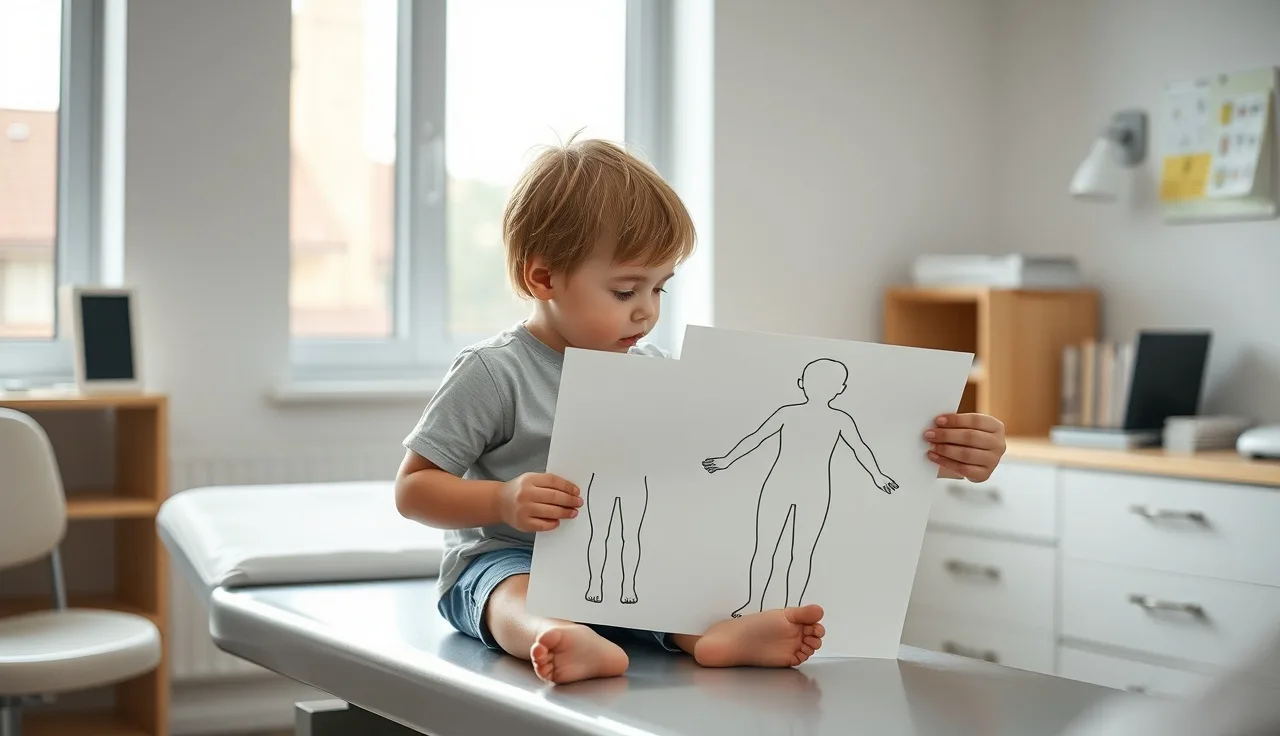
A lot of autistic kids can't reliably tell you "I hurt" the way other kids do, and it's rarely about not noticing pain. Telling someone you're hurt takes several skills firing at once: noticing the sensation, matching it to a word or a body part, then producing that information for another person while your body is under stress. Any one of those steps can break down, and the reasons behind it are more tangled than most parents expect.
The research on pain processing in autism is genuinely messy. Some studies find heightened sensitivity, others find reduced sensitivity, and plenty find both in the same child depending on context. A 2020 systematic review in the journal Pain found autistic individuals showed variable pain sensitivity across studies, some with higher thresholds and some lower, which makes any sweeping claim unreliable [1]. What stays consistent is the gap between feeling pain and reporting it, and that gap matters a lot in daily life.
Language plays a part too. Many autistic children have limited expressive language even when their understanding is strong, and under physical distress the already-hard job of finding words gets harder still. A child who can say "my stomach hurts" on a calm Tuesday may lose access to that exact phrase during an actual stomach ache.
Sensory differences add another layer. Interoception, the internal sense that tells your brain what's happening inside your body, is frequently atypical in autistic people. If a child gets unclear or distorted internal signals, they may genuinely not know where the pain lives, or describe it in ways that sound strange ("my foot feels loud"). That isn't exaggeration. It's an honest report of a confusing signal.
What pain looks like when a child can't say it
Pain shows up in behavior before it shows up in words, and once you know the tells, you catch it earlier. Watch for a sudden jump in stimming, especially self-injury like head-banging or biting; aggression that's out of character or escalates with no obvious trigger; a child backing away from a favorite activity for no clear reason; posture changes like guarding a body part, hunching, or refusing to bear weight on one side; broken sleep or more night waking than usual; eating less or suddenly wanting only soft foods; new vocal behavior such as moaning or higher-pitched sounds (or, just as tellingly, unusual quiet); and repeated touching of one specific body part.
A 2019 study in Autism Research looked at caregiver reports and found behavioral changes were the most commonly recognized sign of pain in nonspeaking autistic individuals, far ahead of verbal reports [2]. Parents are often the best pain detectors around, because they know a child's baseline better than any clinician does.
A simple behavior log helps more than people think. No formal system needed. A notes-app line that reads "Tuesday: refused breakfast, kept touching left ear, hit himself twice more than usual" gives a pediatrician far more to work with than "he seemed off this week."
Is pain sensitivity actually different in autism?
Yes, but not in a tidy "more" or "less" direction. One of the steadier findings is that autistic people often show altered pain responses rather than uniformly higher or lower sensitivity. A widely cited 2009 study by Nader et al. in the Clinical Journal of Pain found autistic children had significantly higher pain thresholds than controls in the lab (it took more stimulus to trigger a pain response), yet their caregivers reported more frequent pain behaviors in daily life [3]. That paradox makes sense through the lens of interoception: the body may under-signal pain at first, then flood awareness all at once when the signal finally breaks through.
Some clinicians describe an "all or nothing" pattern informally: a child shows no distress for hours, then has a sudden, intense meltdown that turns out to be the pain landing fully. That's not manipulation or drama. It's a processing difference.
Reduced pain response, or hyposensitivity, matters most because it creates medical risk. A child who doesn't react strongly to appendicitis or a broken bone can get sicker before anyone realizes something's wrong. The American Academy of Pediatrics advises clinicians to actively ask caregivers about pain communication patterns at well visits, precisely because standard pain tools assume typical self-report [4]. Hypersensitivity is just as real for many kids, though: blood draws, routine procedures, even the feel of an exam table can produce reactions that look extreme to an observer but accurately match what the child feels.
Pain scales that actually work for autistic kids
Standard pediatric pain scales, the classic 0-10 number scale or the Wong-Baker FACES scale, were built and validated on neurotypical kids. They ask for abstract self-rating and facial-expression reading, both common areas of difficulty in autism. Here's how the tools with real evidence behind them compare:
| Tool | What it is | Evidence in autism |
|---|---|---|
| Individualized Numeric Rating Scale | Parent and child co-create anchor descriptions for each number | Small but positive case evidence; widely used clinically |
| Non-Communicating Children's Pain Checklist (NCCPC-R) | Caregiver-rated observational checklist, 30 items | Validated specifically for children with cognitive/communication differences [5] |
| Revised FLACC (Face, Legs, Activity, Cry, Consolability) | Clinician-rated behavioral scale, can be individualized | Used in hospital settings; individualized version outperforms standard [5] |
| Body outline drawings | Child points to or marks where pain is on a body silhouette | Useful for kids with good motor control; cuts language demand |
| Visual Analog Thermometer | Vertical thermometer graphic from 'no pain' to 'worst pain' | More concrete than an abstract 0-10; used in some pediatric centers |
The Non-Communicating Children's Pain Checklist Revised (NCCPC-R) is the most studied option for nonverbal children with developmental differences. A trained caregiver completes it in about 10 minutes, and it's shown reliability across multiple studies [5], so it's worth asking your pediatrician if they're familiar with it.
Many families build a personalized pain scale at home with their speech-language pathologist instead: you identify your own child's behavioral markers at different pain levels and turn them into a reference card for appointments. It takes an hour or two to put together and saves you hours of chaos in an emergency.
Building a pain vocabulary at home
The goal isn't to teach pain words during pain. That's too late. The teaching happens in calm, regulated moments, long before anything hurts, and it starts with body awareness rather than pain itself. Many speech-language pathologists begin with interoception activities: noticing a heartbeat, noticing hunger, noticing temperature. This trains the internal-sensing pathway before it ever has to carry medically important information. The Interoception Curriculum developed by Kelly Mahler is one widely used clinical resource here [6].
For verbal or semi-verbal children, build a pain vocabulary using real photos or drawings of your own child rather than generic ones. "Hurt" is abstract. "This is the face I make when my ear hurts" is concrete. Snap photos during minor known discomforts (a scraped knee you saw happen, the moment right after a vaccination) and label them clearly, then keep them on your phone and in a binder for visits.
For AAC users, pain vocabulary has to be pre-programmed and always within easy reach. Many devices ship with health or body words buried under several menu layers, so it's worth working with your SLP to move pain symbols to a core page or a quick-access button: the word "hurt" should take one tap, not four. Our guide to AAC devices covers setup for medical communication in more detail.
Role play helps more than most parents expect. Use stuffed animals to act out "the bear has a tummy ache, what does he do?" and practice the routine: feel something, point to where, show how much, tell an adult. Run it monthly, not only when something actually hurts. Some families also keep a laminated body map on the fridge, an outline with five or six labeled regions (head, tummy, chest, arm or leg, private parts), where the child's whole job is to point. No words required.
What role does AAC play in pain communication?
AAC (augmentative and alternative communication) can completely change how a nonverbal or minimally verbal autistic child reports pain, but the vocabulary has to be loaded and practiced before it's needed. Trying to add pain words during an actual emergency is too late to do much good.
For kids using a full AAC system, pain expression belongs in the core vocabulary rather than as an afterthought. ASHA recommends AAC systems include vocabulary for expressing physical states, covering pain, discomfort, and body-part identification [7]. If your child's setup is missing this, bring it up at the next SLP session.
Low-tech tools matter just as much as the high-tech ones. A laminated board with body parts, faces showing levels of distress, and simple words like "hurt," "stop," and "help" can travel to every appointment, and it costs almost nothing to make at home with Boardmaker, SymbolStix images, or hand-drawn symbols.
High-tech devices can go further and store phrases specific to your child's history. For a child prone to ear infections, you might pre-program something like "my left ear feels like pressure" or "the kind of ache I had with the ear infection." Building that specificity takes time, but it sharpens conversations with doctors considerably.
Families just getting started might look at our overview of AAC devices, which covers choosing a system and getting insurance to cover it. When motor planning challenges sit alongside autism, our piece on apraxia of speech is worth reading too, since it shapes AAC strategy.
Apps like Little Words, built for daily home practice, help reinforce pain vocabulary in low-stakes moments so it's ready when it's actually needed. The goal is for "hurt" and "help" to fire as automatically as any other word.
No app replaces an SLP's individual assessment, though. If pain communication is a real concern, that calls for direct involvement from a speech-language pathologist, ideally one with AAC experience. Our guide to speech therapy for autism can help you find the right person.
How should you prepare for medical appointments when your child can't self-report pain?
Medical appointments are loud, bright, high-stress rooms that reliably shrink a child's communication. Planning ahead is the single most useful thing you can do.
Before the visit, write a one-page summary of your child's communication profile: how they usually communicate, what their pain behaviors actually look like, any history of delayed or muted pain responses, and what keeps them regulated during exams. Hand it to the nurse before things start. Most pediatric practices are glad to get it and will keep it in the chart.
Many children's hospitals now build patient communication preference sheets into intake. Ask if one exists, and if it doesn't, ask them to create one.
Bring your own tools too: the body map, the photo pain scale, the AAC device fully charged. Don't assume the clinic has equivalents on hand, because most don't.
Ask the doctor to speak to your child directly, even if the child doesn't respond right away. Some autistic children process and answer on a delay, so give them extra time. Silence in a medical setting doesn't mean the question wasn't heard.
For procedures expected to hurt, request a pain plan in advance: topical anesthetics for blood draws (EMLA cream, which needs a US prescription, applied 60 minutes before the draw), a child life specialist if the hospital has one, and sensory accommodations like dimmed lights or fewer unfamiliar people in the room.
Early intervention programs often help with medical communication too. If your child is under 3, ask your early intervention coordinator about it. For older kids, a school SLP can help build a medical communication binder.
How do you tell the difference between a behavioral meltdown and a pain response?
This one is genuinely hard, and anyone who claims otherwise is oversimplifying. The overlap is real.
Still, a few patterns help. Meltdowns driven by sensory overload or frustration usually have an identifiable trigger in the room (noise, a transition, a denied request) and tend to ease with regulation support. Pain-driven distress is often more stubborn despite changes to the environment, and it may carry physical tells: the child keeps returning to touch or guard one area, refuses to put weight on one side, or holds a rigid posture even after calming down.
Fever, unusual pallor, or visible swelling alongside a behavioral spike should trigger a medical check no matter how the episode looks otherwise.
Vomiting or diarrhea paired with behavioral distress deserves special attention in autistic kids, because GI issues run much higher in this population. A 2014 review in Pediatrics found GI symptoms occurred in 46-84% of autistic individuals depending on the study and definition used [8]. Chronic abdominal pain gets missed constantly, simply because the child can't report it clearly.
When you notice a recurring pattern of distress with no clear trigger, keep a written log over several days. That documentation is the fastest route to a useful medical conversation.
A practical rule of thumb: if the behavior doesn't respond to your usual regulatory tools after 20 to 30 minutes, and it keeps returning at the same time of day or week, rule out pain and GI causes before filing it under behavior.
What can schools and caregivers do to support pain communication?
School staff and other caregivers are often the first to notice the behavior change that turns out to be pain. Building one shared system across every place a child spends time pays off quickly.
A pain communication protocol shared between home and school doesn't need to be elaborate. It needs three things: a description of the child's typical pain behaviors, a list of the tools the child can access (body map, AAC, specific phrases), and a decision tree for when to call parents versus when to send the child to the nurse.
Under the Individuals with Disabilities Education Act (IDEA), a child's IEP can include goals and accommodations for health communication, including expressing physical needs [9]. If pain communication is a barrier at school, it belongs in the IEP discussion.
For children with 504 plans rather than IEPs, a health accommodation can direct the school nurse to do a brief physical check whenever the child shows specific listed behaviors, instead of waiting for a verbal self-report that may never come.
Babysitters, grandparents, and respite providers need a stripped-down version of the same information. One laminated card on the fridge reading "this is how [child's name] shows pain," with the top three behavioral tells, is low effort and high payoff.
For children also working on broader speech and communication, consistent vocabulary across settings is the point: whatever pain words you build at home should match the ones used at school and in therapy. Speech therapy sessions can carry pain vocabulary as a target.
Are there specific medical conditions autistic children are more likely to have that affect pain communication?
Yes, and knowing the common ones tells you when to raise your alert level.
Gastrointestinal conditions top the list. As noted above, GI symptom rates in autistic individuals run well above the general population [8]. Constipation, reflux, and functional abdominal pain are all common and all frequently missed, because the child can't reliably report ongoing discomfort. Unexplained behavioral escalations, food refusal, and broken sleep often trace back to the gut in this population.
Ear infections are another quiet culprit, especially in younger children. Head-banging, ear-touching, and rising irritability are textbook signs, but they get read as purely behavioral all the time.
Dental pain is systematically underdetected in autistic individuals too. Many autistic children struggle to tolerate dental exams, so problems go longer before anyone catches them. It's worth hunting down a dentist experienced with autistic patients for regular preventive care.
Headaches and migraines appear to occur in autism at higher rates than the general population, though the research here is less settled. A child who suddenly covers their eyes or ears, or retreats to a dark quiet space, may be answering a headache as much as sensory overload.
Menstrual pain in autistic girls and adolescents is badly underaddressed. Autistic individuals often have more trouble communicating menstrual symptoms, which leaves dysmenorrhea undertreated and driving behavioral changes on a monthly cycle.
In every one of these cases, the same approach applies: track the behavioral patterns, build specific vocabulary for those body systems, and make sure your child's medical team knows self-report is unreliable.
How pain slips past everyone, and why that's dangerous
Pain in autistic children goes undetected in several well-documented ways, and each one carries real medical risk.
The most direct danger is delayed diagnosis. A child with appendicitis who can't say "my lower right side hurts" and doesn't show the pain behaviors doctors expect may not get to the emergency room until the disease has progressed much further. Fractures follow a similar pattern: case reports describe autistic children with reduced pain sensitivity who keep using a broken limb, which pushes the diagnosis back [3].
Chronic pain that goes unnoticed has its own fallout. A child dealing with undiagnosed reflux or chronic constipation will often show it through escalating behavior, broken sleep, self-injury, or aggression rather than through a clear complaint. Because the pain itself stays hidden, everyone ends up treating the behavior instead, which never touches the actual problem. That cycle can run for months, sometimes years, before anyone connects the dots.
There's a system problem underneath all this too. Standard pain assessment in emergency rooms and hospitals leans almost entirely on patients describing their own pain. When a patient can't do that, the assessment often just gets skipped rather than swapped for an adapted tool. Medical advocacy groups have pushed for better training on assessing pain in nonspeaking patients, but that training hasn't reached everywhere yet. For parents, the practical move is to speak up at every single medical encounter. Tell the team directly: my child cannot reliably self-report pain, and here is how we assess it. Put it on the intake form. Repeat it to every new provider. That's not being difficult, it's giving the team information they actually need to do their job.
Common questions parents ask
Can autistic children feel pain but not show it?
Yes, and it's well documented. Some autistic people show high pain thresholds in lab testing yet clearly struggle in daily life once something actually hurts. The gap traces back to interoceptive differences: the internal signal about what's happening in the body gets processed atypically. A child might feel pain without having the words or recognizable behaviors for it, or might seem fine right up until the signal finally registers, all at once and intensely.
What is interoception and why does it matter here?
Interoception is the internal sense that tells your brain what's going on in your body: heartbeat, hunger, temperature, pain. Research suggests it's frequently atypical in autistic people, which means pain signals can arrive distorted, delayed, or hard to locate. A child with weak interoceptive awareness may genuinely not know where something hurts, or may experience pain quite differently from what the injury would suggest.
What pain scale works best for a nonverbal autistic child?
The Non-Communicating Children's Pain Checklist Revised (NCCPC-R) has the strongest validation for nonverbal children with developmental differences. It works from caregiver observation across 30 behavioral items rather than the child's own report. Clinics also use the individualized FLACC scale. At home, though, a personalized photo-based pain scale built with your SLP often beats both, since it's built around your own child's behavioral markers.
How do I teach my child to say or signal "hurt"?
Start during calm moments, never in the middle of actual pain. Build body awareness first, through simple interoception work: noticing heartbeat, hunger, warmth. Then introduce the word "hurt" using photos of your child during minor, known discomforts. Practice a routine: feel something, point to where, show how much, tell an adult. For AAC users, make "hurt" reachable in a single tap, and practice it monthly so it's there automatically when it's actually needed.
Is pain more common in autistic kids than in neurotypical kids?
Several pain-causing conditions show up at higher rates in autism. GI issues affect an estimated 46 to 84% of autistic individuals, compared with roughly 10 to 20% of the general pediatric population. Dental problems run higher too, largely because of sensory barriers to care, and headaches and menstrual pain may be more common as well. The core problem isn't necessarily more pain, it's less ability to communicate it, and a much higher risk that it goes untreated.
How can I prepare my child for painful medical procedures?
Start preparing well before the appointment itself. Social stories or visual schedules help explain what's coming. Ask for a topical anesthetic like EMLA cream before blood draws, applied about an hour ahead, and request a child life specialist if the hospital offers one. Bring sensory supports, noise-reducing headphones or a preferred object, and practice whatever pain tools you use at home so they carry over into the clinic.
How do I know if a meltdown is actually pain?
Pain-driven distress tends to persist no matter what regulation strategies you try, and it often comes with physical tells: repeated touching or guarding of one body part, rigid posture, refusal to put weight on one side. Meltdowns from sensory or behavioral causes usually have an identifiable trigger and respond at least somewhat to regulation support. If a distress pattern keeps recurring at the same time of day with no obvious trigger and won't ease no matter what you do, it's worth ruling out medical causes, GI pain included.
What should I tell the doctor about my child's pain communication?
Say it plainly: your child cannot reliably self-report pain, and here's how you assess it. Describe the specific tells you watch for, and bring your tools along, whether that's a body map, a photo scale, or an AAC device. Ask the team to skip relying only on a verbal pain rating and use an observational tool instead. A one-page communication profile brought to the appointment helps a lot too.
Can an IEP include goals around pain communication?
Yes. Under IDEA, an IEP can address communication of physical needs, and that includes expressing pain, illness, or discomfort. If your child's inability to communicate pain creates a real barrier at school, say the nurse has no way to tell whether the child is hurting, raise it at the next IEP meeting. It can be addressed through goals, accommodations, or simply by naming the behavioral tells staff should watch for.
What GI issues cause hidden pain in autistic children?
Constipation is the most common culprit, and the most frequently missed. It can cause chronic abdominal pain with no outward sign beyond irritability, food refusal, or broken sleep. Reflux (GERD) shows up often too, sometimes without the obvious spitting up you'd expect in a younger child. Functional abdominal pain, real pain without a clear structural cause, is also common. Any recurring, unexplained behavior pattern is worth bringing up with your pediatrician as a possible GI issue.
Does autism affect how pain medication works?
There isn't strong research on pain medication pharmacokinetics in autism specifically. What is better established is that some autistic people are highly sensitive to medication side effects and may respond to sedatives or anesthetics differently than standard protocols expect. Always tell anesthesiologists and procedural teams about your child's diagnosis, communication profile, and any known sensory or medication sensitivities before a procedure that needs sedation.
How early can I start building these skills?
You can begin as early as 18 to 24 months with interoception-based activities: naming body states ("your tummy is full," "that scraped knee hurts"), pointing to body parts, using simple pictures. For kids in early intervention, pain vocabulary can be an explicit goal. The earlier this foundation goes in, the more reliable the words are when real pain eventually shows up, and even partial progress, like pointing to a general body region instead of nothing, makes a medical conversation far more useful.
Are there apps or low-tech tools that help?
Low-tech tools often win in actual emergencies because they need no charging or connection. A laminated body map, a photo pain scale built from your own child's expressions, and a simple board with "hurt," "stop," and "help" all make reliable backups. For daily practice and vocabulary building, apps built for AAC or for neurodivergent communication can reinforce pain words during low-stress moments, so they're ready when it actually counts.
Research on pain and autism keeps landing on the same theme: standard assumptions about how pain "should" look often don't hold up, and that has real consequences for how caregivers and clinicians read a child's signals. Pain sensitivity itself varies enormously from one autistic person to another. A 2020 systematic review in the Pain journal found some autistic individuals showing higher pain thresholds and others lower, with no consistent pattern across studies, which makes broad generalizations unreliable. That mismatch between what's measured in a lab and what happens at home shows up elsewhere too. Nader and colleagues (2009) found autistic children had significantly higher pain thresholds than their peers under laboratory conditions, yet caregivers reported these same children showing pain-related behavior more often in daily life. So the lab result and the lived experience don't line up, which is exactly why parent and caregiver observation matters so much. For nonspeaking autistic individuals, behavior is often the clearest signal available. A 2019 paper in Autism Research found behavioral changes were recognized as the most common indicator of pain in this group, more so than any verbal report. That's part of why the American Academy of Pediatrics pushes clinicians to ask caregivers directly about how a child communicates pain, since standard assessment tools tend to assume a level of self-report that doesn't fit every child. Some tools handle this better than others: the Non-Communicating Children's Pain Checklist-Revised has held up well for nonverbal children with developmental differences, and an individualized version of the FLACC scale, tailored to a specific child rather than scored generically, outperforms the standard version too, according to Breau et al.'s psychometric work. Building a child's own vocabulary for internal states is one practical way forward. Kelly Mahler's Interoception Curriculum is widely used clinically for exactly this: helping autistic individuals recognize and name pain or discomfort as it's happening in their bodies. On the communication side, ASHA's guidance on AAC recommends that any augmentative system include vocabulary for physical states, pain and discomfort among them, along with ways to identify specific body parts. More broadly, ASHA's practice portal backs speech-language pathologists working on this kind of functional communication across settings, not just in therapy sessions. There's a medical stake in getting this right, too. GI symptoms show up in an estimated 46 to 84 percent of autistic individuals, depending on the study and how symptoms are defined, a rate well above that of the general pediatric population, per a 2014 Pediatrics review. A child who can't easily flag pain is a child whose GI issues, or other medical problems, can go unnoticed longer than they should. The Autism Science Foundation notes that altered pain processing, whether that means reduced or heightened sensitivity, is a recognized part of autism that matters for both everyday life and medical care. Families working within a school system have a formal avenue here too: under IDEA, an IEP can include goals around health communication specifically, meaning a child's ability to express pain or physical needs can become a documented, worked-toward skill rather than something left to chance.