Last updated 2026-07-09
TL;DR
The best communication app for autism depends on where your child is in their communication development. Widely used options include Proloquo2Go, TouchChat, Snap Core First, and LAMP Words for Life, ranging from free to about $300. Research supports AAC apps as a real supplement to speech therapy, not a replacement. A licensed SLP should guide the pick.
What are communication apps for autism, and how do they work?
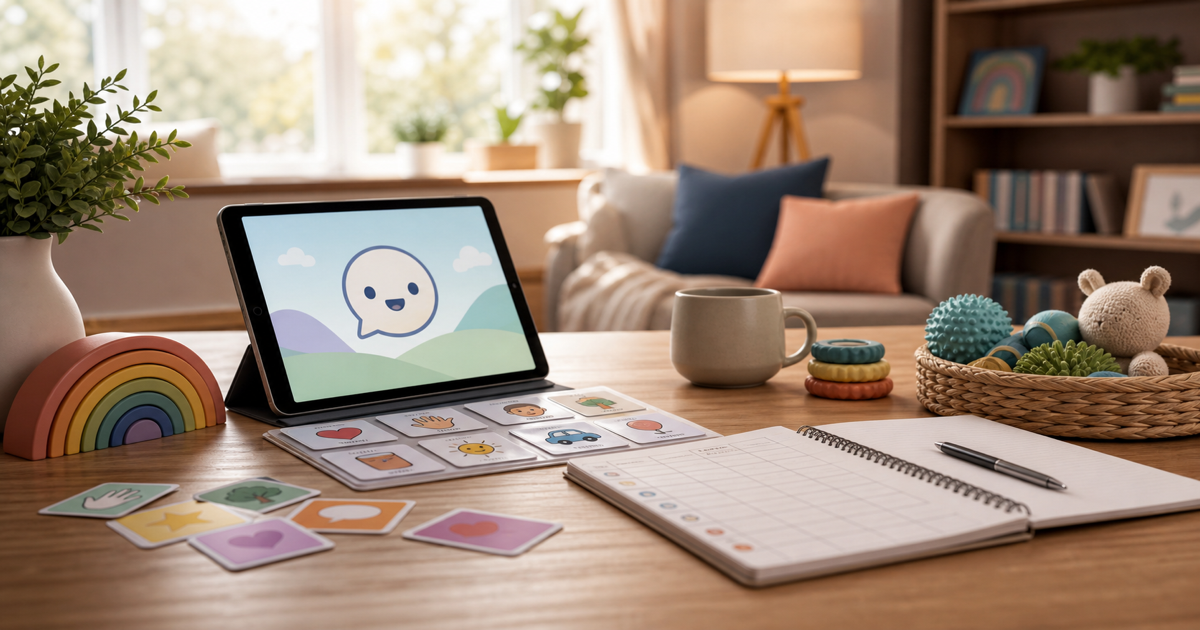
Communication apps for autism are software programs, usually running on an iPad or Android tablet, that give a nonspeaking or minimally speaking person a way to express themselves. They fall under the umbrella term AAC, which stands for augmentative and alternative communication. AAC includes anything that supplements or replaces natural speech: picture boards, speech-generating devices, and app-based systems.
The American Speech-Language-Hearing Association defines AAC as "all forms of communication (other than oral speech) that are used to express thoughts, needs, wants, and ideas" [1]. That definition matters because it frames these tools as genuine communication, not a consolation prize for kids who aren't talking yet.
Most autism communication apps work in one of two ways. Symbol-based apps (like Proloquo2Go or TouchChat) display grids of pictures and words; the child taps a symbol and the app speaks the word or phrase aloud. Text-to-speech apps let older or literate users type words directly. A third category, motor-planning apps like LAMP Words for Life, organizes vocabulary so every word sits in the same physical spot every time, so motor memory becomes the access route rather than visual scanning.
The device running the app matters too. The iPad is the most common hardware for AAC apps, which is why you'll see terms like "iPad communication device for autism" used almost interchangeably with the apps themselves. A dedicated speech-generating device (SGD) runs the same kind of software but on a ruggedized body, and it's often prescribed as durable medical equipment, which opens up insurance coverage paths. [2]
Does using a communication app slow down speech development?
No. This is the fear parents raise more than any other, and the research points one way: AAC does not suppress speech. A 2020 systematic review in the Journal of Autism and Developmental Disorders examined 23 studies and found AAC intervention was associated with growth in both AAC use and natural speech production for most participants [3]. The worry comes from an intuitive but wrong assumption, that giving a child an easy way out makes them stop trying to talk.
The American Academy of Pediatrics treats AAC as a first-line support for children who cannot reliably communicate verbally, and states there is no evidence it hinders speech and real evidence it supports overall language growth [4].
The honest caveat: most studies here have small sample sizes. Nobody has large randomized controlled trial data on AAC apps specifically, as opposed to AAC in general. The strongest evidence comes from PECS (Picture Exchange Communication System) and well-designed SGD research, and those findings get broadly generalized to app-based AAC. That extrapolation is reasonable. It isn't airtight.
What the field agrees on: the sooner a child has a functional way to communicate, the better the long-term trajectory. Waiting until a child "fails enough" to justify AAC is not a recommended approach. [1]
Which communication apps for autism are used most, and how do they compare?
Here's an honest comparison of the major apps speech-language pathologists actually prescribe. Prices reflect 2024-2025 App Store listings and can change.
| App | Platform | Price | Vocabulary system | Best for |
|---|---|---|---|---|
| Proloquo2Go | iOS only | ~$249 | Symbol-based, customizable grids | Wide age range, strong SLP familiarity |
| TouchChat HD with WordPower | iOS & Android | ~$299 | Symbol + text hybrid | Kids moving toward literacy |
| Snap Core First | iOS & Android | ~$300/yr subscription | Symbol-based, dynamic display | School-age kids, classroom integration |
| LAMP Words for Life | iOS | ~$299 | Motor-planning, consistent locations | Children who benefit from motor memory |
| Cboard | Web + iOS + Android | Free (open source) | Symbol-based | Families needing a no-cost starting point |
| LetMeTalk | Android | Free | ARASAAC symbols | Budget option, Android households |
| CommunicoTot | iOS | ~$30 | Symbol-based | Toddlers and early communicators |
Proloquo2Go has the longest track record and is the app most SLPs trained on, which is not a small advantage. When your child's school SLP already knows an app's layout, setup and maintenance go faster. TouchChat with WordPower is popular with SLPs who want to move kids from symbols toward independent literacy. LAMP Words for Life has a specific evidence base because it mirrors the LAMP methodology developed at the AAC Institute [5].
Snap Core First moved to a subscription model, which pushes the long-term cost above a one-time purchase. Factor that in before you commit.
The free apps are genuinely useful starting points, but they tend to carry smaller vocabulary sets and fewer customization options. If your child's SLP recommends a specific paid app, that recommendation usually rests on something worth taking seriously.
How do you choose the right autism communication app for your child?
Start with a formal AAC evaluation from a licensed speech-language pathologist trained in AAC. That's not a sales pitch for therapy. It's the only way to match the app to where your child actually is in their communication development. An SLP looks at motor skills (can the child point accurately to a small grid square?), vision, cognitive level, and current communication functions before recommending anything. [1]
If you're in the US, most states require school districts to consider AAC as part of a child's IEP when communication is an identified need. The Individuals with Disabilities Education Act (IDEA, 20 U.S.C. § 1400 et seq.) requires teams to consider assistive technology for every child with a disability, and AAC apps qualify as assistive technology [6]. So you may be able to access an app through the school system rather than buying it yourself.
Outside formal evaluations, a few practical filters help.
Grid size. Smaller grids (9 to 16 squares) are easier for children with motor challenges or those just starting out. Larger grids (over 100 squares) support more expressive vocabulary but demand finer motor control and more visual scanning.
Voice output. Listen to the synthesized voices before you commit. Some kids are motivated by a voice that sounds like a peer; others do better with a neutral tone. Many apps let you record natural human voices, including a parent's voice, which raises engagement for younger children.
Customization effort. Every app takes setup time. Proloquo2Go and Snap Core First have large communities of SLPs sharing pre-made page sets, which cuts that time down a lot.
Trial periods. AssistiveWare (maker of Proloquo2Go) and some other developers offer free trials or lite versions. Use them.
For families who want a structured way to explore options before an SLP appointment, ASHA's public AAC resources are a free, evidence-informed starting point. [1]
Can insurance or Medicaid pay for autism communication apps?
Sometimes, and the difference between an app on a personal iPad and a "dedicated speech-generating device" changes the cost enormously.
Medicare Part B covers speech-generating devices as durable medical equipment (DME), and Medicaid in most states follows similar rules. Coverage typically requires the device to be "dedicated," meaning it's used only for communication, not entertainment, web browsing, or games. An iPad loaded with Proloquo2Go and also used for Netflix usually won't qualify under Medicare's criteria [2].
For children on Medicaid, the picture is more variable. Many states cover AAC devices, including iPad-based systems, under Early Intervention (for children under 3) or through Medicaid waiver programs, but the specific rules vary by state. ASHA's reimbursement pages track state-by-state Medicaid policy for AAC, though those pages need verification because policies change. [1]
Private insurance increasingly covers AAC following autism-specific insurance mandates. As of 2024, all 50 states plus DC have enacted autism insurance mandates of some kind, though the scope varies substantially [7]. An SLP can write a letter of medical necessity, which is usually required to trigger coverage.
Early Intervention services (for children under 36 months) under IDEA Part C may fund AAC devices and therapy directly, often at no cost to families depending on state rules. [6]
Here's the practical order of operations: before paying out of pocket for any premium autism communication app, have an SLP write a prescription and run it through your insurance. The process is slow and document-heavy, but it can cover hundreds of dollars in app costs.
What is PECS, and how does it compare to app-based AAC?
PECS stands for Picture Exchange Communication System. Andy Bondy and Lori Frost developed it in 1985, and it's one of the most studied AAC approaches in autism research. PECS uses physical picture cards a child hands to a communication partner, moving through six phases from requesting a single item to commenting on the environment [8].
PECS and app-based AAC aren't competitors. Many children use both at different stages. PECS often comes first because it builds the social act of initiating communication with another person, which pure device use doesn't always teach. The physical exchange creates a clear interaction loop. Once a child has that initiation habit, moving to a speech-generating device or app tends to go smoother.
A 2010 meta-analysis in the American Journal of Speech-Language Pathology found PECS produced functional communication gains across multiple studies, though effect sizes varied [8]. App-based systems have fewer independent randomized trials but are increasingly supported by single-case experimental designs.
So which do you pick? Let your SLP's recommendation drive it. Many programs run both in parallel. The app has obvious logistical advantages (thousands of vocabulary items in a pocket-sized device), while PECS has deeper research backing for the earliest phase of building intentional communication.
Are there free communication apps for autism worth using?
Yes. A few are genuinely worth your time, more than placeholders until you can afford something better.
Cboard is an open-source, browser-based AAC app that runs on any device with a browser and works offline after an initial load. It uses ARASAAC symbols, the same symbol set found in many premium apps. A volunteer community maintains it, and it's been deployed in low-resource settings around the world.
LetMeTalk is free on Android and uses the same ARASAAC symbol library. It allows customizable grid layouts and voice output through the device's text-to-speech engine. For families with Android tablets and tight budgets, this is a real option.
CoughDrop offers a free tier, and several state early intervention programs offer free or subsidized app access.
The limitation of free apps is usually vocabulary depth and SLP familiarity. If a child's school SLP has never set up Cboard before, the family ends up doing that work alone. Premium apps have large communities of SLPs sharing page sets and troubleshooting tips.
One honest opinion: if a child is in early intervention or getting school-based speech therapy, use whatever app the SLP recommends and get it funded through the IEP or Medicaid process before paying out of pocket for a premium tool. Free apps shine for families in a gap period, waiting for an evaluation or stuck between providers.
How should parents use communication apps at home alongside speech therapy?
The app doesn't work without steady use across every setting. This is the piece research is most consistent about: AAC works best when the child's communication partners model the system all day, more than during therapy sessions. The technique is called aided language input or aided language modeling (ALM). You use the app yourself to comment, request, and narrate as you talk to your child, showing them how the system works by example rather than by drilling [9].
Here's how to run ALM at home.
Keep the device accessible all the time. Not locked in a cabinet, not brought out only for "AAC time." Communication happens every minute of the day.
Model at least as often as you prompt. If you're pointing to what your child should say more than you're showing what the app says, you're using it backwards.
Expand, don't correct. If a child taps "more" to ask for more juice, model "more juice" on the device, then pour. Don't withhold the juice to demand a longer utterance.
Check with your SLP about which vocabulary to prioritize. Core vocabulary words (more, help, stop, go, want, no, yes) show up across hundreds of contexts and should come before fringe vocabulary (specific noun names).
For a deeper look at how speech therapy connects to home practice, the early intervention speech and language therapy guide has practical strategies.
If you want a way to build daily communication habits alongside a formal AAC system, Little Words is an AI speech companion app made for neurodivergent kids that offers structured language practice in a low-pressure format. It won't replace an AAC system or an SLP, but it can fill practice time between sessions. Start the quiz to see if it fits your child.
Parents who stay consistent with ALM at home see faster growth in AAC use than those who rely on the therapy session alone. A 2016 study in Augmentative and Alternative Communication found parent-implemented aided language modeling produced significant gains in children's use of AAC symbols [9].
What age can children start using communication apps?
Earlier than most families expect. There is no minimum age for AAC, and waiting until a child is "old enough" carries real costs. Research on early AAC introduction consistently shows access to a communication system before age 3 is associated with better language outcomes, not because the app teaches language directly but because it gives the child a functional way to communicate while their verbal system develops [4].
The American Academy of Pediatrics recommends developmental surveillance at every well-child visit and flags children who are not babbling by 12 months, not using single words by 16 months, or not using two-word phrases by 24 months as candidates for immediate referral to a speech-language pathologist [4]. Any child who meets those referral criteria is also a candidate for early AAC consideration.
For very young children (under 2), the apps look different. Simpler symbol sets, larger touch targets, and voice-recorded (parent's voice) output tend to fit better than complex grid systems. CommunicoTot and some Snap Core First configurations are built for this age range.
For older teenagers and adults who are minimally verbal, the same apps work but vocabulary organization and voice selection matter differently. Adults generally prefer a voice that sounds adult, and vocabulary should reflect adult contexts. The speech therapy for adults article covers how AAC evaluation shifts for older users.
What's the difference between an AAC app and a dedicated communication device?
An AAC app is software. A dedicated communication device (an SGD, or speech-generating device) is purpose-built hardware, usually running the same kind of software but on a ruggedized body designed to survive drops, drool, and daily classroom use.
The practical differences come down to four things.
Durability. Dedicated devices like the Accent series (PRC-Saltillo) or Tobii Dynavox devices are built to take punishment. An iPad in a case is more fragile, though heavy-duty cases like the Otterbox Defender narrow the gap.
Insurance. Dedicated devices are classified as DME under Medicare and most Medicaid programs. An iPad is not, even with AAC software on it.
Distraction. A dedicated device does one thing. A family iPad invites battles over screen time, games, and streaming, which creates real problems in school.
Cost. A dedicated device often runs $5,000 to $10,000 or more when bought outright. Funded through insurance or Medicaid, the family cost may be zero. An iPad plus a premium app might cost $800 to $1,200 out of pocket, which is lower than the sticker price of a dedicated device but not necessarily lower after insurance.
For many families, starting with an iPad and a communication app for autism is the right first step because it's faster to access and cheaper to try. If the child thrives and the school or therapy team recommends a dedicated device for coverage or durability, that upgrade can come later. [2]
For a broader look at hardware and dedicated systems, the alternative augmentative communication devices for autism guide covers the full landscape.
How do school teams use communication apps, and what are your rights as a parent?
School-based use of AAC apps is governed by IDEA. Under IDEA, every child with a disability who might benefit from assistive technology must have that possibility considered by their IEP team. "Considered" carries real legal weight: the team must document the consideration, not skip past it [6].
If an AAC app or device goes into a child's IEP as a required tool, the school district must provide it at no cost to the family. That includes funding the device or app, training the staff who work with the child, and making sure the device is available across all school settings, not only in the resource room.
Parents have the right to request an assistive technology assessment as part of the IEP process. You do not have to wait for the school to suggest it. Put the request in writing and keep a copy.
Here's a detail that trips up many families: the device purchased under an IEP belongs to the school district, not the child. If the child graduates, ages out of services, or moves districts, the device may not go with them. Some families buy their own device for home use alongside a school-funded device for exactly this reason.
School SLPs vary enormously in AAC training. If your child's school SLP has limited AAC experience, ask whether the district can bring in an AAC specialist for the evaluation. That request can also go in writing as part of the IEP process.
For more on school-based services, see the autism spectrum speech therapy and pediatric speech therapy guides.
What does the research actually say about communication apps and autism outcomes?
The evidence base for AAC in autism is real but imperfect, and being honest about that matters.
Some of the strongest evidence comes from a 2014 systematic review in Developmental Neurorehabilitation, which found consistent positive effects of SGDs and AAC apps on functional communication outcomes for children with autism across single-case experimental designs. Effect sizes were generally large for requesting and moderate for commenting [10].
A 2020 meta-analysis in the Journal of Autism and Developmental Disorders reviewed 23 studies of AAC interventions (including app-based systems) and concluded that AAC intervention was associated with increased use of AAC, natural speech, and overall communication for the majority of participants [3]. Meaningful finding. But the studies were mostly small (under 10 participants) and used different outcome measures, which limits how far you can generalize.
The LAMP approach has specific efficacy research. A 2019 study in the American Journal of Speech-Language Pathology followed children using the LAMP methodology and found significant increases in spontaneous communication acts over the intervention period [5].
What nobody has: a large randomized controlled trial comparing specific autism communication apps to each other or to no intervention. The field moves faster than the research. Families and clinicians are making reasonable decisions based on best available evidence plus clinical judgment, which is normal in pediatric practice but worth being straight about.
The practical takeaway: the evidence supports using AAC apps as a legitimate communication support for children with autism. It does not tell you which specific app is best for your specific child. That's where the SLP evaluation becomes irreplaceable.
For context on how speech therapy as a whole gets evaluated, the speech therapy for kids article lays out what outcome research actually shows.
Frequently asked questions
What is the best communication app for a nonverbal child with autism?
There's no single best app. The right choice depends on the child's motor skills, vision, cognitive level, and communication stage. Proloquo2Go and TouchChat HD are the most widely used and best-supported by trained SLPs. LAMP Words for Life is a strong option for children who respond well to motor routines. A formal AAC evaluation from a licensed SLP is the only reliable way to match the app to your child.
Is Proloquo2Go worth the $249 price?
For most families who have an SLP guiding implementation, yes. Proloquo2Go has the largest community of trained SLPs and shared page sets, which cuts setup time. The app has been updated continuously since 2009 and runs on iOS devices most families already own. If cost is a barrier, check whether it can be covered through an IEP, Medicaid, or private insurance before paying out of pocket.
Can a 2-year-old use a communication app for autism?
Yes. There is no minimum age for AAC, and the American Academy of Pediatrics recommends that children not meeting speech milestones (single words by 16 months, two-word phrases by 24 months) be referred to an SLP right away. Early AAC access is associated with better language outcomes, not worse. Apps built for toddlers use larger touch targets and simpler symbol sets than those for school-age children.
Will my child stop trying to talk if they use a communication app?
Research consistently shows AAC does not suppress speech development. A 2020 meta-analysis in the Journal of Autism and Developmental Disorders found AAC intervention was associated with growth in both AAC use and natural speech for the majority of participants. The American Academy of Pediatrics endorses AAC as a first-line support with no evidence it hinders speech. Many children who start with AAC apps go on to develop functional verbal speech alongside their AAC use.
Can Medicaid or insurance cover an autism communication app?
Sometimes. Medicaid in many states covers dedicated speech-generating devices as durable medical equipment, and some private plans cover AAC following autism-specific mandates (all 50 states plus DC have some form of autism insurance mandate as of 2024). Coverage typically requires a letter of medical necessity from an SLP and often a dedicated device rather than a shared family iPad. Run the process through your SLP and insurer before paying out of pocket.
What's the difference between Proloquo2Go and Snap Core First?
Both are symbol-based, fully customizable AAC apps with strong SLP support communities. Proloquo2Go costs ~$249 as a one-time purchase and runs only on iOS. Snap Core First runs on iOS and Android but moved to a subscription model (~$300 per year), which raises the long-term cost. Proloquo2Go has a longer track record; Snap Core First is popular in school settings that use Windows-based devices. An SLP familiar with both can advise based on your child's needs.
What is aided language modeling, and how do parents do it at home?
Aided language modeling (ALM) means you use the AAC app yourself as you talk to your child, pointing to or activating symbols to match what you're saying. Instead of drilling your child, you model how the app works throughout the day during natural routines. Research shows parent-implemented ALM produces significant gains in children's AAC use. The core rule: model at least as often as you prompt. Keep the device accessible all the time, not saved for therapy sessions.
Are there free communication apps for autism that actually work?
Yes. Cboard is an open-source, browser-based AAC app that works on any device and uses the ARASAAC symbol library. LetMeTalk is a free Android option using the same symbols. Both have real vocabulary coverage and voice output. The main limitations are smaller communities of SLPs who know these tools and fewer customization options. For families in a gap period waiting for an evaluation or insurance approval, these are legitimate options, more than placeholders.
Does my child's school have to provide an AAC app?
Under IDEA, school districts must consider assistive technology (including AAC apps and devices) for every child with a disability as part of the IEP process. If the IEP team determines an AAC app is required for the child to receive a free appropriate public education, the district must provide it at no cost. You can request an assistive technology assessment in writing. Any tool in the IEP must be available across all school settings, not only in specialized classrooms.
How is PECS different from a communication app for autism?
PECS (Picture Exchange Communication System) uses physical picture cards exchanged with a communication partner and is one of the most studied AAC approaches in autism research. App-based AAC uses a digital display with voice output. They address different aspects of communication: PECS emphasizes the social act of initiation, while apps offer larger vocabulary and portability. Many programs use both, with PECS introduced first to build intentional communication and apps introduced as vocabulary and complexity increase.
What core vocabulary words should be on an autism communication app first?
Core vocabulary words show up across almost every communication context and should come before specific nouns. Key early core words include: more, help, stop, go, want, no, yes, I, you, that, here, and done. These words work in hundreds of daily situations. SLPs recommend teaching core vocabulary first and adding fringe vocabulary (specific nouns like food names or toy names) after the child reliably uses core words.
Can teenagers or adults with autism use communication apps?
Absolutely. Many of the same apps (Proloquo2Go, TouchChat, LAMP Words for Life) work across the lifespan with vocabulary adjustments for adult contexts. Voice selection matters more for older users, who generally prefer a voice that sounds their age. Adults new to AAC may have faster uptake than young children because of greater cognitive capacity. An AAC evaluation for an adult or teen should specifically address vocational, social, and community communication contexts.
What should I look for when reading research claims about autism communication apps?
Check sample size (most studies have fewer than 10 participants), whether the design was a single-case experiment or a controlled trial, and who funded the research. Industry-funded studies of specific apps should be read with more skepticism. The most credible evidence comes from peer-reviewed journals like Augmentative and Alternative Communication, the American Journal of Speech-Language Pathology, and the Journal of Autism and Developmental Disorders. ASHA's evidence maps are a free, searchable resource for evaluating AAC research quality.
Sources
- American Speech-Language-Hearing Association (ASHA), Augmentative and Alternative Communication: AAC is defined as 'all forms of communication (other than oral speech) that are used to express thoughts, needs, wants, and ideas'; ASHA endorses early AAC access and documents no evidence it suppresses speech development
- Ganz et al. (2020), Journal of Autism and Developmental Disorders, AAC intervention meta-analysis: A 2020 systematic review of 23 studies found AAC intervention was associated with increased use of AAC, natural speech, and overall communication for most participants
- American Academy of Pediatrics (AAP), Developmental Surveillance and Screening: AAP recommends immediate SLP referral for children not using single words by 16 months or two-word phrases by 24 months; endorses AAC as first-line support with no evidence it hinders speech
- Halloran & Emerson (2019), American Journal of Speech-Language Pathology, LAMP Words for Life efficacy: A 2019 study found significant increases in spontaneous communication acts for children using the LAMP (Language Acquisition through Motor Planning) methodology
- U.S. Department of Education, Individuals with Disabilities Education Act (IDEA), 20 U.S.C. § 1400: IDEA requires IEP teams to consider assistive technology (including AAC devices and apps) for every child with a disability; Early Intervention under Part C may fund AAC for children under 36 months
- Autism Speaks, Autism Insurance Resource Center: As of 2024, all 50 states plus DC have enacted autism insurance mandates of some kind, though coverage scope varies substantially by state
- Flippin et al. (2010), American Journal of Speech-Language Pathology, PECS meta-analysis: A 2010 meta-analysis found PECS produced functional communication gains across multiple studies, though effect sizes varied; PECS was developed by Bondy and Frost in 1985
- Binger et al. (2016), Augmentative and Alternative Communication, parent-implemented aided language modeling: A 2016 study found that parent-implemented aided language modeling produced significant gains in children's use of AAC symbols
- Lund et al. (2014), Developmental Neurorehabilitation, SGD and AAC systematic review: A systematic review found consistent positive effects of SGDs and AAC apps on functional communication outcomes for children with autism; effect sizes were generally large for requesting and moderate for commenting
- AssistiveWare, Proloquo2Go Product Page: Proloquo2Go is priced at approximately $249 on the iOS App Store and is a symbol-based AAC app with customizable grids and a large SLP support community
