Speech Activities by Age

10-Minute Speech Practice That Doesn't Require Sitting Still

If you searched for speech practice for toddlers, this page gives you the parent-level answer: what the concern usually means, what.

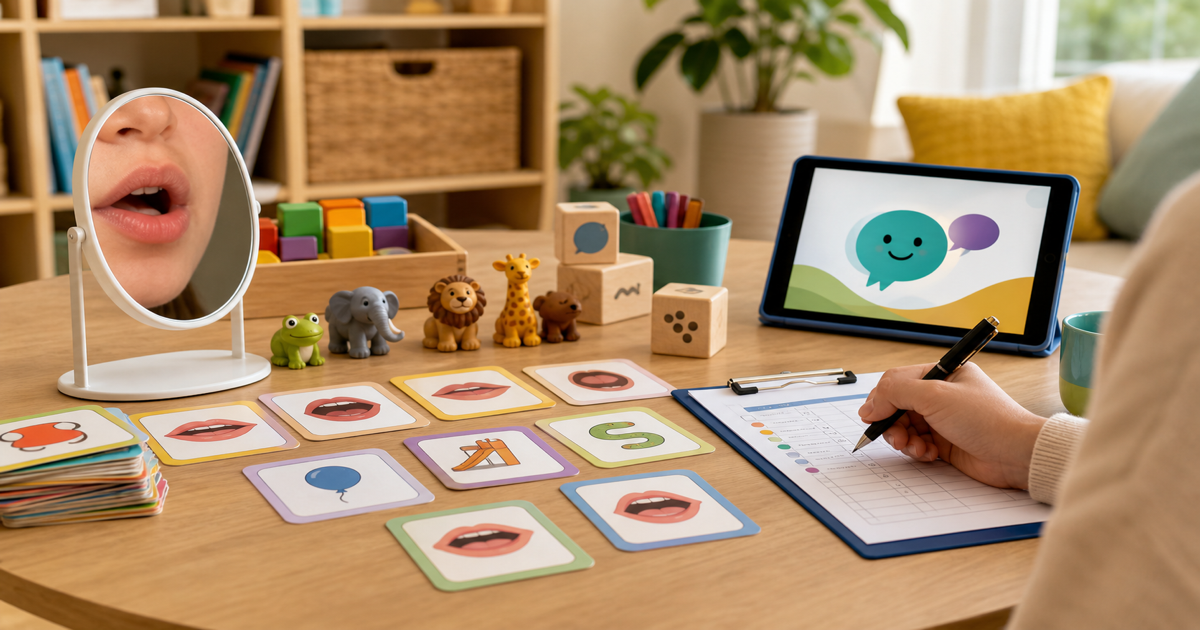
Young child and speech therapist practicing speech sounds with picture cards

Last updated 2026-07-09

TL;DR

Apraxia of speech is a neurological motor-planning disorder where the brain struggles to send the right movement signals to the mouth, lips, and tongue, even though the muscles themselves are fine. The child (or adult) knows what they want to say but cannot reliably get their mouth to do it. It is not caused by weakness and is not a language disorder, though the two can co-occur.

What does apraxia of speech actually mean?

The word comes from the Greek 'a' (without) and 'praxis' (action). Apraxia, in any form, means the brain cannot reliably plan and sequence voluntary movements even when the muscles involved are physically intact and capable. Applied to speech, that means the breakdown happens in the motor-planning and motor-programming stage, the step where your brain figures out exactly how to position and move your articulators (lips, tongue, jaw, soft palate) in the right order, at the right speed, with the right timing [1].

That distinction matters a lot clinically. A child with apraxia is not weak. Their tongue can lick an ice cream cone. Their lips can smile. The breakdown is upstream, in the neural instructions the brain sends. ASHA defines childhood apraxia of speech (CAS) as "a neurological childhood (pediatric) speech sound disorder in which the precision and consistency of movements underlying speech are impaired in the absence of neuromuscular deficits" [1].

Here is the simplest way to picture it. Imagine knowing every word you want to say but having your mouth scramble the order every time you try. Inconsistency is the hallmark. The same word said three times in a row might come out three different ways. That variability is what separates apraxia from most other speech sound disorders [2].

There are three recognized forms. Childhood apraxia of speech (CAS) appears during development, before the child has fully acquired speech. Acquired apraxia of speech (AOS) happens after the brain is injured, typically by stroke, traumatic brain injury, or a degenerative neurological condition. Apraxia can also co-occur with dysarthria (a weakness-based motor speech disorder) and with language disorders, which makes accurate diagnosis genuinely hard and worth getting from a qualified speech-language pathologist [1].

What are the main signs of apraxia of speech in children?

No single sign confirms apraxia. The diagnosis is clinical and needs a pattern. ASHA identifies three core diagnostic features of childhood apraxia of speech [1]:

1. Inconsistent errors on consonants and vowels across repeated productions of the same syllable or word. 2. Lengthened and disrupted coarticulatory transitions between sounds and syllables. 3. Inappropriate prosody, especially in the realization of lexical or phrasal stress (the child's rhythm and melody of speech sounds off).

Parents usually describe a child who seems to understand everything, follows directions well, but whose speech sounds garbled, effortful, or unpredictable. Some kids grope visibly, moving their mouth around silently before a sound comes out. Others speak more clearly when they are not thinking about it and fall apart when asked to repeat something on demand. That demand-task breakdown is a red flag [2].

Early signs in very young children (under 3) can include limited babbling as an infant, a first word or two that then disappears, very few consonant sounds, and heavy reliance on vowels or single syllables. Some children with CAS are virtually nonverbal at age 3 or 4 despite having no apparent cognitive delay [3].

Vowel errors are a strong clinical pointer. Most speech sound disorders affect consonants. Apraxia frequently distorts vowels too, which is unusual and worth flagging to an SLP. Children might say 'buh' for 'blue' or shift the vowel in ways that feel random rather than systematic [2].

Apraxia can look like other things: late talking, autism, dysarthria, a phonological disorder. A proper differential diagnosis from a licensed speech-language pathologist is the only way to know for sure. Self-diagnosis from a checklist is risky here. Not because parents can't observe accurately, but because the treatment approach changes a lot depending on the actual diagnosis.

How common is childhood apraxia of speech?

Exact prevalence numbers are hard to pin down because CAS is often misdiagnosed or lumped with other speech sound disorders. The most-cited estimate is roughly 1 to 2 children per 1,000, meaning about 0.1 to 0.2 percent of children [3]. Some estimates run slightly higher when broader diagnostic criteria are applied, but high-quality epidemiological data is thin.

Apraxia Kids cites figures suggesting CAS may affect up to 1 in 10 children with speech-language disorders referred for evaluation, though it stays relatively rare in the general population [3]. Boys are diagnosed more often than girls, at roughly a 2:1 to 3:1 ratio, though the reason for the sex difference is not well understood.

CAS is not rare enough to ignore and not common enough that every late talker has it. That ambiguity is part of why families sometimes wait years for the right diagnosis.

Core features that distinguish CAS from other speech sound disorders Presence of each feature across three common diagnoses (present = 1, absent/rare = 0, sometimes = 0.5) Inconsistent errors across same w… 1 Vowel distortions 1 Effortful groping/silent posturing 1 Errors increase with word length 1 Consistent error patterns (phonol… 0 Muscle weakness present (dysarthr… 0 Source: ASHA Childhood Apraxia of Speech Practice Portal, 2023

What causes apraxia of speech?

Here is where honest uncertainty is necessary. For many children diagnosed with CAS, no clear cause is ever identified. The condition is often called "idiopathic," which simply means the cause is unknown [1].

Where a cause can be found, it typically falls into one of three categories. First, known neurological conditions: CAS is associated with genetic syndromes including galactosemia, fragile X syndrome, Rett syndrome, and velocardiofacial (22q11.2 deletion) syndrome [4]. Second, brain injury: any prenatal, perinatal, or postnatal injury affecting the areas of the brain that control motor planning (particularly the left hemisphere motor cortex and basal ganglia pathways) can produce apraxia [1]. Third, complex neurodevelopmental conditions: CAS co-occurs at elevated rates with autism spectrum disorder, intellectual disability, and certain language disorders, though the direction of those relationships is still being studied [5].

Recent genetic research points to the FOXP2 gene, a transcription factor involved in speech and language development. Mutations or disruptions to FOXP2 have turned up in some families with a high rate of CAS and other speech-language disorders [4]. This does not mean CAS is always genetic, but it does mean a family history of speech or language difficulties is worth mentioning to the evaluating SLP.

For acquired apraxia of speech in adults, the cause is clearer. Stroke is the most common culprit, typically involving the left perisylvian region of the brain, particularly Broca's area and surrounding structures [1]. Head injury and progressive neurological diseases like primary progressive apraxia of speech (PPAOS) account for most remaining adult cases.

One thing that does not cause apraxia: inadequate language exposure, parenting style, or a bilingual household. Parents sometimes blame themselves. There is no evidence that anything a caregiver did or did not do causes CAS.

How is apraxia of speech diagnosed?

Diagnosis needs a full evaluation by a licensed speech-language pathologist (SLP), preferably one with experience in motor speech disorders. There is no single test that confirms CAS. The SLP works from a combination of case history, observation, and structured tasks [1][2].

A good evaluation usually includes an oral-motor exam (checking structure and function of the mouth, apart from speech), a speech sound inventory (what sounds the child produces and how consistently), connected speech samples, and structured repetition tasks where the child repeats words of increasing length and complexity. The repetition task is revealing because errors in apraxia tend to increase as word length increases, and the errors are inconsistent rather than systematic.

Some SLPs use formal assessment tools built specifically for suspected CAS. The Nuffield Dyspraxia Programme (NDP-3) and the Dynamic Evaluation of Motor Speech Skills (DEMSS) are two well-known options, though neither is universally required for diagnosis [2]. The Diagnostic Evaluation of Articulation and Phonology (DEAP) and other articulation tests may be given alongside them.

Parents should know that a diagnosis of CAS in a child under three is often described as "provisional" or "suspected" because very young children have limited speech samples to assess. That is not a cop-out. It reflects genuine diagnostic uncertainty at early ages. A re-evaluation at six months to a year is common and appropriate.

If your child has already seen an SLP and received a diagnosis of "phonological disorder" or "articulation disorder" but therapy is not making expected progress, it is reasonable to request a second opinion specifically looking at motor speech. CAS is frequently missed on first evaluation, particularly in younger children.

Is apraxia of speech the same as a language disorder?

No. These are different things, though they can and do co-occur.

Speech is the physical motor act of producing sounds. Language is the system of words, grammar, and meaning. Apraxia is a speech disorder, meaning the breakdown is in the mechanics of producing sounds, not in understanding or formulating language. A child with pure CAS often has age-appropriate language comprehension. They understand sentences, follow directions, and hold a rich vocabulary they simply cannot reliably produce [1].

That said, co-occurring language disorders are common in kids with CAS. Studies suggest somewhere between 60 and 80 percent of children with CAS also have expressive and/or receptive language difficulties, though the figures vary by study and sample [5]. The reverse is not true: most children with language disorders do not have CAS.

Apraxia also frequently co-occurs with autism spectrum disorder. The relationship is complex and still being studied. Children with autism who are minimally verbal or nonspeaking are sometimes found on evaluation to also have a motor speech disorder like CAS, which matters because the therapy approach is different [5]. If you want more on this intersection, the article on autism spectrum speech therapy covers it in more depth.

For similar reasons, apraxia is not the same as stuttering, cluttering, or a voice disorder. All of these are different conditions with different underlying mechanisms and different treatments.

How is apraxia of speech treated?

The most important thing to know about treating CAS: approaches designed for phonological disorders or articulation disorders are not the same as motor-speech-specific therapy, and using the wrong approach wastes time [1][6].

Motor learning principles drive effective CAS treatment. That means high repetition of specific movement sequences, immediate and frequent feedback, and systematic progression from easy to hard. ASHA's evidence maps identify several approaches with reasonable evidence behind them for CAS [6]:

Dynamic Temporal and Tactile Cueing (DTTC): A hierarchical cueing approach where the SLP starts with simultaneous production (saying the word together) and fades support as accuracy improves. Developed by Edythe Strand at Mayo Clinic, this is one of the most studied approaches for CAS [9].

Nuffield Dyspraxia Programme (NDP-3): A structured, systematic phonetic program that works from single sounds up through words and phrases with heavy emphasis on visual and tactile cues.

Rapid Syllable Transition Treatment (ReST): Designed for older children with CAS, focuses on blending syllables smoothly with correct stress patterns. A randomized controlled trial published in the Journal of Speech, Language, and Hearing Research found significant gains with ReST in school-age children with CAS [6].

PROMPT (Prompts for Restructuring Oral Muscular Phonetic Targets): A tactile-kinesthetic approach where the SLP uses touch cues on the face and jaw to guide movement. Evidence is positive but more limited than for DTTC.

Session frequency matters a lot. Research consistently shows that higher-frequency therapy (three to five sessions per week) produces faster gains in CAS than once-weekly sessions, particularly in younger children [6]. That intensity is hard to hit in school settings, which is one practical reason families sometimes pursue early intervention services or add home practice to school speech.

For children who are nonverbal or minimally verbal, augmentative and alternative communication (AAC) is not giving up on speech. It is a bridge. Evidence strongly supports using AAC devices alongside speech therapy, not instead of it, to reduce frustration and support language development while oral motor work continues [7].

For adults with acquired apraxia of speech, motor learning principles apply just as much. Treatment timelines vary dramatically depending on the cause and severity. After stroke, significant spontaneous recovery can happen in the first three to six months, and therapy during that window tends to be especially effective [1].

If you are exploring tools to support home practice between sessions, the Little Words app offers a short quiz to match your child's communication profile to appropriate activities.

What is the difference between apraxia of speech and dysarthria?

Both are motor speech disorders. Both affect how speech sounds are produced. They are not the same condition and they respond to different treatments [1].

Dysarthria is caused by neuromuscular weakness, slowness, or incoordination of the speech muscles themselves. The muscles are the problem. Think slurred speech in someone with cerebral palsy or after a stroke. The errors in dysarthria tend to be consistent and predictable because the same muscle limitation produces the same effect each time.

In apraxia, the muscles are fine. The problem sits in the programming step before the muscles act. Errors are inconsistent. The child might say 'spoon' correctly once and then say 'poon,' 'spune,' and 'foon' in three later attempts. That variability, with the correct production showing up sometimes, is a strong indicator of apraxia rather than dysarthria [2].

The two can co-occur, especially after brain injury or in children with complex neurological conditions. When they do, the SLP has to address both the motor programming deficits and the actual muscle function issues, which complicates treatment planning.

Can children with apraxia of speech learn to talk normally?

Outcomes vary a lot, and an honest prognosis depends on severity, age at diagnosis, treatment intensity, and whether other conditions co-occur. That said, the general picture for children with mild-to-moderate CAS who get appropriate, intensive therapy is genuinely positive.

Many children with CAS reach age-appropriate or near-typical speech intelligibility. Early diagnosis and high-frequency treatment from a qualified SLP are the strongest predictors of good outcome [6]. Severity matters. Children with severe CAS who are minimally verbal at age four have a harder road and may benefit from AAC long-term, though that does not rule out meaningful speech gains.

Children with CAS often keep showing some subtle differences into adolescence even when their speech is largely intelligible. Literacy difficulties, particularly with phonological awareness and spelling, are more common in kids with a history of CAS [3]. Watching for these and addressing them early with reading support makes a real difference.

For adults with acquired apraxia after stroke, recovery depends on lesion location and size, time since onset, and treatment intensity. Partial or full recovery of functional speech is realistic for many patients with mild-to-moderate AOS [1]. Severe AOS after a large left-hemisphere stroke may leave chronic significant impairment, in which case AAC and other strategies become long-term tools rather than temporary bridges.

The childhood apraxia of speech article on this site goes deeper on prognosis data and long-term outcomes specifically for pediatric cases.

What can parents do at home to help a child with apraxia?

Home practice genuinely speeds up progress when it is structured and consistent. The catch is that home practice should extend and reinforce what the SLP is doing, not replace it, and it works best when the SLP gives the family specific targets and techniques.

A few things are broadly supported and safe to do regardless of which approach the SLP is using.

Practice the same targets the SLP set, not random words. In motor learning, specificity matters. Practicing 'ball' does not automatically transfer to 'bell.' Work the list.

Keep sessions short and frequent. Ten minutes twice a day usually beats forty minutes on the weekend. Distributed practice is a well-established principle in motor learning research [6].

Reduce demand pressure. Children with CAS often perform worse when they feel tested. Turn repetition drills into games where the repetition happens naturally (naming cards in a Go Fish hand, commenting on a puzzle, building with blocks).

Model without requiring. Repeat the target clearly but do not force the child to say it correctly before moving on. Forced repetition under stress tends to increase groping and errors.

Celebrate approximations. A child reaching toward 'mama' with 'muh' is doing motor work. Reinforce the attempt, then model the full target back calmly.

If the child is frustrated by their own speech and shutting down, that is a sign the demands are too high or the current targets are not achievable. Talk to the SLP about recalibrating. Communication needs to stay worth trying.

For a broader look at what speech therapy looks like and how to work well with your child's SLP, that article covers the full parent-clinician partnership in detail.

How is apraxia different in adults versus children?

The core definition is the same: impaired motor planning and programming for speech in the absence of muscle weakness. But the clinical picture, causes, and treatment context differ in ways that matter [1].

In children, CAS shows up during the period when the brain is still learning to plan and sequence speech movements. In adults with acquired AOS, the motor programs were already built and then disrupted. So adults often keep more awareness of the mismatch between intended and produced speech, and they may feel significant frustration and emotional distress as a result.

Adults with AOS can also have co-occurring aphasia (a language disorder) because stroke and brain injury rarely hit only one function. When AOS and aphasia co-occur, treatment must address both, which requires careful sorting of what is a motor issue and what is a language issue [1].

Primary progressive apraxia of speech (PPAOS) is a distinct adult presentation where AOS appears and gradually worsens over years without significant aphasia or dementia, at least early in the course. It is caused by neurodegeneration affecting motor speech networks. Mayo Clinic researchers have done substantial work describing PPAOS as a separate entity from other progressive aphasia syndromes [1].

For adults working through acquired AOS, the speech therapy for adults article covers what evaluation and treatment look like in that context.

What questions should I ask when evaluating an SLP for apraxia treatment?

Not all SLPs have deep experience with motor speech disorders. CAS in particular needs specific training in approaches like DTTC, NDP-3, or ReST that are not universally taught in graduate programs. Pointed questions before you commit to an SLP can save months of ineffective therapy.

Good questions to ask:

Have you completed training specifically in childhood apraxia of speech, and which treatment approach do you primarily use? (Look for DTTC, NDP-3, ReST, or PROMPT with CAS caseload experience.)

How many children with CAS are currently on your caseload?

How often do you recommend sessions for a child with moderate CAS? (Appropriate answer: at least two to three times per week, with higher frequency preferred for younger or more severe children.)

How will you measure progress and share data with us? (An SLP using motor learning principles should be tracking accuracy across sessions and adjusting targets systematically.)

What will home practice look like, and how will you teach us to do it?

Do you have experience with AAC if speech progress is slow?

If an SLP tells you CAS therapy looks exactly like any other articulation therapy, or that once-weekly sessions will be enough for a young nonverbal child with suspected CAS, those are red flags. The online speech therapy article also covers how to vet telepractice options if in-person specialists are not accessible in your area.

Frequently asked questions

Is apraxia of speech the same as being a late talker?

No. Late talking broadly means a child is using fewer words than expected for their age, without a known cause. Apraxia of speech is a specific neurological motor-planning disorder. Some late talkers turn out to have CAS after evaluation, but most late talkers do not have apraxia. The key difference is that CAS shows inconsistent, effortful speech errors even as words emerge, more than a simple delay in when words appear.

Can a child have both autism and apraxia of speech?

Yes, and this co-occurrence is more common than many people realize. Research suggests a meaningful subset of minimally verbal children with autism also have a motor speech disorder, possibly including CAS. The two conditions call for different intervention approaches, so distinguishing them matters clinically. If your autistic child is nonspeaking or minimally verbal, asking an SLP to specifically evaluate for motor speech disorders is reasonable and may change the treatment plan.

What is the difference between apraxia of speech and a phonological disorder?

A phonological disorder involves patterns of sound errors that follow rules, such as consistently dropping final consonants or swapping one class of sounds for another. Apraxia shows inconsistent errors that do not follow a predictable pattern, along with groping, vowel distortions, and errors that worsen with longer or more complex words. The treatments differ: phonological disorder responds well to pattern-based approaches, while CAS needs motor-speech-specific therapy.

At what age can apraxia of speech be diagnosed?

Many SLPs are cautious about confirming CAS before age three because children have limited speech samples and some inconsistency is developmentally normal. A provisional diagnosis is often given earlier, with re-evaluation planned. By age three, a child with significant speech delay, inconsistent errors, limited consonant range, and vowel distortions can typically receive a working CAS diagnosis that guides treatment, even if it is labeled suspected or probable.

Does apraxia of speech affect reading and writing?

It can. Children with a history of CAS show higher rates of phonological awareness difficulties, which is a foundational skill for reading and spelling. Studies find that kids with CAS are at elevated risk for dyslexia and spelling difficulties even when their spoken speech improves significantly. Monitoring literacy development and seeking reading support early, rather than waiting for a child to fail, is a reasonable precaution for any school-age child with a CAS history.

Is apraxia of speech genetic?

Sometimes. Mutations in the FOXP2 gene have been linked to CAS and related speech-language disorders in some families, and a family history of speech or language difficulties shows up more often in children with CAS than in the general population. But many cases of CAS are idiopathic, meaning no genetic or neurological cause is identified. A family history is worth mentioning to the evaluating SLP and possibly to a developmental pediatrician.

How many speech therapy sessions does apraxia of speech require?

There is no fixed number. Severity, age, and how consistently home practice happens all affect the timeline. What research is clear about is frequency: high-intensity therapy, three to five sessions per week, produces faster gains than once-weekly sessions for children with CAS. Many families spend one to three years in active treatment for moderate CAS, with maintenance and monitoring stretching beyond that. Mild CAS diagnosed and treated early can resolve much faster.

Should a child with apraxia use AAC instead of working on speech?

AAC and speech therapy are not an either/or choice. Current evidence supports using AAC alongside speech therapy to reduce frustration and support communication while oral motor work continues. AAC does not reduce motivation to speak or replace speech development. For a nonverbal or minimally verbal child with CAS, introducing AAC early while keeping intensive speech therapy going is considered best practice by ASHA and Apraxia Kids.

Can apraxia of speech go away on its own without therapy?

Spontaneous resolution without therapy is not well documented for CAS. Some children with very mild motor speech difficulties do improve with maturation, but CAS as a confirmed diagnosis typically needs structured, motor-speech-specific intervention to reach functional speech. Waiting to see if a child grows out of it, especially past age three, risks losing the window where intensive early therapy tends to be most effective. Early action matters.

What is primary progressive apraxia of speech?

Primary progressive apraxia of speech (PPAOS) is a neurodegenerative condition in adults where apraxia of speech gradually worsens over years. Unlike AOS after stroke, it is not caused by a discrete brain injury but by progressive neuronal loss in motor speech areas, particularly the left premotor cortex. It differs from other progressive aphasias in that language comprehension and cognition are often preserved early in the course. It is relatively rare.

How do I find an SLP who specializes in apraxia of speech?

Apraxia Kids maintains a provider directory specifically for practitioners who have completed CAS-specific training, searchable by location and including telepractice providers. ASHA's ProFind directory also lets you filter by specialty area. When contacting an SLP, ask directly about their experience with motor speech disorders and which treatment approaches they use for CAS. General speech therapy experience alone is not enough for this diagnosis.

Is there a cure for apraxia of speech?

Cure is not the right frame. CAS is a motor-planning disorder that, with appropriate intensive therapy, many children learn to manage so well that their speech becomes fully or nearly fully intelligible. Some residual effects on literacy or prosody may persist. The goal is functional, intelligible communication, and that goal is realistic for most children with mild to moderate CAS who receive consistent, appropriate therapy starting early.

What does apraxia of speech sound like?

It sounds inconsistent and effortful. You might hear a child say 'spaghetti' clearly once and then say 'skabetti' and 'paghetti' in the next two tries. Vowels are often distorted. Longer words tend to fall apart more than short ones. You may see visible groping, the mouth moving silently or in searching motions before sound comes out. Prosody can sound off, with stress placed oddly or sentences sounding choppy and monotone.

Sources

  1. American Speech-Language-Hearing Association (ASHA), Childhood Apraxia of Speech Practice Portal: ASHA defines CAS as a neurological childhood speech sound disorder in which precision and consistency of movements underlying speech are impaired in the absence of neuromuscular deficits; also covers acquired AOS and PPAOS definitions and treatment frameworks
  2. Shriberg LD, Aram DM, Kwiatkowski J. Developmental apraxia of speech: I. Descriptive and theoretical perspectives. Journal of Speech, Language, and Hearing Research, 1997: Inconsistent speech sound errors and vowel distortions as distinguishing features of childhood apraxia of speech compared to other speech sound disorders
  3. Apraxia Kids, What is Childhood Apraxia of Speech: Prevalence estimates of approximately 1 to 2 per 1,000 children; elevated rates of literacy difficulties in children with CAS history
  4. Lai CS, Fisher SE, Hurst JA, Vargha-Khadem F, Monaco AP. A forkhead-domain gene is mutated in a severe speech and language disorder. Nature, 2001: FOXP2 gene mutations linked to severe speech-language disorder including features of apraxia of speech across multiple generations of a family
  5. ASHA, Childhood Apraxia of Speech Practice Portal, Assessment and Co-occurring Conditions section: CAS commonly co-occurs with expressive and receptive language disorders, autism spectrum disorder, and intellectual disability; language difficulties reported in a majority of children with CAS
  6. Murray E, McCabe P, Ballard KJ. A Randomized Controlled Trial for Children with Childhood Apraxia of Speech. Journal of Speech, Language, and Hearing Research, 2015: ReST treatment produced significant gains in school-age children with CAS; high-frequency treatment sessions linked to faster gains
  7. ASHA, Augmentative and Alternative Communication (AAC) Practice Portal: AAC does not impede speech development and is supported alongside speech therapy for children with severe CAS or limited verbal output
  8. National Institute on Deafness and Other Communication Disorders (NIDCD), Apraxia of Speech: Federal agency overview of apraxia of speech definition, causes including neurological basis, and treatment options
  9. Strand EA. Dynamic Temporal and Tactile Cueing: A Treatment Strategy for Childhood Apraxia of Speech. American Journal of Speech-Language Pathology, 2020: DTTC described as hierarchical cueing approach developed by Strand at Mayo Clinic with evidence for CAS treatment
  10. American Academy of Pediatrics (AAP), Identifying Infants and Young Children with Developmental Disorders in the Medical Home, Pediatrics 2006: AAP guidance on developmental surveillance supporting early identification and referral for speech-language concerns in young children
  11. CDC, Language and Speech Milestones, Learn the Signs Act Early: Federal developmental milestone guidance against which early signs of speech delay and suspected CAS are evaluated
Little Words is a talk-with-Buddy app built for kids like yours.

Buddy is a voice-first speech companion your child actually talks to, made for late talkers and neurodivergent kids. It is free to download on the App Store.

Download on the App Store