Last updated 2026-07-11
TL;DR
Shyness is a temperament trait: a shy child speaks less around strangers but warms up within 10 to 20 minutes. Selective mutism is an anxiety disorder. A child who chats freely at home consistently can't speak in specific social settings, even after months of exposure to them. The distinction matters because selective mutism needs targeted treatment, not more patience.
Shyness, plainly
Shyness is a trait, not a disorder. About 15 to 20% of children are born with what researchers call "behavioral inhibition," a tendency to hang back, watch before joining in, and need extra time to settle into new situations [1]. It appears in toddlerhood and runs in families to some degree.
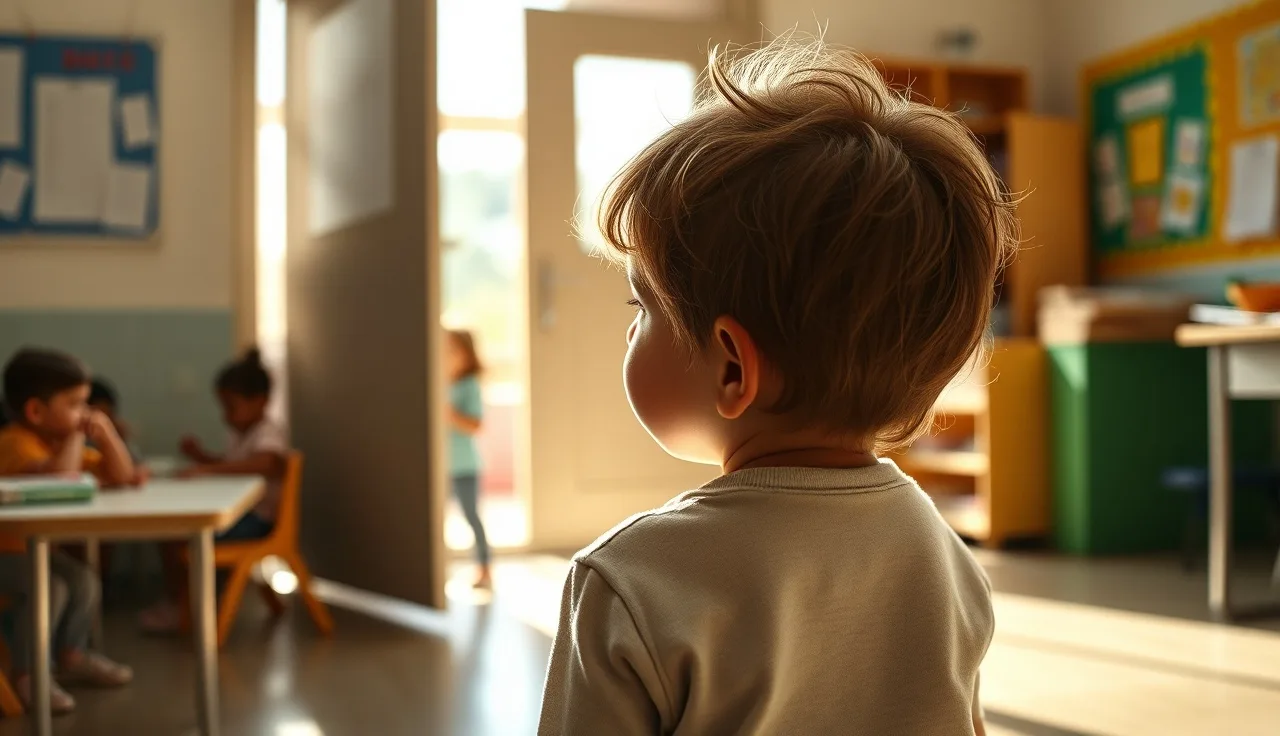
A shy child might hide behind a parent's leg when a stranger says hello, stay quiet when the teacher calls on them on the first day of school, or speak softly in a group. But they do eventually talk. Given time, familiarity, or the right playmate, the words come out. The silence passes.
Shyness sits on a spectrum, from mildly reserved to something closer to frozen in new situations, and neither end automatically signals a problem. Plenty of shy children grow into adults who see their caution as a strength.
What selective mutism actually is
Selective mutism (SM) is classified in the DSM-5 as an anxiety disorder, not a communication disorder [2]. The American Psychiatric Association's criteria include: consistent failure to speak in specific social situations where speech is expected, silence that gets in the way of school or social life, a duration of at least one month (not counting the first month of school), and speech that isn't blocked by unfamiliarity with the language or better explained by another communication disorder or psychosis [2].
The name is misleading, since it sounds like the child is choosing silence as a kind of protest. They aren't. SM is a speech-specific anxiety response: the nervous system treats speaking in certain contexts as a threat and shuts down vocalization. Many kids with SM can mouth words, whisper, or talk to one trusted peer off in a corner, but they can't produce voiced speech for a teacher or on the phone.
Prevalence estimates run around 0.7 to 2.2% of school-age children, usually starting between ages 2 and 5 [3]. It shows up more in children who are already shy or anxious, or who have a family history of anxiety, but shyness by itself doesn't cause it.
Speech and language are usually intact. This isn't a speech therapy speech therapist issue in the usual sense, since the child has the words, the grammar, and the motor plans ready to go. The barrier is psychological. That said, some children do have co-occurring speech or language differences, including apraxia of speech, which complicates the picture.
Telling them apart
Laid out side by side, the differences are easier to see.
| Feature | Shyness | Selective Mutism |
|---|---|---|
| Speaking at home | Yes, freely | Yes, freely and often loudly |
| Speaking with close family friends | Yes, after warm-up | Often no, or only whispering |
| Warm-up period | Usually 10-30 minutes | Months of exposure with little change |
| Interferes with school functioning | Rarely | By definition, yes |
| Duration of silence in specific settings | Fades as child gets comfortable | Persists, often worsens without treatment |
| Child's affect during silence | Shy, awkward, embarrassed | Often flat, frozen, or visibly distressed |
| Family history of anxiety | Possible | Very common [3] |
| Response to gentle pressure to talk | May respond with encouragement | Pressure usually worsens the freeze |
One useful question to ask yourself: has your child ever warmed up in this particular setting after repeated exposure to it? If the answer is no, and the setting has been part of their life for more than a month or two, that's worth paying attention to.
Another clue is the contrast between home and elsewhere. Kids with SM are often described as a completely different child at home: narrating long stories, singing, arguing, bossing siblings around. A parent who's watched their child stand mute and rigid at the same birthday party for the tenth time knows this isn't slow warm-up. That contrast carries real weight [3].
Can a child be shy and have selective mutism?
Yes, and the overlap is common. Research consistently finds that most children with SM also score high on measures of behavioral inhibition and social anxiety [3]. Shyness is a risk factor for SM, not another name for it.
Think of shyness as the soil and anxiety as the seed. Not every shy child develops SM, just as not every anxious child does. But when the two combine in a child with certain temperamental sensitivities, often around a big transition like starting school or moving to a new country, SM can take hold.
Calling a child "just shy" can delay the right help. Many families wait two to four years before seeking an evaluation, often because teachers and pediatricians reassure them the child will grow out of it [4]. Sometimes that's true. But for children who meet SM criteria, waiting without doing anything tends to entrench the pattern rather than resolve it.
Where pediatricians and schools get it wrong
Both shyness and SM can look like a quiet, compliant kid who just needs time. That's the trap.
A pediatrician sees a child for 15 to 20 minutes, often with a parent present in a familiar setting where the child does talk. A child with SM might whisper answers to the parent, who relays them to the doctor, and the doctor sees a shy kid rather than one who hasn't spoken at school in six months.
Schools sometimes accommodate instead of addressing the issue directly. A kind, patient teacher may accept nods, pointing, or written answers, which takes off the pressure but also removes any push toward recovery. The child feels safe in that adapted environment but doesn't actually move forward. The American Speech-Language-Hearing Association (ASHA) notes that SM is frequently undiagnosed or mistaken for shyness, oppositional behavior, or a language barrier in bilingual children [5].
Bilingual and multilingual children get misread the most. A child who's silent in their second language at school may simply be in the normal silent period of second-language acquisition, which usually resolves within six months to a year, or they may be developing SM. The difference: a child in that language-exposure silent period is usually social nonverbally, warms up over time, and starts using the new language bit by bit. A child with SM stays frozen even in their first language with certain people [5].
What causes it
There's no single cause. The evidence points to a mix of genetic predisposition to anxiety, temperamental behavioral inhibition, and environmental triggers [3].
Family history matters a lot. Studies find higher rates of social anxiety disorder and other anxiety disorders among first-degree relatives of children with SM [3]. The child didn't choose this, and neither did the parents.
Some children develop SM after a specific stressor, such as a hospitalization, a move, a new sibling, or starting a new school. Others seem to have always had it, with no clear trigger. There's early evidence that some children with SM process social cues differently in the amygdala (the brain's threat-detection center), though that research is still thin.
SM isn't caused by trauma or abuse, though trauma can sometimes trigger similar patterns. It's also not caused by bad parenting, permissiveness, or giving in to a child's silence.
When to get an evaluation
The DSM-5's one-month rule is a floor, not a wait-and-see suggestion. If a child who talks normally at home has been consistently silent in school or other social settings for four or more weeks past the usual adjustment period, it's worth talking to someone [2].
Start with the child's pediatrician, who can rule out other causes and give a referral. The evaluation itself is usually done by a psychologist (for the anxiety piece), a speech-language pathologist experienced with SM, or both. ASHA recommends a team approach, since SM sits at the crossing point of anxiety, communication, and school life [5].
Getting help early makes a real difference in outcomes. The longer SM goes unaddressed, the more it compounds: missed social learning, academic gaps, and a child who starts to see themselves as "the one who doesn't talk," an identity that can linger even after the mutism itself lifts.
If you're not sure where to start, a speech-language pathologist can help figure out whether the issue is mainly anxiety-based or whether there are also speech or language differences that need attention in their own right. For children on the autism spectrum, the picture gets more layered, and autism spectrum speech therapy may end up being part of the plan alongside SM-specific treatment.
What does treatment for selective mutism look like?
The treatment with the strongest evidence behind it is behavioral and cognitive-behavioral therapy (CBT), built around graduated exposure [6]. The idea is simple even though the process is slow: raise the social demands on the child bit by bit, so confidence builds and the anxiety response drops one step at a time.
A typical exposure hierarchy for a child who can't speak at school might go like this: the therapist visits the school, the child communicates nonverbally with the therapist, then whispers to the therapist, then speaks quietly with the therapist while a peer sits nearby, and eventually the peer joins the conversation. Each step gets repeated until the child feels comfortable before anyone moves to the next one. This can take months.
Parents play a central role. They learn interaction styles that ease off the accommodation of silence without adding pressure, things like playfully ignoring silences, narrating activities without expecting a verbal reply, and reacting warmly to any vocalization at all.
When anxiety is significant, a child psychiatrist may bring up medication. SSRIs have evidence supporting their use alongside behavioral treatment in selective mutism, though medication is rarely the first or only approach [7]. That decision weighs the severity of the child's impairment against possible side effects, and it belongs with a clinician, not a parent forum.
School supports matter as well. A 504 plan or IEP can formalize accommodations during treatment, though the point of those accommodations is to ease distress, not to let the child avoid speaking indefinitely. ASHA and the Selective Mutism Association both publish guidance for educators trying to strike that balance [5].
Some families also find tools that lower communication pressure useful alongside treatment. Little Words (littlewords.ai) offers an AI speech companion that lets kids practice communicating without the stakes of a live social situation, a low-pressure supplement while working with a therapist. It isn't a substitute for professional SM treatment.
Does selective mutism go away on its own?
Sometimes, though the long-term data is limited. Some studies suggest a meaningful share of children with SM improve significantly by adolescence even without formal treatment. But improvement doesn't always mean full recovery, and it often comes at a cost: years of social isolation, academic struggles, and anxiety that shows up in other forms later [4].
Kids who get targeted treatment earlier tend to do better. A 2015 review in the Journal of the American Academy of Child and Adolescent Psychiatry found that behavioral interventions produced response rates of 67 to 91% in treated samples, compared to much more modest spontaneous remission in untreated groups [6]. Those figures are rough, since SM research tends to run on small samples with inconsistent outcome measures, but the direction of the evidence is clear enough.
The children most likely to resolve without treatment tend to have mild SM, strong family support, and a school setting that naturally provides graduated exposure. Kids with more severe presentations, higher baseline anxiety, and rigid avoidance patterns are less likely to outgrow it on their own.
How is selective mutism different from autism-related communication differences?
This trips up a lot of parents, and some clinicians too. Autism can involve reduced or absent speech in certain settings, and some autistic children are selectively verbal in ways that look like SM on the surface. But the mechanisms underneath are different, and that distinction shapes treatment.
In SM, the child has full capacity for speech and uses it freely at home. The silence is tied to specific situations and driven by anxiety. In autism, reduced speech may reflect differences in social motivation, sensory processing, pragmatic language, or motor planning, not necessarily anxiety in the same sense [8]. Some autistic children also have genuine SM alongside autism, which is exactly why a careful evaluation from someone experienced in both conditions matters.
Echolalia, scripted speech, and other autism-related patterns are distinct from the frozen silence of SM. If you're trying to figure out where your child's speech differences fit, reading about echolalia or the wider picture of autism spectrum speech therapy can help frame the conversation with an evaluator.
Worth knowing: some children eventually identified as autistic spent years being described as just shy or as having SM. A full evaluation from a multidisciplinary team, rather than a speech therapist working alone, usually gives the clearest picture.
What can parents do at home right now?
If you're waiting on an evaluation or just starting treatment, some things help and some backfire badly.
Don't pressure. Saying "just say thank you" or "tell Grandma what you told me" when a child is frozen in SM anxiety almost never works. It raises the stakes, deepens the freeze, and can build dread around the next social event. This is one of the hardest habits for parents to break, because it feels like the obvious fix.
Do reduce demand gradually. The same graduated exposure logic used in therapy works gently at home too. If your child can whisper to you but not to Grandma, start by sitting near Grandma and whispering to each other, asking nothing of Grandma at all. Close that gap slowly, over weeks.
Narrate without requiring a response. Read aloud, describe what you're doing, keep talking in the room without asking your child to perform.
Validate what's happening: "I know it's hard to talk in some places. That's okay. We're working on it." Never treat silence as a choice or a behavior problem. Your child isn't being difficult.
Talk to the school. Teachers who understand SM can skip cold-calling the child, build in nonverbal ways to participate during treatment, and watch for peer interactions that might turn into natural exposure opportunities.
For families wanting structured practice between therapy sessions, apps built for low-pressure communication can fill part of that gap. Little Words (littlewords.ai/start) has a quiz that can help pinpoint where your child is struggling and suggest next steps.
What questions should I ask a clinician during an evaluation for selective mutism?
Walking in prepared makes a real difference. A few questions worth asking:
How many children with SM have you evaluated or treated? SM is specialized enough that experience shows. A clinician who's seen five cases thinks differently than one who's seen fifty.
Will you observe my child at school, or review school reports? SM is context-dependent, and an in-office evaluation alone can miss how severe things are at school.
What's your approach to graduated exposure, and how will you involve us as parents? Parent coaching is part of best-practice SM treatment, so if the answer is "we'll work with your child weekly and update you afterward," take that as a red flag.
Do you have experience with bilingual children? Ask directly if it's relevant to your family.
If medication comes up, what's the evidence behind it, and what's the monitoring plan?
How will you coordinate with the school? A good evaluator wants contact with teachers and, ideally, a school observation or consultation.
The Selective Mutism Association keeps a directory of clinicians with specific SM training at selectivemutism.org [9]. Starting there often turns up someone more experienced than a general-practice therapist.
Parents usually start asking about selective mutism somewhere between ages 2 and 5, though most cases get picked up once a child starts school and suddenly has to talk in front of unfamiliar people every day. Some kids show signs as toddlers; others hold it together through preschool and then hit a wall in kindergarten. If it shows up for the first time after age 8, that's less typical and worth a broader evaluation. Waiting it out is tempting, but it's not free. Some children do improve on their own, but research shows behavioral treatment gets response rates of 67 to 91% in treated groups, and starting earlier tends to lead to better outcomes. Kids with more severe SM, higher baseline anxiety, or rigid avoidance patterns are the ones least likely to grow out of it without help. A clinical evaluation can tell you where your child actually falls before you decide to just wait. Shyness and selective mutism overlap constantly, in fact it's the most common pattern clinicians see. Most children with SM are shy or inhibited by temperament, but shyness is a risk factor, not the same thing as the disorder. If your shy child still hasn't warmed up in a familiar setting after months of exposure, or the silence is creating real problems at school, that's a reason to get an evaluation rather than lean on "shyness is normal." Selective mutism is not autism. It's classified as an anxiety disorder. Some autistic children do also have SM, and some kids first flagged for SM turn out to be autistic later, so the overlap is real, but the distinguishing factors are whether the child speaks fully and normally at home, whether the silence is driven purely by anxiety, and whether there are other social communication or sensory differences in the picture. Diagnosis comes from a clinician, usually a psychologist, psychiatrist, or an experienced speech-language pathologist, checking the child against DSM-5 criteria: consistently not speaking in specific settings despite speaking fine elsewhere, for at least a month (not counting the first month of school), with real functional impairment as a result. A solid evaluation usually pulls in school observations, parent interviews, and standardized anxiety measures too. There's no single test that nails it down. None of this touches intelligence or language ability. Kids with SM typically have normal intelligence and fully intact language skills, the block is anxiety, not a knowledge or language gap. At home, plenty of these children are talkative, creative, even verbally sophisticated. That gap between how they talk at home and how silent they go in public is one of the clearest signs of the condition. Bilingual and multilingual kids carry a higher risk of being misdiagnosed, because normal second-language acquisition can include a "silent period" lasting several months that looks a lot like SM from the outside. The difference shows up in behavior: a child going through normal language acquisition will still warm up socially using their first language and show sociability without words, gradually picking up the new language over time. A child with SM stays frozen even in their first language with certain people, and often stays silent in their home language at school too. Selective mutism and speech delay are different problems entirely. A speech delay means the child doesn't yet have age-appropriate language skills and so talks less across the board. A child with SM has fully developed speech, talks fluently at home, and simply can't produce speech in certain social settings because of anxiety. Normal speech at home is the clearest way to tell the two apart. There's no set timeline for treatment. A child with mild SM in a supportive school can make real progress within a single school year of behavioral treatment. More severe cases, especially ones caught later or layered with other anxiety disorders, can take two or more years of active work. Progress rarely moves in a straight line: expect plateaus that last months, followed by sudden jumps forward after some new exposure opportunity clicks. Tell the teacher, and do it early. A teacher who understands SM will skip the things that make the freeze worse, cold-calling, forcing a public answer, treating silence as defiance, and instead become someone who helps set up low-pressure chances for the child to speak. Even sharing basic information while you're still mid-evaluation helps the school work with the treatment instead of against it. Medication, usually SSRIs, sometimes comes into play for children with significant anxiety that isn't responding to behavioral therapy on its own, but it's rarely used as a first-line treatment by itself and works best paired with graduated exposure therapy. That decision belongs to a child psychiatrist weighing severity, impairment, and the family's situation. Plenty of kids improve a lot with behavioral treatment alone. If you're looking for a specialist, the Selective Mutism Association (selectivemutism.org) keeps a clinician directory, and ASHA's ProFind tool (asha.org) helps you find speech-language pathologists with SM experience. When you call around, ask how many SM cases a clinician has actually treated rather than whether they're familiar with the diagnosis. Experience varies a lot among general anxiety therapists who list SM as one of their specialties.Sources
- Harvard Center on the Developing Child, Behavioral Inhibition overview: Approximately 15-20% of children are born with behavioral inhibition, a tendency to withdraw in novel situations, which is partly heritable.
- American Psychiatric Association, DSM-5 Diagnostic Criteria for Selective Mutism: DSM-5 classifies selective mutism as an anxiety disorder requiring consistent failure to speak in specific social situations, lasting at least one month (not counting the first month of school), with functional impairment.
- Muris P & Ollendick TH, Clinical Child and Family Psychology Review, Selective Mutism (2015): Prevalence estimates for selective mutism range from 0.7-2.2% of school-age children; most children with SM score high on behavioral inhibition and social anxiety, and family history of anxiety disorders is very common.
- Selective Mutism Association, About Selective Mutism: Many families wait two to four years before seeking an evaluation, often after repeated reassurances that the child will outgrow the silence.
- American Speech-Language-Hearing Association (ASHA), Selective Mutism practice portal: ASHA notes that SM is frequently undiagnosed or misidentified as shyness, oppositional behavior, or a language barrier in bilingual children, and recommends a team approach to evaluation.
- Cohan SL et al., Journal of the American Academy of Child and Adolescent Psychiatry, behavioral interventions in selective mutism (2015 review): A review found behavioral interventions produced response rates of 67-91% in treated samples of children with selective mutism.
- American Academy of Pediatrics (AAP), Autism Spectrum Disorder overview: In autism, reduced or absent speech may reflect differences in social motivation, sensory processing, pragmatic language, or motor planning rather than anxiety-driven inhibition of available speech.
- Selective Mutism Association, Clinician Directory: The Selective Mutism Association maintains a directory of clinicians with specific SM training.
- ASHA ProFind, Speech-Language Pathologist Locator: ASHA's ProFind tool allows families to locate speech-language pathologists by specialty, including selective mutism.
- Centers for Disease Control and Prevention (CDC), Developmental Milestones and Early Intervention: Early identification of communication and behavioral differences in young children leads to better outcomes, supporting the case for timely evaluation when SM is suspected.