Last updated 2026-07-09
TL;DR
The best ways to encourage a toddler to talk are responding to every communication attempt, narrating your own actions, reading aloud daily, and keeping screens below the AAP limit of one hour per day for ages 2 to 5. If your child has no words by 12 months or fewer than 50 words by age 2, ask your pediatrician about a speech-language evaluation.
Getting a toddler to talk more isn't about drilling words or running flashcard sessions. It's about building conditions where talking feels worth the effort. Toddlers learn language roughly the way they learn to walk: they try something, get a response, and try again. Your main job is making sure the response reliably shows up.
The American Speech-Language-Hearing Association describes language development as a process that depends on rich, responsive environments where children hear a lot of varied speech and get responded to contingently [1]. Contingent means you respond to what your child just did or said, not what you wish they'd done. A toddler points at a dog; you say "dog, yes, big brown dog." That loop is the engine behind most of what follows.
This matters more than people expect. A widely cited 2017 analysis by Gilkerson and Richards at the LENA Research Foundation found that conversational turns between caregiver and child predicted language outcomes at age three far better than the raw number of words a child heard [2]. Talking at your child helps. Talking with them helps far more.
What's normal between 12 and 36 months
Before worrying about whether your child is behind, it helps to know what the ranges actually look like. These aren't hard cutoffs, just medians from population data, and kids vary a lot.
| Age | Typical milestones |
|---|---|
| 12 months | 1 to 3 words; waves bye-bye; points; responds to name |
| 15 months | 5 to 10 words; points to get needs met |
| 18 months | 10 to 20 words; uses words more than gestures |
| 24 months | 50+ words; combines two words ("more juice," "daddy go") |
| 30 months | 200 to 300 words; mostly understood by familiar adults |
| 36 months | 400 to 1,000 words; speaks in short sentences; understood by strangers ~75% of the time |
The CDC's developmental milestone checklist, updated in 2022, lists some of these thresholds as action points rather than reference ranges [3]. The revision lowered several thresholds on purpose, because catching things earlier means help arrives earlier too. If your child isn't meeting the 24-month or 36-month markers above, that's worth a conversation with your pediatrician. Not a reason to panic, just a reason to act.
One number tends to surprise parents: the 50-word vocabulary at age 2 is the single best-studied predictor of later language outcomes. Kids who reach it are far less likely to still have meaningful language delays at school age. Kids who don't reach it by 24 months are sometimes called "late talkers," and a portion of them catch up on their own. But "some catch up" isn't the same as "most catch up," and the ones who don't tend to benefit a lot from getting early intervention started.
The daily habits that actually move the needle
A handful of techniques have real research behind them, and none of them cost anything.
Narrate your own actions as you go about the day, sometimes called "sportscasting": "I'm washing the dishes. Hot water. Soap. Bubbles." It feels odd at first. Do it anyway. It fills your child's world with language attached to something real and visible.
Follow your child's lead rather than your own agenda. Whatever your toddler is looking at or playing with right now is the best possible topic. Research on joint attention shows that words learned when a child is already focused on the object stick better than words introduced to redirect their attention elsewhere [4]. If she's pushing a truck, talk about the truck, not the colors of a toy she abandoned five minutes ago.
Expand on what they say instead of correcting it. When your toddler says "more," you say "more crackers? Okay, more crackers." When they say "doggie," you say "yes, that doggie is running." You're modeling a slightly longer version, not fixing a mistake. Researchers call this "expansion" or "recasting," and it's one of the most studied strategies in the parent-training literature [5].
Create small reasons for your child to need to communicate. Put a favorite snack in a clear container they can see but not open, then wait a beat. Leave gaps in routines they know by heart: start singing "The wheels on the bus, the wheels on the bus..." and pause before the next line. These setups give a toddler a reason to speak up instead of just absorbing language passively.
And read aloud every day. It sounds almost too simple, but it works. The American Academy of Pediatrics recommends reading aloud beginning at birth and continuing through the early childhood years [6]. Picture books give toddlers repeated exposure to vocabulary in a predictable, low-pressure setting, and board books, where the child controls the pace and points at pictures, are especially good at this age.
Three things you can stop worrying about: perfect pronunciation, whether your child is bilingual (bilingualism doesn't cause delays [1]), and whether you're doing all this right enough. Consistency beats perfection by a wide margin.
Does screen time really affect speech?
Yes, and the mechanism isn't mysterious. Screens don't respond to your child. They broadcast language at a child who sits there passively, so the conversational turn-taking that drives language learning simply doesn't happen.
The AAP's current guidance limits screen time to no more than one hour per day of high-quality, co-viewed content for children aged 2 to 5, and recommends avoiding digital media entirely (except video chat) under 18 to 24 months [7]. Video chat gets a pass because it keeps the back-and-forth intact.
A 2019 study published in JAMA Pediatrics found that each additional 30 minutes of handheld screen time at age 18 months was associated with higher odds of expressive language delay at age 3 [8]. That held even after adjusting for other factors. Nobody's proven causation in a randomized trial, and probably nobody will, but ASHA and AAP both point the same direction.
If your child is already attached to a screen, skip the cold-turkey approach. Swap passive viewing for co-viewing, where you narrate and comment alongside the show, and replace some solo screen time with anything where you two face each other and take turns.
What if your toddler understands everything but doesn't say much?
This is the classic "he understands everything I say" situation, and it deserves a real answer.
Expressive language (talking) and receptive language (understanding) run on different systems. Some children have solid comprehension and lagging output. When a child genuinely understands age-appropriate language, that's a good sign: the underlying comprehension and auditory processing are working. But good understanding doesn't cancel out a word-count concern.
A 24-month-old with 10 words and strong comprehension still has a delay worth looking into. The cause matters. It could be a motor speech issue like childhood apraxia of speech, a hearing problem, temperament, or something else, and a speech-language pathologist can help figure out which. Waiting to see if expressive language catches up on its own is a legitimate option for mild delays, but it should be a choice made with a clinician, not a default because you're hoping the problem resolves itself.
Watch also for social communication differences: limited eye contact, not responding to their name, or not pointing to share interest (as opposed to pointing to get something). Those are a separate flag worth raising with your pediatrician sooner rather than later, since that pattern can point toward autism spectrum differences where early help matters a great deal, something covered in more depth in this piece on autism spectrum speech therapy.
Serve and return: why pediatricians keep bringing it up
"Serve and return" is a term from developmental neuroscience, popularized by Harvard's Center on the Developing Child, describing the back-and-forth between a caregiver and a young child. The child does something (the serve): babbles, points, reaches, makes eye contact. The adult responds warmly and in a way that fits what just happened (the return). Then it repeats.
The Center on the Developing Child describes this as the mechanism that builds early brain architecture: "Serve and return interactions shape brain circuitry and lay the foundation for language, reasoning, and social development" [9]. That's not a figure of speech. Repeated activation of neural circuits through interaction physically shapes synaptic connections in the developing brain, especially in the first three years.
In practice it comes down to three things: noticing your child's bids, which are often subtle (a gaze shift, a point, a reach, a sound), responding to them even when you're not sure what they meant, and keeping the exchange going for as many rounds as it'll naturally run.
Most parents already do this by instinct. Naming it just helps you do it more deliberately, and helps you notice the things that break the loop: distracted responses, missed bids, or jumping in to direct instead of follow.
Does asking fewer questions actually help toddlers talk?
It sounds backward, but yes. Parents often pile on questions when they want a toddler to talk: "What's that? What color is it? Can you say 'cat'?" The trouble is that questions put a child on the spot. A toddler who isn't sure what to say will often stay quiet rather than risk getting it wrong.
Comments work better than questions, and there's research behind this. Instead of "what's that?" try "look, a cat." Instead of "what color is the ball?" try "that ball is red." You're modeling language instead of testing your child on it. ASHA's guidance on language stimulation for late talkers specifically recommends trading direct questions for comments and expansions [1].
That doesn't mean all questions are a problem. Open-ended ones with no wrong answer, like "what do you want to do?" or "where should we go?", are fine. It's the closed comprehension checks, "what's the dog doing? Can you say it?", that tend to create anxiety instead of language.
One type of question-shaped prompt does work well for a lot of toddlers though: fill-in-the-blank routines. "Ready, set..." (pause for "go!"). "One, two..." (pause for "three!"). A familiar rhythm gives the child a predictable, low-stakes way to jump in.
When is it time for a professional speech evaluation?
If you're worried, you can ask for an evaluation now. There's no need to wait for a particular birthday, and you don't need a pediatrician's referral to contact your state's early intervention program yourself.
In the US, children under 3 are entitled to a free evaluation through their state's Early Intervention program under IDEA, Part C [10]. Once a child turns 3, services move to the local school district under IDEA Part B. Either process can be started by you, directly, by contacting your state's lead agency. No doctor's note required.
Some signs mean it's worth acting rather than waiting: no babbling by 12 months, no words by 16 months, no two-word phrases by 24 months, any loss of language skills at any age, or concerns about hearing. The AAP recommends developmental screening at every well-child visit at 9, 18, and 30 months, plus autism-specific screening at 18 and 24 months [6].
When you can't tell if what you're seeing is a real delay or just normal variation, a speech-language pathologist can tell you, since an evaluation is diagnostic more than it is treatment. You come away with real information about where your child stands, and that's worth having no matter what it shows.
Families who can't easily get to in-person appointments now have another option: online speech therapy has expanded a great deal since 2020, and the evidence for its effectiveness with toddlers keeps improving.
What helps between speech therapy sessions?
If your child is already in therapy, your SLP is your best source of personalized guidance. But sessions usually run about an hour a week, while language learning happens across every waking hour. What happens at home in between often matters more than the session itself, simply because of how much more exposure time it represents.
The single most useful thing a parent can do is take the specific targets the SLP has set and work them into ordinary moments rather than a formal practice block. If the target word is "more," create chances where "more" is genuinely useful: more bubbles, more crackers, more water, more songs. If the target is a particular consonant sound, use it naturally in conversation. Short bursts of practice woven into play beat longer drills.
It helps to ask your SLP for a written rundown of the techniques they use. Terms like modeling, expansion, and recasting each mean something specific and are worth learning. Some families film a short clip of a session, with the therapist's permission, so they can watch it back later and notice exactly what the therapist does in the moment.
For a child who uses or is being considered for augmentative and alternative communication, carryover at home matters even more. AAC devices work best when everyone in a child's life models their use, not just during scheduled practice. The same is true of sign language used as a bridge toward speech.
Apps built around this kind of guided, low-pressure practice can help fill the gap between sessions. Little Words (littlewords.ai/start) was designed for exactly that: structured practice for neurodivergent kids between appointments, built on the same responsive principles the research supports.
Does baby sign language delay speech, or help it?
People have strong opinions here, but the evidence is more nuanced than either side lets on.
The fear that signing delays speech comes from a simple, if flawed, idea: if a child can get what they want through signs, why would they bother talking? The research doesn't back that up. A 2000 study by Goodwyn, Acredolo, and Brown found that infants taught symbolic gestures developed spoken language at the same rate as non-signing infants, or slightly faster [11]. Later work hasn't reversed this finding, though the effect sizes are modest.
The practical benefit is real, though. A toddler who can sign "more," "all done," "milk," and "help" gets frustrated less often, which means fewer meltdowns and more positive back-and-forth. Positive experiences with communication build the motivation to keep doing it, which is the whole point.
The catch is that signing should run alongside speech, not stand in for it. Every time you accept a sign, say the word too: "more, yes, more crackers." Treat the sign as a success, then add the spoken version on top. That's the approach ASHA recommends for children using any form of alternative communication.
For children with conditions like apraxia of speech, where the motor planning for speech itself is impaired, visual supports aren't a workaround. They're a genuine tool.
Do certain toys and activities build language better than others?
Open-ended toys beat electronic ones for language, by more than most parents would guess.
A 2016 study in JAMA Pediatrics by Sosa found that electronic toys with lights, words, and music led to significantly fewer adult words, fewer child vocalizations, and fewer conversational turns than traditional toys or books did [12]. The gap wasn't small, and the researchers concluded electronic toys may actually lower the quality of parent-child communication during play.
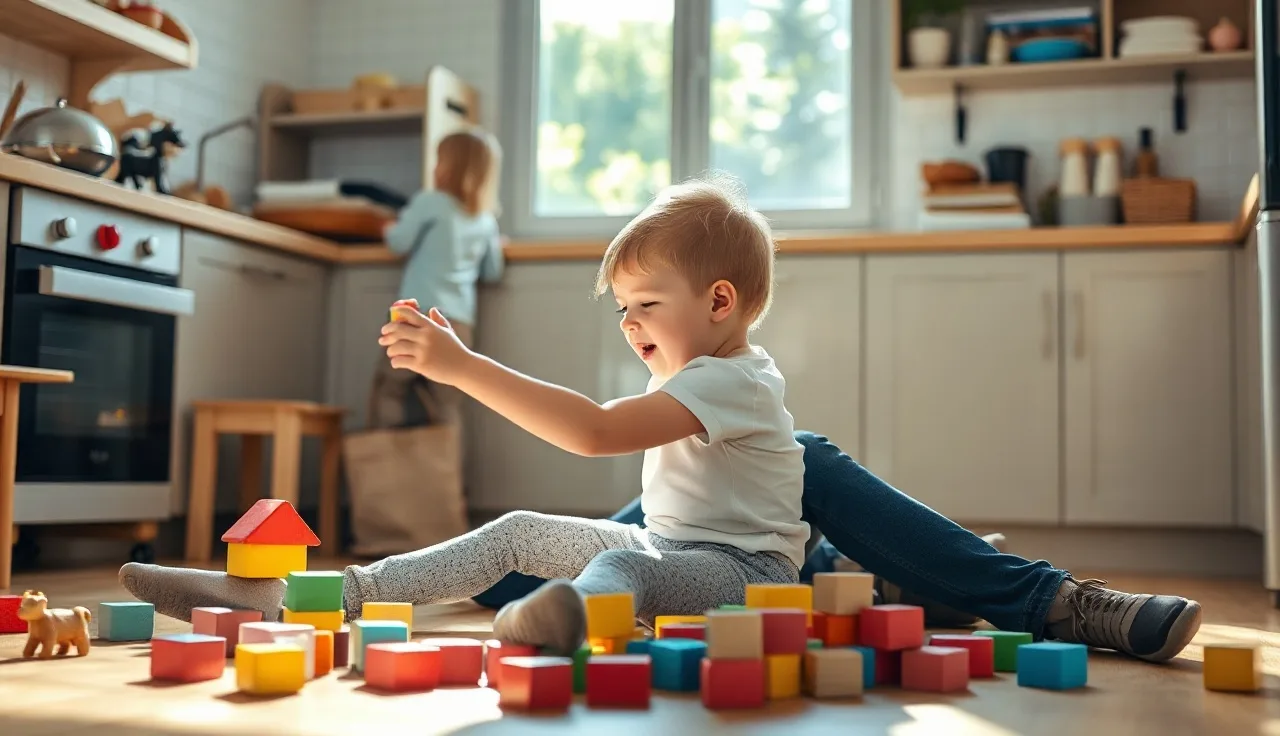
Worth having on hand: simple blocks, shape sorters, play food sets, small animal or people figures, stacking cups, easy puzzles. Not because they're magic, but because they make you and your child talk to each other. A set of farm animals can generate a hundred sentences. A toy that narrates itself generates none from you.
Books remain the most evidence-backed tool of all. Dialogic reading, where you ask open-ended questions during a story ("what do you think happens next?"), pause, wait, and respond to whatever your child offers, has strong evidence behind it for building toddler vocabulary [4]. No special curriculum needed. Any picture book will do.
Don't skip outdoor time either. A walk to the park or around the block puts your child in front of an enormous range of real objects, sounds, and events worth naming and talking about. The real world is still the richest language environment around.
What if your toddler repeats phrases instead of saying new words?
Repeating words or lines from books and shows is called echolalia, and it helps to understand it before reacting to it. Immediate echolalia is echoing back what you just said. Delayed echolalia is producing phrases heard earlier, sometimes from TV or a book, in a different context later.
Echolalia is a normal stage of early language development in all children. In children with autism it can last longer and stand out more, but research increasingly treats much of this echolalia as functional: children are often using scripted language to communicate, to self-regulate, or to join in, even when the connection between the script and the moment isn't obvious right away. More detail at echolalia meaning.
The same approach that works for early communication generally works here: respond to what the child means, not how they said it. If your toddler says "do you want more?" while reaching for crackers, they're telling you they're hungry. A scripted phrase or a reversed pronoun doesn't make that any less real. Respond to the meaning, then model the more typical version back: "more crackers, yes!"
Trying to suppress echolalia tends to backfire. It takes away a working communication tool without giving the child anything to replace it with. The better goal is to build on it, not shut it down.
Frequently asked questions
What's the fastest way to get a toddler talking more?
There's no real shortcut, but the single habit with the biggest payoff is racking up conversational turns: responding to every sound, gesture, and look your toddler sends your way. Gilkerson and Richards at the LENA Research Foundation found that these back-and-forth turns predict language outcomes at age 3 more strongly than how many words a child simply overhears. So the closest thing to a fast track is just showing up for more exchanges, every single day.
Is it normal for a 2-year-old to only say 10 words?
No, that's below what's typical. Most 2-year-olds have at least 50 words and are starting to put two together. A child who has only around 10 words at this age qualifies for a speech-language evaluation, and in the US, kids under 3 can get one free through their state's Early Intervention program under IDEA Part C. Ask for it now rather than waiting to see what happens.
Does educational TV actually help toddlers learn words?
Only a little, and only when a parent watches with the child and talks about what's on screen. Watching alone hasn't been shown to speed up language, and some studies link it to more expressive language delay by age 3. The AAP recommends no more than an hour a day of co-viewed, high-quality content for ages 2 to 5, and no screens at all (aside from video chatting) before 18 months.
Can bilingualism cause speech delay?
No. Bilingual toddlers sometimes pick up each language a bit slower than a monolingual child would pick up just one, but add both languages together and their total vocabulary is on par with their peers. ASHA is direct about this: bilingualism does not cause language disorders. If a bilingual child does have a delay, it needs to be evaluated in both languages, ideally by a speech-language pathologist who has experience with bilingual development.
My toddler used to talk and then stopped. What does that mean?
Losing words or skills a child already had is always worth getting checked out right away rather than waiting it out. Regression like this can be tied to a number of things, including autism spectrum disorder, hearing loss, or neurological changes, and both the CDC and AAP treat it as an immediate concern. Call your pediatrician or your state's Early Intervention program as soon as you notice it.
How do I get my toddler talking during play?
Let them lead instead of steering the play yourself. Narrate what they're doing in short sentences, then pause and give them room to jump in. Lean on routines they already know, and swap out questions for comments. This kind of parallel talk and expansion is a staple of speech therapy parent coaching, and it holds up well in research for boosting how much toddlers vocalize during play.
At what age should I start worrying my toddler isn't talking?
Watch for these markers: no words by 12 to 16 months, fewer than 50 words by 24 months, no two-word phrases by 24 months, or any loss of language at any age. The CDC deliberately lowered several of these cutoffs in its 2022 milestone update so families would seek evaluation sooner. Any single one of these is enough reason to ask for a speech-language evaluation now, not in six months.
Does reading to toddlers every day really help them talk?
Yes, and the evidence here is solid. The AAP recommends reading aloud from birth. Picture books offer the same words again and again in context, without pressure. Dialogic reading, where you comment and pause for your child's input instead of just reading straight through, has been shown across multiple studies to grow vocabulary faster than passive reading does. Daily reading is one of the best habits you can build.
What's the difference between a speech delay and a language delay?
Speech is about physically producing sounds: articulation, fluency, voice. Language is the system underneath it, the words, grammar, and meaning. A child with a speech delay might have plenty to say but struggle to form certain sounds. A child with a language delay might have a smaller vocabulary or trouble putting sentences together. Plenty of kids have some of both, and a speech-language pathologist can check for both in one evaluation.
Can speech therapy really help an 18-month-old?
Yes. Research on early intervention consistently shows that starting therapy earlier leads to better outcomes, not just the same outcomes reached sooner. The brain is unusually adaptable in the first three years. Under IDEA Part C, services in the US are available from birth through age 2 years, 11 months. Families often see real changes in trajectory after just a few months of early therapy paired with parent coaching on strategies to use at home.
Should I correct my toddler when they say a word wrong?
Not directly, no. Correcting a child on the spot can make them less willing to try again. A better approach is the recast: repeat what they said back in the correct form, naturally and warmly, without pointing out the mistake. If your toddler says "wa-wa," you might answer "water, yes, do you want some water?" They hear the right version without feeling singled out, and over hundreds of repetitions, it sinks in.
How do I know if my toddler needs AAC instead of speech therapy?
It's not one or the other. AAC covers tools like picture boards, speech-generating devices, and apps, and it's used alongside work on spoken speech, not instead of it. A speech-language pathologist can assess whether your child would benefit. Research shows giving a child AAC doesn't hold back speech development and often helps it along by easing the frustration of not being understood. If your child's speech is very limited for their age, it's worth asking your SLP about AAC directly.
Is 'baby talk' okay to use with a toddler?
The slightly simplified, sing-song speech parents naturally use with infants, sometimes called child-directed speech, is well studied and genuinely helps early language: it holds attention, exaggerates sound contrasts, and makes it easier for babies to pick words out of a stream of speech. By toddlerhood, you should be using real words, but short sentences, clear pronunciation, and a somewhat higher pitch are still perfectly natural. What matters most is that you're talking with your child, not simply at them.
Sources
- American Speech-Language-Hearing Association (ASHA): Late Blooming or Language Problem?: ASHA describes language development as dependent on rich, responsive environments, and recommends reducing direct questions in favor of comments and expansions for late talkers.
- Gilkerson J, Richards JA et al. (2017). Mapping the Early Language Environment. LENA Research Foundation.: Conversational turns between caregiver and child predicted language outcomes at age 3 more strongly than total word exposure.
- CDC: Learn the Signs. Act Early. Developmental Milestones (2022 revision).: The CDC's 2022 revised milestones lowered several language thresholds to prompt earlier identification and referral.
- National Institute on Deafness and Other Communication Disorders (NIDCD): Speech and Language Developmental Milestones.: Joint attention and following the child's focus supports word learning; dialogic reading accelerates vocabulary growth in toddlers.
- ASHA Practice Portal: Spoken Language Disorders (parent-implemented recasting and expansion evidence).: Expansions and recasts are among the most studied and effective parent-implemented language strategies for toddlers.
- American Academy of Pediatrics (AAP): Literacy Promotion and Reading Aloud Policy Statement.: AAP recommends reading aloud beginning at birth; developmental screening at 9, 18, and 30 months; autism-specific screening at 18 and 24 months.
- American Academy of Pediatrics (AAP): Media and Young Minds policy statement.: AAP limits screen time to one hour per day of high-quality co-viewed content for ages 2 to 5, and recommends avoiding digital media except video chat under 18 to 24 months.
- Madigan S et al. (2019). Association Between Screen Time and Children's Language Development. JAMA Pediatrics.: Each additional 30 minutes of handheld screen time at 18 months was associated with significantly higher odds of expressive language delay at age 3.
- Harvard Center on the Developing Child: Serve and Return.: "Serve and return interactions shape brain circuitry and lay the foundation for language, reasoning, and social development."
- U.S. Department of Education: Individuals with Disabilities Education Act (IDEA), Part C.: Under IDEA Part C, children under age 3 are entitled to a free evaluation through their state's Early Intervention program; families can self-refer without a doctor's referral.
- Goodwyn SW, Acredolo LP, Brown CA. (2000). Impact of symbolic gesturing on early language development. Journal of Nonverbal Behavior.: Infants taught baby signs showed the same or slightly accelerated verbal development compared to non-signing controls.
- Sosa AV. (2016). Association of the Type of Toy Used During Play With the Quantity and Quality of Parent-Infant Communication. JAMA Pediatrics.: Electronic toys significantly reduced adult words, child vocalizations, and conversational turns compared to traditional toys and books during play.