Last updated 2026-07-10
TL;DR
Gestures like pointing, showing, and waving develop between 9 and 14 months and are among the strongest early predictors of later language ability. Many parents wait for words, but research shows gesture use at 12 months predicts vocabulary size at 24 months. Missing several of these milestones by 12 to 16 months warrants a referral to a speech-language pathologist.
Most parents watch for words. A first word feels like the real milestone, the thing you can report when someone asks how your baby's doing. But speech-language researchers have known for decades that gestures come first, and what a baby does with their hands at 10 or 12 months tells you a lot about where language will be at 24 months.
A widely cited study by Goldin-Meadow and colleagues, published in Child Development in 2007, followed 50 children from 14 months to first grade. Children who used more gestures at 14 months had larger vocabularies and better language skills years later [1]. The relationship held even after controlling for socioeconomic factors, which is notable. Gestures aren't a cute phase you wait out. They're the scaffolding language gets built on.
Part of the reason is mechanical. When a child points at a dog and you say "yes, that's a dog," the word lands exactly on the thing the child was already looking at. That's about as good as a learning moment gets. Children who don't point miss thousands of those pairings. They aren't getting less language input; they're getting input that isn't anchored to whatever has their attention.
Neurodivergent children, including those later identified as autistic or as late talkers, often show reduced or unusual gesture use well before anyone notices a language delay. That makes gestures a genuine early window into development, and missing what to look for means missing months when early intervention could make a real difference.
The usual order gestures show up in
Gesture development follows a fairly predictable sequence, though there's real variability inside the normal range. The table below shows approximate ages and what each stage looks like.
| Age | Gesture | What it looks like |
|---|---|---|
| 6 to 8 months | Reaching | Arms extended toward person or object, often with vocalization |
| 8 to 10 months | Giving | Hands an object to caregiver, may or may not release it |
| 9 to 10 months | Social/conventional gestures | Waving bye-bye, arms up to be picked up |
| 10 to 12 months | Pointing (imperative) | Points to request something, e.g., juice on a shelf |
| 11 to 13 months | Showing | Holds up object toward adult without releasing it, for joint attention |
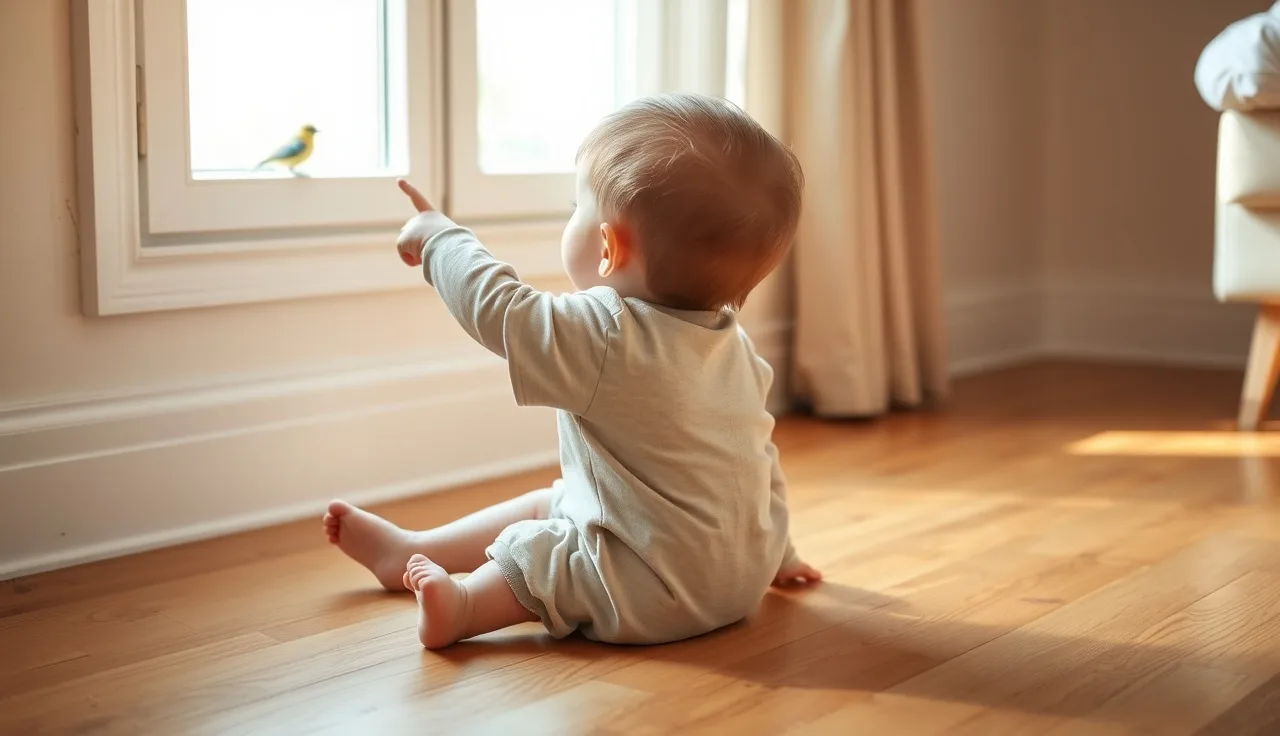
| 12 to 14 months | Pointing (declarative) | Points to share interest, e.g., points at a bird just to share the experience |
| 14 to 16 months | Referential gestures | Shakes head no, nods, shrugs |
The American Speech-Language-Hearing Association (ASHA) identifies joint attention behaviors, including coordinated gaze, showing, and declarative pointing, as core early communication milestones that should be present by 12 to 16 months [2]. The American Academy of Pediatrics (AAP) developmental surveillance guidelines note that by 12 months, a child should wave, point, and show objects [3].
One number worth remembering: the AAP flags absence of any pointing, waving, or showing by 12 months as a reason to refer for further evaluation, not a reason to wait and see [3]. That's a firm threshold, not a soft suggestion.
The gestures parents tend to miss
Waving and pointing get noticed because they're obvious. The ones that slip by are subtler, and a few of them matter more diagnostically than the obvious ones.
Parents often notice when a child hands them something (giving) but miss the distinction between giving and showing. Showing means the child holds an object up toward you for a reaction, without actually trying to pass it over: "look what I have" rather than "here, take this." It's a more sophisticated social act than giving, since it's about sharing attention rather than transferring an object. A child who gives but never shows is worth watching.
Then there's the difference between imperative and declarative pointing. Imperative pointing means "I want that." Declarative pointing means "look at that interesting thing, let's both pay attention to it." Both should be present by 14 months, but declarative pointing is the one that predicts language most strongly, and parents often miss it precisely because there's no obvious need driving it. The child just points at a plane in the sky. That's a big deal.
Following a point is something the child does rather than produces. Does your child look where you're pointing? By 9 to 10 months, most children can follow a point across a room. Some parents don't even register this as a milestone, since it just looks like the child glancing around. But gaze-following and point-following are early joint attention skills that are frequently reduced in autistic children before any other sign appears [4].
Head shaking for no is another one people assume will show up eventually, chalking up its absence to personality or stubbornness. But referential gestures like head shaking and nodding should typically appear by 16 to 18 months. A child who only ever refuses by crying or walking away, never gesturally, may be missing a piece of the symbolic communication system.
The fullest version of declarative pointing includes a gaze shift: the child points at something, looks back at you to check you're looking too, then looks back at the object. That object-to-you-to-object sequence is called the gaze triangle, and it's one of the most reliable early markers of joint attention. Research by Baron-Cohen and colleagues showed this behavior is frequently absent or reduced in children later diagnosed with autism [4].
Not all gestures do the same job
Behavioral regulation gestures are about getting needs met. Reaching, imperative pointing, and giving objects to request help all fall here: they say "I want something from you." Children develop these first because the payoff is immediate.
Joint attention gestures are about sharing an experience rather than requesting one. Showing, declarative pointing, and the gaze triangle all say "I want us focused on the same thing together." That requires understanding that other people have attention that can be directed toward something, a more complex social feat than simply asking for help.
Social and conventional gestures are learned routines: waving bye-bye, clapping, arms-up to be carried. These develop partly through imitating caregivers, so they also tell you something about a child's capacity for social imitation.
For autism spectrum evaluations in particular, joint attention gestures carry the most weight. The absence of declarative pointing and showing by 14 to 16 months is one of the core items on the M-CHAT-R/F screening tool, the Modified Checklist for Autism in Toddlers, which the AAP recommends using at 18 and 24 month well-child visits [3]. But even outside of autism, reduced joint attention gesture use predicts slower vocabulary growth in the broader population of late talkers.
What gestures tell you about the words to come
The link between early gestures and later language is about as well established as anything in developmental communication science.
The Goldin-Meadow 2007 study found that the number of different gesture-plus-speech combinations a child produced at 14 months predicted vocabulary size at 42 months [1]. Children who paired a gesture with a word, pointing at a dog while saying "dog," were ahead of children who only pointed or only said the word.
A separate line of research from Iverson and Goldin-Meadow, published in Psychological Science in 2005, found that words typically enter a child's vocabulary first as gestures. Children point at objects for weeks or months before producing the word for that object [5]. The gesture works as a placeholder that eventually gets filled in with speech, and children who don't build up that gestural vocabulary have fewer placeholders, so word learning tends to lag as a result.
For late talkers specifically, research in the Journal of Child Language found that gesture use at 18 months predicted language outcomes at 36 months better than expressive vocabulary size at 18 months did [6]. That matters because many clinicians and parents focus on word counts when tracking late talkers. Word count matters, but gesture count may matter more.
The practical takeaway: if you're tracking a late talker, count gestures along with words. A child who points at ten different things a day and has five words is in a very different spot than a child with five words and no pointing at all.
What are the red flags that should prompt a referral to a speech-language pathologist?
Pediatricians often screen for language at well-child visits with a handful of questions that don't always capture how a child is doing with gestures. Knowing what to look for yourself helps you advocate if something feels off.
ASHA's evidence maps and guidance on early communication list several reasons to seek an evaluation [2]: no pointing, waving, or showing by 12 months; no consistent use of at least two communicative gestures by 12 months; no declarative pointing by 14 months; no joint attention behaviors, like following a point or a shared gaze, by 12 months; and regression, meaning the loss of gestures that were previously there, at any age.
The AAP's 2022 developmental surveillance guidelines are direct on this: "Developmental concerns at any age should not prompt watchful waiting; referral should happen promptly" [3]. So the wait-and-see advice some parents get doesn't match current AAP guidance. Regression especially, losing gestures or words a child already had, should prompt a referral to both a speech-language pathologist and the pediatrician right away.
A few things are not automatic red flags on their own: a child who waves only when prompted rather than spontaneously, a child who prefers giving objects to showing them, or a child who points mainly to request things rather than to share attention. These are worth watching, but one gesture being slightly delayed or a little different from the textbook version isn't cause for alarm by itself. What matters is the pattern across gesture types, alongside the rest of the child's communication.
If you're trying to sort out what you're seeing, speech therapy evaluations are available through the public early intervention system for children under 3, or through private practice SLPs, and in most states you don't need a doctor's referral to contact one directly.
Do autistic children develop gestures differently, or not at all?
This is where things get more complicated, and more important to get right.
Autistic children tend to show a distinct pattern in gesture development rather than a flat absence of gestures. The most consistently documented finding is reduced declarative pointing and showing, alongside relatively more preserved behavioral regulation gestures like reaching and imperative pointing [4]. That distinction matters: an autistic child might point at the fridge to ask for food but not point at a bird just to share the moment with you. If parents and pediatricians only check for pointing in general, they can miss this.
A 2008 review by Colgan and colleagues found that joint attention behaviors, including showing and gaze following, were among the earliest features that distinguished autistic from non-autistic infants, sometimes visible as early as 9 to 12 months [4]. That's part of why the M-CHAT-R/F screening tool includes gesture items. Some autistic children do develop gestures later rather than never, especially when the gestures are modeled and practiced directly, which is one of the goals of early behavioral and communication intervention. Augmentative and alternative communication systems, including AAC devices, often build in gestural and symbolic components alongside or ahead of speech.
One thing the research hasn't settled: whether teaching gestures directly in early intervention speeds up spoken language in autistic children, or whether gesture and speech grow together as part of broader social communication development. The correlation is strong; which one causes the other is still unclear. Either way, building gesture use is a reasonable goal with little downside.
How can parents support gestural development at home?
You don't need therapy appointments to build gestures into your child's day, just some intentional modeling. Most research on gesture intervention points to adult gesture use as the main driver of how much a child gestures. Model gestures as you talk: point at things when you say "look," hold up open palms for "all done," let your face and hands react when something surprises you. Iverson and colleagues found that how often caregivers gesture predicts how often their children do [5]. This isn't a special exercise, it's just your everyday way of talking. It also helps to pause and wait rather than filling in your child's communication for them. Instead of handing over what you think they want, leave a beat of space for them to reach, point, or gesture first. Even a second or two of expectant waiting gives them a reason to communicate. Respond to every attempt your child makes. When they point at something, name it, react to it, build on it: "Yes! A dog! A big fluffy dog!" That response is what makes pointing worth repeating. Face-to-face games like peek-a-boo and pat-a-cake build the back-and-forth timing underneath all communication, and they naturally involve imitating gestures too. Many SLPs also recommend sign language or simple home signs for late talkers, not to replace speech but to give a child a way to communicate while speech catches up. Signs for "more," "all done," "eat," "drink," and "help" are commonly taught, functional, and they cut down on frustration.
If you want a structured way to track what your child is doing and get suggestions matched to their stage, the Little Words app has a parent quiz that builds a profile of your child's communication and gives targeted activity ideas from there.
How is gesture development assessed in a formal evaluation?
When a speech-language pathologist evaluates a child's communication, gesture assessment usually runs through the whole session rather than standing as its own separate test.
SLPs typically use structured observation during play, watching whether a child gestures spontaneously, what kinds of gestures they use, and whether they pair gestures with eye contact, sounds, or words. They'll also check whether the child follows an adult's point, a receptive skill parents don't always think to look for.
Standardized tools with gesture components include the Communication and Symbolic Behavior Scales (CSBS), the MacArthur-Bates Communicative Development Inventories (CDI), and the M-CHAT-R/F autism screener [3]. The CSBS in particular pairs a caregiver questionnaire with a behavior sample that tracks gesture types and frequency specifically.
Parent report matters a great deal here, since you see your child in dozens of settings no clinician ever will. If an SLP gives you a questionnaire about gestures, take your time and think across contexts: mealtimes, bath time, outdoor play, time with siblings. Kids often communicate very differently with familiar people than with strangers.
It's also worth knowing that gesture assessment isn't only about autism. Childhood apraxia of speech and other motor speech disorders can affect a child's ability to produce gestures on purpose, especially imitated ones. An SLP evaluating a child for suspected apraxia of speech will check whether the child can imitate a gesture on request, not just whether they produce gestures on their own.
What about children who were late on gesture milestones but caught up fine?
Plenty of parents remember their child being slow on some of these gesture markers and turning out fine. That's a real data point, not something to dismiss. Research on late talkers consistently shows that a meaningful share, estimates run from about 50 to 70 percent in some studies, catch up to their peers in language by age 3 to 4 without any intervention [6]. These kids are sometimes called "late bloomers." The problem is that at 12 or 18 months, we still don't have great tools for telling which late talker is a late bloomer and which one has a difficulty that will stick around. Gesture use turns out to be one of the better predictors inside that late talker group. Children who use a wider variety of gestures more often at 18 months tend to have better language outcomes at 36 months even with no intervention at all, while children with very restricted gesture use and few words are at higher risk of a delay that persists [6]. So yes, it's genuinely possible that your older child was slow to point and turned out fine. But "possible" is carrying a lot of weight in that sentence. A speech-language evaluation costs little compared to the cost of missing the window when early intervention works best. The AAP recommends erring toward referral, and that seems like the right call to me.
What questions should parents ask at their child's 12-month well-child visit?
Well-child visits move fast. You typically get 15 to 20 minutes and the doctor has a lot of ground to cover, so if gestural development doesn't come up on its own, raise it yourself. A few direct questions are worth having ready.
Start with the basics: "Does my child point yet, and should they be doing that by now?" That opens the conversation without requiring you to already know the milestones going in. You can follow with, "How many communicative gestures should a 12-month-old be using regularly?" Current guidelines put the number at least 2 to 3, including waving and at least one intentional pointing or showing behavior [2].
If your child points to request things but never seems to point just to show you something, say so directly: "Is that a concern?" The difference between pointing to get something and pointing to share something is a real clinical distinction, and a pediatrician current on developmental guidance will know exactly what you mean. And if you're seeing any red flags at 12 months, ask plainly whether you should be referred for a speech-language evaluation now or wait until 18 months. If the answer is "let's see how they're doing later," ask what that's based on. Don't accept it without a reason.
You can also ask for an M-CHAT-R/F screening at any visit between 12 and 30 months if you have concerns, not just the visits where it's routinely scheduled. It's a five-minute questionnaire that directly includes items about pointing and showing [3].
Frequently asked questions
What age should a baby start pointing?
Most children begin pointing to request things between 10 and 12 months, with pointing just to share interest following by 12 to 14 months. The AAP treats the absence of any pointing by 12 months as a reason for referral, not a reason to wait. By 14 to 16 months, both types should be present and consistent.
Is waving considered a communication milestone?
Yes. It's one of the earliest conventional gestures, usually appearing between 9 and 12 months, and AAP developmental surveillance guidelines list it as something that should be present by 12 months. A wave your child comes up with on their own means more developmentally than one they only do when an adult prompts or models it, though both are worth tracking.
My 15-month-old points but doesn't look back at me after pointing. Should I be worried?
Checking back with you after pointing, sometimes called the gaze triangle or referential gaze shift, is a core joint attention behavior that should be emerging by 12 to 14 months. If it's still missing at 15 months, mention it to your pediatrician. It doesn't automatically mean something's wrong, but it's specific enough to bring up at your next visit or to raise directly with a speech-language pathologist.
Can a child have good speech and still have problems with gesture communication?
It happens, though less often. Some children learn words without fully building the joint attention system underneath them. That can look like language that sounds rote or scripted, trouble with back-and-forth conversation, or a general awkwardness in the social side of talking, even when the words themselves are fine. If speech is technically there but feels one-sided or off socially, gesture use is one of the first things an SLP will look at.
Do bilingual or multilingual children hit gesture milestones at the same time as monolingual children?
Bilingual exposure doesn't seem to shift gesture timelines the way it can with some language-specific milestones. Gestures are pre-linguistic and show up across cultures, so the timelines here apply regardless of how many languages a child is hearing. If a bilingual child is using fewer gestures than expected, language exposure isn't the likely reason, and the same referral thresholds apply.
What's the difference between showing and giving, and why does it matter?
Giving means handing an object to someone, often to ask for help or share it. Showing means holding an object up for someone's reaction without letting go of it, and it's the more telling of the two: the child wants to share the experience with you, not hand over the object. A child who gives but never shows may have gaps in joint attention worth discussing with a speech-language pathologist, even if everything else seems fine.
My toddler used to wave and now has stopped. Is that a problem?
Losing a skill that was previously consistent is always worth reporting to your pediatrician, and it's listed as a red flag in AAP and ASHA guidance no matter what age it happens. One missed wave in an unfamiliar place isn't regression. But if a child who waved reliably for weeks stops doing it across different settings for more than a week or two, that's a call to your doctor, not a wait-and-see situation.
How many gestures should a 12-month-old use?
ASHA guidance says a 12-month-old should have at least two to three consistent gestures, including waving and one pointing or showing behavior, and they should show up on their own rather than only when prompted. Variety matters as much as how often a child gestures. A child who only reaches and never points has the quantity but may be missing the range.
Will teaching baby sign language help my child talk sooner?
The evidence on whether it speeds up spoken words in typically developing children is genuinely mixed. Where it seems to help more clearly is cutting down frustration for late talkers by giving them another way to communicate while speech catches up. It's low-risk and worth trying. SLPs who work with late talkers often suggest a few functional signs, things like "more," "all done," "eat," or "help," not to replace speech but to bridge to it.
What does it mean if my child points at everything but doesn't talk?
Frequent, varied pointing, especially the kind paired with checking back with you, is a strong sign the joint attention foundation is in place, and that's good news for language down the line. Many children like this are late talkers whose social communication is solid and who go on to develop speech without much trouble. That said, no words by 16 months or fewer than 10 words by 18 months still calls for a speech-language evaluation no matter how much pointing is happening.
How do speech-language pathologists assess gesture development in toddlers?
SLPs combine structured play observation with standardized tools like the Communication and Symbolic Behavior Scales (CSBS) or the MacArthur-Bates CDI, along with parent questionnaires. They're watching gesture types (giving, showing, pointing, conventional gestures like waving), how often they happen, whether they're spontaneous, and whether they come paired with eye contact and sound. What parents report seeing across daily life is a real part of that picture, not just background information.
Can apraxia of speech affect a child's ability to use gestures?
It can, especially with imitated gestures. Childhood apraxia of speech is a motor planning disorder, and some children with it struggle to imitate actions and gestures on request, not just speech sounds. That's part of why a thorough evaluation from an SLP experienced with motor speech disorders looks at gesture imitation and not only the gestures a child produces spontaneously. If your child has trouble copying something simple like clapping or waving when asked, mention that during any speech evaluation.
Are there any free resources for tracking gestural milestones at home?
The CDC's "Learn the Signs. Act Early." program (cdc.gov) has free milestone checklists from 2 months through 5 years that include gesture items. The M-CHAT-R/F autism screening questionnaire is free online and has gesture-specific questions you can look over before a well-child visit. State early intervention programs also offer free developmental screenings for children under 3 that cover communication, gestures included.
Gestures turn out to matter more than most parents realize, and the research behind that claim comes from a solid stack of sources. Kids who gestured more at 14 months had bigger vocabularies and stronger language skills later on, even after accounting for socioeconomic factors, according to Goldin-Meadow et al., Child Development (2007) – 'Gestures lead words into the vocabulary'. That tracks with what ASHA lists as core early milestones: coordinated gaze, showing, and declarative pointing should all be showing up by 12 to 16 months, per the American Speech-Language-Hearing Association (ASHA) – Early Communication Indicators and Birth to Three Practice Portal. Pediatricians aren't inclined to wait and see on this either. The American Academy of Pediatrics – Developmental Surveillance and Screening Policy Statement (2022) recommends the M-CHAT-R/F screening at the 18 and 24 month visits and is explicit that developmental concerns should lead to referral rather than a wait-and-see approach; no pointing, waving, or showing by 12 months is reason enough to get a referral. That urgency comes from findings like those in Colgan et al. – Review of early joint attention markers in autism, First Language / Autism Research (2008), which found that joint attention behaviors, including showing and following someone's gaze, were among the earliest signs separating autistic from non-autistic infants, sometimes visible by 9 to 12 months; declarative pointing and showing are often reduced in children later diagnosed with autism. Gesture usually shows up before speech does. Children will point at something for weeks or months before they say the word for it, and how much a caregiver gestures actually predicts how much the child will gesture, according to Iverson and Goldin-Meadow, Psychological Science (2005) – 'Gesture paves the way for language development'. It's also a better crystal ball than vocabulary size: gesture use at 18 months predicts language outcomes at 36 months more reliably than expressive vocabulary does at that same 18-month mark. About 50 to 70 percent of late talkers catch up by age 3 or 4, and gesture diversity is one of the stronger clues for which kids will be in that group, per Thal and Tobias, Journal of Child Language (1992); Rowe and Goldin-Meadow, Journal of Child Language (2009) and related late talker outcome literature. If you want to check where your child stands, the CDC – Learn the Signs. Act Early. Milestone Checklists offers free checklists from 2 months to 5 years that include gesture items like waving and pointing. Speech-language pathologists often use a more formal tool for this, the CSBS, which specifically tracks gesture types and frequency as part of a full communication evaluation, per the ASHA – Communication and Symbolic Behavior Scales (CSBS) Practice Portal. Parents can also get a sense of normed gesture development between 8 and 30 months through the MacArthur-Bates Communicative Development Inventories (CDI) – Fenson et al., Paul H. Brookes Publishing, which asks parents to report on gesture use alongside vocabulary. And if a delay does turn up, help doesn't have to wait or cost anything: under IDEA Part C, federally funded early intervention programs provide free evaluations and services for children under 3 with developmental delays, including delays in communication and gesture, as described by HRSA – Early Intervention Program (Individuals with Disabilities Education Act, Part C). None of this replaces an actual evaluation from your child's doctor or a speech-language pathologist. Think of it as background for a more informed conversation with them, not a diagnosis on its own.