Last updated 2026-07-09
The fastest way to get a toddler talking is to follow their lead, narrate what they're doing, and respond to every attempt they make to communicate, gestures and babbles included. Most 2-year-olds say at least 50 words and put two of them together. If yours is well short of that, book a speech-language evaluation now rather than waiting to see what happens, because waiting is the one move that reliably makes things harder to fix later.
What normal toddler speech actually looks like
Milestones are averages, and kids scatter widely around them. The American Academy of Pediatrics and the American Speech-Language-Hearing Association publish benchmarks that work as a rough map, not a verdict.
By 12 months, most children say 1 to 3 words with meaning, things like "mama" or "up," and follow simple commands like "come here." By 18 months, the typical range is 10 to 20 words. By 24 months, kids should have around 50 words and be combining two, "more milk" or "daddy go." [1]
By 36 months, most kids use 200 to 1,000 words and string together short sentences. A stranger should understand roughly 75% of what a 3-year-old says. [2]
The 50-word and two-word-combination benchmarks at age 2 are real thresholds, not arbitrary lines someone drew. Children who miss them face higher odds of ongoing language difficulty, and the research holds up consistently on that point. But missing a benchmark in one snapshot is different from a persistent pattern. One slow month isn't a diagnosis.
| Age | Typical vocabulary | What you should hear |
|---|---|---|
| 12 months | 1 to 3 words | Babbling, "mama," "dada" with meaning |
| 18 months | 10 to 20 words | Single words, lots of pointing |
| 24 months | ~50 words | Two-word combinations |
| 36 months | 200 to 1,000 words | Short sentences, mostly understood by strangers |
What actually helps at home
The research points at a handful of high-payoff habits, and the rest is mostly noise. You don't need flashcards or apps. You need good conversation habits during the time you're already spending together.
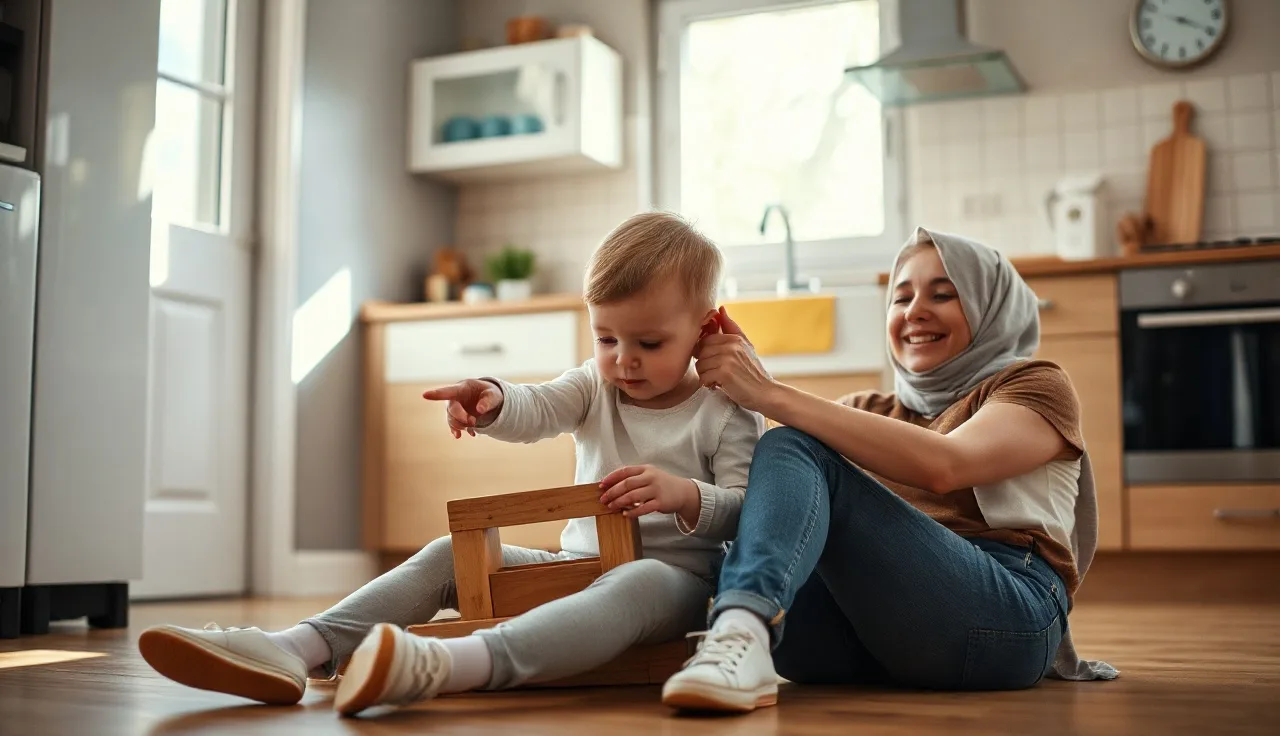
Follow their lead: whatever your child is looking at or touching, that's the topic worth talking about. When a child's attention and a parent's language line up, word learning speeds up, and joint attention research has shown this for decades. [3]
Narrate instead of quizzing. "You're pouring the water. It went in the cup!" beats asking "what color is that?" over and over. Running commentary on what your child is doing, what you're doing, and what's about to happen builds vocabulary without pressure.
Expand on what they say. Your toddler says "dog," you say "big dog" or "the dog is running." Linguists call this recasting: it models a slightly richer version of what they just said, and it works far better than correcting errors head-on. [4]
Try making more comments than you ask questions. Questions ask a child to perform. Comments invite them in on their own terms, and most parents lean too hard on the former.
Give it a beat after you speak. Wait, really wait, five to ten seconds. Kids with developing language need more processing time than adults naturally leave, and the silence will feel awkward. Do it anyway.
When you read together, interact rather than plow through. A parent who reads a board book, points to pictures, asks "where's the dog?" now and then, and lets the child turn pages at their own pace is doing more than one who just reads the words straight. The back-and-forth matters more than the text itself.
These strategies show up under different names in the literature: responsive interaction, naturalistic language intervention, enhanced milieu teaching. The idea underneath is the same each time. Meet the child where they are, respond to every attempt to communicate, and model language just a step beyond what they're doing now.
Serve and return, and why therapists keep bringing it up
Serve and return is a term from the Harvard Center on the Developing Child for the back-and-forth between a child and a caregiver. A child "serves" with a sound, a gesture, a face, or a point. A caregiver "returns" by responding, naming it, reflecting it back. [5]
It comes up constantly in therapy because it's the best-studied engine of early language growth. Children whose caregivers respond quickly and specifically, matching what the child just did, end up with larger vocabularies and more complex sentences at every age researchers have measured.
It sounds simple, and it isn't always. When you're exhausted, or distracted, or your toddler is melting down over a cracker, answering warmly and out loud is genuinely hard. The goal isn't perfection. It's nudging the daily average.
Here's what it looks like in practice. Your 14-month-old points at a bird. You say "bird! A little bird. It's flying." Your child babbles. You say "yeah, it flew away fast." Repeated hundreds of times across a day, that exchange is the core of language development.
Does talking more actually matter, or is this just the 30 million words thing?
The "30 million word gap" comes from Hart and Risley's 1995 study: children in higher-income families heard roughly 30 million more words by age 3 than children in lower-income families, and the gap predicted later vocabulary and school outcomes. [6]
That exact figure has taken hits in replications. Some later studies found smaller gaps, and researchers still argue about which part of the input matters most: total word count, variety of words, or responsiveness. Nobody has good data showing that narrating nonstop without responding does much on its own.
What the evidence backs up consistently is that quality and responsiveness carry the weight. Varied vocabulary, reading aloud, real conversation, and responses tied to what the child just did all track with better outcomes. The number 30 million is probably not precise. The direction of the effect isn't in doubt.
So yes, talking more helps, as long as it's talking that answers your child rather than monologuing at them.
When to worry about a late talker
"Late talker" has a loose clinical definition: a child between 18 and 30 months with fewer words than expected but no other obvious developmental concerns. About 13 to 17% of 2-year-olds fit this description. [7]
Roughly 70 to 80% of late talkers catch up by age 5 with no intervention, which is the reassuring part. Here's the part people skip: the 20 to 30% who don't catch up are hard to spot early, and betting that your child is in the lucky group costs time that matters.
Some red flags are worth acting on sooner rather than later:
- No babbling by 12 months
- No gestures (pointing, waving) by 12 months
- No single words by 16 months
- No two-word phrases by 24 months
- Any loss of language skills at any age (regression always warrants immediate evaluation)
- More trouble understanding language than producing it
The AAP recommends developmental surveillance at every well-child visit and formal screening at 9, 18, and 30 months. [1] If your pediatrician isn't doing this, ask for it.
If your gut says something is off, get an evaluation. Speech-language pathologists can assess children as young as 12 months, and an evaluation commits you to nothing beyond telling you where your child actually stands. It's worth reading up on early intervention and what a speech therapist does during an assessment.
Getting early intervention
In the United States, the Individuals with Disabilities Education Act (IDEA) Part C guarantees free early intervention for children under 3 who have a developmental delay or are at risk for one. [8] No physician referral is required. You can call your state's early intervention program directly and request an evaluation yourself.
Once your child turns 3, services shift to Part B of IDEA, run through your local school district. The steps look similar: request an evaluation in writing, the district completes it, and if your child qualifies, the team writes an Individualized Education Program (IEP). Most states hold the district to a 60-day timeline for the evaluation, though the exact window is set by state rule, so check yours.
If your child doesn't qualify for public services, or you'd rather go private, private speech therapy is the other route. An SLP runs a standardized evaluation, talks through goals, and usually recommends a session frequency. Costs swing hard by region, roughly $100 to $350 per session without insurance, though many private health plans cover speech therapy once there's a diagnosis.
Online speech therapy became a real option around 2020. The research on telehealth for pediatric speech is thin but generally positive for certain kids and certain goals. It isn't right for every child or every approach, but it's worth looking into if geography or scheduling is what's standing in your way.
One more detail about Part C: services are usually delivered in the "natural environment," meaning your home or daycare. That's a strength, not a compromise. For children under 3, parent coaching in the natural environment has stronger evidence behind it than clinic-only pull-out models.
None of this replaces an actual evaluation from a licensed speech-language pathologist. If you're worried, the right move is to get your child seen, not to keep reading articles about it.
Are there speech therapy techniques parents can use at home without formal training?
Yes, and a lot of what happens in a therapy session is the therapist teaching parents these exact techniques rather than doing all the talking themselves. A parent who gets 20 minutes of therapy a week and does nothing at home tends to see much slower progress than one who folds these strategies into an ordinary day.
A few of these have real evidence behind them and cost nothing to start today. Self-talk means narrating your own actions out loud: "I'm washing the dishes. The water is warm. Now I'm rinsing." It feels strange to do. It works anyway. Parallel talk is the same idea turned toward your child: "You're stacking the blocks. Up, up, up. Oh, they fell down!"
Expansion and extension come into play once your child starts using words. If they say "ball," you might say "red ball" (expansion) or "throw the ball" (extension), just modeling the fuller phrase rather than asking them to repeat it. Focused stimulation means picking one or two target words and working them into natural moments over and over. If you want "more" to show up, say it every time the idea fits: more juice, more crackers, more swings.
It also helps to drop the direct pressure. Skip "say ___" and "can you say ___?" Those questions create anxiety without actually modeling anything new. Kids pick up language by watching and interacting, not by performing on command.
If your child seems frustrated by not being understood, or you suspect a motor speech issue, these techniques alone won't be enough. Childhood apraxia of speech and apraxia of speech call for specialized work from a qualified SLP.
How does screen time affect toddler language development?
The AAP recommends avoiding digital media other than video chatting for children under 18 months, and for 18 to 24 months, introducing only high-quality programming watched together with a caregiver who talks about what's happening on screen.[9]
The issue isn't that screens are dangerous by nature. It's that screen time takes the place of interactive time. A toddler staring at a screen isn't getting back-and-forth exchange, isn't hearing responses tied to their own sounds, isn't practicing conversation. Background TV is a particular problem here: it's linked to fewer words from adults and fewer sounds from the child, even when nobody's actively watching it.
Video chatting with a real person, a grandparent or family friend, works differently, because it's responsive and tied to what the child does in real time. Pre-recorded video just doesn't teach language the same way.
So if your toddler watches some TV, that's not a disaster. But if it's crowding out the time you'd otherwise spend talking, that's worth changing.
What's different about helping a toddler talk if they're autistic or have another developmental difference?
The core ideas, responding to your child and following their lead, still apply. But the details shift quite a bit.
Autistic children often communicate differently than neurotypical late talkers. Some use echolalia, repeating phrases from videos, books, or earlier conversations. This is usually a working communication strategy, not something to correct out of them, and how you respond to it can change outcomes; it's worth reading about what echolalia actually means if your child does this.
Some autistic children benefit a great deal from augmentative and alternative communication (AAC), things like picture exchange, speech-generating devices, or apps. There's a persistent fear that giving a child AAC will kill their motivation to speak, but the research doesn't support that. Multiple systematic reviews found AAC doesn't suppress speech and often supports it.[10] If a professional has raised this option, it's worth reading more about AAC devices.
Speech therapy for autistic toddlers often looks different from the typical version, with more focus on social communication, joint attention, and functional communication, and less on building vocabulary word by word.
Parents of neurodivergent kids sometimes get more out of tools built specifically for their child's profile than from general parenting advice. Little Words (littlewords.ai) is an AI speech companion made for neurodivergent kids, and its start quiz can help match a family to the right kind of support. That said, an SLP evaluation is still the foundation. An app doesn't replace it.
Does bilingualism slow down language development in toddlers?
No, and this is one of the more stubborn myths in early childhood. Bilingual children may show smaller vocabularies in each individual language at certain points, but their combined vocabulary across both languages matches monolingual peers.[11] They don't develop delays at higher rates, and when a bilingual child is a late talker, the delay shows up in both languages. The bilingualism isn't what caused it.
SLPs who work with multilingual families evaluate a child in all their languages, since an assessment done in only one language can misclassify a child. If your household speaks more than one language, tell any evaluator that from the first phone call.
Keep speaking your home language with your child. Switching to a second language you're less fluent in, hoping it will help with English, actually lowers the quality of the input they get. Fluent, expressive, responsive language matters far more than which language it happens to be in.
What should you actually do this week if you're worried about your toddler's speech?
Start two things at once rather than one after the other.
First, call your pediatrician and ask for a developmental screening if one isn't already scheduled, and ask specifically for a referral to a speech-language pathologist. You don't need to wait for the next well-child visit to bring this up.
Second, start using the at-home strategies today. They won't fix a speech disorder by themselves, but they help no matter what an evaluation turns up. Follow your child's lead, narrate what's happening, expand on what they say, wait before jumping in, and ask fewer questions. None of this costs anything, and there's no downside.
If your child is under 3 and you're in the United States, contact your state's early intervention program; you can find your state's contact through the CDC's Act Early program.[12] No physician referral is needed, you can refer your child yourself.
If your child is 3 or older, call your school district and request a speech-language evaluation in writing. Federal law puts the district on a timeline to respond.
The one thing that reliably makes outcomes worse is waiting to see what happens. Brain plasticity peaks in early childhood, so services at 18 months beat services at 3 years, which beat services at 5. An evaluation costs you an afternoon. Waiting costs months of the window that matters most.
If you want something built around your specific situation, Little Words offers a short quiz that maps your child's communication profile and points to your next step.
Common questions parents ask
By 24 months, most kids have around 50 words, and just as importantly, they're starting to put two together, like "more juice" or "daddy shoe." That's the benchmark ASHA and the AAP both point to. If your 2-year-old has far fewer words than that, or isn't combining any yet, don't wait for the next scheduled checkup. Ask for a speech-language evaluation now.
What causes speech delay in toddlers?
The causes are all over the map. Hearing loss is one of the most common, and thankfully one of the most treatable, which is why a hearing check is a standard part of any speech evaluation. Beyond that, you're looking at things like developmental language disorder, autism, childhood apraxia of speech, intellectual disability, or simply not enough language input at home. Plenty of kids have no clear cause at all. An SLP evaluation works through the possibilities for your child specifically.
Speech delay versus language delay: what's the difference?
Speech is about physically producing sounds, how clearly a child says words. Language is about understanding and using words and grammar to communicate. A child can struggle with one and not the other. A speech delay usually shows up as words that are hard to understand. A language delay looks like fewer words or simpler sentences than you'd expect for the age. Some kids have both, and an SLP looks at each separately.
If your toddler seems to understand everything you say but doesn't talk much, that comprehension is genuinely a good sign, it means the language system underneath is working. But expressive language matters on its own terms too. A child who understands well but produces very few words by 24 months still meets the definition of a late talker and still deserves an evaluation. Strong comprehension shouldn't talk you out of getting an assessment when the spoken vocabulary is well under 50 words.
Educational TV doesn't do much for language learning, and under 18 months it does essentially nothing. Toddlers pick up language far better from a live person interacting with them than from a screen, no matter how well-made the show is. The one exception is video chatting with a real, responsive person. If your toddler does watch some television, sit with them and talk about what's happening on screen: that interaction makes a real difference. Screens are not a substitute for conversation.
Reading together, on the other hand, genuinely helps, and the evidence for it is solid. Shared book reading introduces words kids don't hear in everyday conversation, builds their attention span, and creates a natural back-and-forth. The best way to do it isn't reading straight through the book but pausing to point at pictures, ask questions, and respond to whatever your child does. Even 10 to 15 minutes a day is linked to measurable vocabulary growth.
Is there a point where it's too late to start speech therapy?
No, it's never too late to see benefits, but starting earlier makes a real difference for young children. Brain plasticity is at its peak in early childhood, so a child who starts services at 18 months tends to progress faster than one who starts at 3 or 5. That said, older kids who start later still make real gains. If your child hasn't been evaluated yet, don't assume you've missed the window: start now.
Cost shouldn't be the thing standing in your way, either. In the United States, IDEA Part C guarantees free early intervention evaluations and services for children under 3 with developmental delays, and you can self-refer through your state's early intervention program without needing a doctor's referral first. For kids 3 and older, put your request for an evaluation in writing to your local school district. Public schools are required by law to evaluate and, if your child qualifies, provide services at no cost.
None of this requires special materials or classes. A language-rich home just means your child hears varied, responsive, meaningful language all day long: you narrate what you're doing, read aloud regularly, respond to every attempt at communication (including babbles and gestures), sing, and keep the background TV off. What matters is the quality of interaction, not the sheer amount of talk in the air. A home where adults talk *with* the child, not just around them, is doing this right.
If your toddler used to say words and has stopped using them, that's worth acting on quickly rather than waiting to see if the words return. Losing previously acquired words is a red flag at any age, it's one of the specific warning signs the AAP lists for autism, and it can point to other neurological concerns as well. Call your pediatrician now rather than at the next scheduled visit.
As for boys talking later than girls: it's true, on average, in population studies, but the difference is small and doesn't change where the clinical thresholds sit. A 24-month-old boy with fewer than 50 words or no two-word combinations needs an evaluation just as much as a girl would. "Boys just talk later" gets used far too often as a reason to put off evaluations that would have actually helped. The milestones apply across the board.
"Speech therapist" and "speech-language pathologist" refer to the same profession: SLP is the formal credential, speech therapist is just the everyday term people use. In the US, licensed SLPs hold a master's degree, complete a clinical fellowship, and pass a national exam. When you're looking for help, make sure you're working with a licensed SLP rather than a "speech coach" or "communication specialist," terms that aren't regulated and don't guarantee any credential.
And if you're picturing therapy as a toddler sitting at a table doing drills, that's not usually how it goes. Good sessions for this age are mostly play-based: the therapist gets down on the floor, follows the child's lead, and builds language targets into whatever the child is already interested in. A skilled SLP also spends real time coaching the parent, since what happens in the hours outside the session matters more than the session itself.
Sources
- American Academy of Pediatrics, Developmental Milestones: AAP recommends developmental surveillance at every well-child visit and formal screening at 9, 18, and 30 months; 50 words and two-word combinations by 24 months are standard benchmarks.
- American Speech-Language-Hearing Association (ASHA), Late Blooming or Language Problem?: By 36 months, strangers should understand about 75% of what a child says; vocabulary of 200 to 1,000 words is typical.
- Tomasello M & Farrar MJ, Joint attention and early language, Child Development, 1986: Joint attention between caregiver and child is associated with faster word learning in toddlers.
- Cleave PL et al., The efficacy of recasts in language intervention, American Journal of Speech-Language Pathology, 2015: Recasting, modeling a slightly more complex version of a child's utterance, is an effective language intervention technique.
- Harvard Center on the Developing Child, Serve and Return: Serve-and-return interaction between children and caregivers is a well-documented mechanism for early brain and language development.
- Hart B & Risley TR, Meaningful Differences in the Everyday Experience of Young American Children, 1995: The 30 million word gap: children in higher-income families heard roughly 30 million more words by age 3 than children in lower-income families, correlating with later vocabulary and academic outcomes.
- ASHA, Late Language Emergence: Roughly 13 to 17% of 2-year-olds are late talkers; about 70 to 80% catch up by age 5 without intervention.
- US Department of Education, Individuals with Disabilities Education Act (IDEA) Part C: IDEA Part C guarantees free early intervention services for children under 3 with developmental delays; families can self-refer without a physician's referral.
- American Academy of Pediatrics, Media and Young Minds, Pediatrics, 2016: The AAP recommends avoiding digital media other than video chatting for children under 18 months and limiting to high-quality co-viewed programming for children 18 to 24 months.
- Millar DC, Light JC, Schlosser RW, The impact of augmentative and alternative communication on speech production, American Journal of Speech-Language Pathology, 2006: Systematic review found that AAC does not suppress speech development and often supports it in children with developmental disabilities.
- ASHA, Bilingual Service Delivery: Bilingual children's total vocabulary across both languages is comparable to monolingual peers; bilingualism does not cause language delays.
- CDC, Learn the Signs Act Early: The CDC's Act Early program provides state-by-state early intervention contact information; families can self-refer without a physician's referral.