Last updated 2026-07-10
TL;DR
Following your toddler's lead, narrating what you're both doing, and responding to every communication attempt (even babble) does more for their talking than drills or flashcards ever will. Research on responsive, child-directed interaction backs this up consistently: it builds vocabulary faster than teaching sessions. Most toddlers say 50 words and start combining them by 24 months. If yours isn't there yet, it's worth getting an early evaluation.
What "teaching" a toddler to talk really involves
Most parents picture sitting across from their child and repeating words until they stick. That's not really how it works. Talking is a social act before it's a linguistic one. Your toddler's brain wires itself for language the moment they start tuning into your voice, tracking your gaze, and watching your mouth move. Your job is feeding that process the raw material it needs.
The American Academy of Pediatrics describes early language development as "serve and return": a child makes a sound or gesture, a caregiver responds, and that exchange itself is what builds neural pathways [1]. Drilling vocabulary at a table doesn't replicate that. Being present and genuinely engaged in your child's world does.
Parents sometimes worry they're the problem, that they aren't teaching hard enough or the right way. Most toddlers who are late to talk aren't late because of anything their parents did or didn't do. Development varies a lot, and some kids need more time, more support, or a different communication approach altogether. What you do at home matters, but it's rarely the whole story.
What speech milestones look like from 1 to 3
Milestones are ranges, not deadlines. They exist because research on thousands of children found that most kids hit certain benchmarks around the same age, and missing them by a real margin is worth paying attention to.
Here's what the American Speech-Language-Hearing Association (ASHA) and the CDC describe as typical [2][3]:
| Age | What most children do |
|---|---|
| 12 months | Says 1-3 words, babbles with expression, uses gestures like pointing or waving |
| 15 months | 5-10 words, responds to simple questions, points to show interest |
| 18 months | 10-20 words, uses some words consistently, starts to follow two-step directions |
| 24 months | 50+ words, combines two words ("more milk", "Daddy go"), strangers understand about half of speech |
| 36 months | 200-1,000 words, three-word sentences, strangers understand about 75% of speech |
These come from large population studies, so there's real spread around every number. A child at 24 months with 40 words who's adding new ones daily is in a very different spot than a child stuck at 10 words with nothing new showing up. How fast a child is growing matters as much as the count at any given moment.
One specific thing worth watching: by 12 months, most children babble consonant-vowel combinations ("ba-ba", "da-da"), respond to their name, and gesture. No babbling by 12 months is one of the earliest signs that an evaluation is worth scheduling [3].
Strategies that actually move the needle
The research here is pretty consistent, and a handful of approaches show up again and again in studies of parent-implemented language support.
Follow your child's attention rather than redirecting it. If they're staring at the dog, say "dog" or "the dog is running." When your words match what they're already focused on, the word lands on an active mental concept, and that's how vocabulary sticks [4].
Narrate your day out loud, sometimes called "self-talk" or "parallel talk." While changing a diaper: "now I'm putting on your diaper, there we go, all done." While making lunch: "I'm cutting the banana, there's the peel." It feels odd for about a week and then becomes second nature. Children in homes with more adult word exposure end up with larger vocabularies, and that effect holds up even after accounting for socioeconomic status [5].
When your child says "ball," hand back a fuller version: "yes, big ball" or "the ball rolled." You're not correcting them, just expanding what they gave you. It's one of the first techniques speech-language pathologists teach parents.
Swap questions for comments. Many parents default to quizzing: "What's that? What color is it? What does the cow say?" Questions put kids on the spot; comments pull them in. Try "I see a big red truck," then wait. The pause does real work.
Create small moments where your child needs to communicate. Hold the cracker near them, make eye contact, and wait instead of rushing to hand it over. A little communicative pressure, paired with a responsive partner, is productive. That's different from withholding until they perform a word.
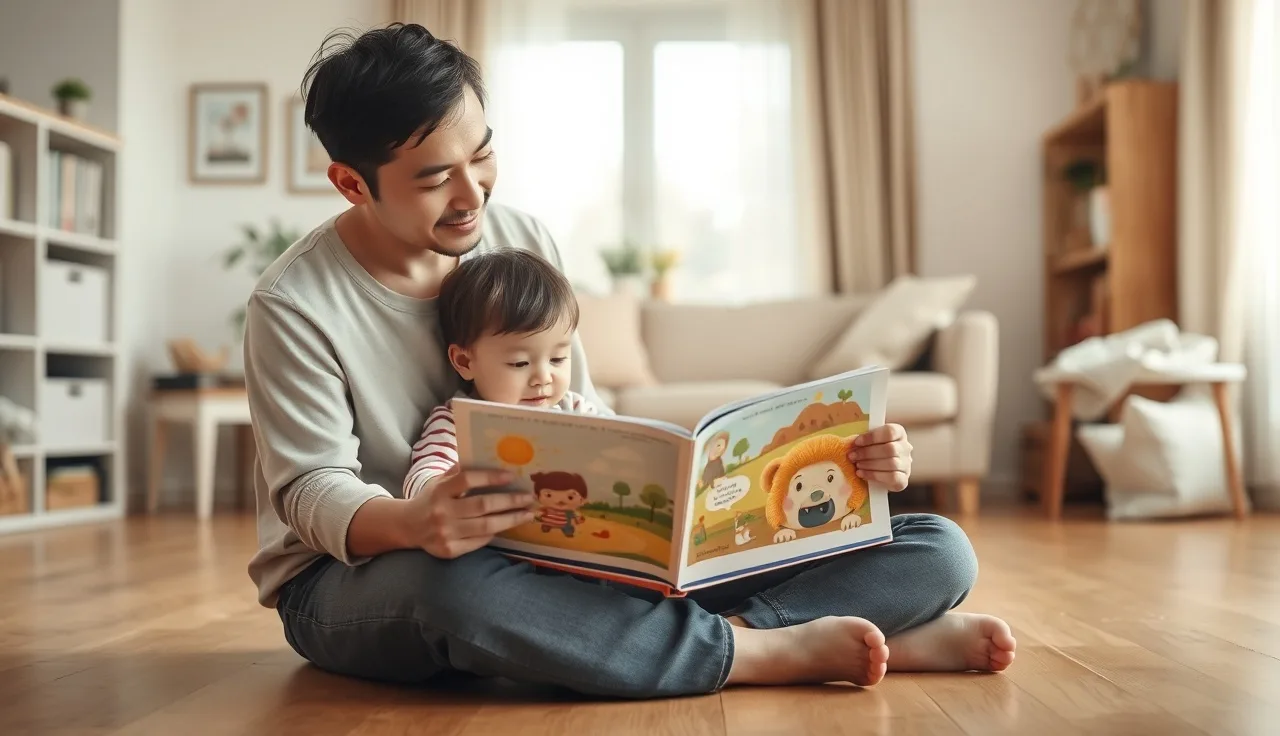
Read together, but treat the book as a conversation starter rather than a text to get through. Shared reading is one of the strongest predictors of vocabulary growth [5], and the benefit comes from the pointing, labeling, and back-and-forth around the pictures, not the words on the page. A three-minute session where your child is engaged and turning pages beats twenty minutes of them squirming while you read.
Where screen time fits in
This is one of the most studied questions in early language development, and the findings are fairly clear: passive screen time before age 2 doesn't teach language in any meaningful way, and heavy screen exposure in infancy is linked to smaller vocabulary at age 2 [6]. The AAP recommends avoiding screen media for children under 18 months except for video chatting [1].
After age 2, the picture gets more mixed. Content quality matters a lot: slow-paced, responsive shows where characters pause and wait, like Daniel Tiger or Sesame Street, show more language benefit than fast-cut action content. Video chatting with grandparents does support language, because it has that real-time back-and-forth quality.
Apps marketed to teach toddlers to talk are everywhere, and honestly, the evidence behind most of them is thin. A few built around clinically validated approaches, some using AAC principles, some built around the same parent-coaching techniques speech-language pathologists use, have more behind them than others. If you're weighing an app, look for one that coaches your behavior rather than just parking a screen in front of your child. That's where the real learning happens.
Little Words, for instance, is built around coaching the parent and adapts to where your child is communicatively, rather than running vocabulary drills. It's worth a look if you want structured daily support between therapy sessions or while you're waiting on an evaluation; you can start with their quiz to see if it fits your situation.
Why play matters as much as talking does
Play isn't a break from learning, for a toddler it is the learning. Language development is tied to symbolic thinking, and symbolic thinking grows through play. When your child pretends a block is a phone, they're making the same cognitive move as understanding that the word "apple" stands for the actual fruit. The two skills develop side by side.
Unstructured, child-led play is especially valuable. Sit on the floor, follow what they're doing, and narrate it. Resist the urge to redirect or quiz them on vocabulary. If they're crashing cars, say "crash, the cars crashed" instead of stopping to ask what color the car is.
Children who get more high-quality free play at home, meaning child-directed play with an engaged adult, tend to show stronger language outcomes by school entry. There's no single clean number for the size of that effect, but it's strong enough that most early intervention programs train parents specifically in child-directed play.
When should I be worried, and when should I call a speech therapist?
A few signals mean it's worth acting sooner rather than later: no babbling by 12 months, no words at all by 16 months, no two-word combinations by 24 months ("more juice," "go outside"), limited or no pointing by 14 months, not responding consistently to their name by 12 months, or a loss of language skills at any age. That last one deserves urgent follow-up, no matter what age it happens at.
The CDC's "Learn the Signs. Act Early." program lists these milestones and offers free developmental screening tools [3]. The M-CHAT-R/F is a validated autism screener that pediatricians typically give at 18 and 24 months. If your gut says something is off, that's usually reason enough to ask.
Getting a speech evaluation doesn't commit you to anything. An SLP will either tell you your child is on track, give you specific strategies to try, or refer you for further assessment, and in every case you walk away knowing more than you did before. It's often worth getting on a waitlist even while you're still unsure, since speech therapy waitlists in many areas run 3 to 6 months [7].
Early intervention, meaning services for children under 3 provided under IDEA Part C, is free, run through your state, and in most states doesn't require a doctor's referral. You can call your state's early intervention program yourself [8]. It's one of the most underused resources available to families.
For children on the autism spectrum, the link between communication and speech gets more complicated. Some children communicate very effectively in ways that don't look like speech at all. Others face specific motor-planning challenges, like childhood apraxia of speech, that need targeted work. When autism is part of the picture, autism spectrum speech therapy involves different considerations than typical late talking does.
What is early intervention and how do I access it?
Early intervention (EI) covers services for children from birth to age 3 under IDEA, Part C [8]. It's federally mandated and available in every state, though eligibility rules and how services are delivered vary by state.
To get started, call your pediatrician or your state's EI program directly. You don't need a diagnosis first. A team evaluates your child at no cost, and if they qualify, speech-language therapy and other services can happen at home or in a community setting.
IDEA Part C requires that families receive services in "natural environments" wherever possible, meaning your home, a daycare, or a community space rather than a clinic. That's a feature, not a compromise: therapy in natural settings tends to generalize better because the child learns in the same context where they actually communicate.
After age 3, children move to Part B of IDEA, delivered through the school district. If your child is between 3 and 5, contact your local school district to request an evaluation for preschool special education services. This is also free.
Do boys talk later than girls, and is it true some kids just talk late?
Boys do, on average, develop expressive vocabulary a bit later than girls, and this shows up across several large studies. The gap is real but small. A boy at 18 months with fewer words than a girl the same age isn't necessarily cause for alarm based on sex alone, but the same milestones still apply to both.
The "Einstein effect," the idea that some kids are quiet geniuses who'll suddenly burst into full sentences, does happen occasionally. There's also a genuine clinical group called "late talkers," children with an expressive language delay but otherwise typical development, and some of them catch up on their own by age 3 or 4. The trouble is you can't reliably tell in advance which late talker will catch up and which won't [9]. A 1996 study in the Journal of Speech, Language, and Hearing Research found that roughly 40-60% of late talkers resolve without intervention, which still leaves a large group who don't, and waiting to find out just delays the support they need.
Waiting has real costs. Early intervention works better the earlier it starts. If a child catches up on their own, an evaluation cost you a few hours. If they don't, you've just given up months of support they needed anyway. The math favors getting them checked.
What about bilingual toddlers? Does speaking two languages cause delay?
No, and this is a persistent myth. Bilingual children are not language-delayed. They may have a smaller vocabulary in each individual language than a monolingual peer would, but their combined vocabulary across both languages is comparable [10]. They hit the same milestones for word combinations and grammar.
If you're raising a child with two languages, the same strategies apply: narrate what you're doing, follow their lead, respond to whatever they're trying to tell you. You don't need to pick one language, and you don't need to worry you're confusing them. That's not how language acquisition works.
If a bilingual child is missing milestones in both languages, that's a more meaningful signal than missing them in just one. Ideally, an SLP who specializes in bilingual development, or who works alongside a bilingual speech therapy assistant, should evaluate the child in both languages.
Are there apps that can help teach my toddler to talk?
Some are genuinely useful. Most aren't. Apps that put vocabulary cards or videos in front of a toddler and expect the child to learn from watching aren't well-supported by evidence for children under 2, and the effect is weak for most kids under 3 too. Passive viewing just doesn't produce language learning.
The apps with better evidence behind them tend to do one of two things: coach the parent (walking you through serve-and-return techniques, giving you things to say or do during everyday moments), or support AAC (augmentative and alternative communication) for children who need a different way to communicate altogether.
AAC devices and apps like Proloquo2Go or TouchChat are generally for children who struggle to produce speech, not for kids who are simply late to talk. If an SLP recommends AAC, using it won't prevent speech from developing. The research is clear that AAC supports spoken language rather than replacing it [11].
For parent-coaching apps, look for ones grounded in established approaches like Hanen ("It Takes Two to Talk") or DIR/Floortime. These apps work best as a supplement to real interaction, never a stand-in for it. Little Words was built around that idea, with daily activities that walk parents through naturalistic language techniques and adjust as the child progresses; you can start with their quiz at littlewords.ai/start.
If your child shows echolalia, repeating words or phrases they've heard, look for an app or therapy approach that knows how to work with that pattern rather than trying to stamp it out.
What can I do today, at home, with no equipment?
A few things make an outsized difference. Turn off background TV: it breaks adult speech into noise and cuts down the number of complete sentences your child hears directed at them, and even having it on in the background while you do something else noticeably reduces conversational turns [12]. Get down on the floor with your child; at eye level you get more eye contact, more shared attention, and more back-and-forth.
Slow down and wait. After you say something, count five seconds silently before jumping in to fill the silence. Kids with language delays often need extra time to process and respond, and while the pause feels awkward to us, it's exactly the window they need.
Label feelings, not just objects. "You're frustrated" or "that made you happy" builds emotional vocabulary alongside object words and helps with self-regulation, which in turn supports communication. And sing: songs with repeated phrases and gestures, like "Wheels on the Bus" or "Old MacDonald," give kids a low-pressure way to try out sounds and words with musical support built in. Plenty of children say their first clear words through song before they ever say them in conversation.
None of this requires a diagnosis, a referral, or any special equipment. These are the same techniques SLPs teach parents in coaching sessions, because the evidence behind them is solid enough to have made it into clinical practice guidelines.
What if my toddler has been diagnosed with autism or apraxia?
Everyday strategies still matter here, but they need to work alongside specialist support rather than replace it.
Childhood apraxia of speech is a motor-planning disorder: the child knows what they want to say, but the signals from brain to mouth aren't coordinating correctly. The evidence strongly favors frequent, intensive therapy delivered by a speech-language pathologist. Parents can help around the edges, but the core work genuinely needs a trained clinician. Don't wait on an evaluation if you're seeing inconsistent errors, a limited set of consonants, or real trouble with longer words.
Communication looks different across an enormous range for children on the autism spectrum. Some autistic children talk early. Some don't develop speech at all, and everything in between is normal for this population. If your child is autistic and has communication delays, online speech therapy is increasingly workable when local access is limited, and many autistic children benefit from AAC while their speech develops. Using AAC doesn't reduce a child's motivation to talk. There's no credible evidence that it does, and quite a bit of evidence pointing the other way [11].
Whatever the diagnosis, if your child is under 3, the first call to make is to early intervention under IDEA Part C.
Frequently asked questions
What is the fastest way to help a toddler learn to talk?
Responsive interaction throughout the day works faster than anything else: narrate what you're both doing, follow your child's attention, expand on what they say, then wait for a response. Research on parent-implemented language interventions consistently shows this beats drills or flashcards. When a child is significantly behind, adding speech therapy on top of these home strategies moves things along faster than either one alone.
My toddler understands everything but doesn't talk. Should I be worried?
That pattern, understanding language well but producing little of it, is called an expressive language delay. Strong comprehension is encouraging and rules out some causes of delay, but it's not a reason to wait and see. Some expressive-only late talkers catch up on their own; others don't. An evaluation from a speech-language pathologist will tell you whether the gap between what your child understands and what they say is within normal range or needs support.
How many words should a 2-year-old have?
Most 2-year-olds have at least 50 words and are starting to put two together ("more milk," "Daddy go"). ASHA and the CDC both use 50 words plus two-word combinations as the benchmark for 24 months. If your child is well below that at their second birthday, the right move is scheduling an evaluation, not waiting longer.
Can too much screen time cause speech delay?
Multiple studies link heavy passive screen time to smaller vocabularies in toddlers. The AAP recommends no screen media besides video chatting before 18 months, and limited, high-quality content after that. The problem isn't really the screen, it's what it displaces: back-and-forth conversation with caregivers. Video chatting keeps that social exchange intact, which is why researchers and pediatricians treat it differently.
Does reading to toddlers really help them talk?
Yes, it's one of the strongest predictors of vocabulary size by school entry. The payoff is biggest when reading is interactive: pointing at pictures, naming things, making sounds, asking open questions, letting your child steer. A messy five-minute session where you're both pointing and laughing does more good than a passive read-aloud. The book itself barely matters; the conversation around it is what builds language.
Is my child a late talker or could it be autism?
The two overlap sometimes, but they're not the same thing. Autism involves differences in social communication, like eye contact, pointing to share interest, back-and-forth exchange, that go beyond how many words a child has. A speech-language evaluation combined with a developmental pediatrician's assessment can tell them apart. The M-CHAT-R/F is a validated screener your pediatrician can give at 18 and 24 months. An evaluation is really the only way to know for sure.
How do I get free speech therapy for my toddler?
Children under 3 qualify for free evaluation and services through IDEA Part C, the federal early intervention program, and you can self-refer by calling your state's program directly (most states don't require a physician referral). Once a child turns 3, services shift to the local school district under IDEA Part B. Both programs are free regardless of income or insurance.
Does talking to your baby and toddler really make a difference?
Yes. Hart and Risley's foundational research found that the number of words a child hears in early childhood predicts vocabulary size and later academic outcomes, and more recent research backs this up, though it also shows that quality of interaction (responsive, child-directed, back-and-forth) matters just as much as sheer volume. Narrating daily activities, commenting on what your child is doing, and responding to babble and gestures all count toward this.
What apps actually help toddlers learn to talk?
The apps with real evidence behind them coach parent behavior instead of putting passive content in front of the child. Ones grounded in Hanen, DIR/Floortime, or AAC principles have more support than vocabulary-card apps. For kids who need AAC, Proloquo2Go is clinically well established. For general late talking, look for something that walks you through naturalistic daily activities rather than promising your child will learn just from watching a screen.
Should I use sign language with my toddler?
Basic baby signs (for words like "more," "all done," "milk") don't delay speech and often cut down on frustration during the stretch when a child understands more than they can say. Some research even shows modest vocabulary advantages in children who sign. If your child has a significant delay or has been evaluated for AAC needs, that's a different and more structured path, one an SLP should guide.
What if my toddler has stopped talking after previously having words?
Losing language a child previously had calls for prompt medical evaluation, not a wait-and-see approach. Word loss can be tied to autism spectrum disorder, seizure activity, or other medical causes. Call your pediatrician and describe exactly what happened: when it started, how many words disappeared, what else changed around that time. This is not something to sit on.
Is it too late to help my 3-year-old start talking?
No, three is not too late. The brain stays quite plastic for language well into childhood, and kids who start intervention at 3 or 4 make real gains. The honest caveat is that earlier starts tend to produce better outcomes for most delays, which is why so much emphasis goes into birth-to-three services. But earlier being better doesn't mean now is too late. Contact your local school district for a free evaluation under IDEA Part B.
How often should I practice speech activities with my toddler?
Short, frequent interaction spread across the day beats one dedicated practice session. Five to ten small exchanges during diaper changes, meals, bath time, and play add up to far more language exposure than 20 minutes at a table. SLPs coaching parents usually focus on weaving language techniques into routines that already exist rather than piling new structured time onto a busy schedule.
Sources
- American Academy of Pediatrics, Council on Communications and Media, 'Media and Young Minds' (Pediatrics, 2016): AAP recommends avoiding screen media for children under 18 months except for video chatting, and describes early language development as fundamentally 'serve and return'
- American Speech-Language-Hearing Association (ASHA), 'Late Language Emergence': ASHA speech and language milestone ranges for ages 12-36 months including word counts and two-word combinations
- CDC, 'Learn the Signs. Act Early.' Developmental Milestones: CDC milestone checklist including no babbling by 12 months, no words at 16 months, and no two-word combinations at 24 months as signals for evaluation
- Tomasello, M. & Farrar, M.J., 'Joint Attention and Early Language', Child Development, 1986: Children learn new words more efficiently when caregivers follow and label the child's existing focus of attention rather than redirecting it
- Hart, B. & Risley, T., 'Meaningful Differences in the Everyday Experience of Young American Children', 1995; and Bus, A.G. et al., 'Joint Book Reading Makes for Success in Learning to Read', Review of Educational Research, 1995: Quantity of adult word exposure predicts vocabulary size; shared book reading with conversation is one of the strongest predictors of vocabulary at school entry
- Zimmerman, F.J. et al., 'Associations between Media Viewing and Language Development in Children Under Age 2 Years', Journal of Pediatrics, 2007: High screen exposure in infancy associated with smaller vocabulary size at age 2; passive viewing does not produce language learning
- American Speech-Language-Hearing Association (ASHA), '2023 SLP Health Care Survey': Speech therapy waitlists in many areas run 3 to 6 months, supporting the rationale for early referral
- U.S. Department of Education, IDEA Part C Early Intervention Program: IDEA Part C provides free evaluation and early intervention services to children ages birth to 3; families can self-refer without a physician referral in most states
- Paul, R., 'Predicting Outcomes for Slow Expressive Language Development', Journal of Speech, Language, and Hearing Research, 1996: Approximately 40-60% of late talkers resolve without intervention, but there is no reliable method to predict which individual children will catch up
- ASHA, 'Bilingual Service Delivery' and Pearson, B.Z. et al., 'Lexical Development in Bilingual Infants and Toddlers', Applied Psycholinguistics, 1993: Bilingual children's total vocabulary across both languages is comparable to monolingual peers; bilingualism does not cause language delay
- Millar, D.C., Light, J.C., & Schlosser, R.W., 'The Impact of AAC on Natural Speech Development', AAC Journal, 2006: AAC use supports rather than replaces spoken language development; no credible evidence that AAC reduces motivation to speak
- Christakis, D.A. et al., 'Audible Television and Decreased Adult Words, Infant Vocalizations, and Conversational Turns', Archives of Pediatrics & Adolescent Medicine, 2009: Background television significantly reduces adult words directed at children and cuts conversational turns between caregiver and child