Last updated 2026-07-11
Sensory processing difficulties show up in roughly 1 in 6 children, and they can break communication in a handful of different ways. A child overwhelmed by noise may just stop talking. Low sensitivity in the mouth can blur speech sounds together. A child who finds eye contact uncomfortable may miss the social cues that language gets built on. Once you address the sensory piece, the words often come back on their own.
Sensory processing is how the nervous system takes in, sorts, and reacts to information from the world and from inside the body. When it's working well, a child can tune out the air conditioner, watch a parent's face, and move their mouth with precision. When it isn't, any one of those steps can jam up.
Communication depends on sensory processing at every turn. Hearing a word is an auditory event. Reading a face is visual and social. Shaping a clean speech sound takes proprioceptive and tactile feedback from the lips, tongue, and jaw. Even sitting near someone without feeling threatened comes down to touch and proximity tolerance. That's a lot of sensory work happening before a single word gets out.
The American Speech-Language-Hearing Association (ASHA) notes that speech-language pathologists routinely see children whose communication trouble is tangled up with sensory differences, and that working alongside occupational therapy is often the right call [1]. Sensory processing and language aren't separate systems. They run on the same brain.
How common is this really
Estimates vary because "sensory processing disorder" isn't a standalone diagnosis in the DSM-5. Still, the sensory differences underneath it are well documented across several conditions. A widely cited 2004 study by Ahn, Miller, Milberger, and McIntosh in the American Journal of Occupational Therapy found sensory processing difficulties affect roughly 1 in 6 children in the general population [2].
Among autistic children the rate climbs much higher. The DSM-5 added hyper- or hyporeactivity to sensory input as a diagnostic criterion for autism in 2013, and research in Pediatric Research puts the figure between 69 and 95 percent of autistic individuals showing clinically significant sensory differences [3].
Kids with ADHD, developmental language disorder, childhood apraxia of speech, and cerebral palsy also show higher rates of sensory atypicality than neurotypical peers. The overlap is the real point here: sensory issues aren't some rare edge case on a speech therapy caseload. They're the norm.
Which senses matter most for speech
There are eight sensory systems, not five, and three are tied most tightly to communication: auditory, proprioceptive, and tactile. The rest still play a part.
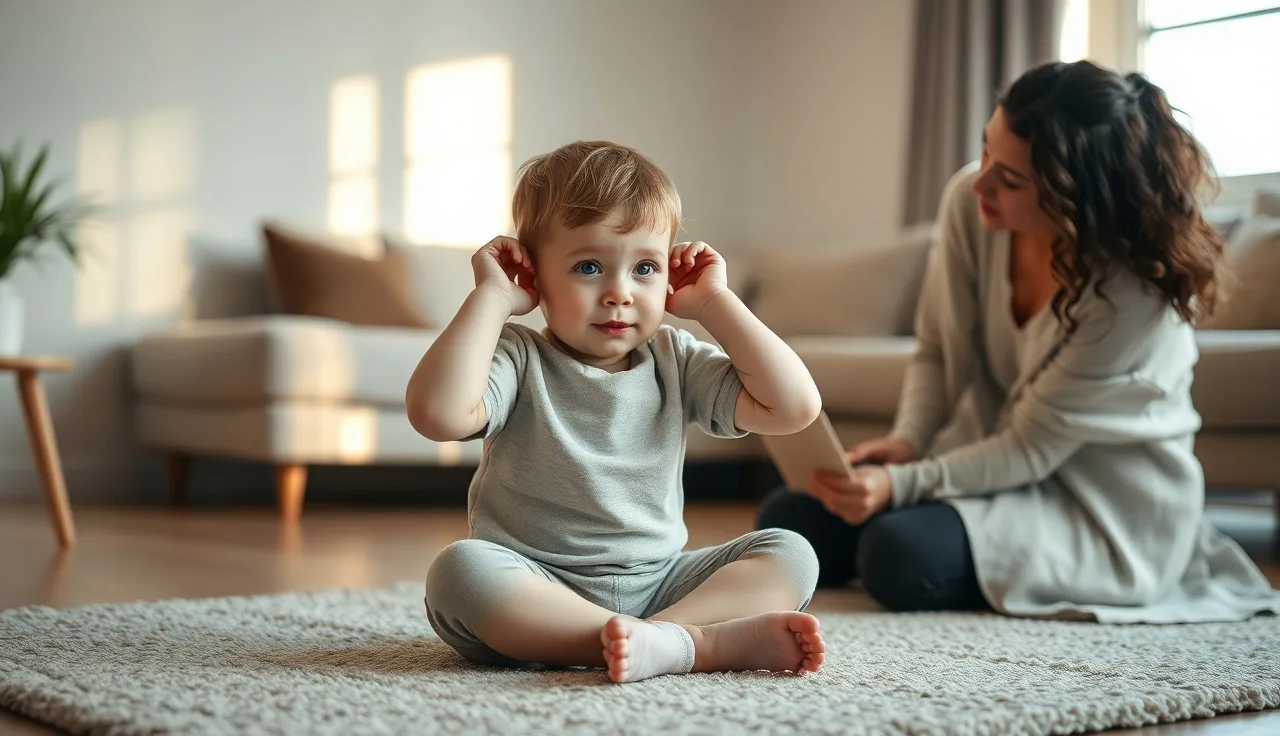
Auditory processing is the obvious one. A child who's hypersensitive to sound might cover their ears in a loud room, go quiet as background noise builds, or genuinely struggle to pull speech out of competing sound. This can look like a hearing problem but isn't: the child hears fine, they just process the signal differently. Auditory processing disorder (APD) is a separate diagnosis that can exist alongside language delays.
Proprioception and tactile processing in the mouth determine how clearly a child feels where their tongue sits, how hard they're pressing, whether their lips are closed. Kids with low oral proprioception may slur sounds, drool longer than you'd expect for their age, or avoid certain food textures in ways that also affect how much oral input they can tolerate during speech work. This overlaps with apraxia of speech in a meaningful way, since both involve the motor execution of speech, and sensory feedback is part of how that motor learning happens.
Vestibular and proprioceptive regulation set arousal level, and arousal level sets language output. A child who's understimulated or dysregulated often can't reach their best language, and a child in fight-or-flight usually loses expressive language first.
Visual processing carries reading faces, tracking a partner's gaze, and joint attention (the shared-looking behavior that's one of the earliest predictors of language). Kids who feel visually swamped in a busy space tend to narrow their visual attention, which cuts down how much language they take in.
Interoception, the sense of internal body states, is newer to clinical attention but shapes communication too. A child who can't reliably read their own hunger, discomfort, or anxiety has fewer internal experiences to draw on when describing how they feel, and often struggles to name emotions, a skill that sits under much of social communication.
What sensory overload looks like in the moment
Parents describe the same scene over and over: their child chatters away at home but goes almost silent at school, in stores, or at birthday parties. That pattern is often sensory. The nervous system is burning so much fuel managing noise, lights, smells, and the press of other bodies that there's almost nothing left over for making words.
Watch for verbal shutdown or whispering in places louder or busier than home, covering ears before or during attempts to speak, echolalia that spikes under stress (repeating familiar phrases instead of building new ones is partly a regulation move, see echolalia for more), hitting or biting or other self-regulatory behavior right before communication falls apart, and a wide gap between what a child says in a calm, quiet setting versus a busy one.
That gap between best-case and worst-case communication is a useful signal on its own. If a child talks well with one trusted adult in a quiet room but barely speaks in a group, sensory load is worth chasing down. A plain language delay doesn't usually swing that hard depending on the environment.
Can sensory sensitivity make a child stop talking?
Yes, and it catches parents off guard, since they usually assume speech delays trace back to mouth muscles or vocabulary. Language output is an executive and regulatory act. When the nervous system is overloaded, expressive language is often the first thing to drop offline.
Think of it as a stress response hierarchy: survival and regulation come before communication. Research on stress and the developing brain shows that heavy cognitive load, and acute sensory overwhelm is one version of that, cuts both the complexity and the amount of language a child produces [4].
For some kids the drop is temporary. Lower the sensory load and the words return. For others, repeated crashes in high-sensory settings harden into a habit of avoiding communication altogether. That's one reason early intervention matters so much: catch the sensory piece early and you cut the odds of avoidance becoming the default.
Selective mutism is a separate but related thing: a consistent failure to speak in specific situations while speaking freely in others. Anxiety is the main driver, but sensory sensitivity often co-occurs and can push the anxiety higher.
The effect on listening and understanding
Receptive language, understanding what's said, needs sustained auditory attention, working memory, and the ability to pull signal from noise. Sensory differences can knock out all three.
A child with auditory hypersensitivity may hear speech perfectly well in acoustic terms yet experience it as painfully loud or smeared when there's background noise. The American Academy of Pediatrics (AAP) recommends audiological evaluation for children with language delays precisely because telling peripheral hearing loss apart from central auditory processing trouble takes a professional [5].
Distractibility hits comprehension too. A child pulled toward every visual or tactile input in the room may not hold onto an auditory chunk long enough to parse a full sentence. Parents often read this as defiance ("he doesn't listen") when the truer description is that his nervous system is busy attending to something else.
Multi-step directions are especially rough for these kids, not because they lack the words, but because holding attention through a two-part instruction while also managing ambient input runs past what they can currently handle. Shorten your instructions, cut the room noise, and get down to eye level before you speak. Those changes cost nothing.
Sensory processing and social communication
Social communication is language in context: reading cues, taking turns, adjusting to your listener, using eye contact when it fits. It leans on sensory integration harder than any other part of communication.
Joint attention, looking where another person looks and sharing that focus, is the foundation. It shows up between 9 and 12 months in typically developing children and ranks among the strongest early predictors of later language [6]. For a child who finds direct eye contact aversive (common in autism, present in other sensory profiles too), joint attention is harder to start and harder to hold. Less joint attention means less shared language experience, which means a thinner vocabulary and weaker narrative skill down the line.
Turn-taking asks a child to read body language, vocal tone, and facial expression all at once. Every one of those is a sensory event, and an overloaded child misses the small signals that tell them it's their turn, or that their listener has checked out.
Proxemics, the physical distance we keep in conversation, is sensory too. Children with tactile defensiveness or proprioceptive sensitivity may stand too close or too far, which throws off the natural rhythm of back-and-forth.
This connects directly to autism spectrum speech therapy: pragmatic language therapy for autistic children now builds in sensory considerations, because you can't really practice social communication with a child who's in a state of sensory dysregulation.
What's the difference between a sensory-based communication difficulty and a language disorder?
Most of the time they overlap, and you really can't tease them apart without an assessment. That's the honest answer parents and clinicians keep bumping into.
A pure language disorder shows up no matter the setting. A child with developmental language disorder (DLD) has vocabulary and grammar gaps even in a quiet room with nothing else going on. A child whose main issue is sensory tends to swing: language holds up when things are calm and falls apart when the room gets busy.
Somewhere between 40 and 70 percent of autistic children have both sensory processing differences and language delays, and plenty of non-autistic kids with sensory difficulties have speech or language concerns too [3]. Treat the language piece alone and ignore regulation, and progress stalls. Treat the sensory piece alone without direct language support, and the gaps stay open.
The right first move is an evaluation by a speech-language pathologist, ideally working alongside an occupational therapist who can run sensory-specific tools like the Sensory Processing Measure (SPM) or the Sensory Profile. ASHA's practice portal lays out how SLPs and OTs should collaborate on complex cases [1].
At home, speech therapy that builds in sensory regulation before and during language activities tends to work better than language drills done on their own.
Supporting communication in sensory-heavy moments
You don't need a therapy degree for this. What helps most is environmental and relational, not technical.
Cut the load before you expect anything back. If you need your child to tell you something important, do it somewhere quiet and familiar, not in the car, not right after school, not in the middle of a transition.
Give regulating input first. Proprioceptive input, heavy work like carrying a backpack, pushing a cart, wall push-ups, along with deep pressure, are the sensory inputs most reliably linked to regulation in the research [7]. A short burst of that kind of movement before a conversation-heavy activity can open up real language capacity.
Slow your own language down and shrink it. A dysregulated child can't process long sentences. Short, predictable phrases work better, and giving more wait time than feels natural helps too: research on wait time in SLP sessions keeps finding that clinicians underestimate how long a child needs before answering.
Skip the push for eye contact while your child is trying to communicate. For many sensory-sensitive kids, eye contact costs real neurological effort, and a child looking away may be processing your words better than one forced to hold your gaze. This is well documented in autism research and almost certainly applies to other sensory profiles too [8].
When speech goes offline, reach for AAC. AAC devices and low-tech picture systems aren't a replacement for speech; they carry communication through the moments when talking is hardest, and cutting the frustration cuts the dysregulation that feeds on it. If your child uses an app-based support tool, something like Little Words, which adjusts to a child's current state, can bridge those high-load moments without adding more verbal pressure.
What speech therapists and occupational therapists actually do
Assessment comes first. An SLP looks at language, speech sound production, pragmatic communication, and oral-motor function. An OT with sensory expertise assesses sensory thresholds and processing patterns, often with standardized tools like the Sensory Processing Measure (SPM-2) or the Sensory Profile 2.
Once both profiles are in hand, treatment usually runs coordinated, and a few approaches come up often. Sensory integration therapy (formally Ayres Sensory Integration, or ASI) is the OT-led approach with the strongest research base for improving sensory modulation: a 2019 systematic review in the American Journal of Occupational Therapy found positive effects on goal attainment for autistic children compared to usual care [9]. It doesn't target language directly, but better regulation builds the ground language grows in.
Naturalistic Developmental Behavioral Interventions (NDBIs) like JASPER and ESDM plant language targets inside regulated, sensory-informed play, and carry strong evidence for improving joint attention and early language in young autistic children [10]. Oral-motor and tactile desensitization work addresses hypersensitivity in and around the mouth that drags down articulation and food acceptance; it's often folded into feeding therapy and matters directly for speech sound production. And in regulation-first language therapy, the SLP tracks the child's arousal throughout the session and uses tools like weighted lap pads, movement breaks, or specific seating to keep the child in the state where language learning can actually happen.
For families who can't get to in-person services, online speech therapy has grown a lot since 2020, and some telehealth SLPs work specifically with sensory-communication profiles.
When to seek an evaluation
There are rough benchmarks worth knowing, though no single milestone tells the whole story. By 12 months, a child should point, wave, and make eye contact to share interest. By 18 months, 10 to 20 words. By 24 months, two-word combinations. These come from the CDC's Learn the Signs. Act Early. milestones, revised in 2022 [11].
Watch for a child who talks better in quiet one-on-one settings than in groups, who covers their ears often and loses language in noisy rooms, who resists oral-motor activities and has unclear speech, or who avoids eye contact in ways that shrink joint attention and turn-taking. These point toward the sensory-communication link specifically.
The AAP recommends developmental surveillance at every well-child visit and formal screening at 9, 18, and 30 months, with autism-specific screening at 18 and 24 months [5]. If a screen comes back positive, or a parent raises a concern, the guidance is to refer for evaluation, not wait and see.
No parent should have to fight for a referral. If your pediatrician brushes you off, the Individuals with Disabilities Education Act (IDEA), 20 U.S.C. § 1400 et seq., guarantees a free evaluation through your local school district for children 3 and older, and early intervention services through Part C for children under 3 [12]. Request the evaluation in writing; the district must respond within timelines set by state law, typically 60 days.
Do sensory-communication patterns point to autism?
Some patterns cluster more heavily in autistic children, though none diagnose anything on their own; a diagnosis takes a full developmental evaluation by a qualified professional.
Patterns with higher specificity for autism include using echolalia as a primary way of communicating (see echolalia meaning for what that looks and sounds like), a consistent aversion to unpredictable sensory events that shuts down communication, extreme sensitivity to vocal tone that makes ordinary conversation feel unbearable, and a profile where a child uses language well to request objects but struggles with social language like commenting or sharing excitement.
The DSM-5 requires that sensory hyper- or hyporeactivity be assessed as part of any autism diagnostic process. That said, sensory-communication difficulties turn up outside autism too, in children with ADHD, DLD, anxiety disorders, and no formal diagnosis at all.
If autism is on your radar, autism spectrum speech therapy covers what tailored intervention looks like, and early intervention programs built for autistic toddlers hold some of the strongest evidence bases in developmental pediatrics [10].
Between therapy sessions
Therapy runs 30 to 60 minutes, usually once a week. The other 167 hours are yours, and what happens during them counts for more.
Follow your child's lead in play. This is the spine of nearly every evidence-based early language approach: join what your child is already doing, comment on it without demanding a response, and wait. It's harder than it sounds, and it beats flashcard drills.
Build predictable sensory routines, too. Predictability lowers arousal, and a steady daily rhythm with known sensory anchors, a morning walk, a bath before bed, a specific texture during calm time, settles the nervous system across the day, which helps language across the day too.
Read together in whatever way fits your child. There's no requirement to sit still. A child who processes better while moving can listen to a story from a trampoline; input is input.
Use visual supports. Picture schedules, first-then boards, and social stories cut the cognitive and sensory load of transitions, which is exactly when a lot of kids' communication gets brittle.
Pay attention to the environment more than the words. Keep a loose note of when your child communicates best and worst: what was the sensory setting, what time of day was it, how much movement had they had beforehand. That information is gold for the therapy team.
If you want a structured way to support communication at home, Little Words has a short quiz at littlewords.ai/start that matches your child's profile to a personalized practice plan, sensory-informed suggestions included.
Frequently asked questions
Can sensory issues cause a speech delay?
Sensory issues don't cause language delay the way a structural problem does, but they can badly limit the conditions a child needs to learn and use language. A child whose sensory system is often overwhelmed takes in less input, practices less, and has fewer regulated moments to communicate. Over time that can produce or worsen a functional language delay. A speech-language pathologist can help sort out what's driving the gap.
My child talks fine at home but barely speaks at school. Is that a sensory problem?
That environment-dependent gap is one of the clearest signals sensory load is affecting communication. Schools are louder, busier to look at, and more socially demanding than home. A child managing all that extra input has less left for talking. Selective mutism can also produce this pattern, with anxiety as the main driver. Both deserve evaluation by an SLP and possibly an OT.
How do I know if my child's sound sensitivity is causing their language delay?
Watch for one specific pattern: language that's clearly better in quiet, low-stimulation settings and clearly worse in noisy or busy ones. A large, consistent gap makes auditory sensitivity worth chasing. A hearing test rules out peripheral hearing loss. An audiologist can assess central auditory processing, and an OT can evaluate auditory sensitivity inside a broader sensory profile. An SLP then interprets how those findings hit language.
Does avoiding eye contact mean my child has a sensory issue?
Not on its own, but for many children, especially autistic children, avoiding eye contact is a sensory and neurological response rather than a social choice. Research in Scientific Reports found that constraining gaze to the eye region provokes abnormally high subcortical activity in autistic individuals. Forcing eye contact can actually lower communication quality for these kids. An evaluation can clarify whether the avoidance is sensory, social, or both.
What is sensory processing disorder and is it a real diagnosis?
Sensory processing disorder (SPD) is not a standalone diagnosis in the DSM-5, the standard diagnostic manual used in the U.S. But the sensory differences it describes are clinically real and appear as diagnostic criteria in autism and other conditions. Many OTs use SPD as a clinical framework for assessment and treatment even when insurers won't reimburse under that label. The underlying differences have solid neurological and behavioral research behind them.
Can occupational therapy improve my child's speech?
OT doesn't target speech directly, but improving sensory regulation builds the conditions that make speech therapy work better. A better-regulated child attends more, tolerates more, and practices more. Studies of combined OT and speech therapy for autistic children show better communication outcomes than either alone in some groups. ASHA explicitly recommends interprofessional collaboration between SLPs and OTs for children with complex sensory-communication profiles.
What sensory accommodations help kids communicate better in the classroom?
Preferential seating away from hallway noise or HVAC units, noise-reducing headphones during independent work, a standing or wobble-seat option, less clutter in the visual field near the board, and advance warning before transitions all cut sensory load without singling the child out. These are low-cost, widely available accommodations that can go into a 504 Plan or IEP under IDEA with no formal sensory processing disorder diagnosis required.
Is there a sensory reason some kids use echolalia instead of original speech?
Yes. Echolalia, repeating memorized phrases rather than generating new language, is partly a sensory-regulatory strategy. Familiar language needs less novel motor and cognitive planning, so it carries a lower processing cost during high-demand or high-stimulation moments. It isn't simple parroting; it often carries real communicative intent. Figuring out what a child is trying to say through their echolalia, rather than suppressing it, is the current clinical recommendation.
How does proprioceptive input help with communication?
Proprioceptive input, the pressure, weight, and resistance felt through muscles and joints, is one of the most reliably regulating sensory channels. Carrying a heavy backpack, wall push-ups, jumping, or wearing a weighted vest (under OT guidance) can lower arousal and steady a child's state before communication-heavy tasks. A regulated child has more neurological room for language. That's why many SLPs build movement into their sessions.
My child gags or refuses oral-motor exercises. Could that be sensory?
Almost certainly. Tactile hypersensitivity inside and around the mouth is common in children with sensory processing differences. The gag reflex is partly governed by tactile sensitivity, and many kids who show hypersensitivity elsewhere show it orally too. That makes oral-motor exercises, toothbrushing, and new food textures all aversive. A feeding therapist or OT who specializes in oral sensory sensitivity can do gradual desensitization work that then supports speech therapy progress.
What's the difference between auditory processing disorder and sensory processing disorder?
Auditory processing disorder (APD) is a specific difficulty in how the brain processes auditory information, diagnosed by an audiologist through specialized testing after normal peripheral hearing is confirmed. Sensory processing disorder is a broader pattern of atypical responses across multiple sensory systems, usually assessed by an OT. They can co-occur, and both can limit communication. APD is more likely to affect reading and language comprehension specifically; SPD affects regulation and communication more broadly.
How do I get my child evaluated for sensory issues that affect their speech?
Start with your pediatrician and request referrals to both a speech-language pathologist and an occupational therapist with sensory processing expertise. For children under 3, contact your state's early intervention program (required under IDEA Part C) for a free evaluation. For children 3 and older, your local public school district must provide a free evaluation upon written request under IDEA Part B. You do not need a diagnosis to request the evaluation.
Can a child's sensory sensitivity improve over time?
Yes, for many children. Sensory thresholds aren't fixed, especially in early childhood while the nervous system is still developing. With appropriate sensory diet activities, OT-guided sensory integration therapy, and a generally lower-stress environment, many children show real gains in regulation and tolerance over months to years. Research on Ayres Sensory Integration therapy for autistic children shows positive effects on goal attainment, though individual outcomes vary a lot.
What should I tell my child's teacher about their sensory-communication connection?
The most useful thing you can say: when my child is in a noisy or busy environment, their language drops, and that's neurological, not behavioral. Give specific, observable examples of what dysregulation looks like for your child before it becomes a meltdown, and what helps (a quiet break, heavy work, shorter instructions). Put accommodations in writing through a 504 Plan or IEP so they stick across staff and substitute teachers.
Sources
- American Speech-Language-Hearing Association (ASHA), Practice Portal: ASHA recognizes that SLPs work with children whose communication difficulties are entangled with sensory differences and recommends interprofessional collaboration with OTs.
- Marco EJ, Hinkley LBN, Hill SS, Nagarajan SS. Sensory processing in autism: a review of neurophysiologic findings. Pediatric Research, 2011.: 69 to 95 percent of autistic individuals show clinically significant sensory differences; DSM-5 included sensory reactivity as a diagnostic criterion for autism in 2013.
- National Scientific Council on the Developing Child, Harvard University. Excessive Stress Disrupts the Architecture of the Developing Brain, Working Paper 3.: Cognitive load from acute stress reduces both the complexity and quantity of language output in children.
- American Academy of Pediatrics (AAP), Bright Futures: AAP recommends audiological evaluation for children with language delays and formal developmental screening at 9, 18, and 30 months, with autism-specific screening at 18 and 24 months.
- Mundy P, Gomes A. Individual differences in joint attention skill development in the second year. Infant Behavior and Development, 1998.: Joint attention develops between 9 and 12 months in typically developing children and is one of the strongest early predictors of later language ability.
- Schaaf RC, Benevides T, Mailloux Z, et al. An intervention for sensory difficulties in children with autism. Journal of Autism and Developmental Disorders, 2014.: Proprioceptive and heavy-work input is linked to improved regulation, which supports language capacity in sensory-sensitive children.
- Hadjikhani N, Johnels JA, Zurcher NR, et al. Look me in the eyes: constraining gaze in the eye-region provokes abnormally high subcortical activation in autism. Scientific Reports, 2017.: Constraining gaze to the eye region provokes abnormally high subcortical activity in autistic individuals; forcing eye contact can reduce communication quality.
- Schreibman L, Dawson G, Stahmer AC, et al. Naturalistic Developmental Behavioral Interventions: Empirically Validated Treatments for Autism Spectrum Disorder. Journal of Autism and Developmental Disorders, 2015.: NDBIs like JASPER and ESDM have strong evidence for improving joint attention and early language in young autistic children.
- CDC Learn the Signs. Act Early. Developmental Milestones (2022 revision): CDC 2022 milestones: 10-20 words by 18 months, two-word combinations by 24 months; pointing and eye contact by 12 months.
- Individuals with Disabilities Education Act (IDEA), 20 U.S.C. § 1400 et seq.: IDEA guarantees free evaluation through local school districts for children 3 and older, and early intervention services through Part C for children under 3.