Last updated 2026-07-11
TL;DR
Siblings can speed up or slow down a late talker's language. Responsive, simplified talk from a brother or sister gives natural practice reps that no therapist's schedule can match. But talking-for, finishing sentences, or fast complex input cuts a late talker's reason to speak. Small, coached changes to daily sibling routines move the needle without turning family life into therapy.
Why does sibling interaction affect a late talker's speech development?
Language grows through interaction, not exposure alone. A child who hears speech but never needs to produce it misses the practice reps that build real skills. Siblings are constant, informal, emotionally loaded communication partners. Often they are more motivating than any adult in the room, because kids want what other kids have and want to play what other kids are playing.
The American Speech-Language-Hearing Association (ASHA) describes language development as shaped by the "richness and responsiveness" of a child's communication environment more than by the sheer count of words heard [1]. That environment includes everyone in the house. A sibling who is there for bath time, car rides, and dinner is hundreds of interaction chances per week.
The flip side is just as real. If a sibling anticipates every need, speaks for the late talker, or floods them with fast, complex language, the late talker learns that communication isn't required to get what they want. That drop in communicative demand is one of the quieter ways families slow progress without meaning to.
What does the research say about siblings and language learning?
The sibling effect on language is documented, though most studies look at typically developing kids, not late talkers specifically. Research in the Journal of Child Language has found that children with older siblings show slightly smaller early vocabularies on average, a pattern attributed partly to reduced one-on-one adult speech directed at the younger child [2]. The effect is modest and depends on context, but it points to a real mechanism: who talks to the child, and how, matters.
For children with autism, sibling-mediated interventions have stronger backing. A 2018 systematic review in the Journal of Autism and Developmental Disorders reported that sibling-implemented naturalistic strategies improved communication in several small studies, with effects comparable to parent-implemented approaches when siblings got structured coaching [3]. Nobody has large randomized trial data on siblings coaching late talkers specifically, as opposed to autistic children. The closest evidence base still suggests the mechanism holds.
Here is what the research agrees on. Sibling interaction quality matters more than quantity. A sibling who asks a genuine question and waits does more good than one who talks nonstop without pausing. That gap between quantity and responsiveness is exactly what parents can teach.
Which sibling behaviors actually help a late talker talk more?
The behaviors that help mirror what speech-language pathologists teach parents: simplified language, real pauses, following the child's lead, and commenting instead of demanding.
Here is what that looks like coming from a sibling.
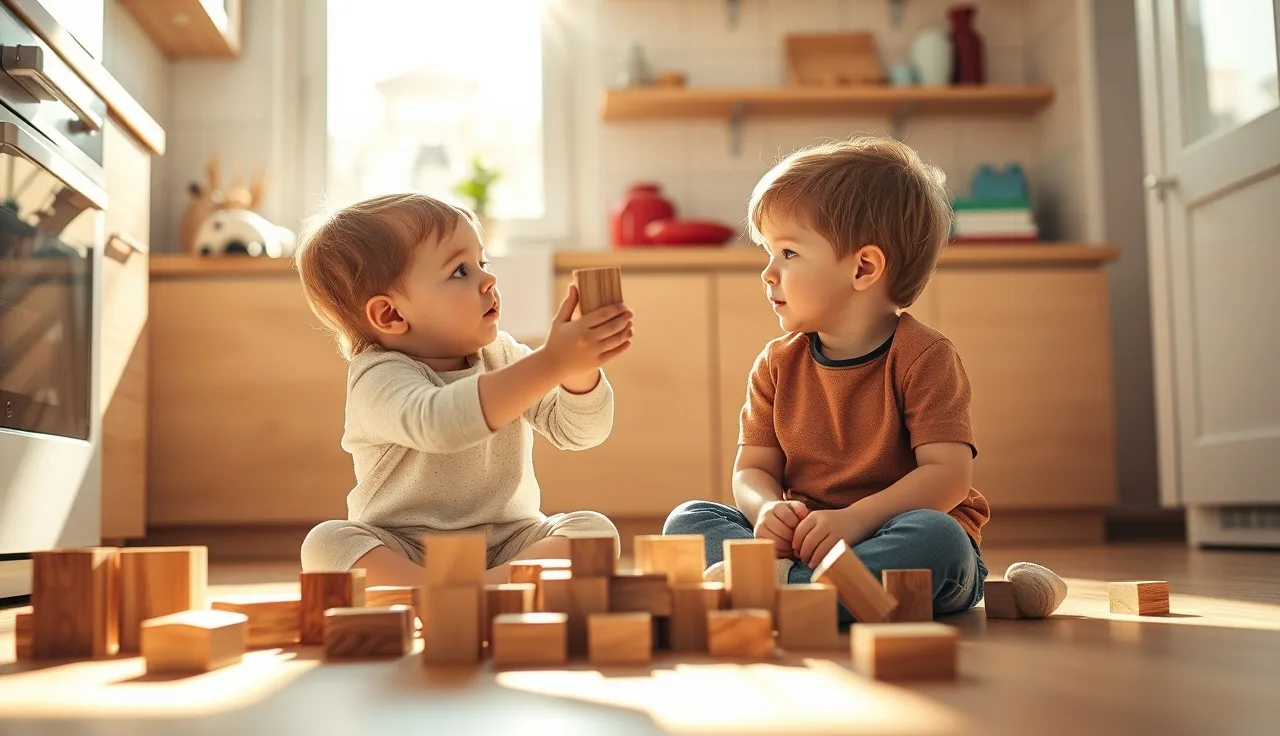
Waiting. After a question or an offer, the sibling pauses five to ten full seconds. That silence feels long. It's the window the late talker needs to build and produce a response. Most siblings, and most adults, fill the gap before the child can speak.
Modeling one level up. If the late talker uses single words, the sibling uses two-word phrases. If the late talker uses two words, the sibling uses short three-word sentences. Speech-language pathologists call this expanding, and it hands the child a clear, reachable target without overwhelming them [4].
Narrating play. "The car goes here. Now the truck. Uh oh, it fell." Simple, present-tense parallel talk during shared play attaches language labels to things the child cares about right now.
Offering choices out loud. "Do you want the red one or the blue one?" This builds a communication opportunity without asking the late talker to generate language from scratch. The words the child needs are sitting right there in the offer.
Celebrating any attempt. A sibling who lights up at a sound, a gesture, or a rough approximation tells the late talker that communication works. This is the part siblings do better than anyone: they're peers, and peer approval hits differently than adult approval.
If you're working with a speech therapy speech therapist, ask them to spend five minutes of a session showing the older sibling one or two of these strategies directly. Kids learn from demonstration, not from a parent relaying instructions later.
Which sibling behaviors can slow a late talker's progress?
No sibling does these things out of cruelty. They do them because the shortcuts work, or because they're just playing, or because nobody told them otherwise. The patterns are still worth naming.
Talking for them. "He wants the blue cup." "She's saying she doesn't want to go." The sibling becomes a reliable interpreter, so the late talker never has to communicate directly. Over time that pushes communicative demand toward zero.
Finishing their sentences. Same problem, faster. The late talker starts a sound or reaches for a word and the sibling jumps in. It feels helpful. It removes the practice rep.
Overwhelming pace and complexity. Older siblings with full language often talk fast, stack complex sentences, switch topics quickly, and leave no natural pauses. A late talker who processes language more slowly can't keep up, and may check out rather than fight to.
Teasing or imitating. Older siblings sometimes mimic a late talker's errors or sounds. It feels like play to them and lands as something worse on the younger child. A kid who is embarrassed or anxious about their speech talks less, not more. Anxiety and communication avoidance are a documented pattern in children with speech difficulties [5].
Doing everything without asking. Pouring the drink, picking the show, handing over the toy before the late talker has any reason to ask. This is kindness, not harm. It still erases every natural chance to communicate.
How can parents coach siblings without making it a chore?
The goal is not to turn older kids into unpaid therapists. That isn't fair to them, and it tends to backfire. Siblings who feel burdened by a sibling's disability often build up resentment, which is worse for the family than doing nothing. Aim for small, specific habits that feel natural.
A few things that tend to work.
Tell the sibling the truth at their level. A six-year-old can handle: "Mia's brain is still learning how to make words. When you wait a little longer after you ask her something, her brain has time to get the word ready. You're really good at waiting." Framing it as a skill the sibling has, instead of a problem the late talker has, flips the whole dynamic.
Pick one behavior. Not five, not a list. One thing, practiced until it's automatic, then maybe one more. "This week we're all trying to wait ten seconds after we ask a question." That's doable. A seven-point sibling coaching plan is not.
Model it yourself where the sibling can see. Kids copy what they watch. If you pause, expand, and follow the late talker's lead every day, the sibling soaks up the pattern. You don't have to explain it. Just do it visibly.
Don't correct the sibling in the moment in front of the late talker. Pull them aside later for a light debrief. "Hey, I noticed you answered for Leo today. Next time let's give him a chance to try first, okay?" Corrections mid-play break the moment for everyone.
Name the sibling's real losses. A brother or sister who can't yet talk back, play pretend at the same level, or take an equal turn is genuinely hard to have. Siblings grieve that in their own way. Making room for the frustration, without piling on guilt, makes them more willing to help, not less.
Does birth order matter? Is it harder if the sibling is older or younger?
Birth order creates different dynamics, not uniformly better or worse ones.
An older sibling has more developed language and can model clearer speech, offer structured choices, and show real patience once coached. But older siblings are also the ones most likely to do everything for the late talker, interpret for them, and dominate the conversation by default. They've been the competent, verbal one since day one of the relationship.
A younger sibling catching up to or passing the late talker brings a different stress. Parents often describe the moment a younger sibling's vocabulary overtakes the late talker's as one of the hardest they hit. That shift can raise the late talker's motivation in some cases, since they watch a younger sibling get things by asking. It can also raise anxiety and avoidance.
Twins are their own case. Research on twins and language has found twins develop language slightly more slowly on average than singletons, likely because adult speech is split and less individually responsive, and because twins build their own efficient shorthand [2]. If both twins are late talkers, that shared low-demand environment can compound the problem.
The honest answer: birth order matters less than interaction style. A younger sibling who has learned to wait and model can help as much as an older one. Age-appropriate coaching is the lever, not the birth order.
What about siblings of children with autism or AAC users?
Children with autism often have communication profiles more complex than a typical late talker. They may use echolalia as a real communicative tool, rely on AAC devices, or have language that only shows up in specific contexts. Siblings in these families need a slightly different playbook.
For AAC users, teach siblings to touch the device themselves, at least a little. When a sibling models AAC alongside the child who uses it, the message lands: this is a real way to talk, not a therapy prop. ASHA notes that communication partners who model an AAC system increase the child's spontaneous use of it [6]. A sibling who pulls up the device and hits "I want" then "snack" before asking the AAC user the same question is doing real work.
For kids who use echolalia, siblings sometimes get frustrated when their question comes back as a line from a cartoon. Explaining that echolalia is usually communicative, not random, cuts that frustration. Keep it simple: "When Jonah says 'To infinity and beyond,' he might mean yes, or that he's excited, or that he wants to keep playing. Watch what he does right after and you'll figure it out."
For families in autism spectrum speech therapy, asking the speech-language pathologist for a sibling-specific session or handout is completely reasonable. Some SLPs work directly with siblings as part of the plan, especially in naturalistic intervention models. If early intervention services are active, the service coordinator can sometimes help set this up too.
How much sibling interaction is the right amount for a late talker?
There is no evidence-based number of minutes. What the research supports is quality over quantity, and counting communication opportunities rather than general togetherness.
A communication opportunity is a moment when the late talker has a reason to communicate and a responsive partner ready. Ten minutes of focused, responsive sibling play with good modeling builds more language than two hours of parallel TV, or a sibling who quietly does everything for the child.
Overwhelm is real, though. Late talkers who also have sensory sensitivities, apraxia of speech, or processing differences can get dysregulated by fast-paced sibling play. A dysregulated child can't learn language. Reading the late talker's cues and stepping back when they're flooded matters as much as creating openings.
A practical rule many SLPs suggest: look for three to five short, natural interaction windows a day where a sibling can practice one coached strategy. A bath, a snack, a ten-minute play session. Not a curriculum. Just windows.
What can parents do when siblings are frustrated or resentful?
This is the part parenting books tend to skip. Sibling resentment around a child with a speech delay is normal, and it deserves direct handling, not quiet management.
Siblings often feel invisible. When a big share of family energy goes to speech appointments, home practice, and managing the late talker's needs, older kids notice. Research on siblings of children with disabilities documents higher rates of anxiety, loneliness, and caregiver burden, especially when their own needs go unmet [7].
Some things that help. Dedicated one-on-one time with the sibling that has nothing to do with the late talker's needs. Direct, honest talks about what the delay is and isn't. Letting the sibling be a kid, not a co-therapist, most of the time. And normalizing the messy feelings: "It makes sense that you're annoyed when she can't tell you what game she wants to play. That's a real frustration."
If a sibling shows signs of real anxiety or big behavior changes, a therapist who works with siblings of children with disabilities is worth considering. That is not overreacting.
Are there structured sibling training programs that actually work?
Yes, a few have real evidence behind them.
Sibling positive behavior support approaches train siblings of children with developmental disabilities in naturalistic communication strategies. They've been studied in small but controlled designs, with effects on communication for the target child and on sibling confidence [8].
Sibshops is a long-running peer-support program for siblings of children with disabilities. It leans toward emotional support rather than communication training, but the two are linked: a sibling who feels supported is more likely to help willingly [7].
Many early intervention programs include family training as a required component under IDEA (Individuals with Disabilities Education Act, Part C), and that training can extend to siblings when a parent asks. The law requires early intervention services to be family-centered, which logically takes in siblings [9].
For families outside a formal program, a single structured conversation with your SLP about sibling coaching is a lower-lift start. If you use a tool like Little Words at home for daily practice, you can pull the same session content into sibling play, following whatever the late talker is working on that week.
The table below lines up the main approaches:
| Approach | Who delivers it | Evidence level | Main focus |
|---|---|---|---|
| SLP-coached sibling session | Speech-language pathologist | Moderate (small studies) | Communication strategies |
| Sibling positive behavior support | Trained facilitator or parent | Moderate (controlled studies) | Naturalistic language support |
| Sibshops | Trained facilitator | Good (longitudinal data) | Sibling emotional wellbeing |
| Parent modeling at home | Parent | Indirect (via parent-implemented research) | Daily habit change |
| IDEA Part C family training | Early intervention provider | Strong (federally mandated) | Family-centered support |
When should parents stop leaning on sibling interaction and push for professional help?
Sibling interaction supplements evaluation and treatment. It never replaces them when there's a real concern. If your child is missing language milestones and you're hoping sibling exposure closes the gap on its own, that hope carries a cost: lost time.
The American Academy of Pediatrics recommends developmental screening at 9, 18, and 24 or 30 months, with referral for a speech-language evaluation any time a parent has a concern, whether or not the child passes a screen [10]. Two thresholds matter most. Fewer than 50 words by 24 months, or no two-word combinations by 24 months, are established flags for referral [10].
If you're past those thresholds and stuck on a waitlist for speech therapy, sibling strategies genuinely help in the meantime. They aren't a workaround for a professional evaluation. They hold momentum. Online speech therapy can sometimes shorten the wait for an initial evaluation or session when in-person lists are long where you live.
For children with more complex profiles, including suspected childhood apraxia of speech, sibling interaction alone will not touch the motor planning deficits involved. Professional treatment is necessary there, and sibling coaching becomes a way to carry skills from therapy into daily life.
Frequently asked questions
Can a sibling actually teach a late talker to talk?
Not the way a speech-language pathologist can, but siblings create hundreds of natural practice openings per week that a therapist's schedule can't match. A sibling who waits, models simple language, and responds to any attempt reinforces skills the child is building. Think of it as generalization practice, not instruction. The sibling extends the work, they don't lead it.
My older child always talks for my late talker. How do I stop it?
Address it directly and specifically, but not during play. Explain simply why waiting helps their sibling's brain. Then pick one habit: "Let's let her try to say it first before we answer for her." Don't expect perfection. Older siblings learned that interpreting works, and changing that takes consistent, low-pressure reminders over weeks, not days.
Is it bad for a late talker to have a sibling who talks a lot?
Not by itself. A talkative sibling gives language exposure, which has value. The question is whether the late talker ever has to produce language. If the sibling fills every silence and handles every request, exposure without output does less. The fix is coaching the talkative sibling to pause and wait, not asking them to talk less overall.
My younger child now talks more than my late talker. How do I handle this?
This is genuinely painful and very common. Name your own feelings first. For the late talker, a younger sibling modeling words can be motivating rather than crushing, especially when they see the younger one getting things by asking. Keep the late talker's therapy active and consistent, and skip comparisons in front of either child.
Should I involve siblings in speech therapy sessions?
Sometimes yes, and it's worth asking your SLP directly. Some naturalistic intervention models build siblings in by design. Even a five-minute demonstration at the end of a session, where the SLP shows the sibling one strategy and lets them try it, can stick. It works better than a parent passing along the instructions secondhand.
What age can a sibling start helping with a late talker's speech?
Kids as young as four or five can learn a single concrete strategy like waiting or offering a choice. Developmental readiness matters more than a fixed age. A mature five-year-old can do more than an immature eight-year-old. Keep the coaching simple, frame it positively, and match expectations to what the sibling can actually hold in mind during play.
Does having multiple siblings help or hurt more than having just one?
More siblings means more communication partners, but also more noise, faster talk, and less one-on-one adult input. Research on family size and language finds that later-born children in large families tend to have smaller early vocabularies on average, partly from reduced individual adult attention. With coaching, several siblings can each give short, quality interactions that add up.
My child with a speech delay gets teased by their sibling. What do I do?
Address teasing directly and right away. Communication anxiety is real: children who feel embarrassed or unsafe about their speech talk less, not more. Name the behavior, explain why it's harmful, and set a clear expectation. If it continues or escalates, it belongs in a conversation with a family therapist, more than a parenting talk at home.
Can sibling interaction help even before a child starts formal speech therapy?
Yes. While you wait for an evaluation or therapy to start, a sibling who uses simple language, waits after asking questions, and responds to any attempt creates real practice. It won't replace assessment, and you should pursue evaluation without delay. Coached sibling interaction in the meantime is not neutral. It can hold momentum.
What if my other child resents the attention the late talker gets?
Resentment is a normal response to an abnormal family demand. Name it, don't dismiss it. Build in dedicated one-on-one time with the sibling that has nothing to do with therapy or the late talker's needs. Research on siblings of children with disabilities shows unaddressed burden grows over time, so handling it early protects the sibling and the family.
Are there books or resources for siblings of late talkers or kids with autism?
Sibshops has a companion book, "Views from Our Shoes," that collects sibling perspectives and gets recommended by therapists. The Sibling Support Project (siblingsupport.org) keeps a list of age-appropriate books and workshops. For younger siblings, picture books about communication differences, such as "My Brother Charlie," open the door to family conversations.
Does a sibling who uses AAC themselves help an AAC user learn faster?
There's no large study on sibling AAC pairs specifically, but aided language stimulation, where communication partners model the device, is well-supported. A sibling who uses the device naturally during play strips away the stigma and provides a model. Even minimal sibling modeling raises the late talker's sense that AAC is a normal, effective way to communicate.
Sources
- ASHA, Spoken Language Disorders: Language development is shaped by the richness and responsiveness of the communication environment
- Journal of Child Language (Cambridge University Press): Children with older siblings show slightly smaller early vocabularies on average, attributed partly to reduced one-on-one adult-directed speech; twins develop language slightly more slowly than singletons
- Journal of Autism and Developmental Disorders, Shivers & Plavnick 2018 systematic review: Sibling-implemented naturalistic strategies improved communication outcomes in several small studies, with effects comparable to parent-implemented approaches when siblings received structured coaching
- ASHA, Late Language Emergence: Expanding (modeling at one level above the child's current output) is a recommended naturalistic language facilitation technique
- American Journal of Speech-Language Pathology (ASHA journals): Anxiety and communication avoidance are documented patterns in children with speech difficulties
- ASHA, Augmentative and Alternative Communication (AAC): Communication partners who model AAC devices increase their spontaneous use by the child
- Sibling Support Project (Sibshops): Siblings of children with disabilities show elevated rates of anxiety and caregiver burden when their own needs go unaddressed; Sibshops peer support programs address this
- Journal of Positive Behavior Interventions (SAGE): Sibling positive behavior support interventions show effects on communication outcomes for the target child and on sibling confidence in small controlled studies
- IDEA Part C, U.S. Department of Education: IDEA Part C requires early intervention services to be family-centered, including training for family members such as siblings
- American Academy of Pediatrics, Developmental Surveillance and Screening: AAP recommends developmental screening at 9, 18, and 24 or 30 months; fewer than 50 words by 24 months or no two-word combinations by 24 months are established referral flags
- ASHA, Late Language Emergence: Naturalistic language intervention strategies including sibling and peer mediation are recommended as part of a family-centered approach