Last updated 2026-07-10
TL;DR
Diaper changes and baths happen six to ten times a day and last three to five minutes each, which adds up to as much as 50 minutes of close, calm, face-to-face time you already have. Narrate what you're doing, pause for a response, and repeat a few key words the same way every time. Those three moves build early language. No toys, no curriculum, no extra minutes required.
You have more built-in language time with your child than you probably realize. Diaper changes and baths are some of the richest language moments in a young child's day, and most families never notice it. During these routines you have the child's full attention: no toy competes with you, no sibling interrupts, and their body is still while they look at your face. That's rare, and you get it several times a day for free.
The American Academy of Pediatrics has been direct about this: language develops through responsive, back-and-forth interaction with caregivers, not through passive exposure to background speech or screen time [1]. Diapering and bathing work well for this because they repeat every day in the same order, so the child starts to learn which words come next.
Researchers who study child-directed speech have found that the amount of talk a child hears from caregivers in the first three years tracks closely with vocabulary at age three and reading skill years later [2]. The Hart and Risley study estimated that children from language-rich homes heard roughly 30 million more words by age four than children from language-sparse homes, a gap that opens in infancy and widens fast. Newer work from the LENA Research Foundation shifted the focus to conversational turns rather than raw word counts, finding that back-and-forth exchanges predict language outcomes better than passive listening does [3]. Diaper changes and baths are good for building those turns because they're slow, predictable, and physically close. You're already there. You just need to talk.
What to say during a diaper change
Start with body parts and actions, not abstract ideas: "Feet up. There are your feet. Up, up." "Wet diaper. It's wet. We're taking it off." "Clean. Now you're clean." These words repeat on their own because the routine repeats, and repetition is how early language sticks. Here's a rough script to adapt: you don't have to say all of it, and you shouldn't rush it. Pick a few anchors and use them every time.
| Moment in routine | Example language |
|---|---|
| Laying baby down | 'Lie down. Here we go. Down.' |
| Removing clothing | 'Off. The snap is off. Off it comes.' |
| Removing diaper | 'Wet. Wet diaper. It's wet and yucky.' |
| Wiping | 'Wipe, wipe, wipe. Clean. I'm wiping you clean.' |
| New diaper | 'New diaper. Dry. Clean and dry now.' |
| Dressing | 'Pants on. One leg, two legs. All done.' |
| Finished | 'All done! Diaper change all done.' |
Give "all done" extra weight. It's one of the earliest functional phrases speech-language pathologists target, since it marks the end of something and children badly want a way to say when they're finished [4]. Say it the same way at the close of every change, and the child learns what it means and gets a model to copy.
For older toddlers, or any child with a few words, say your line and then wait. Leave a real gap, counting to five silently if you have to. That pause is an invitation, and children often need more processing time than adults expect. The American Speech-Language-Hearing Association advises waiting at least three to five seconds before filling the silence, especially for children with language delays [4].
Bath time has a few advantages of its own
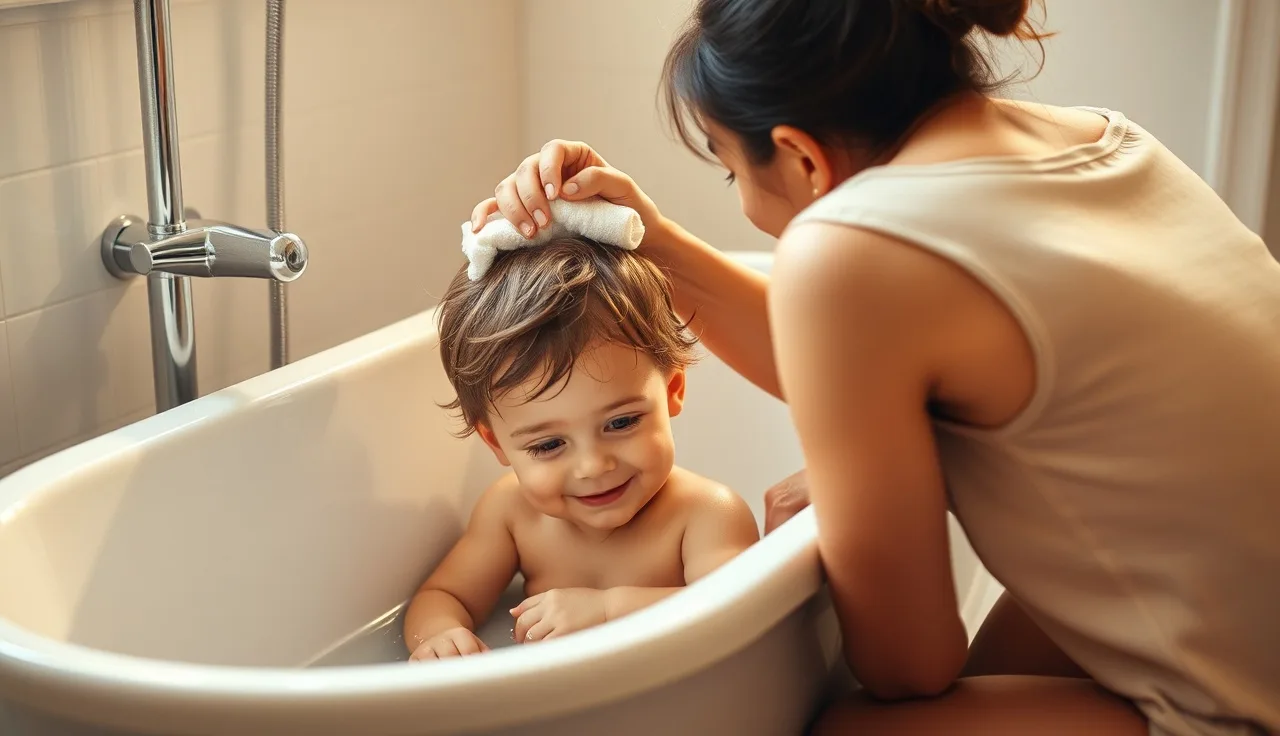
It runs longer than a diaper change, usually five to ten minutes. The child is often in a good mood. And the tub is full of things to name: soap, washcloth, cups, rubber ducks, body parts. Every one is a vocabulary anchor. Narrate the action, label the objects, and describe what you feel: "Warm water. Is it warm? Warm." "Soap. The soap is slippery." "Wash your tummy. Round and round." "Rinse. Water goes over your head. Rinse."
Body-part words come easily in the bath because you're touching each part on purpose. Research published in the journal Child Development found that children learn words faster when the word is said at the moment an adult touches or moves the object, compared to before or after contact [5]. The bath is built around exactly that touch-and-label moment.
If your child loves water play, follow it. When they pour water cup to cup, name it: "Pour. Pour the water. In. Out. Empty. Full." Children learn words for whatever they're already watching. That's not a trick, it's just how word learning works.
If your child uses an AAC device or a communication board, keep a small laminated core-word board near the tub: "more" water, "stop" if it's too hot, "help" getting soap out of the eyes. Even one or two symbols within reach builds the habit of turning to a communication tool.
How you say it matters as much as what you say
Child-directed speech, sometimes called "parentese," uses a higher pitch, a slower pace, exaggerated intonation, and shorter sentences than adult conversation. Babies and toddlers pay closer attention to it. Research from the University of Washington found that infants whose parents used more parentese at six and ten months had significantly more words at fourteen months [6]. The parents weren't talking more, they were talking differently.
Short sentences help. If you're targeting the word "wet," skip "The diaper is wet and we need to change it now" and just say "Wet. Wet diaper." Shorter utterances are easier to hear inside and easier to copy.
Recasting is worth knowing too. When your child attempts a word or lands close, repeat it back correctly and add one word. Child says "ba," you say "bath, yes, bath." Child says "wawa," you say "water, warm water." You're not correcting them, you're showing them the next rung. Speech-language pathologists call this expansion, and it's one of the most consistently supported strategies in the early language research [7].
Mirror their faces too. If they splash and look surprised, look surprised back. That mirroring, sometimes called serve and return, is how children learn that communication moves people. The Harvard Center on the Developing Child describes serve-and-return interaction as the base on which all language and social development is built [8].
When your child doesn't seem to respond
Keep going, but adjust. Some children, especially those with autism, sensory differences, or language delays, may not make eye contact or answer during a routine. That doesn't mean the language isn't landing. Research on children with autism spectrum disorder consistently finds that kids who show no obvious response in the moment still gain from high-quality language exposure, particularly when it's tied to a predictable routine [9].
If your child fights the bath or the change itself, fix that first. A child who is upset can't take in new language, so make the routine feel safer before you expect any communication from it: warm the bathroom, switch to a softer wipe, or sing the same song every time so they know what's coming.
If your child is a candidate for early intervention or already sees a speech therapist, ask directly what you should be doing differently during diapering and bath time. A good therapist gives you two or three specific targets that match where the child is now; general language enrichment is a fine start, but targeted input works faster.
Some children answer to song when they won't answer to talk. If talking feels flat, sing the same simple tune at the same point every time: "Now we wash your tummy, tummy, tummy" to any melody you like. Repetition across weeks builds the expectation, and then the imitation.
Yes, plenty of well-meaning parents overdo it. A nonstop stream of narration with no gaps is harder for a young child to process than speech with clear breaks. Think of music: the rests matter as much as the notes. Say something, then pause. Say something, then pause. You're not giving a lecture, you're having a conversation with someone who can't answer much yet but is learning what a conversation feels like. The LENA Research Foundation, which has run large acoustic studies of home language environments, found that conversational turn counts, more than adult word counts, are the strongest predictor of language outcomes [3]. A turn needs a pause. You talk, the baby coos, makes a face, waves an arm, and you answer that: that's a turn. You don't need more words, you need more exchanges. For a child with some language already, try modeling one step above what they currently produce. If they're a one-word talker, model two-word phrases. A two-word talker gets three-word sentences. You're not talking down to them and you're not talking over them, you're talking just ahead of them. Diaper changes and bath time work as language lessons because they hand you words that are frequent, functional, and tied to whatever the child is doing right that second. The MacArthur-Bates Communicative Development Inventories, the most widely used research tool for early vocabulary, show that the first words most children pick up are names for people, body parts, objects from daily routines, and social words like 'hi,' 'bye,' 'more,' and 'no' [10]. A diaper change alone hands you body parts (belly, legs, feet, back), action words (up, down, off, on, wipe, push, pull), describing words (wet, dry, clean, dirty, warm, cold), and social routines (all done, again, more). That's a solid starter vocabulary before you've even tried. Bath time adds water, soap, wash, rinse, splash, pour, in, out, full, empty, plus a full set of body parts, and it lets you work on prepositions with zero planning. "Soap is in your hand. Now it goes on your belly." In, on, under, over: those are among the first prepositions children learn, and the bath is basically a three-dimensional lesson in them. One thing that actually helps is picking three to five words for the week and leaning on them harder than anything else across both routines. Steady repetition over days beats constantly rotating in new words. You want both consistency and variety, just in the right mix. Predictable language at predictable moments helps a child learn the routine and the words attached to it: "feet up" every single time the feet go up works better than a fresh phrase each time. But some variation teaches a child that one idea can come out in different shapes. "Wet. The diaper's wet. Oh, that's wet!" is three forms of the same word, and that kind of natural variation, not randomness for its own sake, is how kids learn that words stretch. If you're working with a child who has apraxia of speech or the childhood form of it, tip the balance further toward consistency and repetition. These children need high-repetition motor practice on specific targets, and diapering and bathing are among the best natural chances to get that practice without it feeling like drilling, a point worth reading more on in the piece about childhood apraxia of speech. You can start from birth, and that's not an exaggeration. Newborns are already tuning in to the sound patterns of their home language within the first weeks of life, so talking to a three-week-old during a diaper change is not wasted effort. You're building the patterns and the relationship language grows out of. The National Institute on Deafness and Other Communication Disorders (NIDCD) notes that the foundations of language are built in the first year of life, long before a first word [11]. Joint attention, vocalizing, taking turns, and responding to speech all develop in infancy and set the table for talking later. Starting late isn't a failure, either. If your two-year-old has a speech delay and you're only now thinking hard about bath-time language, start today. The brain stays highly plastic through the toddler and preschool years, and stepping into early intervention at any point in that window has real effect. The research keeps saying the same thing: earlier beats later, and later beats never. If you're unsure where your child stands, the AAP recommends developmental surveillance at every well-child visit and formal screening at 18 and 24 months [1]. If your pediatrician hasn't brought up speech and you're worried, bring it up yourself. If your child uses AAC or sign, the same principles apply, with one addition: model the AAC or the sign right alongside your spoken word, every time. On a core vocabulary board, say "wet" while you point to or activate the "wet" symbol at that same moment. With sign, sign "all done" while you say it, meaning it, at the close of every change. This is called aided language input (or aided language stimulation), and it's the evidence-based standard for children who use augmentative and alternative communication. ASHA is explicit that the adults around a child have to model AAC themselves for the child to learn it [4]. A device or board that only comes out during formal sessions doesn't become a communication tool, it becomes furniture. The diaper change is actually a strong AAC moment: it's short, it repeats, and your hands are mostly free. Keep a small laminated board or a low-tech symbol card on the changing table. You don't need the full device, just the three or four symbols the moment calls for: "wet," "clean," "all done," "help." The aac devices overview is a decent place to start if you're setting up AAC across the rest of the day, and if your child also gets speech therapy through an autism spectrum speech therapy program, ask the therapist which symbols to prioritize in each routine. To know whether any of this is working, track what you hear over weeks, not days. Keep a loose note, in your head or on paper, of words the child attempts, new sounds that show up, or moments of intentional communication like reaching, pointing, or catching your eye to ask for something. You're watching a slow build, not waiting for a single-week transformation. If your child has a speech-language pathologist, tell them what you're doing during routines and what you're noticing. Good therapists treat the caregiver as a primary partner in intervention, especially under age three, and the early intervention research is clear that parent-implemented strategies beat clinic-only therapy, mostly because of dose: a therapist sees the child an hour or two a week, and you're there all day [7]. The Little Words app is built around that math, with daily guided activities and real-time feedback so parents can run speech strategies during ordinary moments without a therapy degree. If you're unsure where to start, take the short quiz at Little Words for a personalized starting point. And if you see no new sounds, words, or communicative behaviors after two to three months of steady effort, talk to your pediatrician, not because something is definitely wrong, but because formal screening is the right next step. Early identification matters, and early intervention services, covered in more depth in our piece on early intervention, are free for children under three in the United States under IDEA Part C, even before any diagnosis. The mistake I see most often is parents asking questions instead of making statements. "What's that? Can you say clean? Do you want the towel?" puts a child on the spot and demands a specific answer, while a statement models language without demanding anything back. "That's the towel. Soft towel. You're getting dry." For a child with any language delay, questions often shut the interaction down instead of opening it up. The second most common mistake is not pausing: parents who are used to filling silence do it on reflex. Practice stopping, looking expectant, and letting the child respond however they can, whether that's a sound, a gesture, or just eye contact. Third is language that's too complex. If your child has no words yet, "we're going to take off your diaper now and put on a new clean one" doesn't help; "off, diaper off" does. Match your complexity to about one step above whatever the child is currently producing. Fourth, and maybe the most common of all, is quitting after a few weeks because it "doesn't seem to be working." Language learning is slow, and the words you're modeling now may not show up in speech for another three to six months. That doesn't mean they're not being stored. Keep going. For a sense of typical and atypical timelines, the NIDCD milestone guide is a reliable free resource [11], and if you're seeing patterns that worry you, looking into online speech therapy is worth doing sooner rather than later, since it's widely available now.Frequently asked questions
How many words should I say during a diaper change?
There's no magic number. Aim for short bursts with clear pauses instead of a stream of words. Conversational turn-taking, where you say something and then genuinely wait for any kind of response, predicts language outcomes better than raw word count. For a three-minute change, ten to fifteen exchanges of any kind, verbal or not, is a solid target.
My child has a language delay. Will talking during routines actually make a difference?
Yes, and the evidence is good. Parent-implemented language strategies during daily routines have strong research support, especially for children under three. Dose is the reason: a speech therapist may see your child one or two hours a week, but you're there all day. Diapering and bathing add up to real language exposure when you use them consistently. Ask your child's SLP for specific targets in these moments.
Is it okay to sing instead of talk during bath time?
Yes. Singing uses the same language-learning machinery as speech, and children often find melody easier to predict and copy. One simple song, same words in the same spots, teaches vocabulary through rhythm. Some children with speech delays answer sung input more readily than conversational speech. Use whatever engages your child.
What are the best first words to target during these routines?
Body parts (feet, belly, hands), action words (up, down, off, on, wipe, wash), describing words (wet, dry, clean, warm), and social phrases (all done, more, again) are all ideal. They come up naturally in diapering and bathing, they're among the earliest words typically developing children learn, and they're functional, so the child has a real reason to say them.
My baby is only two months old. Is it too early to do this?
Not at all. Newborns are already processing the sound patterns of their home language within the first weeks. You won't get words back from a two-month-old, but you're building the relationship, the turn-taking instinct, and the exposure that words grow from. Talk during every routine from day one. It's never too early.
Should I use sign language during diaper changes and baths?
If you're learning any sign at home, these routines are a great place to use it. Signs for 'more,' 'all done,' 'wet,' and 'help' are useful and come up naturally. Always pair the sign with the spoken word. Research shows that signing alongside speech doesn't delay spoken language and may support it by giving the child another way to communicate while speech develops.
What if my child cries through every bath and diaper change?
Comfort first. A distressed child can't process or learn language. Work on sensory comfort: warmer water, softer wipes, a calming song, whatever lowers the distress. Once the routine feels safer and calmer, language learning becomes possible. If the distress during these routines is significant and persistent, mention it to your pediatrician.
How is 'serve and return' different from just talking to my baby?
Serve and return means you wait for the child's communicative attempt, a coo, a look, a gesture, a sound, and then respond to that specific attempt. Just talking is one-way. Serve and return is an exchange. The Harvard Center on the Developing Child names this back-and-forth as the base of language and social development, and it works best during calm, close moments like diapering.
Can I use these same strategies for an autistic child?
Yes, with adjustments. Follow the child's attention instead of steering it. If they're focused on the feel of water, label that. Use less language and better pauses. Predictable, routine-based language tends to work well for autistic children because the repetition builds expectation and eases processing load. If your child gets speech therapy, ask which techniques to carry into home routines.
Do I need special toys or tools to make bath time more language-rich?
No. The things already in the bath, soap, washcloth, cup, your hands, the child's own body, are plenty. A small laminated core vocabulary board near the tub is worth making if your child uses AAC, but that's it. The language development research doesn't support buying special products. It supports responsive, back-and-forth interaction with a present caregiver. That's free.
How long does it take to see results from adding language during routines?
Expect months, not weeks, for spoken words to appear. Language builds through many exposures over time, and comprehension usually comes well before production. Words you model today may not surface in speech for three to six months. That's normal. Track comprehension first: does the child respond when you say 'feet up' or 'all done'? That's evidence the language is landing before it comes out.
What's the difference between narrating and baby talk? Which one should I use?
Narrating means describing what's happening in real time ('I'm wiping your feet'). Baby talk in the technical sense, parentese, means a higher pitch, slower pace, and clear intonation with infants. Both have research support. What doesn't help is nonsense or mispronounced words used consistently ('wittle footsie'). Narrate in a parentese style, use real words, and keep sentences short.
My toddler is starting to talk. How do I adjust what I do during routines?
Move from single words to two- and three-word phrases, one step above what your child produces now. Use open questions sparingly ('What's this?') alongside statements, and leave longer pauses for the child to fill. When they attempt a word, expand it: if they say 'wa,' you say 'water, warm water.' You're shifting from input to interaction at this stage.
Sources
- American Academy of Pediatrics, AAP.org – Language Development: Language develops through responsive, back-and-forth interaction with caregivers; AAP recommends developmental surveillance at every well-child visit and formal screening at 18 and 24 months.
- Hart & Risley (1995), Meaningful Differences in the Everyday Experience of Young American Children – summarized by NIDCD: Children from language-rich homes heard roughly 30 million more words by age four than children from language-sparse homes, a gap that begins in infancy.
- LENA Research Foundation – Conversational Turns Research: Conversational turn counts, not just adult word counts, are the strongest predictor of language outcomes in early childhood.
- American Speech-Language-Hearing Association (ASHA) – Augmentative and Alternative Communication: ASHA recommends waiting at least three to five seconds before filling silence for children with language delays; adults must model AAC use themselves for the child to learn to use it.
- Gogate, Bahrick & Watson (2000), Child Development – Multimodal word learning: Children learn words faster when the word is said at the moment an adult is touching or manipulating the referent object, compared to when the word is said before or after contact.
- Ramírez et al. (2020), PNAS – Parentese study, University of Washington: Babies whose parents used more parentese at six and ten months had significantly more words at fourteen months.
- Roberts & Kaiser (2011), American Journal of Speech-Language Pathology – Parent-implemented language intervention: Parent-implemented language strategies produce better outcomes than clinic-only therapy largely because of dose; research supports caregiver involvement in early language intervention.
- Harvard Center on the Developing Child – Serve and Return: Serve-and-return interaction is described as the foundation on which all language and social development is built.
- National Institute on Deafness and Other Communication Disorders (NIDCD) – Speech and Language Developmental Milestones: The foundations of language are built in the first year of life, long before a child says a first word; the NIDCD milestone guide provides typical timelines.
- MacArthur-Bates Communicative Development Inventories (MB-CDI) – norming data: First words most children acquire are names for people, body parts, objects in daily routines, and words for social interaction like 'hi,' 'bye,' 'more,' and 'no.'
- NIDCD – Speech and Language Developmental Milestones fact sheet: The foundations of language are built in the first year of life; NIDCD milestone guide is a reliable free resource for typical and atypical language timelines.