Last updated 2026-07-11
TL;DR
Speech practice starts feeling like a drill when it's adult-led, repetitive, and disconnected from anything your child actually cares about. The fix isn't a new app or a fancier worksheet, it's putting language chances inside play, routines, and real back-and-forth talk. Research keeps finding that child-led, naturalistic approaches transfer to real life faster than massed drill does.
Why speech practice turns into a drill
Most parents end up here for reasons that make total sense. The SLP hands you a list of target words. You sit down after dinner, hold up a picture card, and ask "What is this?" Your child answers, or doesn't, and you flip to the next card. It feels productive. It looks like school. And it does almost nothing for real communication.
Drill trains imitation, not spontaneous language. When a child says "ball" because you pointed at a picture and waited, they haven't learned to use "ball" to ask for the thing they want, to comment when one rolls past, or to protest when a sibling grabs it. Those are three different jobs a word can do, and drill rehearses none of them.
The American Speech-Language-Hearing Association draws a line between decontextualized drill and naturalistic intervention, describing naturalistic methods as ones that teach language inside meaningful activities and interactions [1]. That line matters a lot once you're actually sitting on the floor with your kid.
Drill also wears kids down. When every sit-down with a parent or therapist feels like a test, children learn to dodge the test instead of practicing the skill. You'll see it as shutting down, wandering off, or going silent the second the cards come out.
What the research says about naturalistic versus drill-based practice
The evidence here is solid. A 2007 review by Warren, Fey, and Yoder in Mental Retardation and Developmental Disabilities Research Reviews found that naturalistic developmental behavioral interventions transferred language skills to real settings better than massed drill, especially for children with autism and developmental language delays [2]. Generalization is the word that matters here: it means the child actually uses the skill outside the practice session, not just on command with the picture cards in front of them.
A meta-analysis by Yoder and Warren pushed this further, finding that milieu teaching approaches (a family of naturalistic methods that includes incidental teaching and enhanced milieu teaching) showed stronger effects on expressive vocabulary than structured drill for young children with language delays [3].
The thread running through all of it is the same: language sticks when the child is motivated, the moment is meaningful, and the attempt gets them something they actually wanted. A child who says "more" and gets more crackers learns that word faster than a child who says "more" twelve times to a card and gets nothing for it.
Nobody has clean data on exactly how much faster naturalistic practice works across every population and severity level. The closest summary estimate in the literature puts naturalistic approaches roughly 0.4 to 0.6 standard deviations ahead of structured drill on generalization measures, though the studies vary a lot in method [3].
Drill versus a real practice opportunity
Sit with this distinction for a minute, because it changes everything you do at home.
A drill is adult-controlled repetition, stripped of context. You hold the card, you ask the question, the child responds, next card. The child has no reason to communicate. They're just complying.
A practice opportunity is any real moment when your child actually wants something and needs a skill to get it. Your child wants the bubbles opened. They reach. You hold the jar just out of reach and wait. When they look at you, or make a sound, or say "buh," you name it ("Bubbles! You want bubbles!") and open it right away. That's a practice opportunity. They communicated, it worked, and they'll remember it.
The gap isn't only philosophical. Practice opportunities inside real routines happen dozens of times a day on their own. Drills need a block of time, materials, and parental willpower. Parents burn out, kids resist, and routines just keep running whether you plan them or not.
| Feature | Drill | Naturalistic practice opportunity |
|---|---|---|
| Who controls it | Adult | Child's motivation drives it |
| Context | Decontextualized (cards, table) | Real activity (snack, play, bath) |
| Frequency | Fixed session, 10-20 mins | Can occur 20-50+ times per day |
| Reinforcement | Praise, stickers | Getting the actual thing they wanted |
| Generalization | Weak | Strong [2] |
| Child resistance | Common over time | Minimal when interest-led |
Folding practice into everyday routines
The clinical name for this is "milieu teaching" or "incidental teaching." The plain version: find the moments your child wants something, and make them a tiny bit more work. Not frustrating work, not withholding for its own sake, just a pause, an expectant look, or a model of the next word.
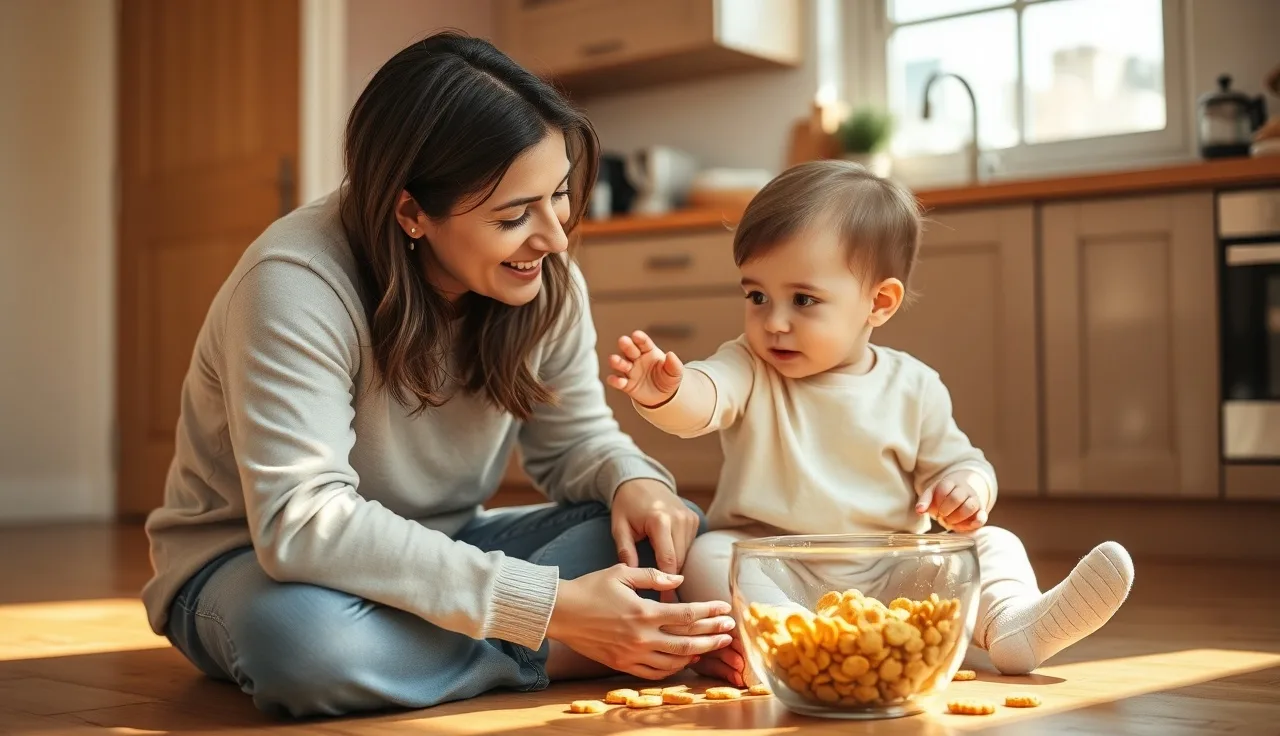
A few routines throw off the most chances. At mealtimes, every snack is a run of requesting, commenting, and protesting. Instead of dumping all the crackers on the plate, put out three, wait, and when your child looks at you or the bag, model "more" or "more crackers" and hand one over. Repeat naturally over the course of the snack.
Bath time gives you water, cups, and toys going in and out of the tub. Narrate the action instead of quizzing them: say what you're doing in short sentences pitched one step above what your child already produces. If they say nothing, you supply the words. If they say one word, you say two.
Dressing is concrete and repetitive, and it happens every day, so it's a steady source of body-part and clothing words, plus "up" and "off."
During play, follow your child's lead all the way. Comment on what they're doing rather than steering them toward a more "educational" toy. If they're lining up cars, narrate the sounds, the positions, the colors. The second you redirect to the toy you'd prefer, you've cut the motivation cord.
Research on Enhanced Milieu Teaching, developed at Vanderbilt University, found that when parents learned these embedded prompting strategies for play and routines, children's spontaneous communication rose compared to business-as-usual controls [4]. The training centered on following the child's lead, setting up the environment to create chances, and answering communication attempts right away.
The "one level up" rule
The "one level up" rule (also called "one step above" or the +1 principle) traces back to Roger Brown's mean length of utterance research and the clinicians who built on it. You model language one step more complex than what your child produces now: single words from them, two-word combos from you; two-word phrases from them, three-word phrases from you.
It works because kids acquire language by hearing slightly harder versions of what they can already say. Full adult sentences aimed at a single-word talker don't give a close enough target to copy, but "more juice" right after they said "juice" hands them exactly one rung to reach for.
The American Academy of Pediatrics advises pediatricians to counsel parents on language-rich interaction, including responding to and expanding on the child's utterances, which is the +1 approach in different clothes [5]. This is mainstream pediatric guidance, not a fringe idea.
In practice, you take whatever your child says or does to communicate and echo it back with one more piece. They point and say "dog," you say "big dog" or "dog running" or "dog there." You aren't correcting them. You're showing the next rung on the ladder.
Making sound practice feel less like a drill
This is where parents get most tangled up, because target sounds (like /r/, /s/, or /k/) really do need some repetition to motor-program. They do. But there's a real difference between massed repetition (say it 50 times right now) and distributed practice folded into real words during real activities.
For kids with apraxia of speech, the motor learning research does support more intensive, repetitive practice of specific motor sequences. Even so, work by Murray, McCabe, and Ballard points toward high-frequency practice inside structured but meaningful contexts rather than decontextualized drill [6]. The child should still have a reason to say the target, even if that reason lives inside a game or a song.
Most late talkers are working on vocabulary and early word combinations, not specific sound errors, so sound-level drill usually isn't what the SLP prescribed for them anyway. If you're not sure, just ask whether the plan calls for massed repetition or practice spread through the day. A good SLP will answer that plainly.
A few approaches manage to build in repetition without feeling like a drill: singing target words into familiar songs (swapping the target word into "If You're Happy," for instance), books with repeated phrases where the child fills in a word they've heard before, play routines like a car wash where the same action words (wash, rinse, dry) come around again and again, and gently sabotaging routines so the child has to comment or request, like handing them an empty cup, putting their shoe on your own foot, or "forgetting" their favorite snack.
What should you do when your child refuses to practice at all?
Refusal is information, and it usually points to one of three things: the task is too hard, the task is boring, or your child is tired and overwhelmed. Check those before you push through anything. Too hard means back off the complexity. Boring means change the activity, not the child. Tired and overwhelmed means stop, full stop.
If your child has started linking speech interaction with pressure, you may need a reset. Spend a week or two doing zero elicitation: just narrate, just play, comment without expecting anything back. Clinicians sometimes call this "input-only" time, and it rebuilds you as a safe partner instead of a tester.
Refusal can also signal anxiety or sensory overload that goes beyond the practice itself. If your child shuts down around communication activities again and again, raise it with your speech therapist and possibly a developmental pediatrician, especially if it fits a broader pattern. Research on demand avoidance in autism (what some clinicians call a PDA profile) reports that low-demand, interest-led environments cut avoidance behavior sharply [7]. More pressure almost never buys more practice. Less pressure and real engagement do.
How does play-based practice compare to structured therapy?
Parent-led naturalistic practice doesn't replace structured speech-language therapy, it sits alongside it. Your SLP brings assessment skill and the ability to shift targets in real time based on what they observe. You bring frequency: you're with your child for hours a day, while your therapist might see them 30 to 60 minutes a week, if that.
Research keeps showing that parent-led strategies raise the dose of language input a child gets. A 2011 study by Roberts and Kaiser found that parent-implemented Enhanced Milieu Teaching produced significant gains in children's expressive language, with effect sizes on par with therapist-delivered intervention [4], and that finding has held across replications.
For families in early intervention, the IDEA Part C program (for children under 3 in the US) requires services in natural environments to the maximum extent appropriate, with parents coached as the main change agents [8]. This isn't a preference, it's federal law: the statute states early intervention services "shall be provided, to the maximum extent appropriate, in natural environments, including the home and community settings in which children without disabilities participate" [8]. So if your child is in early intervention and every session happens in a clinic room with no parent coaching, that's worth asking about.
How do you track progress without turning it into a test?
You don't need a clipboard, just a baseline and a habit of noticing. Start by writing down, this week, the words and communication behaviors your child already uses on their own, unprompted. Keep it on your phone and include the functions: requesting, protesting, commenting, greeting, answering. A child who protests out loud is communicating, even if the whole message is "no."
Then, about once a week, jot down anything new or anything you heard more of. Your child never needs to know this is happening; you're just watching.
Video earns its keep here. A two-minute clip of free play at snack time, taken monthly, gives you and your SLP a real record to review together, and progress that's invisible from inside the daily grind often shows up plainly on tape. If your child uses AAC devices or other augmentative communication, most AAC apps keep usage logs showing communication frequency and vocabulary breadth over time, with no testing required.
If you want a structured but low-pressure way to prompt and track language at home, apps like Little Words are built to generate practice opportunities inside daily routines instead of sit-down drills. You can take their quiz to get started and see if it fits your child's current stage.
What activities do speech therapists actually recommend at home?
Most of them look like play. Book reading with prediction gaps is one: read a familiar book and pause before a repeated phrase so your child fills it in. It's a game they already know, not a test. "Brown Bear" and "The Very Hungry Caterpillar" work well because the language is predictable and repeats.
Sabotaged routines help too. Give them the wrong thing: shoes on their hands, cereal with no milk. Each mistake creates a genuine reason to say something.
Then there's waiting with expectation. Instead of filling the silence, give your child 5 to 10 seconds after you set up a chance, looking at them, then the object, then back at them. This is the "time delay" strategy, one of the best-researched prompting approaches in speech-language pathology [9].
Joint attention activities matter as well: bubbles, spinning tops, light-up toys, anything that grabs attention and invites shared excitement. Point to things together, follow their gaze, name what they see. Joint attention is one of the strongest early predictors of language development, and you can build it without saying a word [10]. For kids on the autism spectrum, autism spectrum speech therapy approaches like JASPER (Joint Attention Symbolic Play Engagement and Regulation) are built around these same principles and have a strong evidence base for improving both joint attention and spontaneous language.
Is repetition a problem for kids who use echolalia?
Echolalia (repeating words or phrases heard elsewhere) often gets read as meaningless, and that misread leads to therapy that tries to stamp it out. But echolalia is often a real communicative strategy, especially for autistic children, and suppressing it can shrink communication rather than grow it.
If your child uses echolalia, the goal isn't to stop the repeating, it's to widen the function. A child who says "Do you want a snack?" (borrowing a phrase they heard an adult use) to mean "I want a snack" is communicating: they mapped a phrase onto a need. Your job is to honor the message and gently model the more conventional form: "You want a snack! Here's your snack." Our guide to echolalia meaning goes deeper into what this looks like in practice and how to work with it instead of against it. The short version: if your child is repeating, your child is processing. Treat repetition as an opening, not a defect. Drill that punishes or ignores echolalia can hit autistic communicators especially hard; the aim is always more communication before more "correct" communication.
When should you bring in a speech therapist?
Naturalistic home practice is powerful, but it doesn't stand in for professional evaluation when there are real concerns. The American Academy of Pediatrics recommends developmental surveillance at every well-child visit and formal developmental screening at 9, 18, and 30 months [5]. If your pediatrician hasn't screened your child's language at those visits, ask directly.
Sign language or AAC belongs on the table early, not late, if a child isn't producing meaningful words by 12 to 18 months. Waiting to "see if they talk" while holding AAC back has no evidence behind it: AAC does not slow spoken language and often speeds it up [11].
Get a speech-language evaluation if your child isn't babbling by 12 months, isn't using any words by 16 months, isn't combining two words by 24 months, or loses language they used to have at any age. Those are the benchmarks cited by ASHA and the AAP [1][5]. You don't need a diagnosis to get an evaluation; you can self-refer to a private SLP or request one through your school district or early intervention program. For families weighing remote options, online speech therapy has grown a lot more available since 2020 and is covered by many insurance plans, often with shorter waits than in-person care.
Frequently asked questions
How many minutes a day should I practice speech with my child?
There's no magic number, and "minutes" is the wrong way to think about it. Research on naturalistic intervention points to lots of brief chances scattered across the day (something like 10 to 20 of them, even 30 seconds each) beating one sit-down session. Pay attention to whether your child is engaged and attempting to communicate, not to the clock. If that's happening, you're doing it right.
Is it okay to let my child lead play during speech practice?
Yes, more than okay. Child-led play is the foundation of naturalistic language work. When you follow what your child is already interested in instead of redirecting them, you get real motivation to communicate. Research on joint engagement shows children produce more language and pick up vocabulary faster during interactions where the adult follows the child's attentional lead [10].
What if my child's SLP has given me flashcard drills to do at home?
Ask why and how. Some targets, especially in childhood apraxia of speech, genuinely benefit from structured repetition. But it's worth asking whether the targets can be folded into games or everyday routines instead. Most good SLPs will help you find that middle ground. If the home program is all flashcards and your child hates it, say so. Whether a family sticks with a plan matters more to outcomes than the plan itself.
My child repeats everything I say instead of answering. What does that mean?
That's echolalia, common in autistic children and some late talkers. It usually signals that something is being processed, along with an intent to communicate, not a failure to understand. Rather than correcting it, model the response you're hoping for and move on. Functional language often grows out of echolalia over time. For a full breakdown, see our guide to echolalia.
Can games replace formal speech therapy?
Games and naturalistic practice are powerful, but they don't replace professional evaluation and therapy for children with diagnosed delays or disorders. What they do is raise the dose between sessions. The research is clear that parent-led strategies produce real gains, and just as clear that clinical expertise matters for deciding what to target and how. You need both.
How do I know if I'm giving my child enough language input?
A rough benchmark from the LENA Research Foundation is that children in language-rich homes hear around 12,000 to 15,000 adult words a day and take hundreds of conversational turns [12]. Don't try to count any of that. Instead, narrate daily life often, respond quickly when your child tries to communicate, and pitch your language a little above where they currently are. Do those three things and you're in the right zone.
Does singing count as speech practice?
It does, especially for children with childhood apraxia of speech, where the rhythm of music supports motor sequencing. Singing is also lower pressure than conversation, so some kids will try sounds and words they'd otherwise avoid. It won't replace other approaches, but a child singing words they won't yet say in conversation is still building the neural pathways for those sounds.
At what age is it too late to start naturalistic speech practice at home?
It's never too late to shift from drill to naturalistic practice. Motivation, real context, and meaningful reinforcement matter whether your child is 18 months or 8 years old. The activities look different (an 8-year-old skips bubbles for video games or cooking together), but the underlying approach doesn't change. Language learning continues through childhood and beyond.
Should I correct my child when they say a word wrong?
Usually not. Direct correction ("that's wrong, say it like this") tends to raise anxiety and shut down communication attempts. Recasting works better: repeat what your child said in the correct form without flagging that you're fixing it. If they say "boo" for blue, you just say "yes, blue car!" back. The research consistently favors recasting over correction for young children learning language.
What if I feel like I'm failing at home speech practice?
Most parents hit this feeling at some point, and keeping up home practice is genuinely hard. You're not a speech therapist, you're a parent with a full life on top of everything else. The research doesn't ask for perfection. It asks you to respond to communication attempts, model language a bit above your child's level, and follow their lead in play. You're probably already doing all three sometimes, and that counts.
Can I use screen time as part of speech practice?
Passive screen time, where a child watches alone, has weak evidence behind it for language learning. AAP guidance says screens should generally be avoided for children under 18 to 24 months except for video chatting [5]. Interactive or co-viewed screen time, where a parent narrates and responds alongside the child, is far more useful. Some apps built around parent involvement can genuinely help as one tool among several.
How is childhood apraxia of speech different, and does the no-drill advice still apply?
Childhood apraxia of speech (CAS) is a motor speech disorder, not a language disorder, and it has stronger evidence for structured, repetitive motor practice than most speech delays do. Even so, research still favors practice inside meaningful contexts over pure decontextualized drill. The "avoid drill" advice applies most strongly to vocabulary and language development. For CAS, read our guide to childhood apraxia of speech and work closely with an SLP who specializes in motor speech.
Sources
- American Speech-Language-Hearing Association (ASHA), Practice Portal: Late Language Emergence: ASHA distinguishes between decontextualized drill and naturalistic intervention, recommending naturalistic methods that teach language in meaningful contexts
- Warren, Fey & Yoder (2007), Mental Retardation and Developmental Disabilities Research Reviews, Naturalistic Developmental Behavioral Interventions: Naturalistic developmental behavioral interventions produced better generalization of language skills than massed drill for children with autism and developmental language delays
- Yoder & Warren (2002), Journal of Speech, Language, and Hearing Research, Milieu Teaching Meta-Analysis: Milieu teaching approaches showed stronger effects on expressive vocabulary than structured drill for young children with language delays, with effect sizes approximately 0.4 to 0.6 SD better on generalization measures
- Roberts & Kaiser (2011), American Journal of Speech-Language Pathology, Parent-Implemented Enhanced Milieu Teaching: Parent-implemented Enhanced Milieu Teaching resulted in significant gains in children's expressive language with effect sizes comparable to therapist-delivered intervention
- American Academy of Pediatrics, policy guidance on developmental screening and media use: AAP recommends developmental screening at 9, 18, and 30 months and counsels parents on language-rich interaction strategies including expanding on child utterances; guidance limits screens for children under 18-24 months
- Murray, McCabe & Ballard (2015), American Journal of Speech-Language Pathology, treatment for childhood apraxia of speech: Motor learning research for apraxia supports high-frequency practice within structured but meaningful contexts rather than decontextualized drill
- Newson, Le Marechal & David (2003), Pathological Demand Avoidance syndrome, Archives of Disease in Childhood: Low-demand, interest-led environments significantly reduce avoidance behavior in children with demand avoidance profiles
- U.S. Department of Education, IDEA Part C, natural environments requirement (34 CFR 303.126): IDEA Part C requires early intervention services be provided in natural environments to the maximum extent appropriate; statute states services 'shall be provided, to the maximum extent appropriate, in natural environments'
- Charlop-Christy & Carpenter (2000), Journal of Positive Behavior Interventions, time delay strategy: Time delay is one of the most well-researched prompting approaches in speech-language pathology for increasing spontaneous communication
- Tomasello & Farrar (1986), Developmental Psychology, Joint Attention and Language Acquisition: Joint attention is one of the strongest early predictors of language development; children produce more language during interactions where adults follow the child's attentional lead
- Millar, Light & Schlosser (2006), American Journal of Speech-Language Pathology, AAC and Spoken Language: AAC does not reduce spoken language development and often increases it; review of studies found no negative effects on speech production
- LENA Research Foundation, research on adult words and conversational turns: Children in language-rich environments hear approximately 12,000 to 15,000 adult words per day and engage in hundreds of conversational turns