Last updated 2026-07-11
TL;DR
Conversation, for a late talker, grows out of back-and-forth interaction, not word drills. The moves with the most evidence behind them are following the child's lead, adding one word beyond what they're already saying, and giving them a genuine reason to communicate. Most of the progress comes from parents practicing this for 20-30 minutes a day inside ordinary routines, not as a separate lesson.
What "conversation" looks like at this stage
Conversation for a late talker doesn't mean sentences. It's any exchange where one person starts something and the other responds, back and forth. A point, a grunt, a single word, a picture handed over, a phrase typed or selected on an AAC device: all of that counts. What matters is the loop of taking turns, not how many words the child has.
The American Speech-Language-Hearing Association defines functional communication as the ability to get across wants, needs, and ideas in ways others can understand, whatever form that takes [1]. That's worth remembering if you're fixated on spoken words specifically. A child who reliably points, waits, and reacts to your response is already holding a conversation. Spoken words tend to follow once the turn-taking habit is there.
Late talkers, meaning children under 3 who understand language appropriately for their age but have fewer than 50 words or no two-word combinations, catch up on vocabulary without formal therapy roughly 70-80% of the time. Conversational back-and-forth and social communication are where the gaps tend to stick around longer [2]. So even as your child's word count climbs, the exchange itself is what's worth watching and building on purpose.
Why the conversation isn't happening yet
There's no single cause here, and assuming there is sends parents down expensive rabbit holes.
For some children the delay comes from motor planning problems that make speech physically hard to produce, as in childhood apraxia of speech. For others it's language processing: they understand less than they seem to, so they don't respond because the message never fully landed. For many neurodivergent children, especially those on the autism spectrum, the social motivation that usually drives conversation is organized differently, not absent, just different [3].
Some children have plenty of words but use them in echoed, scripted ways rather than flexible exchanges. If your child repeats phrases from TV or books in ways that don't quite fit what's happening, that's echolalia, and it helps to understand what those echoes are doing before trying to stop them.
The right approach depends on which of these is going on. A child with motor planning difficulties needs something different from a child who simply hasn't had enough back-and-forth modeled for them yet. If you're not sure which situation you're in, speech therapy with a licensed SLP is the fastest way to find out.
Following the child's lead actually works
This isn't just feel-good advice. There's real data behind it.
A 2004 randomized trial by Aldred and colleagues in the Journal of Child Psychology and Psychiatry tested a parent-mediated social communication intervention built on following the child's lead and syncing up communication. It produced significant gains in child communication and in parent-child synchrony over 12 months [4]. Responsive strategies like following the child's topic, commenting instead of questioning, and waiting for the child to start something are consistently among the strongest non-drug approaches in early communication research.
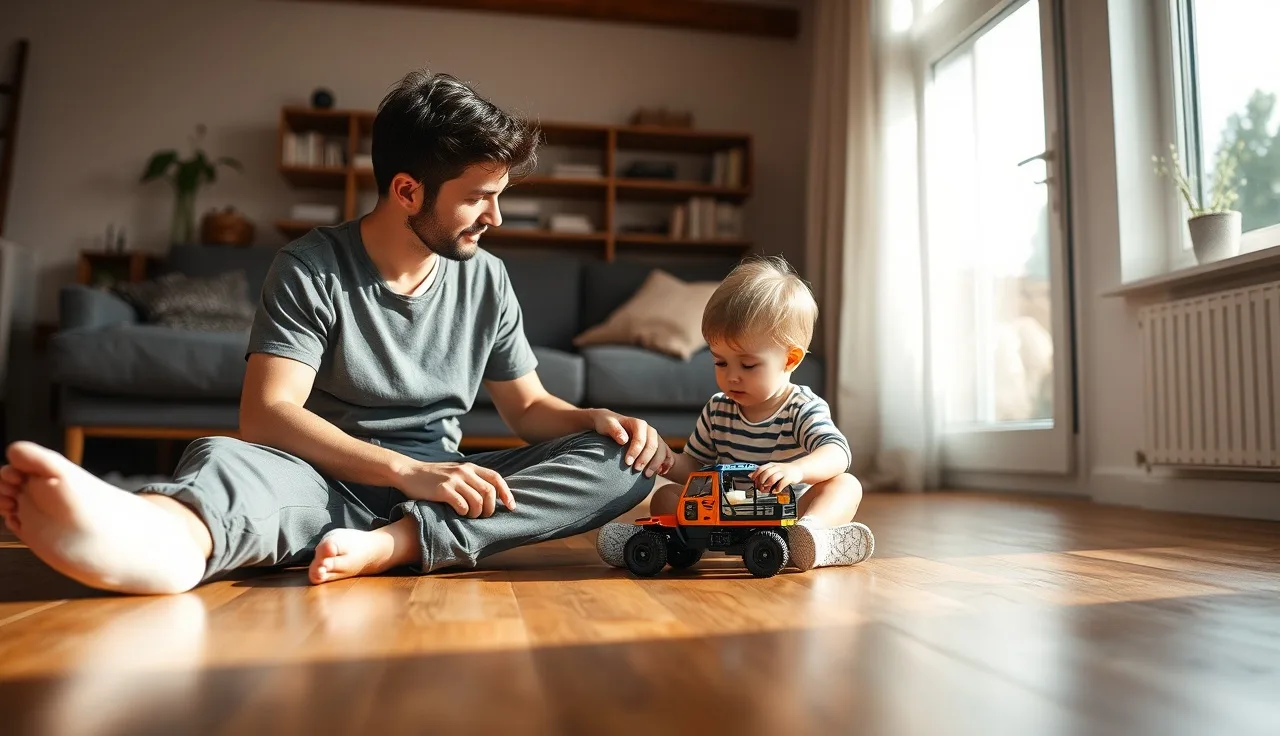
In practice, that means getting down to the child's physical level, every time, and watching where their attention goes: that's the topic. Comment on what they're doing rather than directing it ("Car going fast" instead of "Push the car"), and resist the urge to test them. "What's that?" is a test. "That's a dog" is a comment. Comments build conversation; tests create pressure and shutdown.
This works developmentally because language learning is tightly linked to joint attention: shared focus on the same thing at the same time. Following the child's lead means you're inserting language at the exact moment their attention is highest, which is when new words stick [5].
The "one word beyond" trick
This is one of the most transferable, research-grounded techniques in pediatric speech-language pathology, and you can start today without any training.
The idea: match the child's current level, then add exactly one word or one step of complexity. If the child points, you label it: "Ball." If the child says "ball," you expand it: "Red ball." If the child says "red ball," you extend it: "Red ball rolls." You're always one rung above where they are, never ten rungs up.
Speech-language researchers call these two moves expansion and extension. Expansion adds the grammar the child left out ("Me want" becomes "You want the cookie"). Extension adds new meaning ("Cookie gone" becomes "Cookie all gone, you ate it"). Both keep the conversation moving without taking over the child's topic [6].
What kills this strategy is a parent who hears "ball" and launches straight into "Yes! That's a round ball and it bounces, what color is it?" That's too much at once. It turns an exchange into a quiz and shuts the loop down. One step, then wait, then see what comes back, then one more step.
Giving your child a real reason to talk
A lot of home practice goes wrong right here. Parents set up "speech time" as its own activity with flashcards or naming games, and kids, especially neurodivergent kids, pick up on that context fast and check out.
Motivation to communicate comes from genuine need, not performance. Early intervention has a name for this: "communication temptations," meaning you arrange the environment so the child has an actual reason to say something [7].
A few things that work at home: put a favorite snack in a clear container the child can't open, then wait, longer than feels comfortable, without prompting. Wind up a toy, let it run down, then hold it and wait. Pause in the middle of a loved routine, like bath time, right after pouring water or lathering hands, and just look at them expectantly. Or give a tiny portion of something they love, one cracker or one sip, then wait.
The waiting is the key part. Most parents fill silence within two seconds. Research on responsiveness suggests that giving children 5-10 seconds of expectant silence, with an open, interested face rather than an anxious prompting one, meaningfully increases communication attempts [5]. If you want to feel what seven seconds actually is, set a timer once. It's longer than it sounds.
The routines that work best
Routines are the secret weapon because they're predictable, and predictability frees up mental room for communication instead of using it up figuring out what's happening next. They also create natural slots where a word or gesture fits perfectly.
Mealtimes are high-yield: real objects, real choices, real wants. Offer two options and let the child indicate a preference, narrating what you're both doing more like a quiet running note than a sportscaster call. Bath time works well too, since it's an enclosed space with a consistent sequence and plenty of sensory pull, good for trading turns about body parts, water temperature, and simple actions.
Book sharing counts, but not the way most people do it. Research on dialogic reading shows that asking open-ended questions and leaving space for the child to comment, rather than reading straight through, produces better language outcomes than passive read-alouds [8]. For a nonverbal or minimally verbal child, point to pictures, wait, comment on what you see, and leave room. Outdoor play matters for a different reason: new places generate communication that isn't manufactured. The squirrel is right there. The airplane is loud. The child wants to tell you something true.
Aim for 20-30 minutes of intentional interaction spread across these routines daily. That figure comes from research on parent-implemented early intervention, where consistency across the week turns out to matter more than any single session's length [4].
Comments beat questions, mostly
Questions feel like the engaged, active thing to do, but comments actually get better results almost every time. "What's that?" "What are you doing?" "Can you say ball?" all put a child on the spot and turn the exchange into a right-or-wrong test. A child who already finds talking hard will learn that staying quiet is the safer bet.
Comments do the opposite. They're low-pressure and model language without demanding anything back. "Oh, the dog is running." "That tower is tall." "You picked the blue one." Your child can respond or not, but either way they've just heard the word paired with the exact thing they were looking at, and after hundreds of those pairings, the language starts to stick.
There's one exception worth keeping: choice questions with two concrete options ("Do you want apple or banana?") carry less pressure than open-ended ones and hand the child a clear, reachable answer. These are fine, and often genuinely useful for kids who are building up functional requesting.
ASHA's guidance on augmentative and alternative communication notes that reducing communication pressure while increasing communication opportunities is a core principle for supporting minimally verbal learners [1], and that holds just as true for late talkers who already have some speech.
AAC won't stop a child from talking. That fear comes up constantly with parents of late talkers, but the research says the opposite: studies consistently show that AAC supports, rather than suppresses, speech development in children with communication delays [9].
For a late talker without consistent words yet, something as simple as a picture exchange, a communication board, or a two-button device gives them a way into a conversation right away, instead of waiting for spoken words to show up. Just having a seat at the turn-taking table matters on its own. Children with more complex needs have more ground to cover: AAC devices range from paper boards to full speech-generating systems, and the right starting point is an AAC assessment through a certified SLP, not hardware picked off an Instagram post. If your child is autistic or has a diagnosis that affects communication, autism spectrum speech therapy often builds AAC in from day one, using the device to request, comment, and greet, not just label things.
Timing matters too, and not as a platitude. Brain plasticity for language is highest from birth to age 5, especially before 3, which is exactly the window IDEA Part C was built for: it guarantees free early intervention for children under 3 with developmental delays, including communication delays [10]. If you're worried and your child is under 3, call your state's Part C program directly. Most states don't require a doctor's referral. Once a child turns 3, IDEA Part B takes over and covers school-based services through age 21, and neither part requires a diagnosis just to start an evaluation [10]. The data backs up the urgency: a 2011 meta-analysis by Roberts and Kaiser found parent-implemented language intervention produced moderate-to-large effect sizes on child language outcomes, with stronger effects for younger children [11], and early intervention research overall points the same way: better language, social communication, and school-readiness outcomes for kids who get help before age 3. If you're stuck on a private SLP waitlist (3 to 6 months in a lot of US cities), ask your pediatrician about early intervention eligibility, and consider online speech therapy as a bridge. That waiting period doesn't have to go to waste if you're practicing at home.
A handful of common habits actually work against conversation growth, and most parents fall into at least one. Filling silence too fast is the big one: kids need processing time, sometimes well past ten seconds, and jumping in at second two just teaches them you'll do the talking for them. Over-prompting does something similar: "Say ball. Can you say ball? What's that? Say ball." strings like that teach a child that if they stall long enough, you'll hand them the word or give up and move on. Correcting errors head-on backfires too: if your child says "dat" for "cat," don't say "no, say cat," just say "yes, the cat!" back to them. Direct correction raises anxiety and shuts down attempts, while modeling the right word naturally does the opposite. Insisting on eye contact before you respond can also block communication, particularly for autistic children, many of whom process language better without it. And if every exchange feels like a test to your child, they'll talk less, so let most of your time together be unpressured play and commentary, and save structured practice for short, specific windows.
The American Academy of Pediatrics recommends developmental surveillance at every well-child visit, plus formal screening at 9, 18, and 30 months [12], so ask your pediatrician about this if it isn't already happening. Based on ASHA guidance, these are the markers that should prompt a referral to an SLP [1]:
- No babbling by 12 months
- No single words by 16 months
- No two-word combinations by 24 months
- Any loss of previously acquired language skills at any age
If your child has passed these ages without hitting the markers, don't wait for the next scheduled visit, ask for a referral now. "Wait and see" is reasonable in some situations, but it carries real risk past 18-24 months. A licensed SLP can run a full evaluation, figure out whether the delay is expressive only or affects comprehension too, screen for signs of apraxia of speech, and build a plan around your specific child. Home strategies genuinely help, but they work best once they're tuned to what an SLP finds.
Apps belong in this picture as a supplement, not a replacement for therapy. Where they earn their keep is consistency: parents who practice these strategies for 20-30 minutes a day see better results, and the hard part was never knowing the strategy, it's remembering to use it while dinner's burning and three kids need something. Little Words is an AI speech companion built for neurodivergent kids that helps parents track communication attempts, prompts the responsive strategies covered here, and gives caregivers a structured way to practice between sessions. You can start with a short quiz to see whether it matches your child's communication profile. Whatever tool you choose, look for ones built around coaching the caregiver rather than drilling the child: the research is consistent that caregiver interaction quality predicts outcomes more strongly than any child-facing app or program [11].
Frequently asked questions
At what age should I be worried my child isn't having conversations?
ASHA and the AAP both flag no two-word combinations by 24 months as a reason to get a speech-language evaluation. Conversation as a back-and-forth exchange usually shows up in some form, even gestural, between 18 and 24 months. If your child isn't starting or responding to simple interactions by 18 months, mention it at your next pediatric visit and ask for an SLP referral rather than waiting to see what happens.
Can a nonverbal child have a conversation?
Yes. Conversation is about turn-taking and shared attention, not spoken words. A child who points, waits for your response, then reacts is having a conversation. AAC tools, picture exchanges, and consistent gestures all count as communication. It's more useful to work with an SLP on finding the right modality for your child than to wait for speech before building those back-and-forth skills.
My child repeats phrases from TV instead of answering me. What do I do?
That's echolalia, and it's common in autistic children and some late talkers. It often does a job: filling a conversational slot, expressing emotion, or buying time to process. Figure out what the echo is doing for your child first, then build on it instead of trying to stamp it out. An SLP who knows echolalia well can help you map those functions and grow more flexible responses from there.
Is it okay to use baby talk with a late talker?
Child-directed speech, the higher pitch and slower pace parents naturally use with little kids, is actually backed by research as helpful for language learning. The real issue is vocabulary: use real, correct words for objects and actions instead of inventing your own labels. "Doggie" is fine. Making up "woofer" for dog and sticking with it isn't as useful. Keep sentences short and natural, and pitch your language just slightly above where your child is right now.
How long does it take to see improvement in conversation skills?
There's no clean population-level data on this for home strategies specifically. In parent-mediated intervention studies, parents typically notice more communication attempts within 4 to 8 weeks of using strategies consistently, though measurable standardized gains often take 3 to 6 months. Being consistent across the week matters more than how intense any single day looks. Don't give up at week two.
Should I correct my child when they say a word wrong?
Not directly, no. Saying "No, say it right" raises a kid's anxiety around communicating and makes them try less often. Instead, model the correct form naturally and warmly: if they say "boo" for "blue," you say "Yes, the blue ball!" That's called recasting, and it's one of the best-supported techniques in child language therapy. The child hears the target form without being told they got it wrong.
Does reading to a late talker help build conversation?
Yes, but the style matters. Dialogic reading, where you pause, point, comment, and leave room for your child to respond, works significantly better than reading straight through the text. If your child is minimally verbal, you don't even need to read the words. Point to pictures, name them, make sounds, wait. The book is really just a prop for a back-and-forth interaction.
My child talks a lot but only about one topic and doesn't respond to what I say. Is that a conversation delay?
It can be. What you're describing sounds like one-sided or monologic communication, which is different from a vocabulary delay but is still a conversational difficulty. It's common in autistic children, who may have strong language skills alongside differences in the reciprocal, topic-sharing side of talking. An SLP evaluation that includes pragmatic language assessment would help pin down what's happening and what to work on.
What's the difference between a late talker and a child with a language disorder?
A late talker is typically a child under 3 who has fewer words than expected but age-appropriate comprehension and typical development otherwise. Many late talkers catch up without any intervention. A language disorder is a persistent difficulty understanding or using language that doesn't resolve on its own and may affect multiple areas of development. A formal SLP evaluation is really the only way to know which one you're dealing with.
How can I practice conversation skills if my child doesn't want to sit and interact?
Don't sit, then. The most effective practice happens during movement: walks, bath time, car rides, playtime on the floor. Follow your child physically, join whatever they're doing, and narrate alongside them. Kids who won't tolerate face-to-face structured interaction often communicate more readily when it's folded into something they're already doing. This works better sideways than head-on.
Will speech therapy at school be enough, or do I need to do more at home?
School-based therapy usually runs 20 to 60 minutes a week, which research suggests isn't enough on its own for kids with significant delays. The best outcomes come from pairing school or clinic therapy with caregiver strategies used consistently at home. Think of the SLP as the coach and yourself as the daily practice. Roberts and Kaiser's 2011 meta-analysis found parent-implemented strategies produced moderate-to-large effect sizes on child language outcomes.
Are there specific toys or materials that help build conversation?
Simple, open-ended toys tend to work better than complex electronic ones because they create more openings for conversation. Blocks, cars, balls, dolls, sand, and water all generate natural commentary and shared attention. A 2016 study in JAMA Pediatrics found that electronic toys produced fewer adult words, fewer child vocalizations, and fewer conversational turns than traditional toys or books during play with toddlers.
Can bilingual or multilingual households cause or worsen speech delays?
No. The research is clear that bilingualism doesn't cause language delays. Bilingual children often spread their vocabulary across two languages, so counting just one language can make things look low when the combined vocabulary is age-appropriate. If your bilingual child is delayed in both languages, that's worth getting evaluated. ASHA specifically recommends that bilingual children be assessed in both languages, by an SLP who understands bilingual development.
Sources
- American Speech-Language-Hearing Association (ASHA), Late Language Emergence: ASHA defines functional communication as conveying wants, needs, and ideas in ways others can understand regardless of modality, and provides milestones for referral.
- Rescorla, L. (2011). Late talkers: Do good predictors of outcome exist? Developmental Disabilities Research Reviews, 17(2), 141-150.: Roughly 70-80% of late talkers catch up on vocabulary, but social communication and conversational reciprocity show persistent gaps.
- Kasari, C., Gulsrud, A., Paparella, T., Hellemann, G., & Berry, K. (2015). Randomized comparative efficacy study of parent-mediated interventions for toddlers with autism. Journal of Consulting and Clinical Psychology, 83(3), 554-563.: Social motivation for communication in autistic children is organized differently, not absent, and responds to structured caregiver-mediated intervention.
- Aldred, C., Green, J., & Adams, C. (2004). A new social communication intervention for children with autism: pilot randomised controlled treatment study suggesting effectiveness. Journal of Child Psychology and Psychiatry, 45(8), 1420-1430.: Parent-mediated social communication intervention built on following the child's lead produced significant gains in child communication and parent-child synchrony over 12 months.
- Yoder, P.J., & Warren, S.F. (2001). Relative treatment effects of two prelinguistic communication interventions on language development in toddlers with developmental delays. Journal of Speech, Language, and Hearing Research, 44(1), 224-237.: Giving children 5-10 seconds of expectant silence significantly increases communication attempts; joint attention is tightly coupled to language acquisition.
- Fey, M.E., Cleave, P.L., Long, S.H., & Hughes, D.L. (1993). Two approaches to the facilitation of grammar in children with language impairment. Journal of Speech and Hearing Research, 36(1), 141-157.: Expansion adds grammatical information the child omitted; extension adds new semantic content; both are well-supported techniques in child language intervention.
- Wetherby, A.M., & Prizant, B.M. (1989). The expression of communicative intent: Assessment guidelines. Seminars in Speech and Language, 10(1), 77-91.: Communication temptations, arranging the environment to create genuine communicative need, are a core strategy in early communication intervention.
- Whitehurst, G.J., et al. (1988). Accelerating language development through picture book reading. Developmental Psychology, 24(4), 552-559.: Dialogic reading, where caregivers pause and create space for children to respond, produces better language outcomes than passive read-alouds.
- Millar, D.C., Light, J.C., & Schlosser, R.W. (2006). The impact of augmentative and alternative communication intervention on the speech production of individuals with developmental disabilities: A research review. Journal of Speech, Language, and Hearing Research, 49(2), 248-264.: AAC supports, not suppresses, speech development in children with communication delays; the myth that AAC reduces speech motivation is not supported by research.
- U.S. Department of Education, Office of Special Education Programs, IDEA Part C and Part B: IDEA Part C guarantees free early intervention services for children under 3 with developmental delays including communication delays; Part B covers ages 3-21; no specific diagnosis is required to initiate evaluation.
- Roberts, M.Y., & Kaiser, A.P. (2011). The effectiveness of parent-implemented language interventions: A meta-analysis. American Journal of Speech-Language Pathology, 20(3), 180-199.: Parent-implemented language intervention produced moderate-to-large effect sizes on child language outcomes, with stronger effects when children were younger; caregiver interaction quality is a stronger predictor than any child-facing program.
- American Academy of Pediatrics, Developmental Surveillance and Screening Policy: AAP recommends developmental surveillance at every well-child visit and formal screening at 9, 18, and 30 months.
- Sosa, A.V. (2016). Association of the type of toy used during play with the quantity and quality of parent-infant communication. JAMA Pediatrics, 170(2), 132-137.: Electronic toys produced fewer adult words, fewer child vocalizations, and fewer conversational turns than traditional toys or books in play sessions with toddlers.