Last updated 2026-07-11
TL;DR
You can't replace a licensed speech-language pathologist, but you can do a lot at home. Research consistently shows parent-implemented therapy, when guided by solid technique, produces real gains. Start with ASHA's free parent resources, pursue your child's legal right to school-based services, and practice during daily routines rather than formal drills.
You can do more at home than most parents realize. The research base for parent-implemented speech and language intervention has grown a lot over the past two decades. A 2018 Cochrane review of parent-mediated interventions for autistic children found statistically significant improvements in parent-child interaction and language outcomes when parents were trained in specific strategies [1]. That last part matters: trained in specific strategies. Winging it counts for less than using a handful of well-studied techniques consistently.
The techniques that show up over and over in the literature aren't complicated. Parallel talk (narrating what your child is doing), expansion (repeating what your child says with one or two words added), and following your child's lead rather than directing the play. Parents pick these up well without a degree.
What home practice can't do is assess your child's specific speech sound errors with diagnostic precision, rule out oral-motor issues like apraxia of speech, or give the kind of systematic feedback loop a trained clinician provides. Be honest with yourself about the ceiling here. Home practice works well as a supplement and as a bridge when services aren't available yet. It's not a permanent substitute for professional evaluation.
If your child is under three, the single most useful thing you can do is look into early intervention before trying anything else. It changes the math considerably.
Your child may already have a legal right to free therapy
This is probably the most important thing in this whole article. Two federal laws make speech therapy a legally protected right for eligible children.
The first is the Individuals with Disabilities Education Act (IDEA). It requires states to provide free speech-language services to eligible children from birth through age 21 as part of a Free Appropriate Public Education [2]. For children under three, this comes through Part C early intervention programs, state-run and federally funded. For children three and older, services come through the public school system under Part B.
The second is Section 504 of the Rehabilitation Act of 1973. It can cover children who don't qualify under IDEA's stricter eligibility criteria but still have a disability that substantially limits a major life activity. Speech and language count.
Here's what this means in practice. If your child is under three, call your state's early intervention program today. You can find your state's contact through the IDEA website [2]. Referral is free, evaluation is free in most states, and if your child qualifies, services come at no cost or on a sliding scale. Federal statute requires the evaluation to happen within 45 days of referral in most circumstances.
If your child is three or older, contact your local public school district and request a special education evaluation in writing. The district must respond within a set timeline (typically 60 days, though this varies by state) and must provide services if your child qualifies. Private school enrollment doesn't eliminate this right. Homeschooled children have more limited but not zero access to IDEA services.
Many parents never find out this option exists, and schools don't always volunteer the information. Ask anyway, put the request in writing, and keep copies. For more on how this works before age three and why timing matters so much, the early intervention article covers the evidence on developmental windows in more detail.
Free and low-cost resources worth knowing about
The American Speech-Language-Hearing Association (ASHA) runs a public resource library specifically for parents at asha.org [3]. It's not flashy, but it's accurate. Their "Help Kids Communicate" pages cover age-by-age milestones, guidance on when to seek evaluation, and plain-language explanations of common diagnoses. ASHA also keeps a searchable database of certified speech-language pathologists, useful if you're looking for sliding-scale fees, telehealth, or reduced-cost community clinic services.
The Hanen Centre publishes free articles and parent guides grounded in their well-researched programs (It Takes Two to Talk, More Than Words). The full programs cost money, but the free materials are genuinely useful and evidence-based [4].
YouTube has plenty of speech therapy content, and quality varies wildly. Look for videos made by licensed SLPs who state their credentials clearly. Taryn Goodwin (Mommy Speech Therapy), Meredith Harold (The Informed SLP, more clinician-facing but still accessible), and the Speech and Language Kids channel come up often among practicing therapists. Still, no YouTube channel can tell you what your specific child needs.
University training clinics are one of the most underused resources around. Graduate programs in speech-language pathology need to give their students supervised clinical hours, so many university clinics offer public services at dramatically reduced rates, sometimes under $30 a session, while private-practice SLPs commonly charge $150 to $350 [5]. You can find accredited programs through ASHA's directory. Online speech therapy by telehealth has also widened access since 2020, with several platforms offering sliding-scale pricing.
What actually helps late talkers
The research on late talkers (typically defined as children under 24 months with fewer than 50 words, or any child significantly behind age-level language milestones) points to a consistent set of parent strategies.
Follow your child's lead. This sounds obvious and turns out to be harder than it sounds. Instead of directing play or firing off quiz-style questions ("What color is that?"), get down at your child's level, notice what they're interested in, and join in. Interest-based attention has to come before language learning, not after.
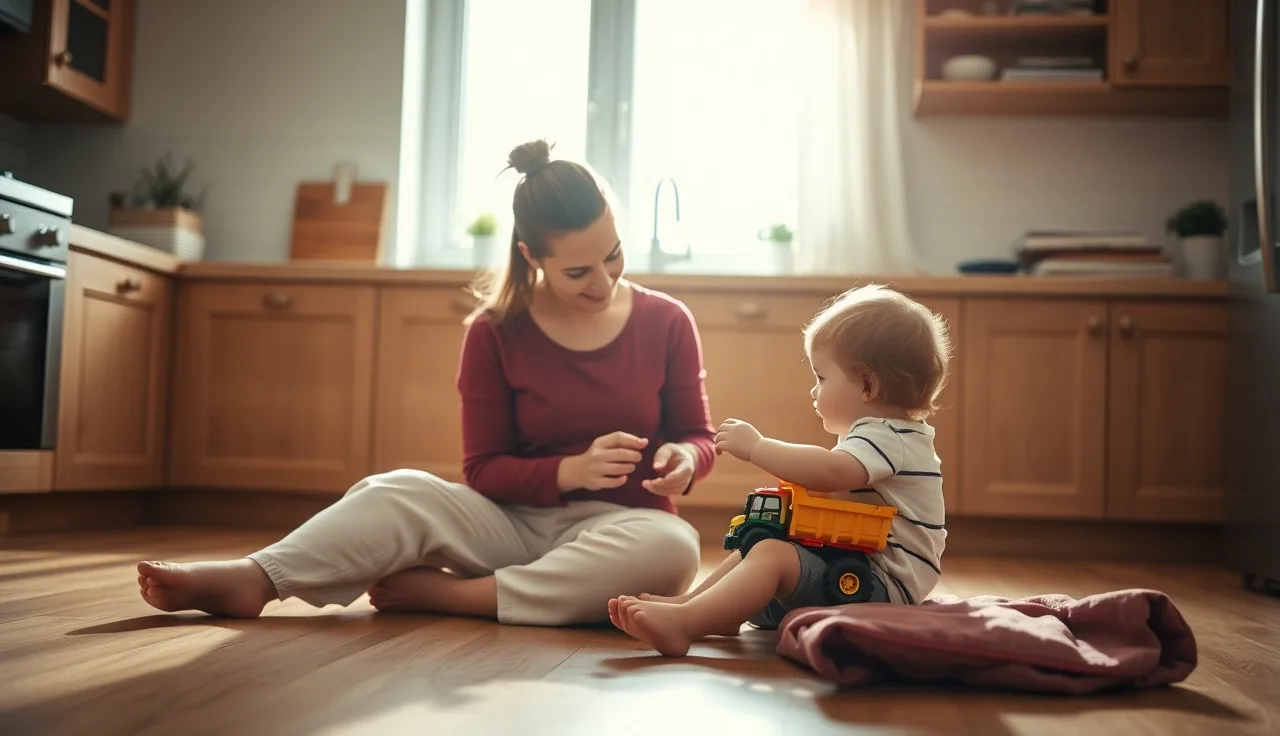
Use parallel talk: narrate what your child is doing without demanding a response. "You're pushing the truck. It's going fast. Crash!" Short phrases, real-time commentary, repeated exposure to words in a context that already means something to your child.
Expand on what they say rather than correcting it. Child says "dog," you say "Big dog. Dog running." Model the correct form instead of pointing out the error. Research from Girolametto and colleagues consistently shows expansion is one of the most effective naturalistic techniques for increasing sentence length in late talkers [4].
Cut back on questions and lean into comments instead. Parents ask a lot of questions instinctively ("What's that? What does the cow say?"), but questions put kids on the spot and can actually reduce how often they try to communicate. Comments invite instead of demand.
Slow down and wait. Create openings by pausing expectantly: hold up two snack options and wait, or put on one shoe and pause for a reaction. Therapists call this an "expectant pause," and it gives children both a reason and a moment to communicate.
Think in terms of repetition rather than perfection. Children generally need to hear a word roughly 10 to 15 times in meaningful contexts before they start using it themselves, though this varies a lot by child and situation. What matters most is the volume of rich language they're exposed to.
None of this requires materials or a therapy room. It happens during bath time, meals, grocery runs, and bedtime.
Practicing speech sounds with a child who's hard to understand
Speech sound development follows a fairly well-documented sequence. ASHA publishes norms showing most children master p, b, m, h, n, w, d by age three, while sounds like l, s, z, r, and th come much later, with r often not landing until age 6 or 7 [3]. A child who can't say "r" at four isn't delayed. A child who can't say "p" or "m" at four probably needs an evaluation.
For children already working on specific sounds under an SLP, home practice usually looks like this: the therapist identifies a target sound at a particular level (isolation, syllables, words, phrases, sentences, conversation), and you practice that exact level with the exact words your SLP gave you. Moving a sound from the therapy room into real conversation is one of the hardest parts of articulation work, and it's where parent follow-through matters most.
Without an SLP, it's genuinely hard to know which sounds to target and at what level, and targeting the wrong one wastes time. The most realistic approach without professional guidance is to focus on general language stimulation (the strategies above), pursue an evaluation whenever you can get one, and limit sound-specific practice to sounds that are clearly age-appropriate targets according to the published norms.
One thing worth flagging: if your child's speech is inconsistent, meaning they say a word clearly one time and completely differently the next, that can point to childhood apraxia of speech, which needs specialized therapy quite different from standard articulation work. Apraxia is much harder to address at home without an SLP guiding you.
What should I do if my child uses echolalia instead of spontaneous language?
Echolalia, repeating words or phrases heard earlier, is a normal stage in language development. In autistic children it often does real communicative work rather than being meaningless repetition. Barry Prizant's research found that delayed echolalia frequently carries intent: a child reciting a line from a cartoon may be using it to express a feeling or make a request [6].
So don't try to erase it. Figure out what your child means by the phrases they use, and respond to that meaning. If your child says "do you want a snack?" to mean "I want a snack," answer the meaning: "Yes, you want a snack. Let's get one." You're modeling the language you want while still honoring what they're trying to say.
Over time you can try "expansion within the echo." When your child uses a scripted phrase, add one element to it and say it back. This nudges them toward more flexible language without punishing the echo itself.
If your child relies heavily on echolalia, an AAC (augmentative and alternative communication) evaluation is worth pursuing. Some kids communicate more flexibly through AAC devices than through speech alone, and AAC does not hold back speech development, the research is clear on that [7]. If you want to go deeper on functional versus non-functional echolalia and what each suggests about next steps, the site's echolalia and echolalia meaning articles cover that in more detail.
Can a speech therapy app actually help?
Apps can be a decent practice tool between sessions, or a way to add language exposure outside formal therapy, but they can't assess your child or adapt in real time the way a trained person can. That's not a criticism, just what they are.
What actually matters in one of these apps: whether the content is grounded in documented speech-language pathology methods, whether it adjusts to your child's level instead of pushing a fixed curriculum, whether it keeps records you could hand to a therapist, and whether your child will actually use it without a fight. For late talkers or autistic kids who need naturalistic language exposure paired with some structure, Little Words (littlewords.ai) is worth a look. It's built around the kind of conversation modeling that shows up in the parent-implemented research, rather than drill-and-repeat, and you can start with their quiz to see if it fits your child.
The American Academy of Pediatrics has guidance on healthy media use, including screen time [8], and their general take on therapeutic apps is that quality and co-use matter more than raw time limits, especially under age five. Apps built for autism spectrum speech therapy have a more mixed track record: a few have small published studies behind them, many don't. Ask for peer-reviewed evidence before you spend money on anything marketed for speech delay.
What does a realistic home practice routine look like?
Structured daily drills aren't what the research supports, especially for young children. Naturalistic, routine-based intervention has consistently beaten clinic-style drilling for actually generalizing skills into everyday communication [4].
A realistic routine looks more like this: pick four or five daily moments where communication naturally happens (waking up, meals, bath, outdoor time, bedtime books) and build language support into each. You're not adding time to your day, just changing what you do during time you already spend together.
Here's a rough example of a day structured around language opportunity:
| Routine | Technique to use | Example |
|---|---|---|
| Morning (getting dressed) | Expectant pause | Hold up two shirts, wait 5 seconds |
| Breakfast | Parallel talk | "You're pouring the cereal. It's making noise." |
| Play | Follow the child's lead | Join what they're doing, narrate without directing |
| Reading | Comment, don't quiz | "Oh, the bear is scared." Not "What is that?" |
| Bath | Expansion | Child: "duck." Parent: "Yellow duck. Duck swimming." |
| Bedtime | Slow down and wait | Pause during familiar routine steps |
Consistency beats duration. Twenty minutes of intentional interaction spread across the day will outperform one 20-minute drill session. Most researchers who study parent-implemented intervention measure outcomes over 8 to 16 weeks of consistent practice [1].
How do I find sliding-scale or low-cost speech therapy?
A few routes reliably lead to lower-cost services.
University clinics are the best-kept secret here. Graduate programs accredited by ASHA have to provide supervised client hours, so services get delivered by students under the supervision of licensed SLPs. You can find accredited programs through the ASHA program directory at asha.org [3].
Community health centers funded under Section 330 of the Public Health Service Act have to offer sliding-fee scales based on income, and some have speech-language services built in. Find one at findahealthcenter.hrsa.gov [9].
Medicaid covers speech-language services for eligible children, and in most states eligibility is broader for kids than adults under the Early and Periodic Screening, Diagnostic and Treatment (EPSDT) benefit [10]. If your child qualifies for Medicaid, therapy is a covered service, call your state Medicaid office or your pediatrician to sort out referrals. Non-profits sometimes offer reduced-cost or free services too. The Autism Society of America and local autism resource centers often keep referral lists, and Easter Seals affiliates in some regions offer sliding-scale therapy.
Telehealth has genuinely widened the options. Several platforms offer sessions with SLPs at lower rates than in-office private practice, and some work with insurance. As of 2024, sessions run roughly $60 to $150 per hour on most platforms, compared to $150 to $350 for private in-person visits [5].
If you're homeschooling and think your child has a speech-language need, contact your local school district's special education office directly. Depending on your state, your child may still be entitled to evaluation and services under IDEA.
When should home practice stop being the whole plan?
Home practice should never be the only long-term plan if your child has a genuine speech or language disorder. The strategies here are evidence-based, but they fit a narrow lane: helping kids who are mild to moderately behind, keeping skills sharp between sessions, and bridging gaps while you wait for services.
Get a professional evaluation if your child isn't meeting these approximate milestones: no babbling by 12 months, no single words by 16 months, no two-word phrases by 24 months, or any loss of previously acquired language skills at any age [8]. Loss of language is always a reason to act fast, not wait and see.
Get an evaluation if your child's speech is mostly unintelligible to people outside the family by age three, if a teacher or daycare provider raises a concern, or if your gut just says something's off. Parents tend to notice things early.
The speech therapy speech therapist article covers what to expect from an evaluation and how to find someone whose expertise fits your child, and if motor speech seems to be part of the picture, the apraxia of speech article is worth reading too.
If you've been turned down for school services and think your child qualifies, you have the right to an Independent Educational Evaluation (IEE) at the school district's expense under IDEA [2]. Parents of kids with suspected communication disorders aren't powerless in this system, even when it feels that way.
What should I track to know if home practice is working?
Without a therapist setting benchmarks, tracking becomes your job, and it doesn't need to be elaborate.
For a late talker, the most useful thing to track is vocabulary: keep a running list of words your child uses spontaneously (not just in imitation) and update it weekly. A child adding five to ten new words a week is responding well. A plateau or regression is worth acting on.
For children working on intelligibility, track how often unfamiliar adults understand them in a short conversation. This is called intelligibility in conversation, and rough norms put it around 50% at age two, 75% at age three, and near 100% by age four for typical development [3].
For children with more complex profiles, including autistic kids or those with suspected childhood apraxia of speech, functional communication gains matter more than word counts. Is your child communicating wants and needs more consistently? Are meltdowns around communication easing? Are they attempting more initiations, even nonverbal ones?
Video is your best tracking tool. A 3-minute clip of naturalistic play or mealtime, recorded monthly, gives you something concrete to compare later, and if you eventually see an SLP, that footage is genuinely useful to them.
Nobody has great data on exactly how much home practice it takes to see measurable gains, since study designs vary so much. The closest we have, Roberts and Kaiser's 2011 meta-analysis of parent-implemented language intervention, found that parents who got training and implemented strategies with reasonable fidelity saw significant gains in their children's language within 8 to 20 weeks [11].
Common questions parents ask
At what age should I stop waiting and get my child's speech checked?
The American Academy of Pediatrics and ASHA both point to the same thresholds: no babbling by 12 months, no single words by 16 months, no two-word combinations by 24 months, or losing language skills they'd already gained, at any age. Hit any of those markers and it's time to ask your pediatrician for a referral. Acting early tends to lead to better outcomes than a wait-and-see approach.
Can home speech therapy techniques do harm if I'm not a professional?
Not really. Parallel talk, expansion, pausing expectantly, following your child's lead: these are the naturalistic strategies research supports, and they're just extensions of normal parent-child interaction, so the risk is very low. The real danger is treating home practice as a substitute for an evaluation when there's a significant delay. You could miss something like apraxia or hearing loss that needs a different treatment approach entirely. Do the home practice, but don't skip the professional evaluation.
Does my child have a legal right to free speech therapy?
Yes, as long as they meet eligibility criteria. IDEA requires free speech-language services for eligible children from birth through 21: Part C early intervention below age three, and public school services from three onward. Medicaid also covers speech therapy for eligible children through the EPSDT benefit. Start the process by contacting your school district or state early intervention program in writing.
What exactly is early intervention, and how do I get in?
Early intervention is the federally mandated system under IDEA Part C that provides developmental services, speech therapy included, to children under three who have delays or disabilities. You can self-refer by calling your state's program directly, no doctor's referral needed, and the evaluation itself is free. If your child qualifies, services happen in your home or community at no cost or on a sliding scale. You can find your state's program through the IDEA website.
What does private speech therapy cost if I don't have insurance?
As of 2024, private-practice sessions in the US generally run $150 to $350, though this varies a lot by region. University training clinics are cheaper, often $20 to $60 a session, and telehealth platforms tend to land between $60 and $150. Some therapists offer sliding-scale fees based on income, and community health centers funded under Section 330 of the Public Health Service Act are required to use sliding-fee schedules.
Do YouTube speech therapy videos actually help kids?
They help you more than they help your child directly. Watching a credentialed SLP demonstrate a technique is a good way to learn a strategy you can then use consistently during everyday interaction, but sitting a child in front of a video and hoping it works the way a real session would is a different thing. Quality on YouTube varies widely, so stick to channels run by SLPs who state their licensure clearly.
What is parallel talk, and am I doing it right?
Parallel talk is narrating what your child is doing as they do it, in short phrases, without asking them to answer back. So while your child stacks blocks, you might say: "You're stacking. One block. Two blocks. It's tall! Oh, it fell!" The point is language exposure tied directly to what they're already experiencing. For a child just starting to talk, keep phrases to about two to four words, and let it flow naturally rather than demanding eye contact or a response.
Does home speech therapy work differently if my child has autism?
Somewhat, yes. The same naturalistic strategies tend to help, but with more weight on following the child's lead, honoring non-verbal communication, and not pushing for eye contact during language learning. Echolalia, which is common in autistic children, is worth responding to as meaningful communication rather than trying to stop it. AAC is worth considering early rather than saving as a last resort. Parent-mediated intervention has solid evidence behind it for autism, particularly programs like JASPER and Hanen's More Than Words.
How many words should a two-year-old be saying?
By 24 months, typical development looks like around 50 or more words along with early two-word combinations such as "more milk" or "daddy go." ASHA flags fewer than 50 words at 24 months, or no two-word phrases at all, as reasons to get an evaluation. The trajectory matters more than the raw number: a child steadily adding new words is in a different situation than one who's plateaued or lost words they used to say.
Can I start using AAC (picture boards or devices) at home without a therapist?
You can start with low-tech options, like a simple core word board or picture exchange system, on your own. AAC doesn't suppress speech development, in fact research consistently shows the opposite. That said, an SLP's AAC evaluation helps match the system to your child's motor and cognitive profile, so for kids with complex communication needs, it's worth pursuing an evaluation through the school or a university clinic before spending money on an expensive device.
How can I tell if it's apraxia rather than a typical speech delay?
Childhood apraxia of speech (CAS) is a motor speech disorder: the brain struggles to program the movements speech requires. Signs include inconsistency (the same word coming out differently each time), errors that get worse as words get longer or more complex, and vowel errors on top of consonant errors. CAS needs specialized therapy, such as DTTC or Nuffield, that looks quite different from standard articulation therapy, and only an SLP evaluation can confirm the diagnosis. Home practice alone is especially insufficient here.
What if my school district won't evaluate my child, or denies services?
You have formal rights under IDEA. You can request an Independent Educational Evaluation at the district's expense if you disagree with their findings, file a complaint with your state's Department of Education, or request mediation or a due process hearing. Wrightslaw (wrightslaw.com) publishes free guides walking parents through these rights. Put your initial evaluation request in writing, and keep records of every communication from the start.
Is telehealth speech therapy as good as in-person sessions?
For a lot of goals, yes. A 2020 systematic review found telepractice produced outcomes comparable to in-person services across conditions including language delays, stuttering, and voice disorders. In-person may still be better for children who need heavy hands-on oral motor work, but for naturalistic language intervention with parent coaching, telehealth often works just as well, and it's far more accessible if there's no local provider near you.
How long before I see results from home speech therapy?
Roberts and Kaiser's 2011 meta-analysis on parent-implemented language intervention found meaningful gains within 8 to 20 weeks once parents were trained in strategies and used them consistently. Your child's age, the nature of the delay, and how consistently you apply the techniques all affect the timeline. If you've put in three to four months of steady effort and still see no movement in vocabulary or communication attempts, that's a signal to get a professional evaluation.
Here's what the research actually shows, pulled from the sources behind our articles. Parent coaching works, and not in a vague, feel-good way. A 2018 Cochrane Library, 2018 review: Parent-mediated early intervention for young children with autism found statistically significant gains in parent-child interaction and language when parents were trained in specific strategies for autistic children. That lines up with what the Hanen Centre, research basis for It Takes Two to Talk and More Than Words programs has shown for years: Girolametto and colleagues found that expansion and other naturalistic parent techniques are among the most effective ways to increase a late talker's mean length of utterance. Roberts and Kaiser's 2011 meta-analysis, published in the Roberts MY, Kaiser AP. 2011. The effectiveness of parent-implemented language interventions: a meta-analysis. American Journal of Speech-Language Pathology., backs this up too: kids showed real language gains in as little as 8 to 20 weeks when parents learned strategies and used them with reasonable consistency. If you're wondering when to actually get evaluated, the American Academy of Pediatrics, developmental surveillance and screening guidance is specific about it: no babbling by 12 months, no single words by 16 months, no two-word phrases by 24 months, or a loss of language skills at any age all warrant getting a referral right away. For broader norms on speech sounds and intelligibility, the American Speech-Language-Hearing Association (ASHA), Speech Sound Disorders and Language Milestones lays out age expectations and the thresholds that should prompt an evaluation. A couple of things worth knowing if your child uses repeated phrases or an AAC device. Barry Prizant's research, in Prizant BM, et al., 1997. Communicative functions of immediate and delayed echolalia in young children with autism. Journal of Speech and Hearing Disorders., found that delayed echolalia in autistic children is often doing real communicative work, not just empty repetition. And on AAC: the fear that it will delay talking isn't supported by the evidence. ASHA's American Speech-Language-Hearing Association, AAC and speech development position statement states plainly that AAC doesn't suppress speech development, and if anything tends to support spoken language rather than get in its way. On cost and access: private speech therapy in the U.S. usually runs $150 to $350 a session according to American Speech-Language-Hearing Association, Private Practice Survey data on session costs, though university training clinics often charge under $60. If that's out of reach, Health Resources and Services Administration (HRSA), Find a Health Center tool can point you to federally qualified health centers, which are required to offer sliding-fee scales based on income. Medicaid is another route: its EPSDT benefit, described by Centers for Medicare and Medicaid Services (CMS), EPSDT benefit overview, covers speech-language therapy for eligible kids under more generous eligibility rules than adult Medicaid uses. Telepractice is also a legitimate option, not a compromise: a 2020 Telepractice systematic review, American Journal of Speech-Language Pathology, 2020 found outcomes comparable to in-person therapy for language delays, stuttering, and voice disorders. If your child is under three, U.S. Department of Education, IDEA website (Individuals with Disabilities Education Act) requires states to provide free speech-language services from birth through age 21: Part C covers the under-three set, Part B covers school-age children. And if you ever disagree with a school district's evaluation, IDEA gives you the right to request an Independent Educational Evaluation at the district's expense, as laid out on the U.S. Department of Education, Independent Educational Evaluation (IEE) rights under IDEA page. None of this replaces an actual evaluation from a licensed speech-language pathologist who can look at your child directly.