Last updated 2026-07-11
TL;DR
Outdoor play is one of the best speech therapy settings you already have. Kids want to be there, and that motivation drives real communication. Research shows child-directed, naturalistic intervention produces language gains comparable to clinic therapy. You don't need a clipboard. You need a sandbox, a swing, and a plan for what to model and when.
Kids talk more outside because they actually want something out there: another turn on the slide, one more push on the swing, the bug that just crawled under a leaf. That want is what makes them communicate, and it's a lot harder to manufacture at a table with flashcards. There's a name for this in the research: naturalistic developmental behavioral intervention, or NDBI. A 2020 meta-analysis in the Journal of Child Psychology and Psychiatry looked at randomized controlled trials and found NDBI approaches produced meaningful communication gains for autistic children compared to no treatment, with the effects tied to following the child's lead in real environments [1]. A yard or a playground is about as real as environments get.
The American Speech-Language-Hearing Association (ASHA) defines naturalistic intervention as embedding communication targets inside activities the child already likes, across home and community settings rather than clinic rooms alone [2]. A hiking trail counts just as much as a living room.
There's a sensory piece too. Running, climbing, and swinging activate the vestibular and proprioceptive systems, and for some kids, especially those with sensory processing differences, that raises alertness and gets more words out. This is well established clinically, though the controlled research on it is thinner. If your child's SLP has mentioned a sensory diet, this is the same idea at work.
And outdoor play hands you turn-taking, requesting, commenting, and protesting for free. Those are core pragmatic language targets, and you don't have to engineer the chances to practice them. The slide does that part.
What you can actually work on outside
Most goals your child's SLP targets in the clinic translate outdoors, with some adjustment.
Vocabulary is the easy win. Dirt, mud, puddle, shadow, worm, bark, petal: the outdoors hands your child concrete nouns one after another, and you can name them the moment your child is interested instead of holding up a flashcard. Research on fast-mapping in toddlers shows that hearing a new word in the presence of its object, during shared attention, is the fastest way it sticks [3].
Swings are probably the single best tool for teaching requesting. A child who wants to keep swinging has to tell you somehow, so you can build in waiting, offer a choice ("higher or slower?"), or just pause and look expectant. These are standard milieu teaching moves, and the swing gives you a highly motivated kid for free.
For two- and three-word combinations, model action-plus-object language as you go: "push me," "more sand," "bug moving," "throw it." You're not asking your child to repeat it back. You're giving a steady stream of language just one step above what they're currently producing, what SLPs call expansion and extension.
For pragmatics, joint attention is built right into being outside. A plane flies over, your child points, you follow their gaze, comment on it, then look back at them. That shared-attention triangle is foundational to language and it happens constantly outdoors.
Articulation is the one goal that's genuinely harder in unstructured outdoor play, since it usually needs repetition and the child's attention on their own speech. Still, games like "I spy" or blowing bubbles (good for bilabial sounds like /p/, /b/, /m/) can give light practice in a more relaxed moment.
If your child uses an AAC device, bring it along and model with it outside exactly as you would indoors. The device shouldn't get a day off just because you're at the park.
Outdoor practice versus clinic sessions
They're not competing, they're complementary. Clinic therapy gives you a controlled setting, a trained clinician, explicit instruction, and clean data. Practice at home or outside gives you frequency, real motivation, and generalization across settings you can't get in a therapy room.
The research backs combining them rather than picking one. A 2006 study by Yoder and Stone in the Journal of Speech, Language, and Hearing Research found naturalistic augmentative and alternative communication intervention produced greater gains in intentional communication than the structured PECS approach for a subset of autistic preschoolers, though results varied depending on how much the child explored objects to begin with [4]. So it's not a blanket win for naturalistic-only, it's evidence that the right approach depends on the child.
| Setting | Strengths | Limitations |
|---|---|---|
| Clinic (SLP-led) | Trained delivery, explicit targets, data tracking | Low frequency, artificial context, generalization gap |
| Home/outdoor naturalistic | High frequency, real motivation, generalization built in | Parent needs coaching, harder to track data |
| Combined (SLP + coached parent) | Best of both; supported by most ASHA guidance | Requires SLP who coaches parents, more time investment |
ASHA's evidence maps for early intervention note that caregiver-implemented intervention, when caregivers get adequate coaching from an SLP, produces outcomes comparable to clinician-delivered intervention for early language targets [2]. The phrase doing the work there is "adequate coaching." Guessing on your own is not the same as having an SLP show you exactly what to do and check how it's going.
If you're already in early intervention services, just ask your SLP directly what you can do at the park to practice that week's targets. A good SLP will hand you three specific things to try. If they can't, that tells you something too.
Activities and what to say during them
"Go play outside with your kid" isn't much of a plan. Here's what actually works, activity by activity.
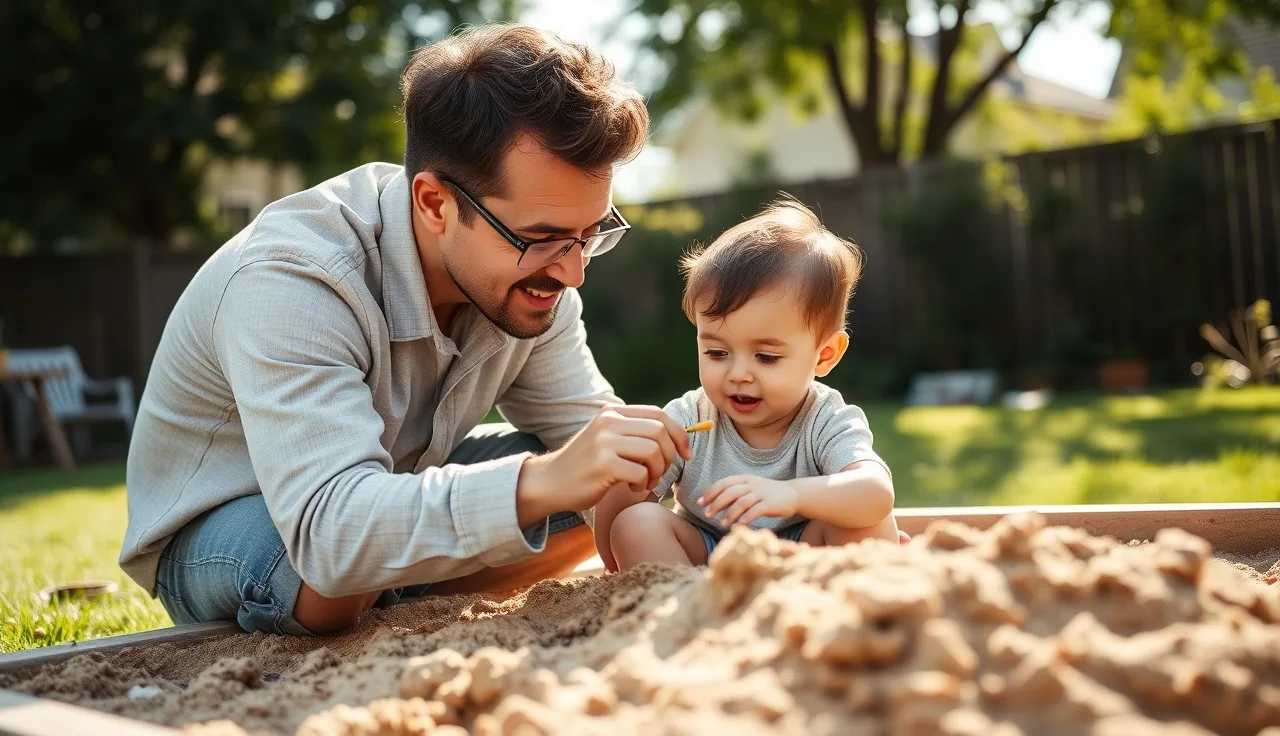
A sandbox or mud kitchen is hard to beat. The sensory pull keeps kids engaged long enough for real back-and-forth, and it's loaded with action words: pour, dump, mix, fill, dig, pat, squish. Model action plus object ("pour water"), model location ("water in"), then wait and see what your child does with it. If nothing comes, model again and keep going. You're building up input, not running a drill.
Bubbles show up on nearly every SLP's list of early activities for good reason: blowing them requires the same bilabial mouth control used in early speech sounds, holding the wand creates a built-in reason for your child to request more, and popping them is just plain fun for toddlers and preschoolers. Try modeling "blow," "pop," "more," "big," "gone."
Swings work as a requesting machine. Push once, then pause and look at your child expectantly, and wait five to ten seconds. Any attempt to communicate, whether that's eye contact, reaching, a sound, a sign, or using their AAC device, earns another push. That's requesting taught through natural consequence, the heart of milieu teaching [5].
Water play, whether it's a hose, sprinkler, or water table, brings out rich vocabulary (wet, cold, splash, spray, drip, pour) along with a lot of spontaneous exclaiming. Narrate as it happens: "it's cold!" "you got wet!"
On walks, slow down and follow real curiosity. Stop when your child stops, look at what they're looking at, name it, and wait. If they point at a dog, expand it: "yeah, dog. big dog. dog running." Try not to turn it into a constant quiz ("what's that?"); commenting teaches more than testing does.
Ball games give you turn-taking and requesting in a physical context that stays motivating on its own. "My turn," "throw it," "you catch" are all functional targets. Keep the game short so interest doesn't fade.
The milieu teaching techniques behind all of this
Milieu teaching is the evidence-based framework most SLPs use to coach parents on naturalistic language work, and it breaks down into four techniques that fit outdoor play naturally [5].
Incidental teaching means waiting for your child to initiate, whether that's reaching, looking, pointing, or making a sound, and then responding with a model or prompt. Your job is really to set up the environment so those initiations happen: put something interesting just out of reach, or leave a gap in a familiar routine. The swing pause described earlier is incidental teaching in action.
With mand-model, you direct your child's attention ("look at that") and then either give a model ("it's a frog") or ask an open question ("what is that?"). Accept any communicative response, not just spoken words, including a point or a tap on their device. If nothing comes back, just model the answer yourself and move on.
Time delay is setting up a familiar routine, then pausing and looking at your child expectantly without saying anything. That pause opens a window for them to jump in, and it works best once they already know the routine well enough to predict what's next.
The fourth piece, following your child's lead completely, means commenting on and expanding whatever they're already doing rather than redirecting them to something else. Koegel and colleagues showed back in 1987 that following the child's lead led to better generalization of language than adult-directed drill, and it also improved motivation and mood [6].
One practical note: all four of these work best when you're actually present, phone down. That's obvious to say and easy to forget, but your child's bids for shared attention need someone on the other end catching them.
Does outdoor speech practice work differently for autistic kids?
For many autistic children, outdoor settings are actually easier than structured indoor ones. Sensory input is more spread out and movement isn't as restricted, and some autistic kids talk more when they're moving. That said, the outdoors brings its own challenges.
Sensory sensitivities are common, and bright sun, unpredictable wind, wet grass, or loud environmental noise can be aversive enough to push a child into survival mode rather than learning mode. If your child melts down or shuts down at the park, that's often sensory overwhelm, not a refusal to communicate. Managing what your child is exposed to, sunglasses, a predictable route, a preferred corner of the yard, can make outdoor language work possible where it wasn't before.
Echolalia shows up a lot in autistic children, and outdoor play is no exception: a child might script lines from a favorite show while digging in the sand. Don't try to redirect it away. Echolalia is communicative and often carries real intent, so it's worth acknowledging rather than suppressing.
Among the naturalistic frameworks mentioned earlier, JASPER (Joint Attention, Symbolic Play, Engagement, and Regulation) was built specifically for play-based settings. Kasari and colleagues' 2010 research on JASPER found gains in joint attention and play diversity that held up outside the clinic [10]. If your child's SLP works in autism spectrum speech therapy, they should already be familiar with it.
For kids who use AAC, outdoor play is one of the best places to model the system. Research shows AAC users need to see their device or board modeled across many different settings before they generalize its use [4], so whoever is at the park with your child has a real say in how that generalization goes.
How much outdoor time actually moves the needle?
Nobody has run a clean trial measuring exactly how many minutes of parent-led outdoor practice produce a given language gain. The closest evidence comes from broader early intervention dosage research.
A 2018 review in the American Journal of Speech-Language Pathology found that more treatment hours per week predicted better outcomes for children with developmental language disorder, though the relationship wasn't strictly linear and depended on the child's profile [7]. The review couldn't tease apart how much of that benefit came from direct SLP time versus parent practice in between.
ASHA and most early intervention programs frame caregiver practice as a multiplier on clinic hours, not a substitute. If your child sees an SLP once a week for 30 to 45 minutes and you add 10 to 15 minutes of naturalistic practice a day through outdoor play and other routines, you've roughly quadrupled the number of chances your child has to learn.
Parent coaching programs often aim for 100 to 200 learning opportunities a day for early communicators, each one being a communicative attempt followed by a meaningful response. A 20-minute sandbox session, done well, can generate 30 to 50 of those on its own.
Don't chase a minute count. Chase quality. Ten minutes of genuinely following your child's lead beats 30 minutes of distracted narration.
What should you avoid during outdoor practice?
The mistakes teach as much as the techniques do.
Asking too many questions is probably the most common one. "What's that? What color is it? What are you doing?" is the pattern most parents fall into, and it's the least effective for language growth. Questions put a child on the spot, turn the interaction into a performance, and leave you with nothing if they don't answer. Comments work better: "It's a bird. It's flying. It went away." That's richer language with none of the pressure.
Correcting speech head-on doesn't help much either. If your child says "I wanna go wide" for "slide," the better response is an expansion: "Oh, you want to go down the slide. Let's go." You've modeled the correct word inside a real response instead of making them feel wrong. Direct correction, telling a child to "say it right," tends to be less effective and can make kids less willing to attempt words at all [5].
Narrating at your child without connecting to what they're doing is another common trap. It beats silence, but it's much weaker than talking with them about whatever has their attention.
Turning every outing into a therapy session backfires too. Kids need unstructured play, and if all outdoor time becomes a structured drill, it starts to feel like pressure instead of fun. Let some of it stay free. The language targets still show up on their own.
And don't leave AAC behind just because you're outside. Bringing a device to the park is a hassle, but bring it anyway. A low-tech communication board can be laminated or tucked into a small binder that fits in a bag. Consistent access matters more than almost anything else for AAC use.
Setting up the outdoor environment to invite communication
Arranging the environment is a formal part of milieu teaching and NDBI. The idea is to create "communicative temptations," moments where your child has a real reason to reach out for something they want.
Put desired items slightly out of reach, or in a container an adult needs to open. Bring only two or three sandbox tools instead of the whole bucket, so there's a reason to ask for something different. Put just a few bubbles in the bottle so it runs out and your child has to ask for more. Hand them a broken toy, a wheel that's come off, and see if they talk their way through fixing it. Controlling access to favorite equipment works the same way: hold the bubble wand yourself, stand near the swing, keep the ball in your hands. Not to withhold it, but to give your child a reason to communicate. If everything is available all the time, there's nothing to ask for.
Routine matters too. When outdoor activities follow a predictable sequence, kids start to anticipate what's next, and that anticipation is what makes time-delay techniques work. Blow a bubble, pop it, then pause and look at your child before the next one, and they'll learn that their response, eye contact, a sound, a gesture, an AAC hit, is what makes the next bubble happen.
For children working on childhood apraxia of speech or other motor speech challenges, this kind of outdoor play supplements the work but doesn't replace it. Apraxia responds to high-repetition, explicitly taught motor sequences, which are hard to build into free play. Outdoor time can help at the edges, but the direct motor work still needs to happen.
How do you know if it's actually working?
This is a fair question, and honest parents ask it. You're not an SLP and you can't run standardized testing, but you can still track things that matter.
Keep an informal log. After outdoor sessions, spend a minute noting what your child communicated, gesture, sound, word, AAC, sign, whatever it was, and the context around it. Patterns show up over weeks: new words, longer phrases, new reasons to communicate (commenting, say, where before there was only requesting). That's real data, even if it's not a formal assessment.
Count what you can count. How many times did your child initiate communication during a 15-minute sandbox session this week compared to four weeks ago? It's a rough measure, but it's honest and doesn't require any training to track.
Tell your SLP what you're seeing. The good ones treat parent report as real clinical data. "She asked for the swing three times today using her AAC button" tells them something useful, and your observations fill the gap between weekly sessions.
Some families use apps to help with this. Little Words, for instance, is an AI speech companion built for neurodivergent kids that helps spot communication opportunities and track them across everyday settings like outdoor play. If you want more structure between SLP visits, it's worth seeing whether a tool like that fits your family at littlewords.ai/start.
If you've practiced consistently and see no change at all over two or three months, bring that back to your SLP. It might mean the targets need to shift, the intensity needs to go up, or a different approach is worth trying. Plateaus happen. They're not a sign you've done something wrong, but they do deserve a response.
Where does the speech therapist fit into all this?
Playing outside with your child doesn't replace their speech-language pathologist. It extends the work between sessions, and that's exactly what SLPs want and what the research supports.
You'll get the most out of your SLP's time by asking them to coach you on your child's current targets, communication style, and environment: which two or three techniques to use at the playground this week, which words to model, how to respond if your child does a particular thing. That's a more useful conversation than a general check-in.
If you don't have an SLP yet, practicing outside is still worthwhile and won't cause harm. But for children with significant speech or language delays, a professional evaluation matters. ASHA recommends that children who aren't meeting language milestones get referred for evaluation rather than having families wait to see if they outgrow it [9]. In the US, early intervention (Part C of IDEA, for children under 3) offers free evaluations and services for kids who qualify, and after age 3, school districts take over under Part B [8].
For children with a diagnosis like apraxia of speech, the SLP isn't optional extra support, they're central to treatment. Outdoor play helps, but the core therapy needs trained delivery, so don't try to run apraxia therapy from the sandbox based on what you've read online.
Look for a speech therapist who coaches parents openly and asks how things went at home between sessions. That's the model the research backs, and it's what makes your outdoor practice actually pay off.
Common questions
At what age can I start doing outdoor speech activities with my child?
Once your child is mobile and interested in being outside, usually somewhere between 12 and 18 months. Even before a child talks, outdoor interaction builds joint attention and vocabulary comprehension. The approach doesn't change with age: follow the child's lead, model language, expand on what they communicate. There's no minimum age for this kind of input.
Can outdoor play replace formal speech therapy sessions?
Not for children with diagnosed speech or language disorders. Outdoor practice is a strong supplement to clinic-based therapy, not a substitute. ASHA's evidence shows caregiver-implemented intervention works best when a caregiver is coached by an SLP and the child also gets direct services. For late talkers without a specific diagnosis, naturalistic practice is a reasonable place to start, but an SLP evaluation is still worth pursuing if delays continue past 18 to 24 months.
What if my child just wants to run and won't engage with me?
Follow them. Running is a legitimate play activity, and it doesn't shut out language. Narrate it: "you're fast, you're running, you stopped." When they pause on their own, that's your window. Chasing games and any activity with a built-in pause give you moments of shared attention without forcing anything. Trying to redirect a child mid-play usually just creates resistance, so think sportscaster, not director.
My child doesn't speak at all yet. Is outdoor play still useful?
Yes, and arguably more useful. Pre-verbal children build the foundation for language through joint attention, gestures, and understanding words before they produce them, and outdoor play is rich in all of that. Keep modeling language without requiring a verbal response, and treat any communicative act, including eye contact, reaching, or pointing, as if it were a word. If your child is pre-verbal past 18 months, get an SLP evaluation.
Should I bring an AAC device to the playground?
Yes. Research on AAC generalization shows devices need to be modeled across natural settings, including outdoors, for kids to use them independently. Leaving the device inside sends the message that it's a therapy tool rather than a real way to communicate. If weather worries you, many devices have protective cases, and low-tech boards can be laminated. The hassle of bringing it along is worth it.
How is outdoor speech therapy different for a child with autism versus a late talker?
The techniques overlap quite a bit, but autistic children often need more sensory preparation before language work is even possible, more explicit routine, and approaches tuned to things like echolalia. Late talkers without autism tend to respond faster to simply increasing language input. Both groups benefit from naturalistic, child-directed interaction, but autistic children are more likely to need guidance from an SLP trained in NDBI alongside home practice.
What are the best outdoor activities for targeting two-word phrases?
Swings, bubbles, and ball games top the list because they're motivating, have natural pauses that create chances to request more, and involve clear actions and objects. Model combinations constantly in that context: "push me," "blow bubbles," "throw ball," "more swing." The goal is for your child to eventually produce these on their own, not to repeat right after you. Two-word combinations tend to emerge from weeks of consistent modeling, not a single session.
How long should an outdoor practice session be?
Quality beats length here. Ten to fifteen minutes of focused, present interaction with good technique does more than 45 minutes of distracted parallel play. Most parent coaching programs aim for two or three short, intentional windows a day spread across normal routines, rather than one long formal session. If your child loses interest, stop: forcing it lowers their willingness to communicate.
What do I do if my child gets frustrated or melts down during outdoor play?
Drop the language goals and deal with the meltdown first. A dysregulated child can't learn in that moment. Offer whatever co-regulation they need, whether that's physical closeness, less stimulation, or a preferred item, and don't try to prompt communication while they're upset. Once they're regulated, the play and language opportunities come back. If meltdowns keep happening during outdoor sessions, that's worth noting: it may mean the targets are too hard or there's an unaddressed sensory issue.
Are there outdoor games designed specifically for speech practice?
"I spy" targets descriptive language and phonemic awareness. Simon Says targets following directions and action words. Blowing dandelion seeds or bubbles targets oral motor control for early speech sounds. Scavenger hunts with picture cards target labeling and requesting. Water races, like blowing a leaf or bottle cap across a puddle, target breath support and lip position. None of these require purchased materials, and all of them tuck speech targets inside play that's already motivating.
How do I explain to other adults at the playground what I'm doing?
You don't have to. What you're doing looks like engaged parenting, because it is. Following your child's lead, commenting on what they're doing, pausing before pushing the swing: to any observer, that just looks like good play. If someone asks, "we're practicing some language stuff our SLP suggested" covers it.
Can siblings help with outdoor speech practice?
Yes, and sibling interaction brings something different to the table. Peers and siblings offer a communication context adults can't replicate, and research on peer-mediated intervention shows siblings can be coached to use specific strategies. Teach an older sibling to wait, to comment instead of question, and to respond to any attempt at communication from their brother or sister. Keep expectations low and the play genuinely fun: it stops working the moment it feels like homework.
What should I tell my child's SLP about what we're doing outside?
Be specific: what activities you did, what you modeled, and how your child responded. Mention any new words, new ways they tried to communicate, or anything that surprised you. Ask whether what you're practicing outdoors matches the current clinic goals, and ask for adjustments if it doesn't. The more concrete detail you bring, the more useful the coaching you get back will be.
Is outdoor speech practice safe to do without professional guidance?
Following your child's lead, expanding on what they communicate, and modeling language is low-risk and backed by evidence. You won't harm your child by doing these things without an SLP present. Professional guidance matters more for children with specific diagnoses like apraxia, significant delays, or AAC needs, where what to model and how to prompt requires trained clinical judgment. For everyone else, naturalistic input is safe.
The research behind naturalistic, play-based approaches to communication is pretty deep at this point, and it's worth knowing what's actually been studied. A 2020 meta-analysis in the Journal of Child Psychology and Psychiatry looked at randomized controlled trials of Journal of Child Psychology and Psychiatry, Sandbank et al. 2020 meta-analysis of NDBI interventions for autism and found that these approaches led to real gains in communication for autistic children when practiced in everyday settings rather than clinical ones. That lines up with how the American Speech-Language-Hearing Association (ASHA), Naturalistic Intervention evidence map defines the approach: folding communication goals into activities the child already enjoys, wherever they naturally happen. ASHA also notes that when parents get enough coaching, what they do at home can work as well as sessions with a clinician. Some of the older research explains why this works. Carey and Bartlett's classic 1978 study on fast-mapping, summarized in Carey, S. & Bartlett, E. (1978) on fast-mapping in children, Cognition; summarized in ASHA's Late Language Emergence resources, found that toddlers pick up new words fastest when they hear them right as they're looking at the thing the word refers to, in a moment of shared attention. Following the child's lead matters too: a 1987 study on the Koegel, R.L., O'Dell, M., & Koegel, L.K. (1987), Journal of Autism and Developmental Disorders, Natural Language Teaching Paradigm found that letting the child steer the interaction led to better generalization of language and more motivation than adult-led drills. For kids who use or might benefit from AAC, a 2006 study comparing PECS to naturalistic methods found that Yoder, P. & Stone, W. (2006), Journal of Speech, Language, and Hearing Research, PECS vs naturalistic AAC intervention produced bigger gains in intentional communication for a subset of autistic preschoolers, though generalizing AAC use still requires modeling it across different everyday settings. Parent coaching itself has good evidence behind it, too: research on Kaiser, A.P. & Hancock, T.B. (2003), Infants and Young Children, Teaching parents new skills to support their young children's communication found that milieu teaching techniques, things like incidental teaching, mand-model, and time delay, lead to language gains when parents are trained to use them, and that expanding on what a child says works better than correcting them outright. How much therapy matters, too, though the picture isn't simple. A 2018 dosage review found that Hsieh et al. (2018), American Journal of Speech-Language Pathology, treatment dosage review for developmental language disorder showed higher treatment intensity generally predicting better outcomes for kids with developmental language disorder, but the relationship wasn't a straight line and depended a lot on the individual child. And for play-based intervention specifically, a 2010 study on Kasari, C. et al. (2010), Journal of Child Psychology and Psychiatry, JASPER intervention for autism found that this naturalistic, play-focused approach improved joint attention and play skills in ways that held up outside the clinic. If you're wondering when and how to get help, a few things are worth knowing. Children under 3 who aren't meeting developmental milestones qualify for free evaluations and services under ASHA, Early Intervention under IDEA Part C, with Part B picking up coverage through school districts from age 3 on. This is backed by federal law: IDEA 2004, Individuals with Disabilities Education Act, 20 U.S.C. § 1400 requires free appropriate public education and early intervention for eligible kids with developmental disabilities, communication disorders included. ASHA's own guidance is direct on this point too: ASHA Practice Portal, Late Language Emergence recommends getting an evaluation rather than waiting it out when a child isn't hitting language milestones. Pediatricians are supposed to be watching for this all along, too: the American Academy of Pediatrics (AAP), Developmental Surveillance and Screening Policy Statement calls for developmental surveillance at every well-child visit, with formal screening at 9, 18, 24 or 30, and 48 months specifically to catch communication delays early.