Last updated 2026-07-11
TL;DR
Snack time gives you what a therapy room usually can't: real motivation, real objects, and a kid who genuinely wants the cracker. That's enough to work on requesting, labeling, turn-taking, and commenting right at the table, ten minutes a day, no worksheets or flashcards required.
Food is one of the strongest motivators a young child has. When your kid actually wants what's on the plate, they have a real reason to communicate, and that reason is most of the battle in early speech work. You create a need to talk, then you support the attempt.
Speech-language pathologists call this "natural environment teaching," and the research holds up. A 2006 study in the Journal of Applied Behavior Analysis found that naturalistic language interventions produced stronger generalization of new words than discrete-trial training alone, meaning kids were more likely to use the words outside the session [1]. That generalization gap is exactly what trips parents up: the child nails it in the clinic, then goes quiet at the kitchen table. Snack time also creates real communicative pressure that a clinic session can struggle to manufacture. Your child needs the cracker. They can't get it without signaling you somehow, and that gap between want and have is where language grows. Routine helps too, since kids with language delays often learn better inside predictable sequences [2]. Snack runs the same arc every day: sit down, see the food, request, receive, eat, finish. That sameness lets you drop the same targets into the same spots over and over, which is how new words get filed into memory. Almost anything on a preschool speech-language IEP can live at the snack table. Requesting (or "manding") is the big one for late talkers and many autistic kids: hold the food slightly out of reach, wait, and support the child to ask, whether that's a word, an approximation, a sign, a picture exchange, or an AAC button. Any intentional communication counts. If your child uses an AAC device, snack is one of the best times to model it, since the vocabulary ("more," "open," "cracker," "done") already sits in almost every system. Labeling works well too: "What is that?" or a simple point and pause teaches your child to name things, and naming food, utensils, colors, and textures in context sticks harder than picture cards ever do. Passing a bowl or trading "my turn / your turn" builds the turn-taking that conversation runs on. Commenting is the one parents underuse, and it matters more than they think: saying something about the world that isn't a request, like "that's crunchy" or "I see yellow," stretches language beyond just asking for things, which matters because kids who only learn to request can stall there. You can also slip in following directions, "put the cup on the mat" or "give me the spoon," without any setup. And if your child says "more," you can model one step up: "more crackers." If they say "more crackers," you model "I want more crackers." This plus-one rule for expanding sentence length is one of the most evidence-backed moves in the field [3].
| Speech Goal | Snack Example | What to Say/Do |
|---|---|---|
| Requesting | Hold cracker just out of reach | Wait, then prompt: "Say 'cracker'" |
| Labeling | Point to apple slice | "What's that?" (pause, then model "apple") |
| Commenting | Child bites something sour | "Ooh! That's sour! Your face is funny!" |
| Turn-taking | Pass the bowl around the table | "Your turn. My turn. Your turn." |
| MLU expansion | Child says "more" | You say "more grapes" |
| Following directions | Snack cleanup | "Put the cup in the sink, please." |
Running an actual snack session
You don't need a therapy background for this, just a plan and a bit of patience. Start by slowing the food down: don't dump the whole snack on the plate, put out one or two crackers and hold the bag back. That way every serving becomes a fresh chance to request. If everything's already sitting there within reach, there's nothing left to communicate about. Then wait before you help. SLPs call this expectant waiting: make eye contact, raise your eyebrows a little, lean in, and hold for three to five seconds before you prompt. That pause is the child's window to start on their own, and most parents jump in too fast and quietly erase the opportunity. If nothing happens after you wait, prompt from least to most: try a gesture first (point to the food, then to your mouth), then a partial verbal model ("cra..."), and if that doesn't land, give the full model ("cracker") and hand over the food regardless of whether they copied you. You're pairing attempts with success, not holding food hostage. Respond to everything, too. A reach, a vocalization, a point, a tap on your hand: all of it is communication. Answer it like it was a word, say the word it stands for, hand over the item, celebrate a bit. That's how intentional communication turns into words over time. Alongside that, keep a running narration going: "I'm opening the bag. Pop! It's open. Here are your crackers. One, two, three crackers. You're eating. Crunch crunch crunch." This kind of self-talk and parallel talk builds vocabulary and processing without asking the child to perform anything. And keep it short. Ten minutes does the job. Turn every snack into a 30-minute drill and you'll burn out both of you, so pick two or three targets, hit them, and let the rest of snack just be snack.
Which prompts actually help?
Prompting is a skill, and doing it badly can slow a child down. Every prompt has one job: to eventually fade itself out so the child communicates on their own. SLPs usually move least-to-most to protect spontaneity, or most-to-least when a child needs heavy support just to get going. For most late talkers at home, least-to-most is the right default: wait first, gesture second, partial model third, full model last. Time delay, where you insert a beat of expectant waiting before offering help, is one of the best-studied prompting procedures in AAC and early language research [4]. A 2014 review in the American Journal of Speech-Language Pathology found it effective for increasing spontaneous communication in young children across a range of diagnoses [4]. It feels awkward the first hundred times you try it. Do it anyway. Go easy on questions like "What do you want?" or "Can you say cracker?" These are high-demand, low-support prompts that work fine for a kid who already owns the word and just needs reps. For a kid still building the word, saying it yourself first works better. There's a difference, too, between asking for imitation ("say cracker"), where the child has to hear it and repeat it on command, and modeling, where you say it, pause, and let the child repeat or not. Both have their place, but for a child who's reluctant to talk, leaning too hard on imitation requests can build anxiety around speaking. Modeling carries less pressure and, for many kids, works better as a starting point. If your child is working through apraxia of speech, the motor-planning demands change. Snack-time practice still applies, but coordinate with your SLP on which specific sound targets to drill, since for that population repeated, structured motor practice matters far more than random word exposure.
How do you choose the right snacks for speech therapy?
The snack itself matters more than you'd think, and it has nothing to do with nutrition.
Start with foods your child actually wants. Motivation drives everything here, so ask yourself which foods your kid will work to get, and use those. A child who ignores rice cakes but loses his mind over goldfish should be practicing with goldfish, not rice cakes.
Mix up textures on purpose. Crunchy, soft, sticky, smooth, cold, warm, chewy: each one hands you different words to model. Stick to one texture and you've capped the sensory vocabulary you can build.
Choose foods that need a little help to open: yogurt pouches, lidded containers, bags that need scissors. Each one gives your child a real reason to ask for something. If everything's already open and sitting within reach, you've removed the structure that makes snack time useful for this kind of practice.
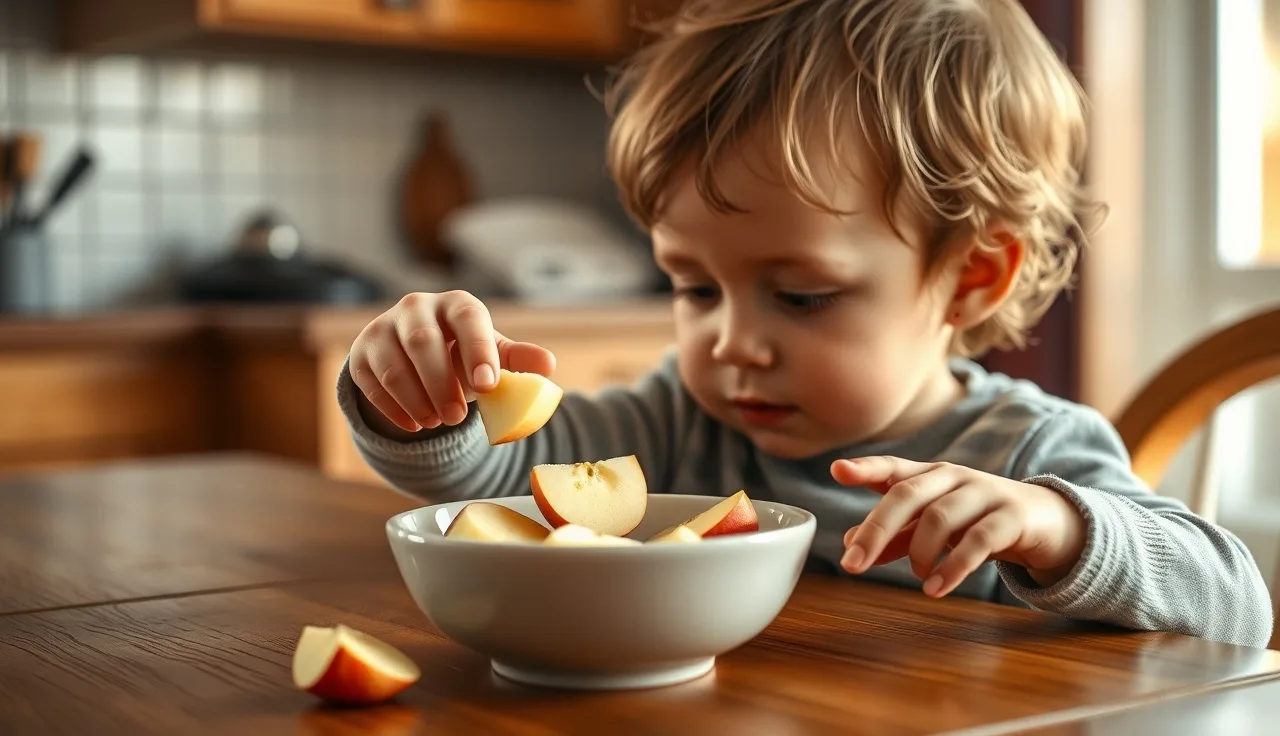
Cut food into small pieces, because that turns one opportunity into many. A single apple slice is one chance to communicate; that same apple cut into 12 pieces is 12 chances. More pieces means more turns, and more turns means more practice per minute.
If your child has an oral motor diagnosis or trouble chewing and swallowing, check with your SLP or feeding therapist before using food this way. This is about communication practice during snack, not oral motor therapy, which is its own, more specialized area.
Some families working through early intervention already have an SLP who also handles feeding therapy. If that's your situation, just ask them directly which textures are fine to use for this kind of practice and which ones aren't, at least while skills are still developing.
How is snack-time speech therapy different for autistic kids?
The core strategies stay the same. What changes is how you apply them.
Many autistic children have strong preferences and strong aversions around food, and both are real, not stubbornness. If a child eats only a handful of foods, snack time still works fine: you build around what they already accept instead of introducing new foods mid-session. Combining feeding goals with communication goals at the same meal can work if you have a feeding therapist guiding you. Trying it on your own, without that guidance, can backfire.
For kids who are minimally verbal or use AAC, snack remains one of the richest communication windows in the day. Model the device right at the table, and if there's a snack page or food folder built into the system, open it every day without fail. ASHA describes aided language stimulation, modeling AAC while you talk, as a core support strategy for AAC users of any age [5].
For kids whose main mode is echolalia, snack is a good place to acknowledge it, connect it to meaning, and gradually stretch it. If your child echoes "do you want crackers?" to mean yes, treat it as yes: "You want crackers! Here are crackers." Over time you can model shorter, more functional phrasing.
Social scripts help too. A repeated exchange like "open, please" (you open it), "thank you" (child gets the food) can turn into an automatic routine that carries over into other settings. There's more on this in our overview of autism spectrum speech therapy.
Routine rigidity can actually work in your favor here. Some autistic kids who resist change will accept a new communication expectation more easily when it's built into the snack routine from the very start, since the routine itself becomes what holds the expectation in place.
How many times a day should you do snack-time speech practice?
Once a day works fine. Twice is better if your child gets two snacks. What matters isn't sessions per day, it's whether you keep showing up day after day.
The dosage research is thinner than most parents assume. A 2018 paper in Language, Speech, and Hearing Services in Schools reviewed the data and found that higher intensity (more sessions per week) generally led to better outcomes, but the ideal amount shifted depending on the disorder, the child's age, and the treatment approach, with no single threshold that applies to everyone [6]. What the evidence does support is that practice spread across everyday moments beats occasional intensive sessions.
So ten minutes of real snack-time practice, five days a week, beats a 30-minute drill session once a week by a wide margin, and it beats doing nothing between appointments even more.
If your child sees an SLP, ask them directly what home dose they'd recommend for your child's specific goals. Most will give you an actual number. Hold them to it. It's a fair thing to ask for.
What should you avoid during snack-time speech practice?
A few common habits make snack time less useful, and a couple make it worse.
Don't drill. Snack is naturalistic practice, not a flashcard exercise. Pointing at every food and demanding "say this" turns a natural moment into a test: pressure goes up, motivation goes down. The exception is a kid who genuinely enjoys that game. If yours does, go ahead and play it.
Never withhold food as punishment for silence. Don't let your child go hungry or cut snack short because a word didn't come out. That's the line between supportive prompting and coercion, and crossing it damages trust around both food and talking. The food should always show up eventually, word or no word.
Don't correct errors directly. If your child says "cratter" instead of "cracker," skip the correction and just say it back naturally: "Yes, cracker! Here's your cracker." This is called recasting, and it's one of the best-supported ways to build accuracy without shutting a kid down [3].
Watch how much you talk. Narrating is good; lecturing isn't. Leave room, pause, count to five in your head if you have to. Some of the best moments happen in the quiet right after you stop talking.
Don't chase too many goals at once. Pick two, maybe three at the most. Try to run requesting, labeling, sentence length, commenting, turn-taking, and following directions all in one ten-minute snack and you'll do none of them well.
How can you track progress without becoming a data scientist?
You don't need a clipboard and a tally chart, but you do need something, because memory plays tricks on you and early speech progress is genuinely slow. Parents who track, even loosely, notice real gains sooner and worry less during the flat stretches.
Try this: after snack, jot a tally in a notes app of how many times your child communicated, in any mode, and whether any new words or approximations showed up. Do that for two weeks and the picture gets a lot clearer than memory alone would give you.
If your child is on an IEP or IFSP, the SLP handles formal data during sessions. Your job at home is just to notice what's happening and bring it to the next appointment. Notes like "she used 'more' spontaneously four times this week without prompting" or "he pointed to the cup and vocalized three days in a row" are exactly what an SLP needs to adjust targets.
Some families use an AI-assisted practice app to stay consistent between appointments. Little Words, for instance, was built to guide parents through this kind of daily practice woven into routines, and to flag patterns worth mentioning to a clinician. It doesn't replace an SLP, but it can make home practice more structured and less of a guessing game. There's a short quiz at littlewords.ai/start if you want to see whether it fits your situation.
The most useful thing to track isn't accuracy, it's initiations: how often your child starts an exchange without being prompted. Watching that number climb over the weeks is the real signal worth paying attention to.
How does snack-time practice fit into a broader speech therapy plan?
Snack time supplements therapy, it doesn't replace it. If your child qualifies for speech services, they should be getting them. Snack practice is what happens every day between appointments to raise the total amount of meaningful language input and practice your child gets.
The American Academy of Pediatrics recommends that children with identified language delays be referred for speech-language evaluation, and that families receive guidance on supporting language at home [7]. Snack-time practice is that home guidance, put into action.
For families in the birth-to-three window, early intervention services under IDEA Part C often build parent coaching in as a core piece. Your early interventionist should be showing you how to weave communication targets into daily routines, snack included; if they aren't, ask them to. IDEA specifically calls for services in "natural environments" for children under three [8], and snack time is about as natural as it gets.
For school-age kids, most IEP speech goals are written as accuracy in structured contexts. Snack practice builds the fluency and generalization that make those structured gains actually mean something at the dinner table or on the playground.
A good SLP will work with you to decide which goals to run at home during snack. If yours hasn't brought this up, bring this article to your next appointment and ask them to match two or three snack-friendly activities to your child's current IEP goals. That's a completely reasonable thing to ask for.
Are there any apps or tools that help with snack-time speech therapy? Honestly, most of what you need costs nothing: a hungry child, a preferred snack cut into small pieces, and your full attention. That's the whole toolkit. A few extras do help some families. Visual schedules, a simple picture sequence of snack steps like sitting down, washing hands, getting the snack, eating, and cleaning up, can ease transition anxiety for autistic kids and build the kind of routine predictability that supports language. You can print these free from many university extension programs or make your own with photos on your phone. If your child uses an AAC device or a low-tech board, the snack table is one of the best spots to keep it out. Research consistently shows AAC doesn't hold back speech development and often helps it [9], so leave the device within reach and model it yourself as you talk. A visual timer (the Time Timer brand is popular) can help some kids grasp that snack is finite, which smooths the transition out afterward, though that's more a behavior support than a speech tool. Video modeling helps too: for some kids, watching a short clip of another child requesting or commenting on food right before the real snack primes the language. It's an evidence-based technique, though it's easier to run well with an SLP's guidance on which behaviors to show. If you want structured daily coaching between therapy appointments, Little Words runs AI-guided practice sessions built around exactly these embedded routines. There's a short quiz at littlewords.ai/start to check whether it fits your child's age and profile. What if your child refuses to communicate at all during snack? This happens, and it doesn't mean snack practice is wrong for your child. It usually just means the expectation sits a step ahead of where the child actually is, or the setup needs a tweak. Start by checking the motivation. Is the food genuinely preferred, or are you offering something the child could take or leave? It sounds obvious, but it's the single most common reason snack practice falls flat. Next, lower the demand: if you've been prompting for words, drop back to any sound or gesture; if you've been prompting for pointing, drop back to waiting and watching. Meet the child where they are, not where you wish they were. Check your pace too. Five seconds of expectant waiting feels endless at a kitchen table, but many kids with language delays process sound more slowly and need that whole pause to formulate a response. And dial down the therapy feel while you dial up the fun. Some of the best snack sessions look like a parent being ridiculous: a silly voice for the narration, pretending the goldfish are swimming, naming colors with mock surprise. When the interaction itself is fun, kids engage more, and more engagement means more attempts. If your child is consistently distressed around snack or refuses food broadly, that's bigger than communication practice and may point to sensory processing issues, feeding difficulties, or anxiety. Talk to your pediatrician or a feeding therapist; the AAP's developmental screening resources are a solid starting point [7].How long should a snack-time speech therapy session be?
Ten minutes is plenty. Most kids' attention and motivation for structured communication practice tap out around there, especially toddlers and preschoolers. You want repeated practice across many days, not marathon sessions. If snack naturally runs longer, that's fine, but don't push the communication work past the point where your child is still enjoying it.
Can snack time replace actual speech therapy appointments?
No. Snack-time practice is home carryover, not a clinical substitute. A child with a language delay or disorder still benefits from formal evaluation and treatment by a licensed speech-language pathologist. What snack time does is raise the total practice dose between appointments, and the research supports that as a real contributor to outcomes.
What if my child only communicates with gestures or AAC during snack? Should I push for words?
Follow your SLP's guidance here. Gestures and AAC are legitimate communication, not lesser stand-ins for speech. For many children they're precursors to spoken words or functional equivalents of them. Pushing for speech before a child is ready can breed avoidance, so respond to every gesture and device hit as the real communication it is.
What are the easiest speech targets to start with during snack?
Requesting and labeling. Start with requesting, since hunger already motivates it, giving your child an easy reason to communicate. Once requesting is steady, add labeling ("what is it?") and commenting ("that's crunchy!"). Turn-taking and direction-following can layer in once the basics are flowing.
My child echoes words back to me but doesn't seem to understand them. Is that okay?
Echolalia is common in autistic children and some late talkers, and it isn't meaningless. Research suggests it often functions as communication even when it looks like pure repetition. Respond to it, map it to meaning, and model shorter forms alongside it. For more, see our overview of echolalia and what it means for language development.
How do I balance making snack fun versus using it for therapy?
They aren't opposites. The best snack practice feels like play and connection, not drilling. Silly voices, big reactions, narrating with humor: all of it raises engagement, and higher engagement means more attempts to communicate. If your child is clearly having fun, you're probably doing it right, even if the session looks nothing like formal therapy.
What age is snack-time speech practice appropriate for?
It works from about 12 months through early school age, though the targets shift. Toddlers work on first words and requesting. Preschoolers add commenting, longer sentences, and direction-following. Early school-age kids can work on narrative language ("tell me what you had for snack today") and conversational repair. The technique scales with developmental level, not chronological age.
Should I talk to my child's SLP before starting snack-time practice at home?
Yes, if your child has one. Ask for two or three specific targets that match the current IEP or therapy goals, plus the exact prompting strategy they want you using. That coordination keeps your home practice aligned with the clinical plan instead of working against it.
Can snack-time practice help with late talkers who aren't diagnosed with anything?
Yes, and it's one of the best things to do while you wait for an evaluation or early intervention services to start. Expectant waiting, modeling, recasting, and following the child's lead are low-risk and evidence-backed at any communication level. If you're concerned about your child's speech, contact your pediatrician and ask for a referral to a speech-language pathologist.
What words should I be targeting for a two-year-old during snack?
By 24 months, most children have around 50 words and are starting two-word combinations, though the range is wide [7]. At snack, target names of preferred foods, action words ("open," "more," "done," "eat"), and simple social words ("please," "thank you"). If your child has fewer than 50 words at two, mention it to your pediatrician at the next well-child visit.
Is it okay to use food as a reward during speech practice?
Giving food in response to a communication attempt isn't the same as using food as an arbitrary reward. Handing over the cracker when the child says or approximates "cracker" is contingency-based teaching, which is well supported. Never withhold food as a consequence for not speaking, though: the food should always come eventually, regardless of the communication outcome.
How is snack-time speech practice different from mealtime speech practice?
Mostly scale and pressure. Snack has a shorter window, fewer items, and less social complexity than a full family dinner, which makes it a better starting place for most families. Mealtime practice works too, especially for turn-taking and narrative language, but the sensory load and social demands run higher, making it harder for some kids to sustain.
What if my child has food allergies or texture aversions that limit snack options?
Work with what you have. Any preferred, safe food creates a communication opportunity. If your child accepts only a handful of foods, those become your snack-time vocabulary targets. The strategies don't need variety, they need the food to be genuinely wanted. Coordinate with a feeding therapist if the aversions are severe or expanding the diet is also a goal.
Sources
- Journal of Applied Behavior Analysis, 2006, Naturalistic language interventions and generalization: Naturalistic language interventions produced stronger generalization of new words than discrete-trial training alone in children with language delays.
- ASHA, Practice Portal: Early Intervention: Children with language delays benefit from consistent routines and natural environment teaching, as described in ASHA's early intervention practice guidance.
- ASHA, Practice Portal: Late Language Emergence: Recasting and the plus-one MLU strategy are evidence-supported techniques for building language accuracy and mean length of utterance in late talkers.
- American Journal of Speech-Language Pathology, 2014, Time delay procedure review: Time delay is effective for increasing spontaneous communication in young children across a range of diagnoses, based on a 2014 systematic review.
- ASHA, Practice Portal: Augmentative and Alternative Communication: Aided language stimulation, modeling AAC while speaking, is a core support strategy for AAC users as described by ASHA.
- Language, Speech, and Hearing Services in Schools, 2018, Dosage in pediatric speech-language treatment: Higher intensity (more sessions per week) generally produces better outcomes in pediatric speech therapy, but optimal dosage varies by disorder type, child age, and treatment approach.
- American Academy of Pediatrics, Developmental Surveillance and Screening: The AAP recommends referral for speech-language evaluation for children with identified language delays and family guidance on supporting language at home; typical 24-month vocabulary is approximately 50 words with emerging two-word combinations.
- IDEA, 34 CFR Part 303, Early Intervention for Infants and Toddlers with Disabilities: IDEA Part C requires that early intervention services for children birth to three be provided in natural environments to the maximum extent appropriate.
- ASHA, Practice Portal: AAC, Does AAC inhibit speech?: Research consistently shows that AAC does not impede speech development and often supports it, as stated in ASHA's AAC practice portal.
- National Institute on Deafness and Other Communication Disorders (NIDCD), Speech and Language: NIDCD provides normative speech and language milestones used for identifying late talkers and determining when referral is warranted.