Last updated 2026-07-10
TL;DR
Nonverbal children communicate all day long through movement, behavior, sound, and routine. Watch what they move toward, what sets off distress, what they repeat. Pair that with a communication system, low-tech or high-tech, and a speech-language pathologist, and most families start cracking the code within weeks.
What "nonverbal" actually means
The word gets thrown around loosely, and that sloppiness changes how you read your own child. Clinically, a child is usually called minimally verbal when they produce fewer than 30 functional words or lean on non-speech ways to get needs met [1]. That's a different child from the late talker who's trending upward, and different again from the child who has words but loses access to them under stress.
Roughly 25 to 30 percent of autistic children are minimally verbal or nonspeaking, according to estimates published in Pediatrics [2]. Minimally verbal doesn't mean minimally communicating. Every reach, every pull on your arm, every meltdown at the exact same morning transition is information.
Speech-language pathologists call the stage before words or symbols emerge "presymbolic communication." Communication still exists there, it just shows up as movement, behavior, and sound instead of language. Once you see that, you start watching your child differently.
Reading body language and movement
Start with direction of movement. Where does your child go without being prompted? What do they pick up, carry, or hand back? A child who keeps bringing you an empty cup is asking for a refill even without the word "more." A child who grabs your hand and walks you to the pantry has already made the request.
Posture and proximity tell you emotional state. Leaning in, reaching out, a flick of soft eye contact tend to signal openness. Turning away, covering ears, crouching, pressing into a corner usually signal overwhelm, not defiance.
Facial expression is often the fastest read, and also the one that fools parents expecting neurotypical faces. Some children sit at a flat baseline and show excitement through their whole body instead. Others feel things hard but in bursts you miss if you blink. Film your child for ten minutes during free play and watch it back at half speed. The patterns you missed the first time jump right out.
Hands say a lot too. A point, even a whole-hand sweep rather than a neat index finger, is intentional communication. Hand-leading, where your child sets your hand on an object, is a request for action. Repetitive hand movement near a thing often marks interest.
Here's a framework worth memorizing. The American Speech-Language-Hearing Association describes three communicative functions that even presymbolic children use: behavior regulation (getting you to do something), social interaction (getting your attention), and joint attention (getting you to notice something with them) [3]. When your child acts, ask which of those three boxes it fills.
What behaviors are telling you
Behavior analysts and speech-language pathologists land in the same place here: behavior is communication, especially when the other channels are limited or unreliable [4].
The four classic functions of behavior are access (I want that), escape (I want out of this), attention (look at me), and sensory (this feels good, or I need to change how I feel). A child who throws food is probably saying "I'm done" or "not this." A child who screams at the door before a grocery run may be saying "I know what's coming and I'm not ready."
Keep a simple ABC log for three to five days: antecedent, behavior, consequence. Write down what happened right before, what the behavior looked like, and how it ended. Patterns you can't feel in the moment show up on paper fast. The same behavior in the same context, over and over, carries a steady message.
Meltdowns deserve their own mention. A meltdown is not a tantrum. Tantrums are goal-directed and stop when the goal lands or the audience leaves. Meltdowns in autistic and sensory-sensitive kids are neurological overload, and they usually have a buildup phase with early tells: stimming ramps up, eye contact drops, voice tone shifts. Learning your child's personal escalation ladder is one of the highest-value things you'll ever do as a parent, because those early signals are your child communicating before words are even an option.
What vocalizations can tell you
A child doesn't need words to use their voice with meaning. Pitch, rhythm, and volume carry a load of information on their own.
Rising pitch at the end of a sound often marks a question or a request. Flat, repetitive vocalizing during an activity usually means enjoyment or self-regulation. A sharp, short sound with a startled body means something scared them. A long, low sound while pushing an object away is about as clear a "no" as you'll get.
Some children use echolalia, repeating words or phrases they've heard, as real communication before they build original sentences of their own. A child who says "do you want a snack?" when hungry is reusing a phrase they heard paired with that moment, and that's not empty repetition. Our deeper look at echolalia meaning breaks down how to tell functional repetition from the non-functional kind.
Write down the sounds your child makes regularly and match them to context. Plenty of families find their child already has a stable "vocabulary" of vocalizations with fixed meanings that nobody had ever written down.
Low-tech tools that work at home
You don't need an app or a device to start a communication system today. Low-tech AAC has decades of evidence behind it and costs close to nothing.
Object symbols are the most concrete start for kids at early presymbolic stages. Put your child's shoes in front of them before a walk, and the shoe becomes the symbol for "going outside." Show the empty cup before you fill it. The object predicts the event, and over time your child learns to hand you the object to request the event.
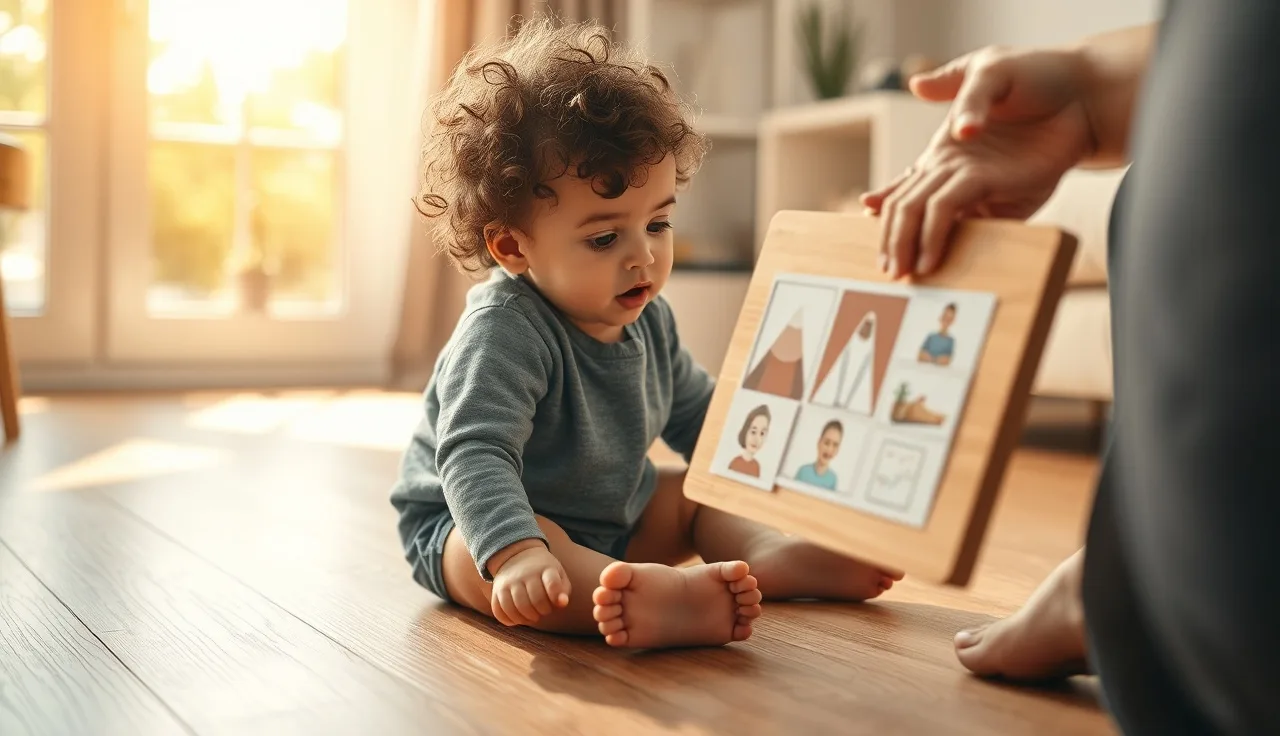
Photo boards come next. Take real photos, not clip art, of your child's actual cup, actual swing, actual blanket, and laminate them on cardboard. Six to eight choices is plenty; you don't need 200. Hang them where your child walks past naturally.
Core word boards are what many SLPs reach for once a child understands that pictures stand for things. Core vocabulary, the 50 to 200 words that account for roughly 80 percent of everything anyone says, runs mostly on verbs, prepositions, and pronouns: more, stop, go, want, help, no, yes, I, you, mine [3]. A laminated grid of the 20 to 30 most-used words hands a child a huge range.
Model the system yourself, over and over. The research is blunt about this: adults have to use the tool before children pick it up. Point to "more" on the board when you want more of something. Point to "stop" when you want the tickling to stop. Kids learn the tool by watching you use it in real, motivated moments.
Do AAC devices and apps really help?
Yes, and the evidence is strong. A 2012 systematic review in the Journal of Speech, Language, and Hearing Research found that AAC use does not suppress spoken language development and may support it [5]. The American Academy of Pediatrics has said AAC should start early, without waiting for a child to somehow prove they're "ready" [6].
High-tech AAC runs from about $200 for a tablet loaded with a dedicated app to $8,000 to $12,000 for a dedicated speech-generating device. Most insurance covers dedicated devices under durable medical equipment benefits when a physician prescribes one after an SLP evaluation, though coverage swings hard by plan and state [7]. If you want the full picture on device types, funding, and how to get evaluated, our guide to AAC devices walks through it.
One honest caveat: a device by itself produces nothing. The work around it, modeling, responding, using it constantly, is what produces gains. A child handed a $10,000 device with no modeling will use it less than a child handed a $5 laminated board with adults who point to it all day long.
| AAC Type | Approximate Cost | Best For |
|---|---|---|
| Object symbols | $0 | Presymbolic stage |
| Photograph board | $5-20 | Early symbolic stage |
| Printed core word board | $5-15 | Single-word to phrase stage |
| AAC app (tablet) | $200-350 one-time | School age and up |
| Dedicated SGD device | $8,000-12,000 | When insurance covers it |
How can early intervention help me understand my child better?
If your child is under three, early intervention under Part C of the Individuals with Disabilities Education Act is free and comes to your home. You don't need a diagnosis to qualify. You request an evaluation, a team assesses your child, and if they qualify, you get a free Individualized Family Service Plan that includes speech therapy and other supports[10].
Part C requires states to deliver services in the "natural environment," meaning your home and your routines rather than a clinic. That works well for communication, since you end up learning alongside the therapist in the exact places where communication actually happens.
Once a child turns three, Part B of IDEA takes over: the school district covers evaluations for free, and school-based speech therapy is free if your child qualifies for an IEP.
The research on timing isn't ambiguous. A 2018 meta-analysis in the Journal of Child Psychology and Psychiatry found that communication interventions started before age three produced significantly larger gains than those started later[8]. Starting later still helps, but there's no upside to waiting.
What does a speech-language pathologist do that I can't do at home?
Quite a lot. An SLP runs a formal assessment that pins down where your child's communication stands right now: what they understand, what they can produce, how they use communication socially, and how their mouth and jaw function. That profile shapes which strategies actually make sense.
Some kids struggle not because of language or thinking but because of motor planning. Childhood apraxia of speech is a motor speech disorder where the brain has trouble coordinating the movements needed for speech, and it calls for specific approaches (DTTC, ReST, or PROMPT) that look nothing like general language therapy.
An SLP also trains you. Often the most valuable outcome of a session is a parent who leaves knowing exactly what to do during bath time, breakfast, or the car ride. Our overview of speech therapy and speech therapists covers what to look for in a provider.
If in-person options are limited, online speech therapy shows outcomes comparable to in-person care for most areas of communication in children over two, and it's much easier to find. Families working through autism spectrum speech therapy will often see the focus shift toward functional communication and AAC, working with a child's sensory and communication profile instead of against it.
How do I know if my child understands more than they can say?
Comprehension and expression run on separate tracks. A child who can't produce a single word may still understand dozens or hundreds of words, full sentences, and long routines. This gap shows up often, in autism, in apraxia of speech, and in plenty of expressive language delays.
Home checks are rough but still useful. Try a two-part instruction with no gesture (just the words, not "come here" with your arms open). Ask your child to point to an object without looking at it yourself first. Kids who understand tend to find objects reliably, follow routines from spoken cues alone, or turn toward their name from across the room.
A formal assessment, including a standardized receptive language test like the Peabody Picture Vocabulary Test, gives a much sharper picture. Parents often come out of these evaluations stunned by how much their child was actually taking in.
Knowing the gap changes how you feel about your child, too. A child who hears and understands every word but can't answer deserves a different kind of patience than a child with a broader delay. Talk to them as if they understand, because they very well might.
What should I track and bring to appointments?
The single most useful thing you can bring is a two-week communication log. For each attempt your child makes, note what they did (a gesture, sound, behavior, or use of AAC), what they seemed to want, the context, and whether it worked, meaning whether you responded in a way that satisfied them.
Video is gold. A five-minute clip of your child during a motivated activity, like snack time or water play, tells an SLP more than a 30-minute clinic visit where a new room has left your child dysregulated.
Write down any new sound or attempt from the week before the appointment, even the ones that feel random. "She made a bbbbb sound twice when I got out the bubbles" is real clinical information.
If your child uses a communication system at home, bring it every time and ask the SLP to model on it during the session. Consistency across settings is one of the biggest factors in whether communication carries over from therapy into everyday life.
Apps like Little Words log your child's communication attempts with timestamps and notes you can export or share with your SLP, which helps when appointments are weeks apart and details get fuzzy. If you want to see whether it fits your situation, the start quiz takes about three minutes.
When should I be worried, and what are the red flags?
The American Academy of Pediatrics and ASHA publish developmental milestones worth knowing as rough benchmarks, not as diagnostic tools[9]. Call your pediatrician the same week if you notice no babbling by 12 months, no single words by 16 months, no two-word combinations by 24 months, or any loss of language or social skills your child already had, at any age[6].
Loss of skills is the most urgent flag of all. Regression in language or communication is almost never a phase, and it calls for immediate medical evaluation.
For a child already flagged with significant delays, the question isn't whether to worry but whether things are working. If your child is in therapy and you can't name one new communication behavior from the last 60 days, bring it up with the SLP. Progress should be visible, even if small.
Most parents of nonverbal children already sense something needs attention, and that instinct is worth trusting. Some pediatricians still lean on a "wait and see" approach to communication delays that current evidence doesn't support. ASHA's position is that referral should happen as soon as a concern exists, not after a waiting period[11].
If you leave an appointment feeling brushed off and your gut disagrees, ask for a direct referral to a speech-language pathologist. In most states you can also self-refer to an SLP without a physician's order.
What else might be affecting communication?
Communication depends on a lot of other systems working underneath it. Hearing loss is the factor missed most often. Even mild, fluctuating hearing loss from repeated ear infections can slow speech noticeably, so if your child has never had a full hearing test (an audiogram, not just a newborn screen or an in-office click test), it's worth scheduling one. The AAP recommends a full audiological evaluation for any child with a speech or language delay[6].
Oral motor function matters too. Some children have the language but can't coordinate the mouth, tongue, and jaw well enough to produce speech. That's childhood apraxia of speech or dysarthria, and it can look like a language delay while actually needing motor-focused therapy.
Sensory processing differences shape communication from the side. A child in sensory overload can't reach their communication system, whatever form it takes. Cutting down noise, keeping lighting steady, and giving warning before transitions aren't extras: they're the conditions communication needs in order to happen at all.
Anxiety, poor sleep, and gut discomfort all shrink the bandwidth left for communication. Some nonverbal children live with chronic pain (GI issues are common in autism) with no way to tell you about it. Ongoing distress with no clear trigger is worth bringing up with a doctor.
Frequently asked questions
Can a nonverbal child eventually learn to talk?
Many do. Research published in Pediatrics followed minimally verbal autistic children and found a meaningful share developed phrase speech by adolescence, especially those who got early, intensive intervention. There is no reliable cutoff age after which speech becomes impossible, though earlier intervention is consistently tied to better outcomes. AAC use does not lower the odds of speech and often supports it.
What is the difference between nonverbal and preverbal?
Preverbal describes a stage before spoken words emerge, which every typically developing child passes through in the first year. Nonverbal or minimally verbal describes an older child or adult who has not developed functional speech. The distinction matters: preverbal children sit on a typical trajectory, while minimally verbal children may need intervention to build any functional communication system, spoken or not.
Is it bad to let my child use pointing and gestures instead of encouraging words?
No. Pointing and gestures are legitimate communication, and suppressing them buys you nothing. The research is clear that honoring every communication attempt, in whatever form, is the base you build more on. Responding to a gesture teaches your child that communicating works, which is the prerequisite for trying harder or trying new forms. Ignore the gesture and the drive to communicate can fade.
How do I respond to my nonverbal child to encourage more communication?
Match their level and add one step. If they vocalize, vocalize back and add a word. If they point, name what they pointed at and comment on it. Make space by pausing and waiting with expectant attention instead of filling the silence. Respond to every attempt, even the ambiguous ones. The technical term is contingent responding, and it reliably increases communication attempts in children with delays.
What is aided language input and how do I do it at home?
Aided language input means you point to symbols on your child's board or device while you talk, not to teach them to use it on command, but to show them what the board means and how it links to real language. Do it naturally during play, meals, and routines. Most recommendations suggest 20 to 30 modeled interactions a day before expecting your child to start on their own.
My child has words sometimes but not others. What does that mean?
Inconsistent word access is a hallmark of childhood apraxia of speech and also common in autism during stress or sensory overload. It does not mean your child is choosing silence. Words stored in memory can go out of reach when the brain is under load. A formal evaluation by an SLP trained in motor speech disorders can tell whether apraxia is a factor and which approach fits.
What if my child gets frustrated when I don't understand them?
That frustration is a good sign. It means your child is communicating on purpose and cares whether it lands. Acknowledge it first ('I can see you really want something, I'm going to keep trying'). Give more time. Offer choices to narrow it down. If you have a communication system, guide them toward it rather than asking them to repeat louder. Repeated failure is demoralizing; partial success keeps them going.
How is echolalia related to communication in nonverbal kids?
Echolalia, repeating heard phrases or scripts, is often functional communication rather than empty repetition. A child who says 'do you want some milk?' when thirsty has paired that phrase with that need through experience. Speech-language pathologists treat echolalia as a strength, not a deficit, helping children attach script phrases to more contexts and eventually build novel language. See more in our guide to echolalia.
At what age should a child be using words, and what counts as a word?
ASHA developmental norms put first words around 12 months and 50 or more words by 24 months. A word counts if the child uses it consistently and on purpose to mean something specific: 'ba' for bottle, used reliably, is a word. If your child is not at 50 words by 24 months or not combining any words by 30 months, a speech-language pathology evaluation is warranted right away.
Does sign language help nonverbal kids or does it delay speech?
The evidence consistently shows signing supports speech development in children with communication delays rather than delaying it. Signs give children a motor route to communication while spoken language builds. Many children drop signs on their own once speech gets easier and faster. Key word signing (signing the most important words in a sentence rather than all of them) is practical and does not require parents to learn full ASL.
What should I do if my child's school says to wait and see?
Ask for a formal written evaluation request under IDEA. Schools are legally required to evaluate within 60 days of a written parental request in most states. If the school declines, get that refusal in writing too. You can request an independent educational evaluation at public expense if you disagree with the school's assessment. Early intervention through Part C (under age 3) skips the school system entirely and can be faster.
Can I do speech therapy at home without a therapist?
You can do a lot, and what you do daily matters more than a weekly session. But a speech-language pathologist gives you the road map: which strategy, for which goal, in which order. Without that, well-meaning home work can miss the target or head the wrong way. The best setup is a trained SLP who coaches you so you become the main intervention agent across your child's normal day.
Sources
- National Institute on Deafness and Other Communication Disorders (NIDCD) - Speech and Language Developmental Milestones: Definition of minimally verbal and functional communication thresholds in children
- Pediatrics (AAP journal) - Prevalence and Characteristics of Minimally Verbal Children with Autism: Approximately 25 to 30 percent of autistic children are minimally verbal or nonspeaking
- American Speech-Language-Hearing Association (ASHA) - Augmentative and Alternative Communication: Three communicative functions (behavior regulation, social interaction, joint attention) and core vocabulary accounting for roughly 80 percent of spoken language
- Association for Behavior Analysis International - Behavior as Communication: Behavior functions as communication especially when other channels are limited; four functions of behavior
- Journal of Speech, Language, and Hearing Research - Systematic review of AAC and spoken language development: 2012 systematic review finding AAC does not suppress spoken language and may support its development
- American Academy of Pediatrics - Developmental and Behavioral Pediatrics: AAP red flags (no babbling by 12 months, no words by 16 months, no two-word phrases by 24 months, any regression), recommendation for full audiological evaluation with speech delay, and early AAC introduction
- Autism Speaks - Augmentative and Alternative Communication (AAC): Cost range and funding overview for AAC devices ($200 to $12,000) and insurance coverage pathways under durable medical equipment
- Journal of Child Psychology and Psychiatry - Meta-analysis of early communication interventions: 2018 meta-analysis finding communication interventions started before age three produced significantly larger gains than those started later
- Centers for Disease Control and Prevention (CDC) - Learn the Signs. Act Early.: Developmental communication milestones at 12, 18, 24, and 30 months for speech and language
- U.S. Department of Education - IDEA (Individuals with Disabilities Education Act): IDEA Part C provides free early intervention services at home for children under three; Part B provides free school-based services; evaluation required within 60 days of written parental request
- American Speech-Language-Hearing Association (ASHA) - Early Intervention: ASHA position that referral to an SLP should happen as soon as a concern exists, without a waiting period
- Peabody Picture Vocabulary Test (PPVT) - Pearson Assessments: Standardized receptive vocabulary measure used to assess comprehension in children