Last updated 2026-07-10
Most 3-year-olds have somewhere between 200 and 1,000 words and are stringing together 4 to 5-word sentences, but the number of words a child knows matters less than whether they actually want to share them with someone. You build that desire through play, by following your child's lead, dropping the pressure to perform, and giving them real reasons to talk. If your child seems to have little interest in connecting at all, that's worth a look from a speech-language pathologist.
What communication interest looks like at three
Most kids this age are social by nature. They tell you things unprompted, ask question after question, laugh at jokes only they understand, and narrate their own play like a sports announcer. The American Speech-Language-Hearing Association says a typical 3-year-old uses about 200 to 1,000 words, puts 4 to 5 words together in a sentence, and is understood by strangers about 75 percent of the time [1].
But word count only tells half the story. A child might know 400 words and rarely feel like sharing any of them. Another might have only 100 words and constantly reach out to connect anyway. Both cases matter. The drive to get a message out of your head and into someone else's is sometimes called communicative intent, and without it, vocabulary doesn't really go anywhere on its own.
If your 3-year-old seems content playing alone, rarely starts an interaction, or gets frustrated trying to get a point across, that isn't automatic proof of a problem, but it's worth paying attention to. And there's a lot you can do at home whether or not you end up seeking professional help.
Why interest in communicating might be low
Low communication interest at this age has a lot of possible causes: some developmental, some situational, some worth flagging to a professional.
Language delay is among the most common. About 7.5 percent of children under 5 have a communication or language disorder, according to the CDC [2]. When talking is hard or unreliable, a lot of kids simply stop trying as much, because the effort no longer feels worth it.
Autism is another possibility. Many autistic children are highly motivated to communicate, just in ways adults tend to miss: lining things up, intense parallel play, scripted lines from a favorite show. Some autistic children genuinely do have lower social motivation, and that's a real difference in wiring, not something pressure will fix. Since the right approach depends heavily on which pattern you're seeing, autism spectrum speech therapy goes into this in more depth.
Apraxia of speech is less common but worth ruling out. It's a motor planning disorder: the brain struggles to coordinate the movements needed for speech even though the child knows exactly what they want to say, and repeated failed attempts can make some kids give up on talking altogether. The apraxia of speech and childhood apraxia of speech articles cover this further.
Sometimes it's the environment. A caregiver who anticipates every need before the child can ask for it, a household with heavy screen time and little back-and-forth, or a child going through a stressful stretch can all dampen the drive to communicate for a while. These tend to be the easiest to fix.
Hearing loss is easy to miss and more common than people think. Around 2 to 3 per 1,000 newborns are born with significant hearing loss, and more develop it in early childhood from ear infections [3]. If your child hasn't had a proper hearing test, start there.
What actually builds interest at home
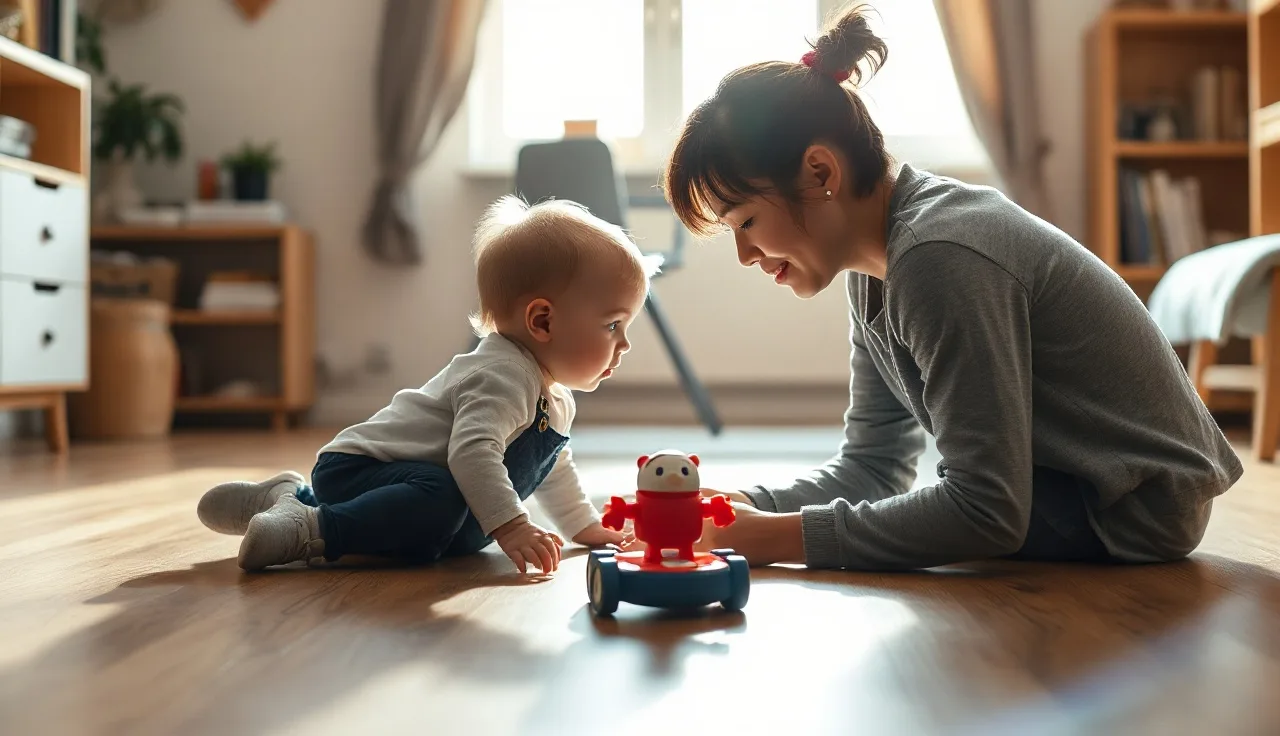
The research is fairly consistent: strategies that follow the child's lead and create natural opportunities to communicate work better than drills, flashcards, or structured question sessions [4]. Here's what that looks like in practice. Follow their interest instead of steering toward yours. Get down on the floor, watch what your child is doing, then join in. Comment on what you see instead of asking questions: "You're stacking the red one" lands better than "What color is that?" Questions put kids on the spot; comments invite them in. Build in small communication temptations. Put a favorite toy just out of reach, open a snack bag partway and hand it over, pause a video at a good moment. These work because they give the child a genuine reason to communicate instead of a test to pass [4]: there's actually something to say. Get face to face. Positioning matters more than most parents realize. At eye level, a child can make eye contact more easily, read your expression, and feel like the exchange runs both ways. Sit on the floor, face them across a small table, hold interesting objects near your face so their gaze lands near your mouth and eyes. Ease off the pressure to perform. "Say ball" prompts produce compliance, not communication, so they shouldn't be your main strategy. A child who says "ball" because you told them to isn't doing the same thing as a child who says "ball" because they want you to know where it went. Try narrating your own actions with no expectation of a reply, sometimes called parallel play or sportscasting: "I'm pouring the water. Now I'm stirring." Kids who hear rich language in these low-pressure moments absorb it over time [5]. It rarely looks like it's working at first, which is why a lot of parents quit too soon. And imitate your child. It sounds backwards, but copying their sounds, actions, and play is one of the strongest ways to build joint attention and back-and-forth exchange. When you copy them, they notice, then repeat it, then you copy again, and suddenly you have a conversation with no words in it yet.
Why play does so much of the work
Play isn't extra credit here. It's the main setting where 3-year-olds build language. The AAP's 2018 clinical report on play stated that "play is so important to optimal child development that it has been recognized by the United Nations High Commission for Human Rights as a right of every child" [6].
Play does several jobs at once. It builds shared attention, which everything else depends on. It repeats words and phrases in a real context, over and over. And it puts the child in the expert's seat, which lowers anxiety and raises motivation to keep going.
Some kinds of play earn their keep more than others. Pretend play, cooking, caring for dolls, playing store, gives kids a script for back-and-forth conversation. Cause-and-effect toys like pop-up toys, simple puzzles, and bubbles create a natural opening every time something happens, a chance to comment, request, or react. Books with repetition, like "Brown Bear" or "The Very Hungry Caterpillar," use predictable patterns kids can fill in themselves, a low-pressure way to produce language. And rough-and-tumble or sensory play, tickling, chasing, jumping on cushions, gets kids fired up and laughing, which is a great state for connecting.
What doesn't help much: solo tablet time, background TV, and any activity where the adult does most of the talking. It's the back-and-forth, the serve-and-return, that builds communication. A 2018 study in Psychological Science found that conversational turns between adults and children, not adult word exposure alone, predicted children's language and brain development [5].
What about AAC or picture systems?
Augmentative and alternative communication (AAC) isn't a last resort, and you don't need to wait until speech fails to try it. It's a genuine communication tool that can support speech rather than replace it.
Many parents worry AAC will make a child lazy or kill their drive to talk, but the research doesn't support that fear. A systematic review in the Journal of Speech, Language, and Hearing Research found no evidence that AAC suppresses speech, and several studies found it supports speech production instead [7].
For a 3-year-old with low communication interest, a simple picture exchange system, a low-tech board, or a speech-generating device can take a lot of the frustration out of the equation. When a child manages to get a message across successfully, they're motivated to do it again, and that cycle of success building motivation, and motivation driving more attempts, is what eventually builds speech.
In practice this might mean a small laminated board with pictures of favorite items, posted in the rooms where they're needed, or an AAC app on a shared device. What matters most is that every attempt, verbal or not, gets a consistent response. For a fuller look at the options, AAC devices covers this in more detail.
If your child is relying mostly on AAC or has very limited speech, it's worth knowing that early intervention services through your state's Part C program offer free evaluations and therapy for kids under 3, with Part B taking over once they turn 3.
How much does screen time affect a 3-year-old's communication interest?
Anyone who gives you a clean answer here is oversimplifying. The AAP recommends capping entertainment screen time for kids ages 2 to 5 at one hour a day of high-quality programming, watched together with a parent when possible [8]. That guidance exists because passive screen time crowds out back-and-forth, and back-and-forth is what drives language along.
One number worth knowing: background TV, even when children aren't watching it directly, cuts conversational turns between parents and children by about 20 percent, according to a study published in Archives of Pediatrics and Adolescent Medicine [9]. Conversational turns are one of the best predictors of language outcomes we have.
Screen time with an engaged adult next to the child is a different animal from passive solo viewing. Watching a show together, pausing to ask "what do you think happens next?", or acting out scenes afterward turns media into a tool for communication instead of a stand-in for it.
If your 3-year-old is obsessed with one show or character, use it. Favorite media gives you a shared reference point and a built-in motivator. The goal is building a bridge from the screen into real interaction, not treating every minute of screen time as poison.
When should I be worried about my 3-year-old's communication?
There's a difference between developing slowly and showing signs that call for a professional look, and a few things at age 3 are worth acting on quickly. ASHA lists these as reasons to seek a speech-language evaluation at or by age 3 [1]: fewer than 200 words, not putting 2 to 3 words together on their own, strangers understanding them less than half the time, no interest in interacting with other children or adults, and regression, meaning the loss of words or skills they used to have.
That last one deserves prompt evaluation rather than a wait-and-see approach. Losing language a child already had can tie to autism, neurological conditions, or serious stress, and it needs professional attention.
If your gut says something is off, trust it. Parents catch things developmental checklists miss, and a "wait and see" from a pediatrician is sometimes right and sometimes not. You can request a speech-language evaluation through your school district (free, under IDEA Part B) or through a private SLP, and the two aren't mutually exclusive; our speech therapy speech therapist article walks through that process in more detail.
What role does joint attention play, and how do you build it?
Joint attention is the shared focus on an object or event between two people: a child points at a dog, then looks back at you to make sure you saw it too. It sounds small. It isn't. Joint attention usually shows up between 9 and 18 months and is one of the strongest early predictors of later language and social communication [11]. Children who struggle with it, as many autistic children do, often need targeted support to build it.
The good news is that it responds to practice. Point at something interesting, look at your child, and say nothing for a beat. See if they look at what you're pointing at and then back at you. When they do, respond big: you just completed a joint attention cycle. You can also build shared reference without asking anything of the child, just by narrating together, "oh, look at that truck!" said while you're both watching the same truck.
Cutting competing noise helps too. Joint attention is harder with background sound, a running screen, or twenty toys dumped out at once, and a quieter, simpler space makes it easier for a child to tune into you. It also helps to imitate their focus: if your child is fascinated by water dripping, get interested in the water dripping too. Enter their world before you try to pull them into yours.
For a child with ongoing joint attention difficulty, a speech-language pathologist can assess whether it's part of a broader communication profile that needs more targeted work.
How does a speech-language pathologist help a 3-year-old who doesn't want to communicate?
A good speech-language pathologist doesn't sit a reluctant 3-year-old at a table and drill them with flashcards. That gets compliance, not communication, and most experienced SLPs left that approach behind long ago. Evaluation and therapy at this age happen mostly through play: the SLP watches how the child plays, what grabs their interest, how they start and respond to interaction, and what communication strategies (gestures included) they already use. That paints a fuller picture than a standardized test alone.
Therapy then targets the specific gap. For a child with low communicative intent, the SLP might work on joint attention and social engagement first. For a child who wants to communicate but can't, the focus might shift to motor planning or articulation. For a child with comprehension trouble, they build understanding before output.
Parent coaching is a big part of modern pediatric speech therapy, because research keeps showing that kids move faster when strategies are worked into daily routines at home rather than practiced in one 45-minute session a week [4]. A good SLP teaches you what to do, rather than having you wait in the lobby while they work with your child alone.
You can find a licensed SLP through the ASHA ProFind directory at asha.org, and if in-person access is limited, online speech therapy is a real option; the evidence for telehealth-delivered pediatric speech therapy keeps growing.
Are there daily routines that naturally build communication in 3-year-olds?
Yes, and they beat special "communication sessions" carved out separately, since they happen more often and in real contexts. Mealtimes are among the richest: food motivates, back-and-forth is built in, and kids have real things to ask for (more, no, that one). Offering choices works better than open questions: "do you want the red cup or the blue cup?" is easier to answer than "what do you want?" while still asking for communication.
Bath time works well too, since water play is sensory, predictable, and fun, and a repeating routine (same songs, same steps) hands children a script they can join, which builds confidence. Dressing offers the same kind of opportunity: give choices, then pause before you pull the shirt on. That pause isn't passive, it's an invitation, giving them a moment to try communicating before you do it for them.
Car rides and stroller walks can loosen up quieter children, since sitting side by side sometimes feels less pressured than face to face. Comment on what you pass, then wait and see what comes back. Bedtime routines help too: reading aloud, letting a child point at pictures, asking them to find things in the illustrations, leaving a pause at the end of a familiar sentence for them to fill in. All of it is low-pressure, high-warmth practice.
If your child uses any AAC tool, these same routines are the best place to model it: pick it up, point to a symbol, say the word, put it back. No pressure on the child to copy, just modeling. Consistent modeling over weeks and months is how AAC becomes functional.
Can apps like Little Words actually help? They can, if you treat them as one piece of a bigger plan rather than the whole plan. Purpose-built communication apps differ from general entertainment apps in one important way: they give kids structured, repeatable chances to practice communication in a format that feels like play, modeling language through characters or themes a child already loves, and giving parents a framework and real-time guidance to work with. That matters a lot when weekly sessions with a speech-language pathologist aren't realistic. But no app replaces human interaction or professional therapy, and it shouldn't try to. Little Words was built for neurodivergent kids and late talkers, with a focus on weaving communication habits into daily life through activities parents lead themselves. If you're waiting on an evaluation or just trying to figure out what to do next, the quiz at /start takes about three minutes and gives you a personalized plan based on where your child's communication stands right now. Be wary of anything promising specific word counts by a specific date, apps designed mainly for passive watching, or tools that market themselves as a stand-in for a qualified SLP. The technology works as a scaffold, not a solution. It's worth being clear-eyed about the difference between a late talker and a child with a language disorder, because the label changes what you should do next. A late talker is a child whose expressive language (what they actually say) lags behind their age while everything else, understanding, social skills, play, thinking, looks on track. Somewhere around 10 to 15 percent of 2-year-olds fit this description, and most of them, an estimated 70 to 80 percent, catch up on their own by age 4 or 5 without any formal help. These are the kids people mean when they say "late bloomer." A language disorder is different: it doesn't resolve on its own, because it's a persistent difficulty with language that isn't explained by anything else, and time alone won't fix it. Developmental language disorder (DLD) affects roughly 7 percent of children and can follow someone into adulthood without support [2]. It's one of the most common developmental conditions of childhood, and one of the least talked about. The hard part is that at age 3, there's usually no reliable way to tell which one you're dealing with. That's precisely why watching closely and getting support early matters so much. Every bit of research on early intervention points the same way: earlier help means better outcomes, and waiting rarely helps and sometimes costs you. If you're also seeing echolalia, where a child repeats phrases they've heard instead of generating their own words, bring it up with an SLP. It isn't automatically concerning, but understanding what's driving it changes your response, and the echolalia meaning article goes into that in more depth.Questions parents ask most
My 3-year-old understands everything I say but won't talk much. Is that a problem?
Maybe not. Strong understanding paired with limited talking is common, and plenty of these kids turn out to be late bloomers who catch up by 4 or 5. But there's a real difference between "won't talk" and "can't talk," and a speech-language evaluation tells you which one you're facing. If expressive language is well below where it should be, get support now rather than waiting to see what happens.
How many words should a 3-year-old be saying?
ASHA puts the typical range at 200 to 1,000 words, with sentences of 4 to 5 words. That's a wide range, and it's normal. What matters more is whether the vocabulary is growing, whether the child is putting words together, and whether they're communicating with intent. A child with 150 words who's clearly trying to connect is in a completely different place than one with 150 words and no real drive to interact.
Can I teach my 3-year-old to communicate at home without a speech therapist?
You can do quite a lot. Follow your child's lead, build in small moments where they need to ask for something, narrate your everyday routines, and back off the pressure to perform on command. Research on parent-led early intervention shows these approaches genuinely work. Still, a speech-language pathologist can pinpoint the specific barriers your child is running into and build a plan around them. Home efforts and professional support work best together, not as one instead of the other.
What if my 3-year-old only communicates through behavior, like tantrums or grabbing?
That's still communication, just without words attached. Behavior fills the gap when language isn't reliably available yet. The goal isn't to stop the behavior but to hand the child a better tool alongside it. Once they have a working way to ask for what they want, the tantrums and grabbing tend to fade on their own. AAC tools, simple picture boards, and steady SLP support all help make that shift happen.
Does watching shows like Bluey or Sesame Street help with communication?
Good children's programming can support language development, but only when watched together with an adult who talks about what's happening and asks questions. Watching alone does much less. The AAP recommends capping high-quality screen time at one hour a day for kids 2 to 5, ideally with a caregiver watching alongside them. Treat the show as something to talk about together, not a substitute for interaction.
How do I know if my child needs AAC?
If your child keeps trying to communicate and it keeps not landing, if frustration is building, or if their current words and gestures just aren't enough, AAC is worth looking into. An SLP can run a formal assessment. Research consistently shows AAC doesn't hold speech back and often helps it along, and there's no word count you need to hit first.
My child used to talk more and has gotten quieter. Should I be worried?
Yes. Losing language or social skills a child already had is a genuine red flag, and it calls for a prompt evaluation rather than a wait-and-see approach. Regression can be linked to autism, neurological conditions, illness, or significant stress. Call your pediatrician and ask for a speech-language evaluation. If your child is under 3, your state's early intervention program can provide one for free.
What's a communication temptation and how do I use one?
It's a setup that gives your child a real reason to communicate. Put a favorite toy just out of reach. Hand them a container they can't open alone. Pause mid-game and wait. None of this is a trick, it just creates genuine need. The child has something actual to ask for or react to, and that pulls more language out of them than quizzing ever will.
How long does it take to see improvement in a 3-year-old's communication interest?
That depends entirely on what's behind the low interest to begin with. Some kids respond to small environmental changes within a few weeks. Kids with an underlying language disorder or autism often need months of steady support before you see real movement. Research on parent-led early intervention (Roberts & Kaiser, 2011) found measurable gains within a few months of consistent practice.
Is speech therapy free for 3-year-olds?
It can be. Under the Individuals with Disabilities Education Act (IDEA), qualifying children ages 3 to 5 are entitled to free speech-language services through their local school district under Part B, though an evaluation comes first. Some states offer additional programs on top of that. Private therapy isn't free, but insurance may cover part of it. Start by contacting your local school district's special education office to request an evaluation.
How do I get my 3-year-old to communicate with other kids instead of just adults?
Talking with peers develops later than talking with adults and draws on different skills entirely. Parallel play, where kids play near each other rather than directly together, is completely normal at 3. You can support it by setting up shared activities with just one other child instead of a group, narrating what's happening ("Mia has the truck, and now she's giving it to you"), and keeping playdates short. Pushing a child to interact on cue usually backfires.
What's the difference between a language delay and autism at age 3?
A language delay affects what a child says or understands but leaves the rest of their development, including social connection and play, largely intact. Autism involves broader differences in social communication: less joint attention, atypical play, strong restricted interests, sometimes sensory differences, alongside whatever language differences are present. Telling the two apart matters because the interventions differ, and only a qualified professional can make that call. A speech-language evaluation combined with a developmental pediatrician's assessment gives the clearest picture.
Sources
- American Speech-Language-Hearing Association (ASHA), Speech and Language Developmental Milestones: Typical 3-year-olds use 200 to 1,000 words, produce 4 to 5-word sentences, and are understood by strangers about 75 percent of the time
- CDC, Developmental Disabilities: About 7.5 percent of children under 5 have a communication or language disorder; developmental language disorder affects approximately 7 percent of children
- CDC, Hearing Loss in Children: Around 2 to 3 per 1,000 newborns are born with significant hearing loss, and more develop it in early childhood
- Roberts, M.Y. & Kaiser, A.P. (2011). The effectiveness of parent-implemented language interventions. American Journal of Speech-Language Pathology, 20(3), 180-199: Parent-implemented, play-based strategies following the child's lead improve early language outcomes; communication temptations and naturalistic teaching produce stronger results than structured drills, with measurable gains within a few months
- Romeo, R.R. et al. (2018). Beyond the 30-million-word gap. Psychological Science, 29(5), 700-710: Conversational turns between adults and children, not adult word exposure alone, predicted children's language development and brain activity in Broca's area
- American Academy of Pediatrics, The Power of Play: A Pediatric Role in Enhancing Development in Young Children (2018): "Play is so important to optimal child development that it has been recognized by the United Nations High Commission for Human Rights as a right of every child"
- Millar, D.C., Light, J.C., & Schlosser, R.W. (2006). The impact of AAC intervention on speech production in individuals with developmental disabilities. Journal of Speech, Language, and Hearing Research, 49(2), 248-264: A systematic review found no evidence that AAC suppresses speech development; several studies found AAC supports speech production
- American Academy of Pediatrics, Media and Young Minds (2016 policy statement): AAP recommends limiting entertainment screen time for ages 2 to 5 to one hour per day of high-quality programming, with co-viewing when possible
- Christakis, D.A. et al. (2009). Audible television and decreased adult words, infant vocalizations, and conversational turns. Archives of Pediatrics and Adolescent Medicine, 163(6), 554-558: Background TV reduces conversational turns between parents and children by approximately 20 percent
- IDEA, Individuals with Disabilities Education Act, 20 U.S.C. Section 1400 et seq.: Under IDEA Part B, children ages 3 to 5 who qualify are entitled to free speech-language services through their local school district
- Tager-Flusberg, H. & Kasari, C. (2013). Minimally verbal school-aged children with autism spectrum disorder. Autism Research, 6(6), 468-478: Joint attention is a strong early predictor of later language development and social communication outcomes in young children
- Yoder, P. & Stone, W. (2006). A randomized comparison of PECS and PROMPT for children with autism. Journal of Autism and Developmental Disorders, 36(3), 395-409: Communication interventions that increase successful communication attempts build communicative motivation and support speech development