Last updated 2026-07-11
Call your pediatrician or dial 1-800-CDC-INFO and ask for a referral to a pediatric audiologist. Most toddlers can get a complete evaluation in one 60 to 90 minute visit, using visual reinforcement audiometry and tympanometry. And if your child is under 3 and you suspect a delay, you don't even need a doctor's order: Early Intervention (Part C of IDEA) can arrange a free hearing evaluation on its own.
Speech delays are the most common reason parents end up in an audiology clinic in the first place. Before anyone labels it a language problem or a processing problem, someone needs to confirm the child can actually hear what people are saying. A toddler who misses high-frequency sounds misses the consonants that carry meaning, and their speech comes out sounding like a puzzle with pieces gone.
The American Academy of Pediatrics recommends that any child who fails a newborn hearing screen, misses speech milestones, or shows a sudden change in language development get a full diagnostic hearing evaluation right away, not another quick office check with a noisemaker [1]. That recommendation exists because informal checks miss a lot. A child can turn toward a slamming door and still have moderate high-frequency loss that wrecks speech perception.
Other reasons to get evaluated include recurrent ear infections (three or more in six months), a family history of childhood hearing loss, suspected autism, a speech therapy provider who says progress is slower than expected, or simply your own gut feeling that something's off. That last one counts on its own. Pediatric audiologists see kids referred for every one of these reasons daily, and you don't need a diagnosis or certainty first. Concern is enough.
Who should actually do the testing?
A licensed audiologist performs diagnostic hearing evaluations, not a hearing aid dispenser, a school nurse, or a pediatrician with a handheld otoscope. Most hold a doctoral degree, since the Doctor of Audiology (Au.D.) has been the entry-level clinical degree in the United States since 2007 [2].
For toddlers specifically, look for a pediatric audiologist who works mostly with children under five. Testing this age group takes specialized equipment and real practice reading responses from kids who are tired, wiggly, or non-verbal, and plenty of general audiology practices don't test children under three at all. The American Speech-Language-Hearing Association (ASHA) keeps a searchable directory of certified audiologists through its ProFind tool [2], filterable by specialty and zip code. Children's hospitals with ENT departments almost always have a dedicated pediatric audiology team, and university audiology training clinics are worth checking too since they often have shorter waits than private practice.
When you call to book, ask directly whether they evaluate children under age three and whether they have visual reinforcement audiometry equipment. If they hesitate or say they mostly see adults, keep dialing.
Getting the referral
Start with your pediatrician and ask specifically for a referral to a pediatric audiologist for a diagnostic hearing evaluation, not a screening. That distinction matters once insurance gets involved.
If your child is under three, there's a second path that skips the pediatrician entirely. The Individuals with Disabilities Education Act (IDEA), Part C, requires every state to provide free early intervention evaluations to children under 36 months who may have developmental delays [3], and hearing is part of that evaluation. You can self-refer to your state's Early Intervention program with no doctor's order needed. Find your state's program through the Center for Parent Information and Resources or by calling 1-800-695-0285 [10].
Medicaid covers diagnostic hearing evaluations for children under 21 through the Early and Periodic Screening, Diagnostic, and Treatment (EPSDT) benefit, with no cost-sharing [4], so if your child is on Medicaid, coverage is essentially guaranteed regardless of how the referral happens.
Private insurance is less predictable. Most plans cover diagnostic audiology when a physician orders it under the medical benefit, but some require prior authorization first. Call the number on your insurance card and ask exactly this: is a diagnostic audiological evaluation covered when a pediatrician refers for speech delay concerns? Get the representative's name and note the date of the call.
If your pediatrician resists the referral, ask them to document in the chart that a hearing evaluation was requested and declined. That tends to end the resistance quickly.
What the testing actually involves
A complete pediatric hearing battery for a toddler usually has four parts, and while they don't always happen in a single visit, a good clinic covers all of them.
Otoscopy comes first: the audiologist looks in the ear canal with a light to check for wax, fluid, or anything structural that could throw off the rest of the testing. Takes about two minutes. Tympanometry follows, testing how well the middle ear and eardrum move by changing the pressure in the ear canal slightly and measuring the response. It catches fluid behind the eardrum, the kind that comes with ear infections, even when the ear looks fine from the outside. Painless, roughly 30 seconds per ear, and acoustic reflex testing often happens at the same time.
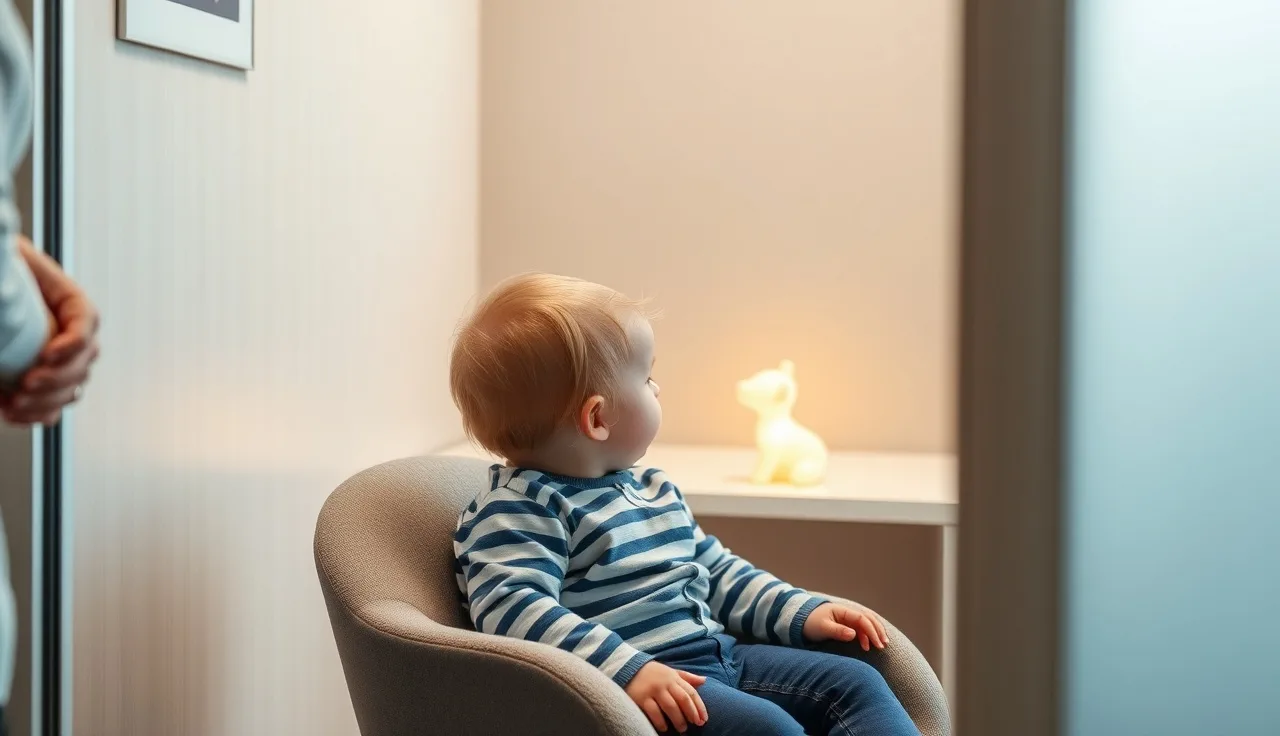
Visual Reinforcement Audiometry (VRA) is the main behavioral hearing test for children roughly six months to three years old [5]. The child sits in a chair, a sound plays from a speaker at a set frequency and volume, and when the child turns toward it, a lighted toy activates as a reward. The audiologist lowers the volume until finding the softest sound the child reliably responds to (the threshold), building a frequency-by-frequency map of what the child can and can't hear. It takes some conditioning to work, so certain kids need a warm-up period.
Auditory Brainstem Response (ABR) testing, sometimes called BAER, measures the brain's electrical response to sound through electrodes on the scalp. It needs no behavioral response at all, which makes it the gold standard for children who can't cooperate with VRA or for confirming VRA results [9]. It runs while the child sleeps or is sedated, and many clinics do natural-sleep ABR for toddlers, asking parents to keep the child awake beforehand so they doze off in the booth. Sedated ABR is reserved for children who genuinely can't finish the test awake.
Otoacoustic Emissions (OAE) testing is common too, measuring a faint echo the healthy inner ear makes in response to sound. A probe sits at the ear canal entrance for about 30 seconds. OAEs offer a quick check of outer hair cell function, show up in newborn screening, and still earn a place in a full diagnostic battery.
Not every child needs every test. A cooperative two-year-old with clean VRA results and normal tympanograms may skip ABR entirely, while a child who can't condition to VRA will need it.
What to expect on the day
Plan for 60 to 90 minutes for a complete evaluation. Some clinics split it into two visits: one for tympanometry and OAEs, a second for behavioral testing once they know what they're working with.
Bring a snack, a comfort toy, and one small favorite toy you can hand to the audiologist for VRA. They'll probably ask you to sit quietly in the booth so the child looks toward the speakers rather than at your face. It feels strange, but do it anyway. It matters for accurate results.
Bring records too: the newborn hearing screen result if you have it, any documentation of ear infections or tubes, and a one-page summary of your speech concerns. Audiologists see a lot of families in a day, and a short written note helps them get up to speed fast.
If the child is too tired or sick to cooperate on the scheduled day, call ahead and reschedule. A bad test day just gives you results that don't match reality, and you'll end up coming back anyway.
Once testing wraps up, the audiologist should go over the audiogram with you before you leave. Ask for a printed copy, ask what the results mean for speech perception specifically, ask whether any frequencies fall in the range that affects hearing consonants, and ask what happens next if anything lands outside normal limits.
Making sense of the results
Hearing thresholds are measured in decibels hearing level (dB HL), and ASHA sorts them into standard categories[2]: normal is 0 to 15, slight is 16 to 25, mild is 26 to 40, moderate is 41 to 55, moderately severe is 56 to 70, severe is 71 to 90, and profound is 91 and above.
| Category | Threshold range (dB HL) |
|---|---|
| Normal | 0 to 15 |
| Slight | 16 to 25 |
| Mild | 26 to 40 |
| Moderate | 41 to 55 |
| Moderately severe | 56 to 70 |
| Severe | 71 to 90 |
| Profound | 91+ |
Many audiologists hold young children to a stricter standard than that, flagging anything above 15 dB HL in one or more frequencies as worth a closer look. Kids learn language in noisy, imperfect rooms, so even a slight loss gets magnified in effect by distance, background chatter, and classroom acoustics.
Any degree of hearing loss usually leads to a referral to a pediatric ENT and a conversation about whether hearing aids or other amplification make sense. Mild to moderate loss now gets fit with hearing aids in infancy as a matter of routine, and conductive loss caused by fluid may call for ear tubes instead.
If hearing comes back normal but the speech delay is still there, the evaluation still did its job: it ruled out the most treatable cause. From there the usual next step is a speech-language evaluation, and it's worth reading up on how speech therapy works and what early intervention looks like for toddlers under three.
Sometimes results are ambiguous or incomplete, maybe the child wouldn't cooperate, or something asymmetric needs a second look. That usually means a follow-up ABR, and it's a normal part of the process, not a failed test.
What it actually costs
Costs swing hard depending on where you go and what insurance you carry. Children on Medicaid get diagnostic audiology covered with no out-of-pocket cost through the EPSDT benefit[4], which makes Medicaid the best payer for this service by a wide margin.
Children under three who qualify for Early Intervention under IDEA Part C get the evaluation itself for free, regardless of income or insurance[3]. It's a legal entitlement. Services that follow, like hearing aids or speech therapy through EI, may carry sliding-scale fees depending on your state, but the evaluation itself doesn't.
With private insurance, a diagnostic evaluation with a physician referral is usually billed under the medical benefit, so your deductible and coinsurance apply. Out-of-pocket costs after insurance tend to land somewhere between $0 and $250 at in-network providers, though high-deductible plans push that higher. A sedated ABR costs considerably more, since it requires an anesthesia team and almost always comes with a hospital facility fee.
Without insurance, cash-pay rates at private practices typically run $200 to $600 for a full evaluation[6]. University training clinics charge less, sometimes just $50 to $150, since supervised graduate students do much of the testing under a licensed audiologist.
Hearing aids are their own separate cost. Medicaid must cover them for children, but private insurance coverage is uneven and depends a lot on state law.
What if my child won't sit still for the test?
Pediatric audiologists deal with this constantly, and a good clinic already has a plan for it. VRA generally works once a child is at least six months developmentally and can make a controlled head turn, which covers most toddlers. There's a short conditioning phase at the start that teaches the child the game, and a skilled audiologist can pull usable thresholds out of plenty of two-year-olds who seemed impossible at first.
If a child truly can't get through behavioral testing, ABR is the backup plan. Natural-sleep ABR comes first: keep the child awake on the drive over, let them fall asleep in the booth, and testing happens while they sleep. If sleep doesn't come naturally, a sedated ABR gets scheduled. Nobody takes sedating a toddler lightly, but it's a better outcome than years of not knowing whether a child can hear.
One incomplete visit is common, and there's no shame in it. Two is less common. By the third try with a patient, experienced team, most kids come away with usable results.
How hearing loss and speech delay connect
Hearing loss is one of the most common, and most treatable, causes of speech delay. About 1 to 3 of every 1,000 newborns is born with permanent hearing loss, which makes it the most common condition caught through universal newborn screening[7]. But permanent, congenital loss is only part of the story.
Conductive hearing loss from chronic middle ear fluid (otitis media with effusion) is extremely common in toddlers, and it tends to come and go. A child might hear fine one week and everything sounds muffled for two months after an ear infection. The National Institute on Deafness and Other Communication Disorders estimates that 75 percent of children have had at least one ear infection by age three[8]. When fluid lingers, it reduces the auditory input a child gets right when language is being built.
A child who spent six months with hearing that switched on and off while phonemes, words, and grammar patterns were forming is going to sound different from a child who heard everything clearly the whole time. That gap isn't permanent, but the speech-language system has some catching up to do, and knowing the cause sooner means you can start addressing it sooner.
If speech delay is already a concern, it's worth looking into early intervention and talking with a speech therapist who works with toddlers. When autism might be part of the picture, our guide to autism spectrum speech therapy covers what's different about that path, and if what you're seeing looks like severe, inconsistent sound errors, it's worth reading about apraxia of speech as well.
How this differs from the newborn hearing screen
The hearing screen most hospitals run at birth is a pass/fail check, not a diagnostic test. It uses OAEs or ABR to see whether a baby's auditory system produces the expected response. Passing means the child passed that day's screen: it doesn't mean hearing loss will never develop, and it won't catch anything progressive or late-onset.
According to the CDC's Early Hearing Detection and Intervention (EHDI) data, about 1.7 per 1,000 babies who pass the newborn screen go on to develop hearing loss by school age[7]. Loss can show up at any point in childhood, from genetics, illness, noise, or causes nobody ever identifies.
A full diagnostic evaluation checks specific frequencies (250 Hz to 8,000 Hz is the standard range), tests each ear separately, looks at middle ear mechanics, and measures the auditory response at the brainstem. It produces an audiogram, a precise map of what the child actually hears. The newborn screen produces none of that.
So if your pediatrician mentions that your baby passed their newborn screen, that's not a reason to skip a later evaluation. The two tests answer different questions at different points in a child's development.
Good questions to ask the audiologist afterward
Walk in with a list, since these are the questions that actually shape what happens next. Ask for the audiogram in writing and have the audiologist walk you through each frequency, including what normal looks like on that chart and where your child's results fall.
Ask whether the results explain the speech pattern you've noticed. A good pediatric audiologist will connect what they found to the communication concern that brought you in in the first place.
Ask about the speech banana, the informal name for the area of the audiogram where speech sounds fall (roughly 250 to 6,000 Hz, between 20 and 60 dB HL). Whether your child's thresholds land inside or outside that zone tells you a lot about the real impact on language learning.
Ask whether the results are complete, or whether follow-up testing is recommended, and if so, which test and on what timeline. Ask whether an ENT referral makes sense and why, whether a speech-language evaluation is warranted, and whether they can send a written summary to the SLP.
Finally, ask what you can do at home before any follow-up appointment. Audiologists don't always volunteer this, but most have practical suggestions, like cutting background noise, talking at close range, and positioning yourself so a child with hearing trouble gets the best possible shot at catching the words.
Can Little Words or similar tools help while you're waiting for an evaluation?
Depending on where you live, a pediatric audiology appointment can take weeks or months to get on the calendar. That wait is real, and it's hard to just sit with it doing nothing.
Some families use the time to start keeping notes. A simple communication diary works well: what words or sounds your child uses, which situations they seem to hear well in versus miss, whether they startle to sounds, whether they lock onto your face when you talk. That record turns out to be genuinely useful both at the audiology appointment and at any speech evaluation that follows.
If your child has already been tested and has confirmed normal hearing along with a speech delay, this is a good time to work on speech at home. Little Words was built for that: an AI-powered speech companion that helps parents support communication between therapy sessions, with activities matched to where a child actually is rather than where a chart says they should be. Taking the quiz will tell you whether it fits your child's current level.
For children with hearing loss, the order changes. Amplification and auditory access need to come first, and home speech activities without that piece in place won't do much. Get that sorted with the audiologist before adding anything on top.
Frequently asked questions
Can I take my toddler directly to an audiologist without a pediatrician referral?
In most states, yes, you can self-refer to an audiologist. Your insurance may still require a physician's order for the visit to be covered under the medical benefit, so call your plan first. If your child is under three, you can also self-refer to your state's Early Intervention program, which arranges an evaluation at no cost regardless of insurance.
What age can a child be reliably tested for hearing?
Hearing can be evaluated at any age, including at birth. Newborns are tested with ABR or OAEs in the hospital. For behavioral testing, Visual Reinforcement Audiometry becomes reliable around six months developmental age. Conditioned Play Audiometry, where the child does a task like dropping a block in response to a sound, usually starts around two to three years. A skilled pediatric audiologist can get usable results from virtually any age.
My toddler passed the newborn hearing screen. Do I still need an evaluation if they have a speech delay?
Yes. The newborn screen catches hearing loss present at birth, but loss can develop or worsen afterward. Progressive genetic loss, damage from illness, and chronic middle ear fluid causing conductive loss are all common childhood causes the newborn screen wouldn't catch. ASHA and the AAP both recommend a full diagnostic evaluation for any child with unexplained speech or language delay, regardless of newborn screen results.
Is a full hearing evaluation covered by insurance for a toddler?
For children on Medicaid, yes, coverage is required with no cost-sharing under the EPSDT benefit. For private insurance, diagnostic audiological evaluations with a physician referral are usually covered under the medical benefit, subject to your deductible. For children under three, Early Intervention evaluations are always free under federal law. Without insurance, expect $200 to $600 out of pocket at a private clinic, less at a university training program.
How long does a toddler hearing evaluation take?
A full battery usually takes 60 to 90 minutes in one visit, though some clinics split it across two appointments. If the child needs a natural-sleep ABR, plan for two to three hours including the wait for the child to fall asleep. Sedated ABR is a separate hospital procedure with its own scheduling, usually several weeks out depending on anesthesia availability.
What is Visual Reinforcement Audiometry and does it hurt?
Visual Reinforcement Audiometry (VRA) is painless. Sounds play from speakers in a sound-treated booth, and when the child turns toward a sound, a lighted or animated toy activates as a reward. The audiologist adjusts volume to find the softest sound the child reliably answers. Most toddlers find the lighted toys engaging enough to play along, and the behavioral testing portion usually takes 20 to 40 minutes.
What is the difference between a hearing screening and a hearing evaluation?
A screening is pass/fail and checks whether responses fall above or below a set threshold, usually at a single intensity, and takes five to ten minutes. A diagnostic evaluation tests specific thresholds at multiple frequencies in each ear separately, tests middle ear function, and often includes brainstem response testing. It produces an audiogram with detailed information. A failed screening should always lead to a full diagnostic evaluation, not another screening.
What happens if my toddler is found to have hearing loss?
The audiologist explains the type (conductive, sensorineural, or mixed), degree, and configuration of the loss and refers to a pediatric ENT. For conductive loss from fluid, ear tubes are often recommended. For sensorineural loss, hearing aids can be fit on infants and toddlers and work well when started early. Early Intervention services can support families through amplification and language development. The earlier amplification begins, the better the language outcomes.
Should my child also see a speech-language pathologist if we're getting a hearing evaluation?
Often both. Audiology rules out or identifies hearing loss as a factor, while a speech-language pathologist evaluates language and speech sound production. These are separate and complementary, and many children with speech delays need both, with results from one informing the other. If your child is under three, Early Intervention can coordinate both under one intake. For older toddlers, ask your pediatrician for referrals to both at once.
How do I find a pediatric audiologist near me?
ASHA's ProFind directory lets you search for certified audiologists by specialty and location. Children's hospitals and university medical centers almost always have pediatric audiology departments, and your state's Early Intervention program keeps a provider list too. When you call any clinic, confirm they see children under three and have Visual Reinforcement Audiometry equipment before you book.
Can hearing loss cause a child to appear to have autism?
Significant hearing loss in early childhood can produce behaviors that look like autism, including limited eye contact during communication, delayed or absent spoken language, social withdrawal, and repetitive behaviors when communication attempts fail. That's why ruling out hearing loss is a standard first step in any autism evaluation. The two can also co-occur, so a normal hearing result doesn't rule out autism, but it's useful information either way.
What should I bring to my toddler's audiological evaluation?
Bring the newborn hearing screen results if you have them, any records of ear infections or ear tube surgeries, insurance cards, and a written summary of your concerns with the specific behaviors you've noticed. Bring a familiar comfort item and a small favorite toy the audiologist can use during testing. If the appointment involves natural-sleep ABR, keep the child awake on the way to the clinic so they sleep during testing.
What if my toddler won't sit still or cooperate during the hearing test?
Pediatric audiologists are trained for exactly this. Most clinics get usable results even from active, resistant toddlers through the VRA game structure. If behavioral testing truly can't be completed, ABR testing (which needs no behavioral response) is the alternative. Natural-sleep ABR is scheduled for children who can fall asleep in the clinic, while sedated ABR is reserved for children who need the test but can't complete it awake or naturally asleep.
How often should a child with a history of ear infections have their hearing checked?
The American Academy of Pediatrics recommends a hearing evaluation after any significant or persistent ear infection history, especially with three or more infections in six months or middle ear fluid lasting three months or more. After ear tube placement, a follow-up hearing evaluation is standard. Children with frequent infections during the language-learning years (ages one to three) benefit from more frequent monitoring even after infections resolve.
Where to start: if a hearing test seems overdue, you don't need a referral to get one. You can call your state's Early Intervention program directly, or ask your pediatrician for a referral to an audiologist, whichever feels faster. A few things are worth knowing before you make that call. Kids who pass their newborn hearing screen aren't guaranteed clear hearing for life: about 1.7 per 1,000 who pass that first screen go on to develop hearing loss by school age, and 1 to 3 per 1,000 newborns overall have some form of permanent hearing loss (CDC, Early Hearing Detection and Intervention (EHDI) program data). Ear infections are part of this picture too. The National Institute on Deafness and Other Communication Disorders (NIDCD), ear infections fact sheet puts the number at 75 percent of children having at least one by age three, and fluid from repeated infections can affect hearing temporarily. The American Academy of Pediatrics, Hearing Assessment in Infants and Children policy statement recommends a full diagnostic evaluation for any child who failed a newborn screen, is missing speech milestones, or has had a sudden change in language. If your child is under three, you don't need to wait for a doctor's referral at all. Under IDEA Part C, states must provide free evaluations and services to children under 36 months with suspected delays, and families can self-refer (U.S. Department of Education, IDEA Part C Early Intervention Program overview). The easiest way in is often through the Center for Parent Information and Resources, Early Intervention overview, or by calling 1-800-695-0285. For the actual test, look for an audiologist rather than a general hearing screener. Au.D. has been the standard clinical degree since 2007, and ASHA keeps a searchable directory if you're not sure who's nearby (American Speech-Language-Hearing Association (ASHA), Audiology Information Series and ProFind directory). For children roughly six months to three years old, the standard approach is Visual Reinforcement Audiometry, where the child turns toward sound paired with a visual reward (ASHA, Visual Reinforcement Audiometry clinical resource). If a child can't cooperate with behavioral testing at all, audiologists turn to Auditory Brainstem Response testing instead: scalp electrodes measure the brain's electrical response to sound directly, no behavior required, which makes it the gold standard for the youngest or least cooperative kids (ASHA, Auditory Brainstem Response testing clinical resource). Cost shouldn't be the thing that stops you. If your child is on Medicaid, EPSDT covers diagnostic hearing evaluations for anyone under 21 with no cost-sharing required (Centers for Medicare and Medicaid Services, EPSDT benefit overview). Paying out of pocket at a private practice usually runs $200 to $600 for a full evaluation, though university training clinics tend to charge less (American Academy of Audiology, patient resources on hearing evaluation costs). This article is for general information and isn't a substitute for advice from your child's own doctor or audiologist.