Last updated 2026-07-11
TL;DR
Nonverbal children can make real choices using eye gaze, reaching, picture boards, gestures, or AAC devices. Offer just two clear options, wait 5 to 10 seconds, and accept any consistent signal as a valid answer. A child doesn't need speech to have a preference, and most families see progress within weeks once the method fits the child's motor and sensory profile.
Choice-making isn't a bonus skill you get to once the basics are covered. It's one of the earliest building blocks of communication, and research consistently shows that giving nonspeaking children control over their environment reduces challenging behavior, increases engagement, and builds motivation to communicate more.[1] A child who can't yet say "I want the red cup" can still point at it, look at it, or touch a picture of it, and get the same result.
The American Speech-Language-Hearing Association (ASHA) describes choice-making as a core part of functional communication and a natural entry point into augmentative and alternative communication (AAC) systems.[2] That framing matters, because it means practicing choices counts as real communication therapy, not just something nice to do during snack time. For autistic children, kids with apraxia of speech, or children with complex communication needs, the road to spoken words often runs through non-speech communication first. When a child learns that their signal means something and that adults will act on it, that's the foundation later language gets built on. Our overview of early intervention covers the research on why acting early on communication changes long-term outcomes.
A choice can look like any consistent, intentional signal, and it's your job to catch it and respond. Most people picture pointing and talking, but for a nonverbal or minimally verbal child, the signal might be a glance, a reach, or a single sound repeated in the same way each time. Common signals include eye gaze (looking at one option, then the other, then back to the preferred one), reaching or touching an object or picture, a gesture the family has learned to read, a vocalization that consistently shows up with a preference, or pressing a button on a speech-generating device or app. None of these is a lesser form of communication. They're all real answers, and research on supported communication[3] and natural aided language input[4] is clear that any reliable, repeatable signal deserves a full response from the adult: say the word, hand over the item, treat it exactly as you'd treat spoken language.
If you're not sure whether your child's signals are intentional, watch for consistency (they do it more than once in similar situations), directionality (the signal points toward something specific), and persistence (they repeat it when you don't respond right away). Those three together are strong evidence of intentional communication, even without a word spoken.
Start with two options, not more
This isn't arbitrary. Working memory and processing speed vary enormously among children with complex communication needs, and a field full of options is genuinely harder to parse than a simple either-or.[5] Two choices keeps the cognitive load low, makes the array visually cleaner, and gives the child a 50% shot at success on the first try, which matters more for motivation than people expect.
Once your child reliably chooses between two items across three or four different contexts, you can add a third. Most speech-language pathologists wait until the child shows consistent, unprompted choices with two options for a couple of weeks across different settings and people before expanding.
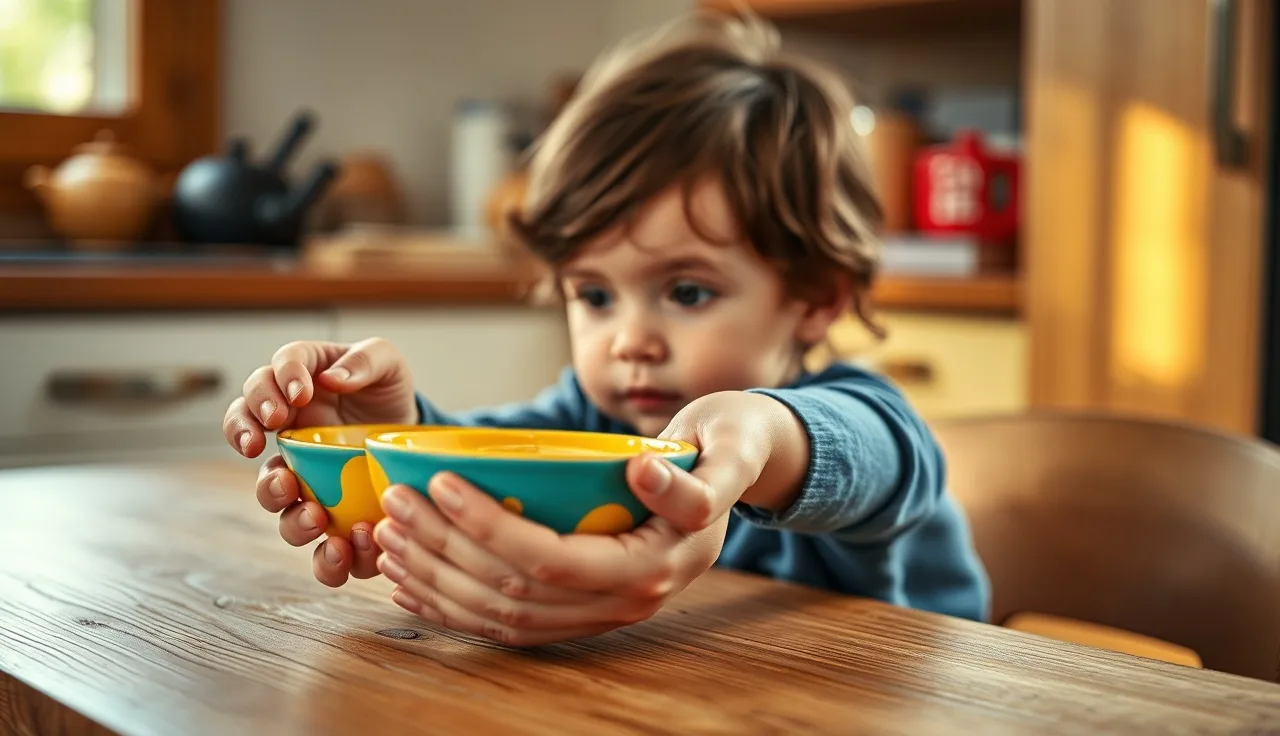
A few structural habits make two-choice arrays work better: hold both items at the same height so gravity doesn't bias the reach, alternate which side each item appears on so a side preference doesn't get mistaken for a real choice, keep the items visually distinct (especially important for kids with low vision), name each option out loud as you present it, and pause before presenting so the child can settle before scanning.
| Rule | Why it helps |
|---|---|
| Hold items at the same height | Prevents gravity from biasing the reach |
| Alternate which side each item appears on | Prevents side preferences from looking like choices |
| Make items visually distinct | Reduces confusion, especially for kids with low vision |
| Name each option as you present it | Pairs the label with the item every time |
| Wait before presenting | Lets the child settle before scanning |
For children who rely on eye gaze, positioning matters even more. Some kids need the items held slightly apart at eye level; others do better with items on a flat surface where they can shift gaze without tracking a moving hand.
Give it more time than feels natural
Most adults wait about one or two seconds before repeating themselves, adding more information, or moving on. That's far too short for many nonspeaking children, especially those with motor planning difficulties like childhood apraxia of speech or those who simply process language more slowly.
Research on response latency suggests 5 to 10 seconds is a reasonable starting point for children with complex communication needs, and some kids need even longer.[6] This is sometimes called expectant waiting, and your body language matters as much as the silence itself: look at your child with a calm, expectant expression, lean in slightly, and resist filling the quiet. What you're communicating during that pause is simple: I think you have an answer, and I'm going to wait for it.
If nothing comes after 10 seconds, repeat the offer, model it by touching one item yourself, or accept a partial signal like a gaze flicker and treat it as the answer. What you shouldn't do is answer for the child or move on as though the moment never happened. That teaches them their timing doesn't matter, which undoes the whole point.
Pictures, objects, eye gaze, or a device: which one to use
It depends on the child, and a good SLP will look at motor skills, vision, cognitive profile, and sensory sensitivities before recommending a starting method.
Real objects work best early on, for children with significant cognitive delays alongside their language delay, or for kids who respond better to touch than to symbols. Hold up an apple and a cracker; the child touches the one they want. No symbol system needed.
Photographs and picture symbols (like those used in PECS, the Picture Exchange Communication System) are the most common choice in school settings. A 2010 systematic review in the American Journal of Speech-Language Pathology found evidence that PECS improves communication outcomes for autistic children, though the review noted the evidence base was small and mixed in quality.[7] Pictures are cheaper and easier to carry around than a device, but they need a symbol library and consistent training for everyone involved.
Eye gaze suits children with significant motor limitations who can't easily reach or touch. A low-tech eye gaze frame (two pictures in a cardboard frame with a hole in the middle to look through) costs next to nothing, while high-tech eye gaze systems can run $8,000 to $15,000 or more. The low-tech version is a perfectly legitimate place to start. AAC devices and apps sit at the highest-access, highest-cost end of things; our article on AAC devices breaks down options by cost and feature. Many insurance plans cover a dedicated speech-generating device when an SLP prescribes it, usually through Medicaid or private insurance with a letter of medical necessity. For families who want an app-based bridge while waiting on a full device assessment, Little Words offers a quiz that matches your child to tools and strategies based on their current communication profile.
None of these methods rules out the others. Most children with complex communication needs end up using more than one, depending on the setting and who they're talking to.
What is natural aided language input and why does it matter for choice-making?
Natural aided language input (NaALI, sometimes called aided language stimulation) means the adult models AAC while talking, instead of just saying "Do you want juice or water?" you touch the juice symbol and the water symbol on your child's board as you name each one.[4]
This matters a lot for choice-making because kids learn symbol systems the same way they learn spoken words, by watching people use them. If a child never sees an adult touch the picture board, they have little reason to believe those pictures mean anything.
The research here is genuinely promising. A study published in Augmentative and Alternative Communication found that children whose partners used aided language stimulation showed more diverse AAC use and communicated more often than comparison groups.[8] The sample was small, worth saying plainly, but the mechanism lines up with how language modeling works in typically developing children too.
In practice: keep a copy of your child's communication board within reach. When you ask a choice question, touch the symbols as you say the words, every time, even before your child starts using the board themselves. Especially before.
How do you build choice-making into daily routines?
Working choices into routines you already have beats setting aside separate "practice" sessions. You want dozens of real choice moments a day, not five structured trials.
They show up everywhere once you look: which shirt, which cereal, which cup, which video in the morning; which snack, where to sit, which spoon at mealtime; which toy or game, going first or watching first during play; which towel, book, or stuffed animal at bedtime; walking or being carried, shoes or coat first during transitions.
None of these are trivial. They're high-motivation moments where the child actually has something at stake, and that stake is what drives a clear response. A child who genuinely wants the red cup over the blue one will signal far more clearly than one asked to pick between two flashcards they don't care about.
One rule worth following strictly: only offer choices you're willing to honor. If you ask "bath now or in five minutes," you need to actually wait the five minutes if that's what gets picked. Overriding a choice teaches a child that choosing doesn't work, and makes the next offer harder to trust.
What if the child always picks the same thing, or doesn't seem to pick at all?
Both patterns come up often and are worth untangling separately.
If your child always picks the same option, a few things could be going on. It might be a genuine preference, which is perfectly fine. It could be a positional bias, always the item on the left or right, so try alternating positions and see if the "choice" moves with them. It could be that the child is picking up on your own subtle cueing, like leaning toward the option you expect them to want, so try a neutral posture, or block your line of sight with a book or screen. Or the second option just isn't appealing, so swap it for something else and see what happens.
If your child never seems to pick, or seems passive about it, start with sensory and motor factors. Some kids need more proprioceptive input to initiate a reach. Some have low muscle tone that makes extending an arm costly. Some get overwhelmed by having too much in front of them visually. An occupational therapist can be genuinely useful here, sometimes more than an SLP. Also check whether the options themselves are motivating enough, since a child who doesn't care about either item has no reason to respond. And watch for small signals you might be missing, like a brief eye flick, a slight lean, a change in breathing. Respond to those consistently and build from there.
If nothing shifts after a few weeks of steady effort, that's a reasonable point to bring in a speech-language pathologist who has experience with AAC and complex communication needs. The American Academy of Pediatrics recommends an SLP referral for any child not meeting age-level communication milestones.[9]
How do you get a teacher, grandparent, or other caregiver on board?
This is where a lot of home programs quietly fall apart. A child might make reliable choices with one parent and then go quiet at school or with grandparents, simply because nobody else has been trained on the method, the wait time, or how to respond.
Consistency across the adults in a child's life is probably the single biggest factor in how quickly new communication skills generalize. A 2015 review in Language, Speech, and Hearing Services in Schools found that AAC interventions with explicit partner training produced significantly better outcomes than those without.[10]
A short training checklist works well here. Show the other adult your child's specific method, whether that's a device, a board, eye gaze, or gesture. Demonstrate the wait time by literally counting to ten out loud a few times so they feel how long it actually is. Explain what counts as a choice and what the right response looks like. Practice together before they try it solo. Then make a one-page reference card and leave it somewhere useful, like the fridge or the school bag.
Teachers and paraeducators can request this kind of training through your child's IEP team. ASHA treats AAC training for communication partners as a legitimate billable service, not an extra.[2] If the school isn't offering it, raise it at the next IEP meeting. Our article on autism spectrum speech therapy covers broader strategies for autism-specific speech supports.
Can choice-making practice actually lead to more speech?
For some children, yes. Not all.
The link between AAC use and speech development has been studied a lot, and the evidence is fairly clear that AAC does not suppress speech. A systematic review in the American Journal of Speech-Language Pathology looked at 24 studies and found that AAC intervention led to improved or maintained speech production in most participants, with no studies showing a decrease.[11]
One leading explanation is that AAC, even a simple picture-choice system, takes pressure off the child. Once a kid knows they can get their needs met through a picture or gesture, the anxiety around trying to talk tends to drop, and some children end up vocalizing more because communication finally feels safe.
That said, not every child with complex communication needs will develop functional speech, and that isn't a failure of the therapy, the child, or the parents. The goal was never speech at all costs, it's communication in whatever form works reliably for that child, and ASHA's position on AAC backs this framing directly.[2]
Choice-making practice builds communication skills either way. Whether speech eventually comes along depends on the child's underlying diagnosis, motor profile, and what's driving the delay in the first place.
What to do today if your child isn't making choices yet
Start simple, and start today. You don't need a device, a professional, or a formal program to begin.
Pick one high-motivation moment, snack time works well for most families. Choose two items your child clearly reacts to differently. Hold one in each hand at eye level, name them, then wait. Watch for any signal at all, and respond to it immediately and warmly.
Do this twice a day for a week, and keep a simple log of what you offered, what signal you saw, and how long you waited. After a week you'll have a much clearer sense of whether your child is showing real preferences, which signals are consistent, and what needs adjusting.
If two weeks pass with no signals at all, or you're noticing regression or a wider pattern of delayed communication, talk to your pediatrician about a referral to a speech-language pathologist. Early intervention services are available at no cost to children under three in most states under the Individuals with Disabilities Education Act (IDEA).[12] Past age three, that obligation shifts to the school district. Our article on early intervention walks through how to access those services.
Families wanting a structured next step alongside professional support can try the short quiz at Little Words (littlewords.ai), which helps identify where a child is in their communication development and what tools might fit.
Most typically developing kids start making simple choices around 12 to 18 months by reaching and looking, and by 24 months they're often putting preferences into words. For children with language delays or complex communication needs, that timeline stretches out, and honestly, age isn't the number that matters. What matters is whether your child has one reliable way to signal a preference in at least a context or two. If they don't have that by 18 to 24 months, bring it up with an SLP. Food works well for choice-making practice precisely because kids have real opinions about it. Use snack time for this constantly. The caution you may have heard about food as reinforcement comes from ABA therapy protocols, which are a different context entirely. Offering two actual food options during a normal meal is fine and backed by research, just be sure your child always gets the item they pick. If your child with autism points clearly and you understand them, don't push picture cards instead. Pointing counts as real communication, and the goal was never a specific system, it's getting the message across. You can layer picture symbols in later to widen the range of things they can choose from, but there's no reason to swap out something that already works. Naturalistic choice-making differs from ABA's discrete trial training in a key way: choices happen inside real activities with real payoffs, and the child's signal gets honored right away. DTT tends to use more structured, controlled conditions with set reinforcement protocols. Both can involve choices, but the naturalistic route puts communication ahead of compliance, and it's the approach most SLPs now favor for early communication work. When a child grabs both options, that's not a failed choice, it's an early one. It tells you they know the items are there and want them badly enough to reach. Try holding items slightly out of reach so a clear reach or gaze becomes necessary, or present one option, wait for a response, then bring out the second. Taking the "grab both" option off the table this way makes preference much easier to read. Eye gaze works too. Plenty of autistic children use it very effectively for choosing, especially when other motor routes are harder for them, and it's worth remembering that reduced eye contact in social situations is a separate thing from functional gaze toward objects. Low-tech eye gaze frames cost next to nothing and SLPs use them all the time. If your child looks longer at one item, or keeps returning their gaze to it, treat that as a real signal and respond to it. Building a low-tech choice board yourself is simple: print or cut out two clear photos or picture symbols, laminate them if you can (a self-laminating pouch runs about a dollar), and add velcro so they stick to a board, folder, or scrap of cardboard. Present two at a time during everyday routines. Skip the commercial kit, a binder ring with a handful of printed photos, used consistently, beats an expensive system gathering dust on a shelf. If a school says your child isn't "ready" for AAC, that's almost never accurate. There's no evidence-based readiness requirement for AAC, and ASHA along with the broader AAC research community has explicitly rejected that idea. Any child with communication needs can benefit from AAC, whether that's pictures or a device. If a school holds AAC back on readiness grounds, you have the right under IDEA to request an independent AAC evaluation. How you phrase the question matters more than you'd think. "Do you want juice?" only calls for yes or no. "Do you want juice or water?" forces an actual choice, which is what you want for practice, since it requires telling two options apart rather than just answering yes or no. Point to or hold up each item as you name it, and keep the phrasing short and repeatable: "Juice or water?" said the same way each time helps the routine sink in. If your nonverbal child melts down instead of choosing, that's usually a sign they know exactly what they want, can't get it across, and the gap is overwhelming them. It's a communication problem wearing a behavior costume. Practice choices during calm, low-demand moments rather than during transitions or already-frustrating situations, so the skill builds while regulation is easy. As a reliable communication method takes hold, meltdowns often ease up, simply because your child no longer has to escalate to be understood. To tell whether a choice signal is intentional or just noise, watch for three things: it happens consistently in similar situations, it points toward something specific, and your child repeats it when you don't respond right away. Random signals fade when ignored; intentional ones get louder or more frequent. It helps to film two or three choice sessions and watch them back at half speed, patterns that are easy to miss live often jump out on video. As for whether home practice is enough or you need a professional: really, it's both. An SLP assessment matters for finding the right method for your child, training you on how to use it, and ruling out anything else affecting communication. But the actual practice happens at home, across the dozens of small choice moments in a day, with parents as the main communication partners. Research backs this up consistently: parent-implemented naturalistic approaches, guided by an SLP, produce real gains. You're not standing in for professional support, you're the biggest part of how it works.Sources
- ASHA, Functional Communication Measures: Choice-making is a core functional communication skill; access to choice reduces challenging behavior and increases engagement in children with complex communication needs.
- ASHA, Augmentative and Alternative Communication (AAC) Practice Portal: ASHA positions AAC, including choice-making with pictures or devices, as appropriate for any child with communication needs regardless of readiness criteria; partner training is a billable service.
- Romski & Sevcik, American Journal of Speech-Language Pathology, 2005: Any reliable, repeatable signal from a child with complex communication needs deserves a full communicative response; AAC does not impede speech development.
- Drager et al., Augmentative and Alternative Communication, 2006: Natural aided language input (aided language stimulation), where partners model AAC use while speaking, increases diverse AAC use and frequency of communication acts in children.
- Reichle, J. et al., Implementing Augmentative and Alternative Communication, ASHA: Starting with two-choice arrays reduces cognitive load and increases successful communication attempts in children with complex communication needs.
- Calculator, S. & Black, T., Language, Speech, and Hearing Services in Schools, 2009: Wait times of 5-10 seconds (expectant waiting) are recommended for children with complex communication needs to allow sufficient processing and motor planning time.
- Flippin, Reszka & Watson, American Journal of Speech-Language Pathology, 2010 (systematic review of PECS): PECS (Picture Exchange Communication System) shows evidence of improving communication outcomes for autistic children; a 2010 systematic review found gains in communication acts across studies, though evidence quality was mixed.
- Sennott, Light & McNaughton, Augmentative and Alternative Communication, 2016: Children whose communication partners used aided language stimulation showed more diverse AAC use and more frequent communication acts than comparison groups.
- American Academy of Pediatrics, Developmental Surveillance and Screening Policy Statement: AAP recommends referral to a speech-language pathologist for any child not meeting age-level communication milestones.
- Kent-Walsh, Murza, Malani & Binger, Language, Speech, and Hearing Services in Schools, 2015: AAC interventions that include explicit communication partner training produce significantly better outcomes than those without partner training.
- Millar, Light & Schlosser, American Journal of Speech-Language Pathology, 2006 (systematic review): A systematic review of 24 studies found AAC intervention resulted in improved or maintained speech production in the majority of participants; no studies showed a decrease in speech.
- U.S. Department of Education, IDEA Part C Early Intervention: Under IDEA Part C, early intervention services including speech-language pathology are available at no cost to families for children under age three with developmental delays.
- Beukelman & Mirenda, Augmentative and Alternative Communication: Supporting Children and Adults with Complex Communication Needs, 4th ed.: Eye gaze is a legitimate primary communication modality; low-tech eye gaze frames are a cost-effective starting point for children with motor limitations.