Last updated 2026-07-11
AAC only helps if it's within reach the second your child wants to say something. In practice that means more than one device or board in the house: something in the kitchen, something in the bedroom, something in the bathroom, something wherever your child plays. A single expensive device sitting on a charger in the living room can't do that job alone. Low-tech backups, boards that always live in the same spot, and a habit of restocking them will get you further than one high-end gadget ever could.
Why placement matters so much
Kids need to communicate all day, not on a schedule. A child who wants a snack at 7 a.m. can't wait while you dig the speech device out from wherever it ended up last night. A child who's upset in the bathroom needs a way to say so right then, not two minutes later once the moment has passed.
The American Speech-Language-Hearing Association's position on AAC is that communication systems should be available "across all environments and activities," and that restricting access limits language learning [1]. That's not a gentle suggestion, it's the clinical standard. Every time a device is locked away, buried in a bag, or stuck charging in one corner of the house, your child loses small chances to communicate, and those add up fast over a day.
Research on aided language stimulation shows kids pick up AAC symbols faster when adults model on the device regularly and in the moment, at breakfast, in the tub, out in the yard [2]. None of that works if the device isn't physically there. And for a lot of late talkers and autistic kids, there's a short window before a communication attempt turns into a meltdown. If the AAC isn't within reach in that window, the chance is gone. This really isn't about convenience. It's about whether the system does what it's supposed to do.
High-tech versus low-tech, and why you probably need both
High-tech AAC means dedicated speech generating devices and tablet apps with voice output. Low-tech AAC means paper boards, picture exchange cards, core word boards, and eye-gaze frames. Most families end up using a mix, and that mix is exactly what determines how you spread things around the house.
High-tech devices are powerful, but they have real limits at home. They need charging. They run anywhere from a few hundred dollars for an app to $6,000-$15,000 for a dedicated speech generating device, and most families only own one [3]. One device can't be in five rooms at the same time, and that's exactly why low-tech backups aren't optional if you want real all-day access.
Low-tech boards, on the other hand, cost almost nothing to print and laminate, so there's no reason not to have ten of them. A waterproof core word board for the bathroom might cost two dollars to make and tapes straight to the wall. A small card set in a plastic sleeve on the fridge costs even less. None of this is a lesser version of "real" AAC. It's the same communication, just in a form that can actually exist everywhere at once. If you're still deciding what kind of system to invest in, it's worth reading about how different AAC devices work and what questions to ask an SLP before you spend money.
The simplest way to think about it: the high-tech device is your richest tool, the one you lean on most. The low-tech boards are the safety net in every room, so a dead battery or a misplaced tablet never shuts down communication entirely.
Setting up stations room by room
Each room tends to call for different words, because each room comes with its own communication demands.
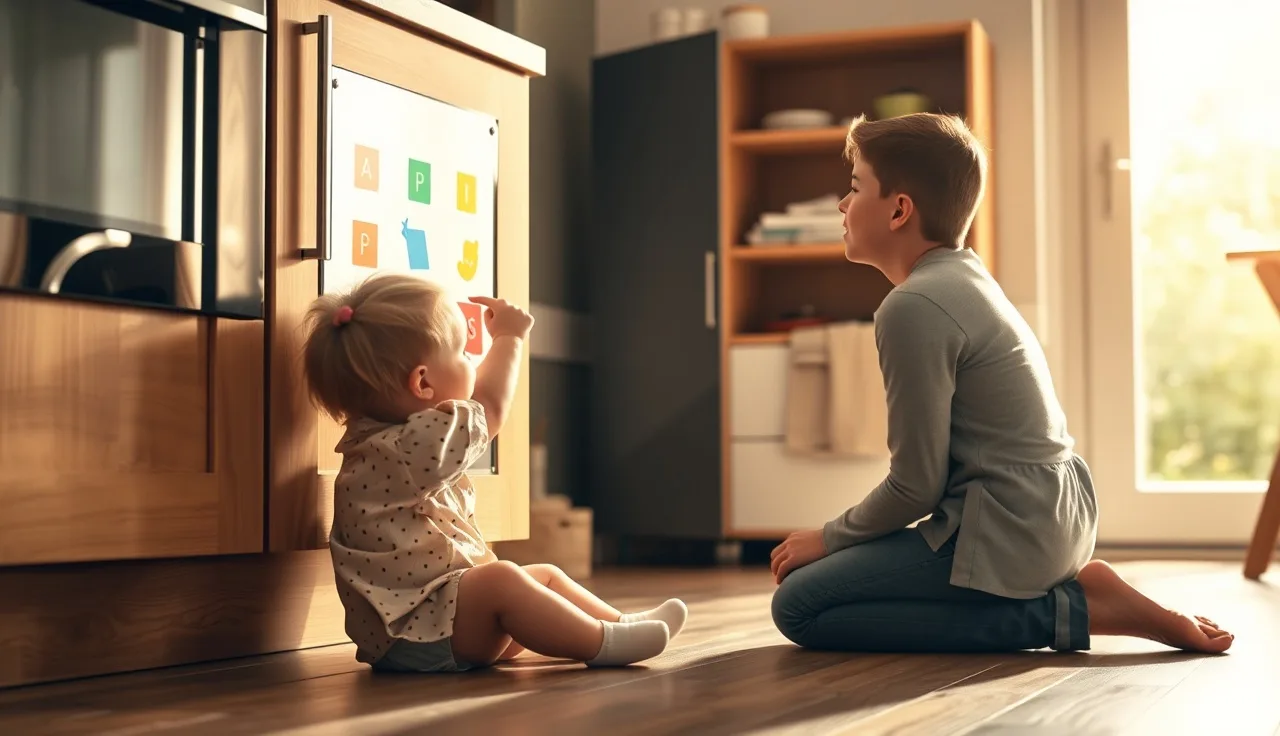
The kitchen and dining area are probably your busiest communication zone: food, drinks, "more," "all done," "I don't want that," often right when a child is already getting frustrated. Mount a core word board at eye level on a cabinet or the fridge. If your child uses a high-tech device, give it a charging spot in the kitchen so it starts the day there. A waterproof first-then board for mealtimes helps too.
In the living room and play area, you're dealing with spontaneous requests: turn on the TV, I want that toy, come here, stop. A portable board in a fixed spot, a small stand on the coffee table or velcroed to a low shelf, works well here, and if your child uses a tablet app, this room often makes sense as its home base during the day.
Bedrooms generate a lot of language too, especially around morning and bedtime: clothes, feelings, book requests, discomfort. A small laminated core board on the nightstand or attached to the headboard covers most of it. Some families clip a mini version of their child's most-used words to the door frame so it's the first thing in view.
The bathroom is the room people forget, and it shouldn't be. Pain, discomfort, hygiene, simple requests, all of it happens here. Tape a waterproof laminated board inside the cabinet door or on the wall at child height, and skip plain paper: it won't survive a week of humidity.
The car counts too, even though it's not a room. A small binder of core pages or a mini PECS set in a seatback pocket keeps communication going once you've left the house, and some families mount a small board right to the headrest in front of their child.
Outside, a laminated board in a ziplock bag by the back door, or clipped near a spot the child passes often, handles play requests and feelings during outdoor time.
Keeping boards from getting lost or ignored
The single biggest factor is keeping the location the same. If a board moves around, kids who rely on predictability just stop looking for it. Pick one spot per room, make it permanent, and use velcro dots, adhesive strips, command hooks, or a small stand to anchor it there. Then leave it alone.
Labeling helps too, not for your child, but for everyone else in the house. A strip of tape that says "AAC board, put it back here" reminds siblings and caregivers that the object has a fixed home.
Boards also need refreshing more often than people expect. One that's been on the wall for two years with the same ten symbols may no longer reflect what your child actually wants to say. Review and update boards with your SLP every three to six months, or the symbols just fade into the background like wallpaper.
If your child throws or chews materials, lamination and binding rings help, and so does mounting boards flat to the wall at a height that's reachable but not easy to pull down. Some families fix boards to the underside of a cabinet at seated eye level for exactly this reason.
One honest note: no system survives if only one adult in the house actually uses it. If one parent consistently offers the AAC and the other doesn't, the child ends up with spotty access. That's worth talking through directly, or raising with your speech therapist if the inconsistency keeps causing friction.
What words belong on a whole-house board
Core vocabulary is the small set of words that make up most of what anyone says, in almost any context. Marvin, Beukelman, and Bilyeu found that roughly 250 to 400 high-frequency words account for about 80% of what typically developing children say in everyday conversation [4]. Think: more, stop, go, help, want, no, yes, that, here, again, big, little, good, bad, mine, done. Fringe vocabulary is the specific stuff tied to context: juice, dog, Minecraft, a sibling's name. Fringe changes from room to room. Core stays the same everywhere, and that's what you should prioritize on a whole-house board. A 36-symbol core board, like one from LAMP Words for Life or a free version from PrAACtical AAC, gives a child what they need to express basic wants and feelings in any room [5]. Add room-specific fringe on a smaller strip beside or below it.
Keep the core words in the same position on every board in the house. If "more" is top left in the kitchen, put it top left in the bedroom too. Motor learning, the idea that the same physical movement should produce the same word every time, is a real part of how kids internalize AAC. Shuffling the layout from room to room undoes that.
| Location | Core vocab priority | Fringe add-ons |
|---|---|---|
| Kitchen | more, want, done, help, no | food names, drink names |
| Living room | go, stop, that, again, good | toy names, show names |
| Bedroom | tired, hurt, want, no, yes | book titles, clothing words |
| Bathroom | help, stop, hurt, done, no | hygiene items |
| Car | go, stop, more, look, help | destination words |
How do I handle the high-tech device when it needs to charge?
This is one of the most common practical snags families run into. The device dies, it goes on the charger in the bedroom or a corner of the kitchen, and for the next two hours the child has no AAC access.
The cleanest fix is a dedicated charging station in the room where your child spends the most quiet-period time, often the living room or kitchen table, plus a hard rule that a low-tech board is always visible in that same spot. Charging should never mean silence.
Some families buy a second tablet just to run the AAC app, so one is always charged and ready. Apps like Proloquo2Go, TouchChat, or Snap Core First run on iPads you can buy refurbished for $150 to $300, far less than a dedicated SGD. This isn't feasible for everyone, but a backup tablet running the same app keeps vocabulary consistent in a way a paper board alone can't match.
If your child's insurance-funded SGD comes with strict rules about backup devices, ask your SLP or the device funding coordinator about it. Some Medicaid-funded devices have provisions around secondary devices, though funding rules vary a lot by state [6].
Set a daily charging routine, ideally overnight while the child sleeps, so the device starts each morning at full battery. Treat it like a phone. You wouldn't let your phone die and just shrug. This device is your child's voice.
What if my child refuses to use AAC in certain rooms?
Figure out what's actually being refused before you try to fix it. Is the child refusing AAC in that room specifically, or refusing to engage in that context at all, regardless of the tool? A child who won't communicate during bath time in any form isn't an AAC problem so much as a routine or sensory issue that shapes how you introduce communication there.
If the refusal is room-specific and the board or device is right there, check a few things. Is the vocabulary on that room's board actually useful for what happens in it? A bathroom board covered in food symbols isn't going to motivate much pointing. Are adults modeling? Research on aided language input consistently shows that children's use of AAC climbs when communication partners model on the same system, at a ratio of multiple adult models per child-expected use [2]. If you're not pointing to symbols during bath time, your child likely won't either.
Also look at whether the board's placement creates a motor barrier. A board mounted on the wall above the tub is out of reach for a child sitting in the water. A board flat on a non-slip mat on the tub's edge, or held by a caregiver, is a different story.
Some children just use AAC more readily in certain rooms for a long stretch of time, and that's fine. Keep the materials present, keep modeling, and don't turn any single communication attempt into a battle. Pressure to use AAC is linked with reduced spontaneous communication in the research literature [7].
How do I get babysitters, grandparents, and teachers using AAC at home too?
The clinical term is communication partner training, and it matters more than people expect. A child whose primary caregiver uses AAC consistently but whose grandparents don't gets patchy access, and patchy access slows learning.
For each person who spends regular time with your child, a short written one-pager works better than a long verbal explanation. It should cover where the AAC materials live in each room, how to offer a choice using the board, and the one non-negotiable rule: model first, don't demand a response.
ASHA's AAC resources for communication partners note that training doesn't need to be formal or long to work [1]. Even 15 minutes showing someone how to point to a symbol while saying the word out loud covers the most important skill.
For school and therapy settings, your child's SLP should be coordinating vocabulary across environments. Ask specifically whether the symbols on the home boards match the school system, since vocabulary mismatch between home and school is a known barrier to AAC generalization [8]. If home boards use one symbol set and school uses a completely different one, the motor patterns and visual recognition your child builds at home won't transfer cleanly.
If your child receives early intervention services, your service coordinator can often set up a conversation between the home and school SLPs about aligning vocabulary.
What does a practical daily AAC accessibility checklist look like?
A short daily habit beats any complicated system. Here's what tends to work, based on what SLPs recommend. In the morning, spend about two minutes confirming the device is charged and sitting in its home-base spot, doing a quick visual scan to make sure boards are in place in the kitchen, living room, and bathroom, and returning any boards that wandered off the day before.
During the day, check that the relevant board or device is reachable before you start a routine like a meal, playtime, or bath, and model at least a few symbols during each one. You don't need to narrate everything: a few clear models per activity is plenty.
In the evening, the device goes on the charger, and the low-tech board stays visible in the bedroom for bedtime communication.
Once a month, check whether the boards are showing wear (reprint if the lamination is peeling), flag any outdated vocabulary for the next SLP visit, and note any new words or topics that need adding.
One app-era option: if you use a tablet-based AAC app, you can also try a companion tool like Little Words that supports vocabulary building at home between therapy sessions, especially for families who want extra modeling prompts.
None of this is meant to add stress. The point is to make access the default state, so you're not scrambling when a communication moment actually arrives.
How do I handle transitions between rooms without losing AAC access?
Transitions are a real friction point. A child walks from the kitchen to the bedroom and the communication board stays behind on the kitchen table. Now there's a gap.
For high-tech devices, a wrist strap, a small crossbody bag, or a mounting bracket on a mobility device (if applicable) lets the device travel with the child. It takes some habit-building, but it's worth it for children who need the device constantly.
For low-tech systems, the answer is usually redundancy: have a board waiting in the destination room so the child is never more than a few feet from communication materials on arrival. The transition itself is brief enough that a small gap is usually manageable.
Some families make a travel board, a small laminated card with 12 to 20 of the most-used core words, that clips to the child's clothing or lives in their pocket. It doesn't replace the full system, but it covers basic wants and feelings during any transition.
Children with apraxia of speech or childhood apraxia of speech often benefit especially from consistent physical access during transitions, since AAC carries some of the motor planning load that verbal communication demands under stress. If motor speech is part of your child's picture, ask your SLP whether an always-present lightweight board makes sense.
The general principle: don't count on any single room to cover all communication. Design the environment so your child never has to wait or search for it.
How much does it cost to set up AAC access throughout the house?
Cost varies a lot depending on whether you're building a low-tech system, a tablet-based system, or distributing a dedicated SGD.
A full low-tech setup across five to six rooms, using printed and laminated boards, runs roughly $20 to $50 total if you print at home and laminate with a basic $25 to $35 laminator. Free printable core boards are available from sources like Boardmaker Share, PrAACtical AAC, and ASHA's resource library [1][5].
A tablet-based AAC app setup runs $150 to $300 for a refurbished iPad plus $100 to $500 for a good AAC app. Proloquo2Go costs around $220 as of this writing, and Snap Core First uses a subscription model around $200 per year [3]. A second backup tablet adds another $150 to $300 if you go that route.
A dedicated SGD funded through insurance or Medicaid can range from roughly $3,000 to over $15,000. The Assistive Technology Act of 2004 (29 U.S.C. § 3001 et seq.) requires each state to maintain an assistive technology program that includes device lending and financing assistance [9], so if cost is a barrier, your state AT program can loan devices before you commit to buying.
Medicaid covers AAC devices as durable medical equipment for eligible children, but coverage rules vary by state and require documentation from an SLP [6].
| Setup type | Estimated cost | Notes |
|---|---|---|
| Low-tech boards only | $20 to $50 | Printable, DIY lamination |
| Tablet + AAC app | $250 to $800 | Refurbished iPad + app |
| Backup tablet setup | Add $150 to $300 | Same app, vocabulary syncs |
| Dedicated SGD (out of pocket) | $3,000 to $15,000+ | Insurance/Medicaid often covers |
| State AT loan program | Free to borrow | See your state's AT Act program |
What does the research actually say about AAC at home?
The evidence is solid on a few specific points and thinner on others, so let's be honest about which is which.
What's well established: when adults model language directly on the AAC device during everyday routines, children show more spontaneous symbol use and faster vocabulary growth [2]. A 2012 study by Drager and colleagues in the American Journal of Speech-Language Pathology found that children with ASD who received this kind of aided input showed significant increases in symbol use compared to children who didn't, and that natural home routines produced better generalization than structured therapy sessions alone [10].
What's less established: there's not much large-scale data on how the number of accessible AAC stations in a house relates to how fast vocabulary grows. Nobody has run a trial comparing a house with two AAC-equipped rooms against one with five. The push for wide access across the house comes from clinical consensus and generalization theory, not one definitive study.
The American Academy of Pediatrics recommends that children with communication differences get AAC as part of a broader communication plan, and specifically notes that what families do between therapy sessions is a key factor in outcomes [11]. That puts home access squarely among the things that determine how well therapy actually works.
Which leads to a simple, practical point: you don't need airtight science to justify a laminated board in every room. The rationale is strong, the cost is low, and there's essentially no downside to having too much access.
Questions parents ask most
How many AAC boards does a house actually need?
Aim for one per high-traffic space: kitchen, living room, bedroom, bathroom, and wherever your child plays most. That usually lands at four to six boards. If your child has a high-tech device, low-tech backups fill in for the rooms it isn't in. Keep the core vocabulary the same across every board so your child builds the same motor patterns no matter where they are.
Can I just use my phone instead of buying a board?
Some families do this as a stopgap, and it can work for a while. The trouble is that phones are small and harder for young kids to hit accurately, they get pulled into other uses so the AAC app gets buried, and the screen isn't designed for high-contrast symbol display. A printed board is simply more dependable as a fixed backup in a room than a phone that travels with you and does five other jobs.
My child ignores the board in their bedroom. Should I take it down?
Leave it up. Check instead whether the words on it match what your child would actually want to say in that room, and whether anyone is modeling on it. Kids often seem to ignore a board for weeks before they suddenly start using it on their own, and pulling it removes the chance for that to happen. If the ignoring is happening everywhere, not just one room, mention it to your SLP. That's more likely a vocabulary mismatch or a modeling issue than a sign to give up on access.
What's a good way to waterproof a board for the bathroom?
Hot lamination with at least 5-mil pouches holds up fine in a humid bathroom, and sealing the edges with clear packing tape afterward adds durability. Adhesive dry-erase lamination sheets work too. Stick the board to the tile with suction-cup hooks or a removable adhesive strip on the back, and expect to reprint and re-laminate every six to twelve months with daily use, once it starts peeling.
Does AAC at home replace speech therapy?
No. It supports therapy, but it isn't a substitute for it. An SLP designs the vocabulary, tracks progress, trains the people around your child, and adjusts the system as your child grows. The American Speech-Language-Hearing Association treats AAC as a clinical specialty that needs professional assessment and ongoing support, and home access just extends what's happening in sessions. It doesn't stand in for that expertise.
How do I get school and home using the same AAC vocabulary?
Ask your child's SLP to coordinate directly with the school SLP on symbol sets and layout, which matters most if your child has an IEP. Ideally the school device and the home boards use the same symbol library and the same physical arrangement, so the motor learning carries over. If there's already a mismatch, ask both SLPs to agree on a shared core word set as a starting point.
Is a toddler too young for AAC?
No. Guidelines support introducing AAC as soon as there's a sign of communication need, with no minimum age. Both the AAP and ASHA advise against waiting, and early AAC use doesn't suppress speech, in fact multiple studies show it has a neutral or positive effect on verbal development. If your child is a late talker or has already been flagged for evaluation, an early intervention referral is the right next move.
Where can I find free AAC core boards to print?
PrAACtical AAC has free downloadable boards, and Boardmaker Share offers community-contributed boards without a subscription. ASHA's website has a section on AAC implementation, and the LAMP Words for Life app has its own resource library. Your state's AT program, required under the Assistive Technology Act of 2004, may also lend devices or provide printed materials at no cost.
Will Medicare or Medicaid cover an AAC device?
Medicaid covers speech-generating devices as durable medical equipment for eligible children, though it requires documentation from an SLP and coverage varies by state. Medicare covers AAC for adults with severe speech impairments under its DME benefit. Both require proof that the device is medically necessary and that the person can't communicate adequately without it. Your state Medicaid office or an AAC funding specialist can walk you through specifics.
My child uses PECS at school. Can we use it at home too?
Yes, and it's worth doing for consistency. PECS (Picture Exchange Communication System) follows a specific protocol, and using the same exchange-based approach at home reinforces what's happening at school. Ask the school SLP which phase your child is currently working on and which vocabulary cards are in use, then replicate that phase and behavior at home. That works better than running a separate system just for home.
What do we do about AAC when traveling?
A small travel set, whether that's a mini binder with 20 to 30 core and fringe cards or a phone loaded with the AAC app, covers most situations, so keep one in your bag by default. For families with a high-tech device, bring the charger and a portable battery for long days out. You can approximate a hotel setup with a mini board tucked in the suitcase, and some families build a travel-specific board with words like airport, restaurant, and hotel.
What if siblings keep grabbing or moving the AAC boards?
Anchor them physically where you can, with velcro, adhesive strips, or mounted frames, so they're harder to casually carry off. For siblings old enough to get it, a simple explanation that this is how their brother or sister talks tends to change the behavior. Something concrete like "this is like his voice, it lives here" lands better with younger kids than a rules-based explanation. Keep spare copies printed so you can swap in a replacement fast when one goes missing.
Should the AAC device stay in the bedroom overnight?
Keep a low-tech board within reach even if the device itself charges elsewhere. Kids need to communicate during nighttime routines, when they wake up upset, and first thing in the morning. A laminated board on the nightstand or headboard costs nothing and covers that overnight gap, without putting a screen in the sleep environment, which most pediatric sleep guidelines advise against anyway.
Sources
- American Speech-Language-Hearing Association (ASHA), AAC Technical Report: AAC systems should be available across all environments and activities; restricting access limits language learning
- Drager, K., et al. (2006). 'The Performance of Typically Developing Children on Aided Language Tasks Using Three Symbol Displays.' Journal of Speech, Language, and Hearing Research. Cited for aided language stimulation increasing symbol use.: Aided language stimulation (adults modeling on the AAC device) increases spontaneous symbol use and vocabulary growth
- AssistiveWare, Proloquo2Go pricing page: Proloquo2Go costs approximately $220; tablet-based AAC apps range from $100 to $500
- Marvin, C., Beukelman, D., & Bilyeu, D. (1994). 'Vocabulary-use patterns in preschool children.' Augmentative and Alternative Communication, 10(4), 224 to 236.: Roughly 250 to 400 high-frequency words account for approximately 80% of what typically developing children say in natural conversation
- PrAACtical AAC, free core board resources: Free printable core boards available for home use from PrAACtical AAC
- Centers for Medicare & Medicaid Services (CMS), Medicaid Durable Medical Equipment coverage: Medicaid covers AAC/SGDs as durable medical equipment for eligible children; coverage rules vary by state and require SLP documentation
- Mirenda, P. (2003). 'Toward Functional Augmentative and Alternative Communication for Students with Autism.' Language, Speech, and Hearing Services in Schools, 34(3), 203 to 211.: Pressure to use AAC is associated with reduced spontaneous communication
- Beukelman, D. & Mirenda, P. (2013). Augmentative and Alternative Communication: Supporting Children and Adults with Complex Communication Needs. (4th ed.): Vocabulary mismatch between home and school is a known barrier to AAC generalization
- Assistive Technology Act of 2004, 29 U.S.C. § 3001 et seq., U.S. Department of Health and Human Services: The Assistive Technology Act requires each state to maintain an AT program including device lending and financing assistance
- Drager, K., et al. (2012). 'Effect of AAC intervention on AAC use, speech, and symbolic gestures.' American Journal of Speech-Language Pathology, 21(2), 101 to 119.: Children with ASD who received aided input showed significant increases in symbol use; naturalistic home routines produced better generalization than structured therapy alone
- American Academy of Pediatrics (AAP), Policy Statement on AAC and Communication Supports: AAP recommends AAC as part of a multimodal communication plan and identifies family implementation between therapy sessions as a key variable in outcomes