Last updated 2026-07-11
You can make sturdy picture cards for four to ten cents apiece using free printable images, a home laminator ($20 to $35), and 5-mil pouches. A full starter setup runs $65 to $102 up front and gets you 300 to 400 cards. If you don't want a machine, self-laminating pouches or clear contact paper both work fine. Cards printed on cardstock and sealed in 5-mil laminate hold up to daily toddler handling for six months to a year.
Why make your own instead of buying a set
A single themed deck of commercial picture cards runs $30 to $80 [1]. Once you're covering several topics and goals, that adds up fast, and plenty of families end up having spent $200 or more only to notice half the cards never leave the box.
Homemade cards do something a store deck simply can't: they show your kid's actual life. A commercial set has a generic sandwich. Your child wants the one from the diner you visit every Friday. So you photograph your house, your dog, your morning routine, and laminate the things your child already recognizes on sight.
There's a reason speech-language pathologists in early intervention lean on personalized materials: familiarity lowers the load of learning to communicate [2]. A child doesn't have to decode an unfamiliar cartoon character. They just see the thing they already know.
This guide assumes a real budget and a printer that jams sometimes, not a laminator you already happen to own.
What you actually need
The short list is a printer, paper, images, and a way to laminate. Everything past that just saves time.
Any inkjet or laser printer works, though laser holds up better under heat since inkjet ink can smear in a hot laminator. If you're stuck with inkjet, print at the highest quality setting and let the page dry ten minutes before laminating. Color is worth it here: young children, and especially autistic children learning to connect images with words, do better with realistic color photos than line drawings [3], though black-and-white is fine for older kids.
Standard 20 lb copy paper works as long as you're laminating, since the laminate itself gives the card its stiffness. If you're skipping lamination and using contact paper instead, print on cardstock (65 lb or heavier) because plain paper won't survive daily handling on its own.
Skip paid clip art entirely; free sources cover this well (more on that below). For lamination, there are four real options, covered in the next section, ranging from an $8 roll of contact paper to a $20 to $35 thermal laminator that'll last years. For cutting, a paper trimmer (about $12 at any office supply store) beats scissors for speed and clean lines, and a rounded-corner punch ($6 to $10) stops the sharp corners that peel and snag. Both are worth buying.
Where to find free images
A handful of genuinely free, high-quality sources cover most of what you'll need, and most SLPs already use them.
Mulberry Symbols (mulberrysymbols.info) is a free, open-licensed symbol set used by AAC practitioners worldwide, with over 3,500 symbols downloadable as PNG files. Snap Core First publishes part of its symbol library too, and PECS-style images circulate freely through teacher communities on Teachers Pay Teachers if you filter for free items only. For personal cards, photos you take yourself are usually the best option: any modern phone camera prints sharp at 3x3 or 4x4 inches without going pixelated. Canva's free tier will build card layouts from your own photos or simple graphics, resize them, and export a PDF, and a 3x3 grid on a letter sheet gives you nine cards per page. Do2Learn (do2learn.com) also has free printable picture cards and communication boards made specifically for children with special needs [10].
Boardmaker symbols are licensed software, but many school districts already own it, and your child's SLP can often print cards for you from that library, so it's worth just asking. Skip anything that demands a subscription to download a single image. Combine Mulberry symbols for common objects with your own photos for personal items, and you can build a 200-card set for nothing.
Comparing the four lamination options
| Method | Upfront cost | Per-card cost | Durability | Best for |
|---|---|---|---|---|
| Thermal laminator machine | $20 to $35 | $0.03 to $0.06 | Excellent | Families making 50+ cards |
| Self-laminating pouches (no machine) | $8 to $15 per 50-pack | $0.16 to $0.30 | Good | Occasional use, no machine |
| Clear contact paper | $7 to $10 per roll | $0.04 to $0.08 | Good | Budget-first option |
| Printable laminate sheets | $12 to $18 per 50-pack | $0.24 to $0.36 | Fair | One-off cards |
Most families land on a thermal laminator after trying the alternatives. Scotch, AmazonBasics, and Fellowes all make models in the $20 to $35 range that take standard 3-mil and 5-mil pouches, and 5-mil is what you want for cards: it's noticeably stiffer and holds up to chewing, water splashes, and being flung across a room far better than 3-mil. A 200-pack of 5-mil letter pouches costs $20 to $25 and yields 400 to 600 cards depending on how you cut, putting lamination alone at roughly $0.04 to $0.06 per card [4].
Self-laminating pouches are peel-and-stick sleeves with no heat involved: slide the card in, peel the backing, fold, press. They work, but the edges tend to lift over time, especially with kids who pick at things, so they're better suited to cards that don't get handled every day. Clear contact paper is the old teacher trick: cut two pieces slightly larger than the card, sandwich the card sticky-side-in, press hard, and trim. It's the cheapest option by total dollars spent, though you'll fight air bubbles and rough edges (dragging a credit card across the surface as you press knocks most bubbles out). Printable laminate sheets run through your printer over an already-printed image and lay down a plastic coat, but results vary wildly by brand, and it's hard to recommend them when contact paper costs less and performs about the same.
Building a workflow that doesn't fall apart
Families who actually keep up a card system work in batches. Making cards one at a time is how the whole project quietly dies.
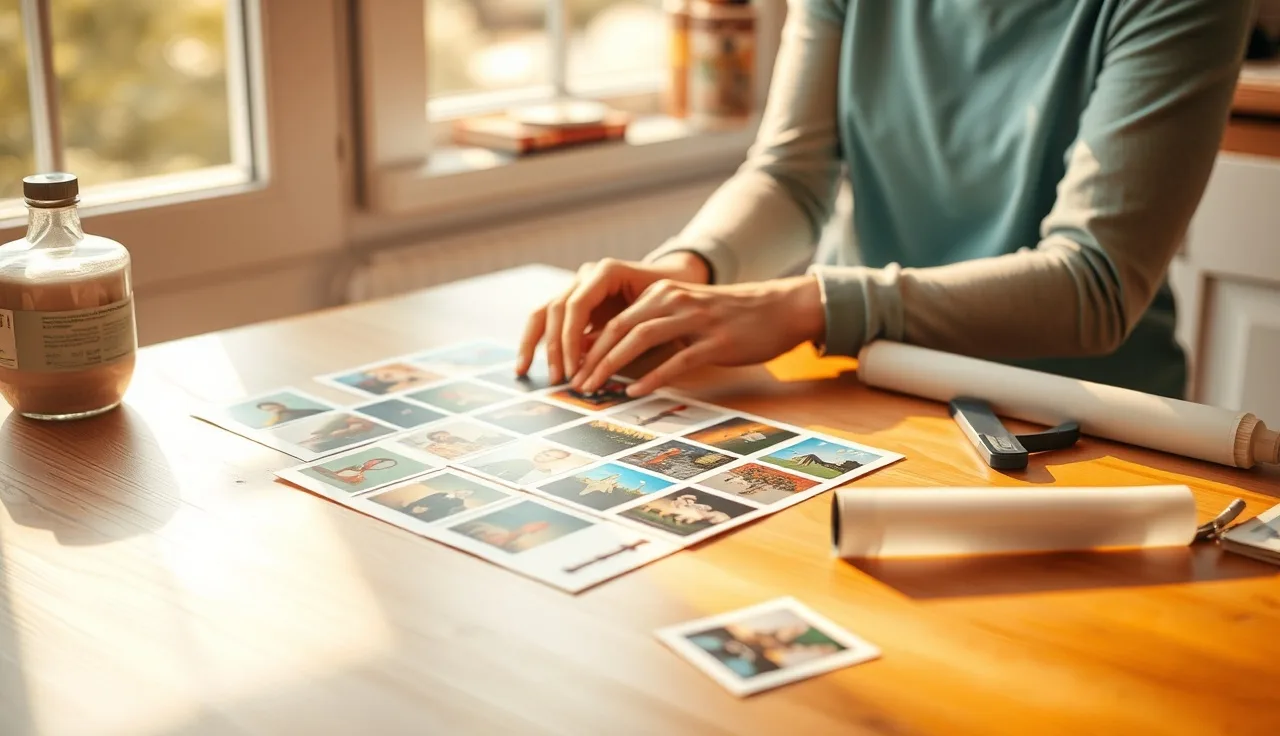
Start by gathering images into one folder, aiming for 20 to 30 before you print anything (printing singles wastes ink, paper, and laminate). Then build a template in Canva, Google Slides, or Word: a grid of equal cells, three columns by three rows for 3x3-inch cards on a letter sheet, with a word label under each image in a plain sans-serif font like Arial or Open Sans, 14 to 18 points. Print on your printer's highest quality setting, and if you're on inkjet, let the pages sit flat for ten minutes before doing anything else.
Cut all the pages with a paper trimmer before laminating, since laminating cut cards instead of full sheets uses less laminate and leaves cleaner edges. Feed cards through one at a time, or if you're running several in one pouch to save pouches, leave half an inch between them, and let everything cool flat (warm cards stacked together curl). Once they're cool, trim the laminated edges down to about a 1/8-inch border, which is the seal that keeps moisture out, then round the corners with a corner punch. That last step is the one people skip and later regret.
Once your setup is in place, a batch of 30 cards takes about 45 minutes.
Keeping cards from getting lost
A beautiful set of cards dumped loose in a bin turns into a shuffled, half-lost pile within a week. How you organize them matters almost as much as how you made them.
Binder rings are probably the most common SLP recommendation: punch a hole in the top-left corner and clip related cards onto a 1-inch binder ring ($3 to $5 per 12-pack), which lets a child flip through independently while categories stay put. Photo albums with 4x6 pockets are another cheap option ($3 to $6 at dollar stores), one card per pocket, wipeable and easy to toss in a bag, and they work well for communication books and PECS-style setups. For first-then boards and choice boards, Velcro is the standard: stick hook Velcro on the back of each card, mount loop Velcro on a painted board or foam strip or piece of fabric, and cards hold for display but peel off easily to hand to a communication partner. And as a simple backup, labeled zip bags by category (food, feelings, places, actions) let you grab the right set fast for a session.
Whichever system you use, keep duplicates of whatever card your child reaches for most. If the "more" card goes missing at dinner, the evening gets a lot harder.
What card size works best for different ages and needs?
There's no single right size, it depends on the child's age, motor skills, and how the cards get used. For toddlers and kids with limited fine motor control, bigger is easier: a 4x4-inch or even 4x6-inch card is graspable without a precise pincer grip, and the image reads at a glance. These suit wall-mounted choice boards and floor-level visual schedules.
For portable communication systems and binder-ring books, 3x3-inch cards are the practical standard. They fit a shirt pocket, print nine per page, and stay large enough for a clear image and word label. Older children working on category sorts and matching often do better with 2x2-inch cards, since you can spread more options across a table without crowding.
If your child uses PECS (Picture Exchange Communication System), standard cards run roughly 2x2 inches for sentence strips, with larger cards for early manding practice [5]. Your SLP can tell you what size fits the current phase of the program.
One practical note: if you're pairing physical cards with an AAC device, match the symbol style across both. Consistent visuals help vocabulary carry over from one context to another.
How durable are homemade laminated cards compared to commercial ones?
Honestly, 5-mil laminated homemade cards match or beat most commercial sets, which usually use thinner lamination. The weak point isn't the laminate, it's a too-thin border, sharp unrounded corners, and low-resolution images. A 5-mil card survives a lot: a brief dunk in water, food wiped across it, a toddler's teeth without tearing, being sat on, even an accidental trip through the washing machine inside a bag. That's real-world tough.
What it doesn't survive is a corner seal peeled up over and over, which kids who stim on edges will do. Rounded corners cut this down a lot, and a thin line of clear nail polish along a peeling edge is a fast repair.
Commercial sets from companies like Stages Learning Materials or Super Duper Publications use cardstock with UV coating or thin lamination. Good, but not indestructible. Their real edge is professional photography and a consistent symbol style, which matters for some children. The downside is zero customization and steep cost per card. For kids in early intervention who need a lot of vocabulary across many categories fast, a hybrid works best: buy one or two commercial sets for core words, then make custom cards for everything personal and specific.
Can you make cards without a printer, using photos or handwriting?
Yes, and for some kids it's the better choice. Real photos printed at a drugstore or grocery photo counter cost about $0.09 to $0.15 per 4x6 print, or $0.25 to $0.35 per 4x4. Shoot on your phone, upload to the store app, pick up prints in an hour, then write the word on the back or on a front sticker and laminate as usual. These cards carry a photographic realism generic symbol sets can't touch, and research in autism communication support suggests real photos improve comprehension for some learners over cartoon symbols [3].
Hand-drawn cards work for quick functional use too, especially for abstract ideas that don't photograph well, like feelings. A clearly drawn "happy" face from a parent is functionally equal to a symbol-set image for a child who sees mom's drawing every morning. Some families use stamps or foam stickers for simple images. Not pretty, but they work. The goal is communication, not art.
If you're supporting a child who uses or is being evaluated for an AAC device, ask the SLP whether physical cards should match the AAC software's symbol set (Tobii Dynavox, PRC-Saltillo, and so on) to keep things consistent across settings.
Are there free or low-cost apps for designing and printing picture cards?
A few tools speed up the design step a lot. Canva (free tier) is the most flexible for parents comfortable with basic design: build one card template, duplicate it, swap images, export a PDF, print. Google Slides has a free template community too; search "picture card template Google Slides" and you'll find dozens of shared decks to copy and customize.
SymbolStix Online and Boardmaker Online are professional SLP tools with subscription costs of $200-plus per year, so a personal subscription rarely pays off, but your district or SLP may already have access and can generate sheets for you [11]. Little Words (littlewords.ai) is an AI speech companion app for neurodivergent kids with visual vocabulary tools that can help you decide which words to target first, worth a look alongside your SLP's guidance when you're prioritizing which cards to make. Avery Design and Print (avery.com) has free templates sized for specific label and card products, some already at cardstock weight.
For speech therapy at home, the design tool matters less than having a clear target list before you start. Ask your child's SLP for 20 to 30 priority words, build those first, and let the rest wait.
What's the total realistic budget to get started?
Here's an honest accounting for a family starting from zero.
| Item | Low estimate | High estimate |
|---|---|---|
| Thermal laminator | $20 | $35 |
| 200-pack 5-mil pouches | $18 | $25 |
| Cardstock (100 sheets) | $8 | $12 |
| Paper trimmer | $10 | $15 |
| Corner punch | $6 | $10 |
| Binder rings (12-pack) | $3 | $5 |
| Total upfront | $65 | $102 |
That kit makes roughly 300 to 400 cards. After the first purchase, each new card costs about $0.08 to $0.12 in consumables (laminate share plus ink plus cardstock), so at 200 cards a year you're looking at about $16 to $24 annually to keep the system growing. If you already own a printer, are willing to use free images, and go the contact paper route instead of buying a laminator, you can make 50 usable cards for under $15 total.
Compare that to a commercial PECS starter kit at roughly $250 to $300 for the manual plus card set [5], or a standard symbol card set at $40 to $80 for 100 to 200 cards [1]. The budget math favors making your own. Buy commercial sets only when time is genuinely gone or when a specific AAC system's symbol-consistency requirement makes custom printing impractical.
What does the research say about picture cards and language development?
Picture cards sit at the center of several evidence-based approaches. They show up most in PECS, which has the strongest evidence base among augmentative communication approaches for nonverbal and minimally verbal children with autism [6]. A 2010 systematic review in the American Journal of Speech-Language Pathology found PECS increased functional communication across multiple studies, though its effect on speech production itself varied [7].
ASHA identifies visual supports, picture cards included, as an evidence-based practice for children with autism spectrum disorder, pointing to their part in supporting comprehension and expressive communication across settings [2]. The American Academy of Pediatrics recommends that children not meeting language milestones be referred for a speech-language evaluation, and that families get support using communication strategies at home while waiting for or receiving services [8]. Picture cards are one of those strategies.
Some parents worry that picture cards or AAC will kill a child's drive to talk. The research doesn't back that fear: ASHA's position is that AAC, including low-tech options like picture cards, does not slow speech development and may support it [2]. As ASHA states plainly in its AAC guidance, "AAC does not impede the development of speech" [11]. That single line answers the concern most parents raise the first time someone suggests picture cards.
If your child is being evaluated or already diagnosed, get a speech-language pathologist involved. Autism spectrum speech therapy and early intervention services can help you build a card system tied to your child's actual communication goals, which beats any generic vocabulary list.
Frequently asked questions
What's the cheapest way to laminate picture cards at home?
Clear contact paper, hands down, roughly $0.04 to $0.08 per card and no machine required. Cut two pieces slightly larger than the card, sandwich the printed card adhesive-side-in, press firmly (a credit card works well for clearing bubbles), then trim the edges. It won't look as polished as machine lamination, but it holds up fine to daily use.
What thickness laminate pouch should I buy?
Go with 5-mil, not 3-mil. Five-mil is noticeably stiffer and stands up to chewing, moisture, and rough handling much better. Three-mil cards bend and crease quickly once a young child starts using them daily. The price difference is small, about $2 to $4 per 100-pack, so the extra durability is worth it.
Can I laminate without a machine?
Yes, two options work well: self-laminating pouches (peel-and-stick, no heat needed) and clear contact paper. Self-laminating pouches run about $0.16 to $0.30 each at office supply stores. Contact paper costs less per card but takes more manual effort to apply neatly. Neither looks quite as clean as a thermal laminator, but both survive regular daily use.
Where can I find free printable picture cards?
Mulberry Symbols (mulberrysymbols.info) offers over 3,500 free open-licensed symbols, and Do2Learn (do2learn.com) has free printable communication cards built for special needs. Teachers Pay Teachers has plenty of free downloads if you filter by price. It's also worth asking your child's SLP or school district, since many have Boardmaker access and can print custom sheets for you.
What size should the cards be?
For toddlers, 4x4 inches is easiest to grasp and see, since limited fine motor control means bigger is better. For portable communication books and binder-ring systems, 3x3 inches is the practical standard and fits nine cards per letter sheet. Older kids doing sorting or matching activities do fine with smaller, 2x2-inch cards at the table.
How long do homemade laminated cards actually last?
With 5-mil pouches, expect six months to over a year of daily use before edges show real wear. Rounding the corners and leaving a full 1/8-inch laminate border around the image both add life, and a peeling edge can be touched up with clear nail polish. Cards stored in a binder or album outlast ones left loose in a drawer or bag.
Will picture cards stop my child from learning to talk?
No. ASHA states directly that AAC, including low-tech picture cards, does not impede speech development and may actually support it by cutting down communication frustration and increasing interaction. Studies on PECS and other visual supports show no negative effect on spoken language. This worry comes up constantly, and the research keeps landing on the same answer.
Photographs or cartoon symbols?
It depends on the child. Some children, particularly those with autism, comprehend real photos more readily than abstract symbols, especially early on, while cartoon symbols become more useful once a child learns to generalize meaning. If you're not sure which fits your child, try both and see which one gets a response, and ask your SLP to help interpret what you see.
How many cards should I start with?
Keep it small: twenty to thirty cards covering the vocabulary your child actually needs each day beats 200 cards nobody can find when it matters. Good starting categories include food and drink your child wants, family members, everyday activities like bath, eat, sleep, and play, and basic feelings. Add more once your child is using the first set consistently.
Can I just use a regular inkjet printer?
Yes. Print at the highest quality setting and let the pages dry for about 10 minutes before laminating, since fresh inkjet ink can smear inside a hot laminator. A laser printer has an edge here, since toner bonds differently and won't smear at all, but either one makes perfectly usable cards.
How do I organize cards so my child can use them independently?
Binder rings are what most SLPs recommend: punch a hole in each card, group related ones on a ring, and hang the rings from a hook or clip. Photo albums with 4x6 pockets work well for communication books. Velcro on a fabric strip or board lets kids peel a card off and hand it to you, which is the standard format for PECS-style exchange.
Is making cards at home worth it compared to buying commercial sets?
For most families, yes. Commercial sets run $40 to $80 for 100 to 200 cards, while homemade cards cost $0.08 to $0.12 each in consumables after a $65 to $100 upfront purchase for a laminator and supplies. The real advantage is customization: cards built around your own home, food, and routines. Plenty of families split the difference, buying commercial sets for core vocabulary and making custom cards for personal items.
Sources
- Super Duper Publications, product catalog (representative commercial card set pricing): Commercial picture card sets typically cost $30 to $80 per themed deck
- American Speech-Language-Hearing Association (ASHA), Autism Spectrum Disorder Evidence Maps: ASHA identifies visual supports including picture cards as evidence-based practice for children with ASD, and states AAC does not impede speech development
- Mirenda, P. (2003). Toward functional augmentative and alternative communication for students with autism. Language, Speech, and Hearing Services in Schools, 34(3), 203-216.: Research in autism communication support suggests real photographs may improve comprehension for some learners compared to cartoon symbols, particularly early in communication development
- Fellowes laminator product specifications and office supply retailer pricing (Amazon, Staples, Office Depot), verified range: Home thermal laminators cost $20 to $35; a 200-pack of 5-mil letter pouches costs $20 to $25, producing material for 400 to 600 cards
- Pyramid Educational Consultants, PECS starter kit pricing and phase descriptions: Standard PECS card size is approximately 2x2 inches for sentence strips; a PECS starter kit costs approximately $250 to $300
- Bondy, A. & Frost, L. (1994). The Picture Exchange Communication System. Focus on Autistic Behavior, 9(3), 1-19. Pyramid Educational Consultants.: PECS has the strongest evidence base among augmentative communication approaches for nonverbal and minimally verbal children with autism
- Flippin, M., Reszka, S., & Watson, L.R. (2010). Effectiveness of the Picture Exchange Communication System (PECS) on communication and speech for children with autism spectrum disorders. American Journal of Speech-Language Pathology, 19(2), 178-195.: A 2010 systematic review found PECS increased functional communication across multiple studies; effect on speech production varied
- American Academy of Pediatrics, Council on Children with Disabilities, language delay guidance: AAP recommends children not meeting language milestones be referred for speech-language evaluation and that families be supported in using communication strategies at home
- Do2Learn, free educational resources for children with special needs: Do2Learn offers free printable picture cards and communication boards specifically designed for children with special needs
- ASHA, Augmentative and Alternative Communication (AAC) practice portal: ASHA practice portal covers evidence-based AAC approaches including low-tech picture-based systems and states AAC does not impede the development of speech