Last updated 2026-07-11
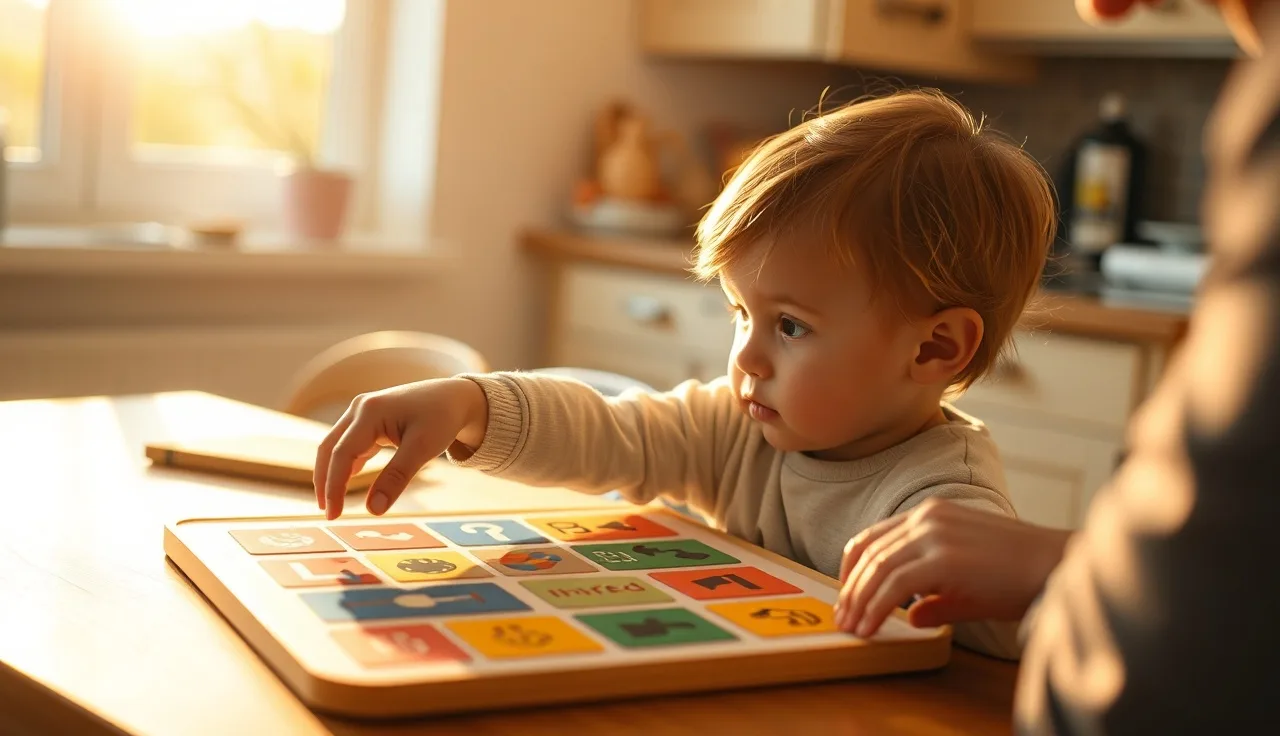
A low-tech communication book is just a printed set of pictures your child points to, hands over, or scans with their eyes to say something without talking. No battery, no screen, just paper. You can put one together in an afternoon with free symbol libraries, a binder, and a laminator. The part that actually matters is organizing it by category, starting with somewhere between 30 and 80 symbols, and showing your child how it works yourself before expecting them to pick it up on their own.
Who actually needs one of these
The word "low-tech" just places it on the wider spectrum of augmentative and alternative communication, or AAC. The American Speech-Language-Hearing Association defines AAC as "all of the ways someone communicates besides talking," and that includes communication books, boards, and picture-based systems as legitimate tools [1]. This isn't a fallback for kids who can't talk. It's a recognized clinical approach in its own right.
Kids who tend to benefit include late talkers who understand far more than they can say, children with autism who are minimally verbal or whose speech is inconsistent, kids with apraxia of speech whose motor control makes word production unreliable, and children who already use an AAC device but need something they can bring to the pool or the sandbox without worrying about water or batteries. Adults use them too, though that's a different design problem than the one this article is about.
If your child gets frustrated trying to communicate, a book is worth trying. It won't slow down their speech. A 2015 systematic review in the American Journal of Speech-Language Pathology found no evidence that AAC use inhibits speech development, and some evidence that it actually supports it [2].
What you'll need to build one
Nothing exotic here. For symbols, you have two main free routes. Boardmaker's library is the clinical standard, but the software isn't free. Most families instead use the Mulberry Symbol Set, an open-source library with more than 3,000 symbols at no cost [3]. Snap Core First's symbol set (SymbolStix) is another option, though you'd be working from screenshots. For anything specific, like your child's own toys, their bed, or the family pet, a photo from your phone often works better than a generic symbol.
For the physical book itself, a 1-inch three-ring binder with tabbed dividers is the classic setup. Some families prefer a spiral-bound flip book made from index cards for something smaller and easier to carry, while others use a zippered pencil pouch with laminated cards on a ring.
Beyond that, you'll want a color printer (symbols read faster in color than black and white), laminating pouches and a laminator or a trip to a local print shop, Velcro strips if you want symbols to be moveable, clear page protectors as a cheaper stand-in for laminating, and tabbed dividers, one per vocabulary category. Total cost usually runs $15 to $40 if you already own a printer and buy a basic laminator, or $20 to $60 if you outsource printing and laminating to a copy shop. You shouldn't need to spend more than that.
Choosing the first words and symbols
This is the decision that determines whether the book actually gets used or ends up in a drawer. Start with core vocabulary rather than category nouns. Core words are the high-frequency words that show up across nearly all communication: "more," "stop," "help," "want," "go," "no," "yes," "I," "you," "look," "like," "don't like," "done," "again." Research on core vocabulary in AAC suggests these 20 to 30 words make up roughly 80 percent of what most people say day to day [4]. They belong on the first page or the cover, somewhere your child can reach quickly every time.
After that, add fringe vocabulary: the specific nouns and topics that matter in your child's actual life, like favorite foods, siblings' names, activities they love, places they go often. A workable starting range is 30 to 80 symbols total. Fewer than that limits what your child can say; more than that can overwhelm a new user who can't find anything. You can always add pages later as their use grows.
Some clinicians organize pages by parts of speech instead of topic, with separate sections for core words, people, actions, feelings, and places. Both approaches work, but the parts-of-speech version tends to produce more flexible language because it nudges kids toward combining words rather than just naming things. Worth asking your speech therapist which they'd prefer, since keeping home and therapy consistent helps.
One trap to avoid: filling the book only with things you want your child to request. Kids also communicate to refuse, comment, ask questions, greet people, and protest. A book that only lets them ask for things starts to feel limiting fast.
Laying out each page
Size and spacing matter more than most people expect. For most children under age eight, symbols should be at least 2 inches by 2 inches per cell; smaller than that and pointing becomes ambiguous. If your child has motor difficulties, such as childhood apraxia of speech affecting hand control, go bigger: 3-inch cells in a 4-per-page grid rather than 9 or 12.
| Grid size | Cells per page | Best for |
|---|---|---|
| 2x2 | 4 | Early beginners, motor challenges |
| 3x3 | 9 | Most preschool-age beginners |
| 4x4 | 16 | Children with established pointing skills |
| 5x5 or 6x6 | 25-36 | More experienced users, older children |
Group related words together on each page, and put the symbols your child will use most in the lower-right corner if they're right-handed (lower-left for lefties), since that's the spot they'll reach for again and again. Color-coding by word type also speeds up scanning. The Fitzgerald Key, a color system common in AAC, uses yellow for people, orange for verbs, green for descriptors, blue for nouns, white for other parts of speech, and pink for social words [5]. You don't have to follow this exact scheme, but pick one and stick with it so your child builds a mental map of where things live. Print the word beneath each symbol, too: even before your child can read, the adults around them can, and eventually the print starts to matter to the child as well.
Putting it together, step by step
Start by listing your vocabulary: 30 to 50 words split between core words and fringe words specific to your child, ideally with input from their speech therapist if they have one. Next, gather symbols, either from the Mulberry Symbol Set or Google Images for simple nouns, and photograph your child's own belongings when a generic symbol won't do.
Build a template in Google Slides, Microsoft Word, or a free tool like Canva, with a consistent grid, symbols pasted in, text labels underneath, and your color-coding applied. Print it in color on standard 8.5 x 11 paper (a 3x3 grid with 2-inch cells fits nine symbols comfortably per page), then laminate the pages, either with a cheap home laminator or by sliding them into heavy-duty page protectors.
Assemble everything in the binder, with core vocabulary on a cardstock insert just inside the front cover so it's always visible when the book is open, and the rest tabbed by category. Then make sure the book actually goes where your child goes: the kitchen table, the backpack, the car seat pocket. Some families keep two copies, one for home and one for school. The whole build takes two to four hours the first time through.
How do you get your child to actually use the communication book?
This is where most books fail, and it's rarely because the book itself was built wrong. It's because nobody modeled it.
Modeling (sometimes called aided language stimulation) means pointing to symbols in the book while you talk, throughout the day, without asking your child to do anything back [6]. Say "want more?" and touch the "want" and "more" symbols at the same time. Say "all done" at the end of a meal and point to "done." Do it over and over. Research suggests kids need to see a symbol used many times before they'll reach for it themselves, with estimates ranging from 20 to over 100 exposures depending on the child. Resist the urge to guide your child's hand to a symbol, especially if they haven't shown any interest in touching it on their own. That kind of full physical prompting can chip away at a child's sense of agency. Point yourself and wait instead, longer than feels natural. Ten seconds is not too long.
Introduce the book during activities your child already loves, snack time, a favorite game, a show they're obsessed with. "Want," "more," "stop," and the name of the show will get used because those are the moments you're practicing in.
If your child receives early intervention services, ask the team to use the same layout and vocabulary in sessions. Consistency across settings speeds things up considerably.
Give it six to twelve weeks before expecting reliable independent use. Some kids pick it up faster, some take longer, and both are normal. It doesn't mean the book is wrong for your child.
What free tools and symbol sets can you use to make symbols?
A few standouts worth knowing about. The Mulberry Symbol Set offers over 3,000 open-source symbols under a Creative Commons license, downloadable individually or in bulk, and the quality holds up; these are the symbols behind many open-source AAC apps [3]. Global Symbols is a nonprofit that gathers several sets, including Mulberry and Tawasol Symbols, into one searchable, free download site. Do2Learn has free printable communication boards and symbol sets, particularly useful for social skills and routine cards.
Don't overlook Google Images and a printer: fine for real objects, especially anything specific to your child's life. A photo of their actual cup gets the message across faster than any clip art ever will. Canva's free tier lets you build grids, add text, and export to PDF. It isn't built for AAC, but it's flexible enough to work well. And Boardmaker Share, the community site tied to Boardmaker, has thousands of pre-made boards you can download with a free account, no paid license required.
One caution: mixing symbol sets on a single page (some Mulberry, some SymbolStix, some photos) tends to look inconsistent. Not a disaster, but worth avoiding within the same page.
How is a communication book different from an AAC device or app?
It comes down to output, durability, and cost. A dedicated AAC device speaks aloud through a speaker when a button is pressed; a communication book makes no sound at all. That gap matters sometimes. A child touching symbols in a book still needs a partner watching closely to catch the message, while a device broadcasts it out loud, which works at a distance and asks less interpretation of the listener.
On durability and cost, the book wins easily. A full high-tech AAC device runs $6,000 to $12,000 or more without insurance, while a communication book can be built for under $50. Books don't run out of battery, don't need a case, and don't cause a small crisis when they hit the floor.
Most speech therapists suggest starting with a low-tech book, or running one alongside device work. If a child is trialing a device, the book is the backup. If insurance approval is stuck in prior authorization, the book is the bridge in the meantime. Some kids use both indefinitely, just reaching for whichever is closer.
Research doesn't show one format beating the other for language development. The best format is whichever one your child actually uses consistently [2]. And if you're also exploring autism spectrum speech therapy, your therapist will likely weigh in on this decision too.
Can a communication book work for a child who already uses some words?
Yes, and it's an option a lot of families overlook. Children who speak in single words or short phrases often have a much bigger expressive vocabulary available to them when they can point instead of say. A child might reliably say "juice" but struggle to produce "I want more juice please" out loud. A book lets them build that sentence by pointing to "I," "want," "more," "juice" in order, teaching word order and stretching sentence length without waiting on speech motor skills to catch up.
For kids with echolalia, a book gives a more intentional way to communicate alongside the echoed phrases; it doesn't replace them, it just runs beside them. The section on echolalia covers how the two relate in more depth.
Speaking children with apraxia of speech often benefit the most clearly. They know exactly what they want to say, and the frustration of a motor breakdown mid-sentence is real. A book gives them something reliable to fall back on.
The worry parents raise most often is whether this will make a child lazy about talking. The evidence says no: AAC use doesn't suppress speech attempts. Having a dependable way to communicate often lowers frustration, and sometimes frees up effort that was going into forcing speech out [2].
How do you keep a communication book updated as your child grows?
Plan on revisiting the vocabulary every three to four months at the very least. Two signs tell you a page needs work. One: your child keeps pointing to the same symbols but seems frustrated, usually meaning they want a word that isn't there yet. Two: certain symbols never get touched, which means the word isn't relevant anymore or the symbol itself is confusing and needs to become a photo instead.
Build vocabulary in layers: core words first, then the first tier of fringe words (food, family, activities), then deeper subcategories as your child's use expands. You might add a school vocabulary page once preschool starts, or a medical words page if appointments are frequent. Pull symbols that haven't been touched in three months and aren't tied to a season, since a crowded page with dead symbols just slows down the search.
If you're using Little Words, its vocabulary tracking shows which concepts your child gravitates toward, which can guide what you add to the physical book for moments when screens aren't around. And keep a master digital file of your page templates. When the laminate peels, the binder gets wet, or the dog chews a page, you want to reprint in ten minutes, not rebuild from nothing.
What does a speech therapist do differently from what a parent can build at home?
A speech-language pathologist brings three things most parents building alone don't have: a formal communication assessment, deep knowledge of the AAC research, and the ability to write the system into an IEP or treatment plan in a way schools and insurers will actually accept.
A formal AAC evaluation looks at motor skills (can the child point accurately, would eye-gaze access work better), language comprehension, vision, and current communication functions. That assessment shapes decisions about grid size, symbol type, and access method that are easy to get wrong without clinical training.
The American Academy of Pediatrics recommends referring children with suspected speech or language delays to a speech-language pathologist, and starting AAC early rather than waiting for a child to "be ready" [7]. Their position is that no child is too young for AAC.
Still, building a book at home before or between appointments is genuinely useful, and therapists tend to welcome it rather than discourage it. Most will hand you a vocabulary list and give layout feedback if you ask. If you don't have a therapist yet, early intervention services are federally mandated for children under three under IDEA Part C, so an evaluation is free and available to any family who asks for one [8]. IDEA requires that services be provided at no cost to the family once a child qualifies, and that includes any assistive communication tools written into the IFSP [8].
Most communication books fail for the same handful of reasons, and once you know what they are, they're easy to avoid. The biggest one is filling the book with nouns only. A page of labeled objects lets a child point to "ball" or "cup," but it doesn't let them say they don't want something, or that they're upset, or ask you to stop. Core words fix that gap. A close second is going too big too fast: a 200-symbol book on day one overwhelms most beginners, so it's better to start small and add pages as your child earns them. The book also needs to travel. If it lives on the kitchen counter, your child can only communicate in the kitchen. Modeling is where most families stall out. Handing a child the book and waiting for them to use it doesn't work, because they don't yet know what it's for. You have to point to symbols yourself, over and over, hundreds of times, before it clicks. And it helps to build for more than requesting: "want" and food words matter, but so do "stop," "I'm hurt," "I'm sad," and "look at that." A book that only lets a child ask for things leaves out most of what they actually need to say. Two smaller but real issues: skipping color-coding (unlabeled black-and-white symbols on white backgrounds are genuinely harder to scan), and giving up too soon. Six to twelve weeks of consistent modeling before independent use shows up is normal, but a lot of families quit at three weeks and conclude the book doesn't work. One more thing that surprises people is making the book too precious. If it's beautifully laminated and you're nervous about it getting damaged, you'll unconsciously keep it away from the places where it could get messed up. Make it sturdy enough to be dragged around, keep a backup copy, and let it get used.Frequently asked questions
How many symbols should a beginner communication book have?
Start with 30 to 50 symbols, enough to cover common situations without overwhelming a new user. Put 20 to 30 core words ("want," "more," "stop," "help," "done") front and center, then add fringe vocabulary specific to your child's life. You can grow the book to 80 or more symbols once your child gets comfortable finding words in it.
What age can a child start using a communication book?
There's no minimum age. The American Academy of Pediatrics supports introducing AAC early, and SLPs routinely build simple communication books for children as young as 12 to 18 months with communication delays. For very young children, keep it simple: four to nine large symbols per page, real photos where possible, and high-motivation words like favorite foods and activities.
Do I need a speech therapist to make a communication book?
You don't need one to get started, but a speech-language pathologist can check that the grid size, access method, and vocabulary actually match your child's profile. If you build one at home first, bring it to therapy for feedback. If your child is under three, an early intervention evaluation is free under federal law and should include an AAC consult if needed.
What's the best free symbol set for a homemade communication book?
The Mulberry Symbol Set is the most widely used free option, with over 3,000 open-source, Creative Commons-licensed symbols covering core and fringe vocabulary. Global Symbols aggregates several free sets in one searchable site. For anything specific to your child's life, photos from your phone printed at home are often clearer and more motivating than generic clip art.
Will using a communication book stop my child from learning to talk?
No, and this is the fear parents raise most often. A 2015 systematic review in the American Journal of Speech-Language Pathology found no evidence that AAC use inhibits speech development. Many children who use AAC books keep developing speech alongside them, and the drop in communication frustration sometimes supports more speech attempts rather than fewer.
How do I organize the pages of a communication book?
Use tabbed dividers to separate categories like core words, people, feelings, food, activities, places, and school or therapy. Keep core words on the inside front cover so they're always within reach, and color-code by word type using a consistent scheme like the Fitzgerald Key. Within each page, put the most-used symbols in the lower-right corner, since that's the easiest spot for most right-handed children to reach.
Can a child use a communication book alongside a high-tech AAC device?
Yes, and most SLPs recommend it. The book works as a backup for when the device is charging, at the beach, in the bathtub, or being repaired. Some children prefer the book in quiet settings and the device in louder environments where speech output matters. Using both doesn't cause confusion; it just gives your child more options.
How do I get my child to point to the book instead of grabbing or crying?
Model consistently before expecting any independent use: point to symbols yourself during daily routines dozens of times a day without requiring a response, and introduce the book during preferred activities first. Pause after modeling and give your child 10 or more seconds to respond. Over six to twelve weeks of this, most children start initiating on their own once they learn the system works.
What paper and laminating setup works best for durability?
Print on standard 8.5x11 card stock rather than printer paper, since it holds up far better to handling. Run pages through a home laminator (a $25 to $35 model is fine) with 5-mil pouches, which are thicker and more durable than 3-mil, or slide pages into clear page protectors inside a three-ring binder. With regular use, expect to reprint and relaminate individual pages every six to twelve months.
How is a communication book different from a PECS system?
PECS (Picture Exchange Communication System) is a specific structured protocol where a child physically hands a picture card to a partner to make a request. A general communication book is pointed to rather than exchanged, covers a wider range of communication functions beyond requesting, and doesn't follow PECS's phase-based training sequence. Both are valid low-tech AAC approaches, though PECS requires therapist training to implement correctly.
My child ignores the communication book. What should I try?
Start by checking that the vocabulary matches what your child actually wants to talk about; a book full of words they don't care about won't get used. Make sure you're modeling it yourself more than just offering it to them, and try limiting it to one highly motivating activity for two weeks before expanding. If the book's been available for more than three months with consistent modeling and still isn't used, ask your SLP to reassess the layout, symbol type, or access method.
Should the communication book use photos or drawn symbols?
It depends on the child. Many beginners find real photographs easier to recognize because the connection to the object is direct, while drawn symbols (like Mulberry) are more flexible for abstract concepts and travel better across contexts. A common approach uses photos for highly specific personal vocabulary (family members, specific toys, your child's actual cup) and drawn symbols for core and fringe words. You can mix both in the same book.
How do I make a communication book for school so teachers will actually use it?
Build a duplicate copy just for the school bag, with a one-page guide inside the front cover explaining the color-coding, how to model, and your child's most common communication functions. If your child has an IEP, ask for the communication book to be written in as a support with staff modeling expectations spelled out. Consistency between home and school vocabulary speeds up how quickly a child takes to the system.
Sources
- ASHA, Augmentative and Alternative Communication overview: ASHA defines AAC as all ways someone communicates besides talking, explicitly including communication books and picture-based systems
- Millar, Light, & Schlosser (2006), American Journal of Speech-Language Pathology, AAC and speech development systematic review: Systematic review found no evidence that AAC use inhibits speech development and some evidence it supports it
- Mulberry Symbol Set, Straight Street (open-source AAC symbols): Mulberry Symbol Set provides over 3,000 open-source, Creative Commons-licensed symbols free for download
- Beukelman & Mirenda, Augmentative and Alternative Communication (5th ed.), core vocabulary research: Core vocabulary words make up approximately 80 percent of what most people communicate day to day
- Fitzgerald, E. (1949), Fitzgerald Key color coding system for AAC: The Fitzgerald Key assigns specific colors to word types: yellow for people, orange for verbs, green for descriptors, blue for nouns, white for other words, pink for social words
- Drager et al. (2006), Journal of Speech, Language, and Hearing Research, aided language stimulation research: Aided language stimulation (modeling on the AAC system while speaking) is the primary evidence-based strategy for teaching communication book use
- American Academy of Pediatrics, AAP Policy on AAC and early introduction: AAP recommends referral to SLP for suspected speech delays and supports early AAC introduction rather than waiting for readiness
- IDEA Part C, 20 U.S.C. § 1431 et seq., Individuals with Disabilities Education Act early intervention mandate: IDEA Part C mandates free early intervention evaluations and services for children under three, explicitly at no cost to families, including assistive communication tools in IFSPs
- ASHA, Evidence Maps for AAC interventions: ASHA evidence maps summarize research outcomes for AAC system types including low-tech communication books
- National Institute on Deafness and Other Communication Disorders (NIDCD), AAC fact sheet: NIDCD describes low-tech AAC tools including communication books as viable options for individuals with complex communication needs