Last updated 2026-07-11
TL;DR
Kids practice communication more when it feels like play. What works follows the child's lead, tucks words into activities they already love, and stays short (5 to 10 minutes). Child-directed interaction produces more spontaneous language attempts than adult-led drills. You don't need special equipment, though some families find AAC tools helpful.
Most parents picture speech practice as a child sitting at a table repeating words off flashcards. That picture is almost exactly backwards from what the research supports.
Children learn language best when stress is low and motivation is high. An engaged child's brain releases dopamine, and that signal is part of what makes new words stick [1]. Drill-based practice without that hook can produce rote responses, but it rarely produces the spontaneous, functional communication parents actually want. The American Speech-Language-Hearing Association (ASHA) describes naturalistic developmental behavioral interventions as some of the best-supported approaches for children with language delays, specifically because they build communication targets into activities the child already finds rewarding [2]. The fun isn't decoration. It's the mechanism.
There's a second layer too: a child who dreads practice will avoid it, and avoidance means fewer chances to try. A joyful 10-minute daily routine compounds into hundreds of hours over a year. A 30-minute reluctant session that ends in tears gives you almost nothing.
Following your child's lead
You'll hear this phrase from nearly every speech-language pathologist, and it can sound vague. In practice it means watching what your child cares about right now and making that the topic, not the topic you planned, not the flashcard on your lap. Wherever their eyes, hands, and body point, that's your entry point.
If your child walks to the window and stares at a garbage truck, the garbage truck is your lesson. You narrate: "Oh, truck. Big truck. Loud truck." You don't redirect to something "more educational." Your child's attention is the most educational thing in the room.
This is the backbone of Hanen's It Takes Two to Talk, a parent-coaching model with randomized controlled trial evidence that it increases children's communication turns compared with no-treatment controls [3]. Adult responsiveness to child interest drives language growth. A few concrete moves:
- Pause after you speak and wait. Count silently to five. That silence is an invitation, not dead air.
- Comment instead of question. "You're rolling the car" gives language input. "What color is the car?" puts the child on the spot and often shuts communication down.
- Imitate what your child does before adding anything new. If they bang the drum twice, you bang it twice. Imitation tells them you're paying attention and builds trust that this interaction is safe.
Shared focus between caregiver and child is one of the strongest predictors of vocabulary growth in toddlers [4].
The kinds of play that pull language out of kids
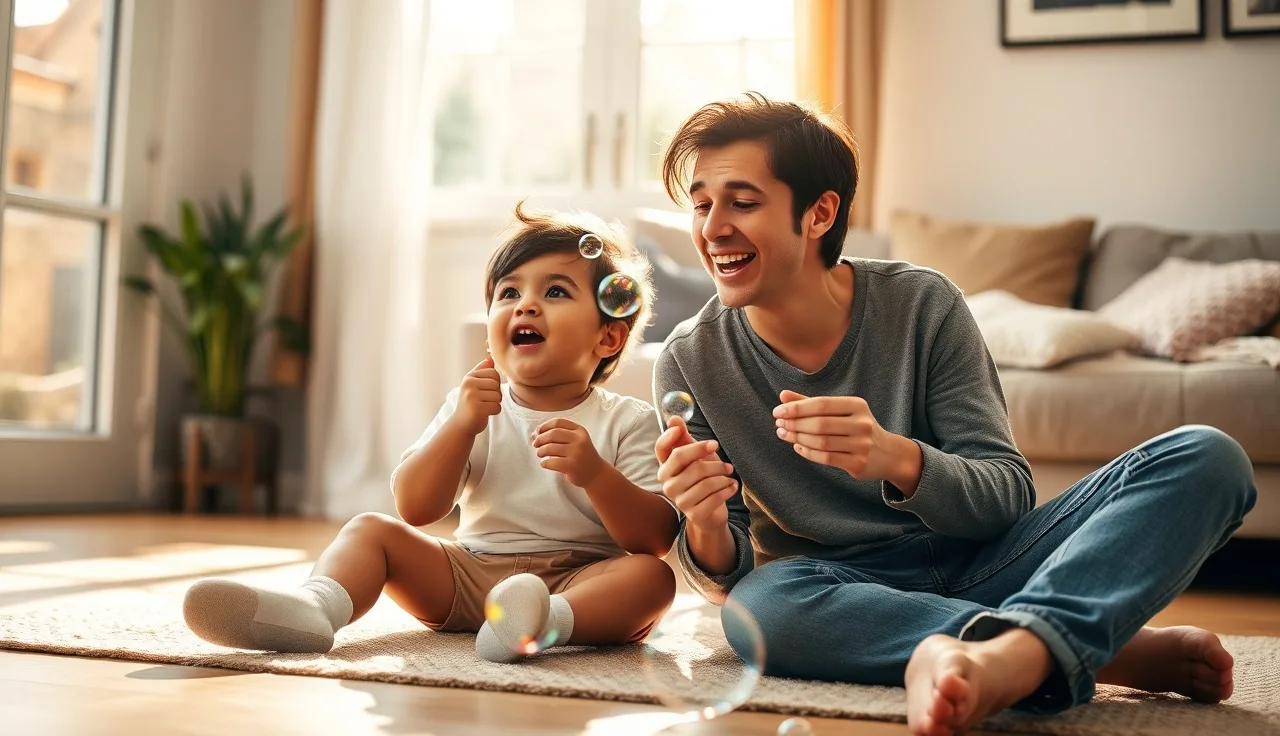
Not all play is equal for language. Some activities create natural communication pressure. Others are so absorbing that a child has no reason to use words at all. The best communication-rich play runs on back-and-forth exchange and creates moments where the child needs or wants something from you. Bubbles are the classic example: you blow, the child pops, then you hold the wand and wait. The child has to reach, look, or vocalize to get more. That waiting moment is called a "communication temptation," and it's one of the most researched strategies in early intervention [5].
Songs with predictable gaps ("The wheels on the bus go...") let children fill in the blank without generating language from scratch. The predictability lowers anxiety, and the pause gives them a clear moment to jump in. Simple sensory play, water, sand, or playdough, with no right answer and no performance demand, pulls out more spontaneous vocalizations too, especially from children who are anxious about getting things wrong.
Pretend play tied to special interests deserves its own mention. A child obsessed with trains will talk about trains. A child who loves one cartoon character will narrate scenarios around that character. Never underestimate a special interest as a language gateway.
| Play Type | Communication Opportunity | Pressure Level |
|---|---|---|
| Bubbles / cause-effect toys | High (natural requesting) | Low |
| Songs with fill-in gaps | Medium-high | Very low |
| Board games with simple rules | Medium | Medium |
| Flashcard drills | Low | High |
| Special-interest pretend play | High | Low |
| Screen time (passive) | Very low | None |
Keep sessions short
Much shorter than most parents expect, actually. For toddlers and preschoolers, 5 to 10 minutes of focused, engaged interaction beats 40 minutes of fading attention. The American Academy of Pediatrics (AAP) says quality of interaction matters more than duration, and children's attention spans for structured tasks run roughly 2 to 5 minutes per year of age [6]. A three-year-old has about 6 to 15 minutes before real engagement drops off.
So skip the idea of "a speech session" altogether and build three or four small pockets of rich interaction into the day instead: mealtime, bath time, the car ride to preschool, getting dressed. Those recurring routines are already structured and predictable, which primes your child's brain for language inside them. Many speech-language pathologists suggest weaving language into daily routines rather than carving out dedicated drill time, so the child experiences words as part of life instead of a chore attached to one chair and one hour.
If your child is in speech therapy, ask their SLP for three specific targets that fit your actual routines. That's the bridge between clinic and home that makes therapy carry over.
When a child shuts down instead of communicating
Shutting down is information. It usually means one of three things: the task is too hard, the stakes feel too high, or the activity isn't motivating enough. It almost never means your child is being stubborn.
Children with speech delays, autism, or apraxia of speech often carry a long history of communicative failure. They tried to say something, it didn't land, and adults looked confused or frustrated. That history piles up, and by the time some children reach formal therapy, they've already learned that trying to communicate is risky. Your first job is rebuilding trust that their attempts will land well, however partial.
A few things help when a child keeps shutting down. Lower the entry bar all the way: if pointing feels like too much, accept eye contact; if eye contact is too much, accept being in the same room while you narrate play nearby. Lean on non-verbal interaction too, imitation games, turn-taking with objects, physical play with a clear back-and-forth rhythm, since these build the foundation without demanding words. Check for sensory overload as well: some children shut down because noise, light, or physical sensation is eating their cognitive bandwidth, and a quieter, lower-stimulus setting can change everything.
What you shouldn't do is force eye contact or verbal responses. Forced eye contact is aversive for many autistic children and can increase avoidance rather than communication [7]. Autism spectrum speech therapy increasingly works to reduce demand pressure instead of adding it. If shutting down is consistent and significant, raise it with a licensed speech-language pathologist. It may signal that a different modality, like AAC devices, would drop the pressure and raise total communication.
Are special interests helpful, or just indulging a fixation?
This comes up constantly in parent groups, and the worry is understandable. The evidence is pretty clear, though: special interests are a legitimate, powerful language tool, not a crutch. A 2021 review in the Journal of Autism and Developmental Disorders found that building a child's restricted interests into intervention tasks significantly increased engagement, learning retention, and spontaneous generalization of new skills compared with non-preferred activities [8]. The effect was especially strong for autistic children.
The reason makes sense. A child talking about something they love is running on enthusiasm, not performance anxiety. They already have a rich mental map of the topic, so new vocabulary and sentence structures attach to it far more easily than to unfamiliar content. If your child is obsessed with dinosaurs, use dinosaurs. If it's a specific YouTube channel (kept within AAP screen time guidelines), use that content as a launch point for conversation. You're not indulging a fixation, you're meeting your child's brain where it already lives.
Here's the reframe that seems to help parents most: the goal isn't a child who talks about a broad range of topics, it's a child who experiences successful, enjoyable communication. Breadth tends to follow once that foundation is solid.
How does self-directed play support language differently from adult-directed play?
Adults tend to steer play toward an end product: build the tower, name the colors, finish the puzzle. Left to their own devices, children get messier and stranger with their play, and that messiness turns out to be linguistically rich.
When a child runs the show, they narrate, sometimes out loud, invent scenarios, assign roles, and negotiate even with themselves. This self-generated talk is called private speech, and Lev Vygotsky's foundational work showed it scaffolds cognitive and language development [9]. Later neuroimaging research found that self-generated speech activates language areas more broadly than speech that's prompted from outside.
One of the most productive things you can do as a parent is get out of the way sometimes. Sit near your child, stay available, and let them lead. When they pull you in, join with real enthusiasm. But when they're deep in their own flow, keep your narration light ("Oh, the lion is going in the cave") rather than firing off prompts and questions.
This runs against most parents' instinct, which is to jump in the moment a child does something interesting. That instinct comes from love, but it can interrupt the very process that generates language in the first place.
Are there specific games or activities speech therapists recommend?
Yes, and most of them cost little or nothing.
Bubbles are worth mentioning again: almost every SLP working with toddlers reaches for them because they're endlessly motivating and set up a clean moment for a child to ask for more. Hold the wand, make eye contact, and wait. Mr. Potato Head and similar assembly toys work well too, since every piece is a chance to name something, and the child already has a clear goal (build the face) pulling them into the interaction without any adult pressure. Simple turn-taking games like Candy Land or Hi-Ho Cherry-O build in the rhythm of your turn, my turn, which mirrors conversation directly. Hiding games earn their popularity too: tuck a toy under a cup or blanket and ask "Where's the dog? There it is!" The anticipation and reveal keep children coming back for more without it ever feeling like drilling. Obstacle courses pair movement with language ("jump, jump, crawl, stop"), which can speed up retention noticeably for kids who learn best by moving. Books with repetitive text deserve special mention. "Brown Bear, Brown Bear" and its cousins are loved for a reason: they're built so children can predict and fill in the language themselves. Reading together at bedtime is one of the most studied language activities there is, and a meta-analysis covering 116 studies found significant vocabulary gains from shared book reading between adults and young children [10].
Families using augmentative and alternative communication can adapt all of these the same way: model the words or symbols on the AAC device while you play, then wait for the child to use it themselves. The play stays motivating; only the output changes.
Apps built for speech practice can fit in here too, especially ones that give children immediate, playful feedback instead of a score or a red X. Little Words, for instance, builds short activities around a child's actual communication goals, so practice happens inside something that feels like a game rather than a drill. Worth a look if structured home practice has been hard to keep going.
How do I handle echolalia or scripted language during practice?
Many parents worry when their child repeats lines from TV shows or the same phrase over and over. But echolalia is almost never something to erase. It's a starting point to build from.
Barry Prizant's research showed that echolalia is often functional: children use memorized scripts to communicate intent, regulate emotions, or rehearse language structures [11]. A child who says "the movie is starting" every time they want something to begin isn't being robotic. They're communicating with the tools they have.
During play, work with the echolalia instead of against it. If your child loves a particular phrase, feed it back playfully and build a game around it. Over time you can expand it gently: if they always say "to infinity and beyond," you might slip in "ready, set, blast off" in a similar moment, growing new language that carries the same emotional charge.
Blocking or correcting echolalia tends to shut communication down. Accepting and expanding it keeps the channel open. The echolalia meaning article goes deeper into what specific patterns usually signal, if you want to understand the different forms it can take. And if you're unsure what your child's scripts mean, that's exactly the kind of question to bring to a speech-language pathologist experienced with autistic communication styles.
What role does the parent's own stress level play?
A big one, and it's rarely talked about honestly. Children read adult emotional states with uncanny accuracy, especially children who are already anxious about communicating. If you sit down to "do speech practice" with a tight jaw and a timer ticking in your head, your child feels it, and the session is contaminated before it starts.
This isn't about blame. Parenting a child with a communication delay is genuinely hard, and worrying about their future, wondering if you're doing enough, and running on plain exhaustion is a lot to carry at once. But managing your own state during these moments matters probably as much as any technique.
A few things help. Set a genuinely low bar for success: one spontaneous vocalization during play counts as a win, and if you write it down, patterns show up over weeks that you'd otherwise miss. Don't keep a running score either; if yesterday went badly, it doesn't count against today. And let yourself enjoy the play for its own sake sometimes. Not every minute with your child needs to be targeted practice. Ordinary joy builds language too.
If keeping up home practice feels impossible some weeks, you're not alone in that. Early intervention programs often include parent coaching precisely because the research shows it makes home practice more effective and easier to sustain.
How do I know if my approach is actually working?
This is where parents feel most uncertain, especially between therapy appointments. What you're watching for is directional progress over weeks, not days: more initiations, where the child starts the interaction instead of only responding to yours; more variety, with new sounds, words, or symbols showing up even inconsistently; more repair attempts, where a breakdown in communication gets a second try instead of a meltdown or a shutdown; more relaxed body language during these moments; and less latency, meaning the gap between your turn and their attempt keeps shrinking.
Keep a simple log. Once a week, jot down two or three things you heard or saw that were new. It doesn't need to be fancy; a note in your phone calendar works fine.
Nobody has great data on exactly how fast home practice should show measurable gains. The closest evidence comes from formal parent-coaching programs, where gains were measured over 12 to 16 weeks [3]. So give any strategy at least two to three months before deciding it isn't working.
If you see real regression (skills that were there disappearing consistently, not just on a bad day), flag it to your child's SLP or pediatrician promptly. Regression during a developmental leap is common and usually temporary, but sustained regression deserves a proper look.
Tools like Little Words can also track what your child attempts at home between sessions, which gives the SLP more to work with and helps you feel less like you're guessing in the dark.
Frequently asked questions
At what age should I start making communication practice fun at home?
From birth, really. Responsive interaction, narrating daily routines, following your infant's gaze: all of that builds communication, and all of it counts as play. By 9 to 12 months you can add deliberate turn-taking games like peek-a-boo. There's no age that's too young for joyful back-and-forth. If you have specific worries about your child's development, the AAP recommends raising them at the 18-month and 24-month well-child visits at the latest.
How many words should my child be able to say before playful practice can help?
None. Children who don't have words yet benefit from communication-rich play just as much as children who do. For a pre-verbal child, the goal isn't instant words but the groundwork underneath them: joint attention, turn-taking, the sense that communication does something. Plenty of children go from near-silence to a burst of new words after weeks of steady, low-pressure interaction. If your child has no words by 16 months, or loses words at any age, tell your pediatrician.
Is screen time ever useful for communication practice?
Passive screen time, a child watching alone, produces very little language gain. Video chatting with a responsive adult is an exception, since it keeps the back-and-forth exchange alive. Interactive apps used together with a parent can help too. The AAP recommends avoiding solo screen time entirely for children under 18 to 24 months, and keeping it limited and co-viewed for ages 2 to 5 [12].
What if my child is more interested in the toy than in communicating about it?
That's normal, and it's useful. Intense focus on an object often comes right before joint attention shows up. Sit alongside your child and narrate what they're doing without demanding a response. Now and then, put your hand near the toy or hold a piece they need, which gives them a natural reason to look at you without you forcing it. Over time the object stops being a barrier and becomes a bridge to interacting with you.
Can siblings or peers make better communication partners than parents sometimes?
Often, yes. Research on peer-mediated intervention shows children with language delays initiate communication more often with same-age peers than with adults. Peers use simpler, more natural language, and the pull of playing with another child is strong. Structured playdates with a patient, talkative peer can be genuinely therapeutic, and sibling involvement, coached briefly by a parent or SLP, works much the same way.
My child only communicates during certain activities. Should I stick to those?
Start there. Consistent communication in any context is something to build on, not a limitation. Once your child communicates reliably during a favorite activity, introduce small variations, the same toy in a new location, or the same routine with a small tweak. Generalization happens slowly and needs to be deliberate. Jumping straight to a totally different activity usually sets things back.
Is singing better than talking for building speech?
For many children, yes, especially those with motor-speech differences like childhood apraxia of speech. Melodic speech uses slightly different neural pathways than conversational speech, so some children who can't say a word on its own can sing it clearly. Nursery rhymes, action songs, and call-and-response songs are all real speech tools, not just diversions. If your child responds unusually well to singing, mention it to your SLP: it may point to approaches worth trying.
How do I make AAC feel like play rather than homework?
Model AAC yourself during play without requiring a response. Use the device to narrate, joke, and comment, not only to request or answer. Attach it to whatever your child loves most: bring it out during their favorite game, not only during structured work time. When a child sees AAC as their voice in fun moments rather than a tool that only appears during testing, spontaneous use goes up a lot.
What's the difference between communication temptations and manipulation?
Communication temptations are setups that give a child a genuine reason to communicate: holding something they want, pausing in a favorite routine, putting a toy just out of reach. They work because the motivation is real. What keeps this from being manipulation is that you always follow through when the child communicates, however partial the attempt. The child learns that communicating works, and that's the whole point.
Should I correct my child when they say a word wrong during play?
Generally, no. In the moment, correction raises anxiety and makes another attempt less likely. Use an expansion instead: if your child says "buh" for ball, you say "yes, ball! Big ball!" You've modeled the correct form without telling the child they got it wrong. Save targeted correction for formal therapy, where the SLP has the relationship and the timing for that kind of feedback.
Does making practice fun mean avoiding all structure?
No. Predictable routines are deeply reassuring for many children with language delays and autism. The structure that helps is temporal, the same sequence of events every time, not a demand that they say a specific word on cue. A song with the same verse every time, a game that always starts the same way, a bedtime routine with the same three books: that kind of predictability lowers anxiety, and lower anxiety means more communication.
My child has childhood apraxia of speech. Do these fun strategies still apply?
Yes, with one adjustment. Children with apraxia need high-repetition practice of specific motor sequences, which can get tedious fast. The trick is folding that repetition into contexts your child already loves: a favorite game that naturally uses a target word dozens of times, or a song that repeats a target sound in every verse. Your SLP should give you specific target words to work into play. Forced, joyless drilling measurably works less well than repetition your child is actually motivated to do.
Sources
- Nature Reviews Neuroscience, Schultz 2000 - dopamine and reward learning: Dopamine signaling in reward circuits is central to reinforcement learning and skill acquisition in the brain.
- ASHA - Naturalistic Developmental Behavioral Interventions: ASHA identifies naturalistic developmental behavioral interventions as well-supported approaches for children with language delays because they embed targets in motivating activities.
- Hanen Centre - It Takes Two to Talk program research summary: Randomized controlled trial evidence supports Hanen's It Takes Two to Talk parent-coaching model for increasing children's communication turns.
- Tomasello & Farrar, Child Development 1986 - joint attention and vocabulary: Joint attention between caregiver and child is one of the strongest predictors of early vocabulary growth.
- Kaiser & Trent, 2007 - communication temptations in early intervention: Communication temptations such as holding desired objects and waiting are among the most researched strategies in early language intervention.
- American Academy of Pediatrics - Developmental Milestones and Attention: Children's attention spans for structured tasks are roughly 2 to 5 minutes per year of age, according to AAP developmental guidance.
- Leekam et al., Journal of Child Psychology and Psychiatry 2000 - forced eye contact in autism: Forced eye contact is aversive for many autistic children and can increase avoidance behaviors rather than support communication.
- Journal of Autism and Developmental Disorders, 2021 - restricted interests in intervention: Incorporating children's restricted interests into intervention tasks significantly increased engagement, retention, and generalization of new skills compared to non-preferred activities.
- Vygotsky, Thought and Language (1962) - private speech and development: Self-generated private speech is a critical scaffold for cognitive and language development in young children.
- Flack et al., Educational Psychology Review 2018 - meta-analysis of shared book reading: A meta-analysis covering 116 studies found significant vocabulary gains from shared book reading between adults and young children.
- Prizant & Duchan, Journal of Speech and Hearing Disorders 1981 - functions of echolalia: Barry Prizant's research showed echolalia is often functional, used by children to communicate intent, regulate emotions, or practice language structures.
- AAP Council on Communications and Media - screen time guidelines: The AAP recommends avoiding solo screen time for children under 18 to 24 months and keeping it limited and co-viewed for ages 2 to 5.