Last updated 2026-07-11
TL;DR
Durable toddler AAC starts with thick lamination (5-mil minimum, 10-mil for full boards), rounded corners, and binding that holds up to daily opening and closing. A basic core word board costs under $15 to make at home. Built right, it survives chewing, throwing, and spills for months, not days.
Toddler AAC materials break fast because they live on the floor, go in the mouth, get dragged across concrete, and occasionally fly across the room. The failure points are always the same: paper symbols peel, laminate edges lift, binding cracks, Velcro wears smooth. Every one of those is a materials problem, and materials are cheap to fix.
ASHA defines AAC (augmentative and alternative communication) as any method that supplements or replaces verbal speech for people who have difficulty communicating [1]. For toddlers who are late talkers, autistic, or have motor-speech differences like apraxia of speech, low-tech AAC boards are usually the first tool a speech-language pathologist reaches for alongside higher-tech options [2]. Those boards only help if they last long enough to actually get used, and the good news is you don't need a professional printer or a laminator that costs hundreds of dollars. A well-built homemade board can take months of abuse from the same materials you can grab at an office supply store this afternoon.
What you need to build cards and boards that hold up
The short list: laminate pouches, stiff paper, a basic laminator, a corner rounder, binder rings, and industrial Velcro. Everything runs roughly $10 to $30 total at a big-box office store or online.
Go 5-mil minimum on laminate pouches for individual symbol cards. Most home laminators ship with 3-mil pouches, which crack along the edge once a toddler bends them over and over. A 100-count pack of 5-mil pouches costs about $12 to $15 and changes how long the cards survive [3]. For a full communication board, go up to 10-mil.
Skip plain printer paper. It tears through laminate over time because the paper itself breaks down. Print symbols on 60 lb (or heavier) cardstock, or on glossy photo paper, before laminating. Stiffer paper gives the laminate something to grip. A basic Scotch or Amazon Basics laminator ($25 to $35) handles 5-mil pouches fine; run each card through twice, rotating 90 degrees on the second pass, to seal the edges tighter.
Sharp laminate corners are the first thing to peel, so a corner rounder punch ($8 to $12) is probably the cheapest upgrade you can make, and it buys real time. For board books, binder rings ($5 a pack) outlast spiral and coil binding because you can open and reload them; use a standard hole punch with reinforcement stickers, or a grommet kit for holes that take the most stress. When it comes to hook-and-loop, industrial-grade Command strips or Velcro's "Extreme" line hold far better than craft-store Velcro, and sew-on Velcro is the most durable option of all if you're mounting symbols to a fabric carrier or communication vest.
Two things worth adding even though they're optional: a binder clipboard with a rigid back board gives a toddler a portable surface, and a layer of clear contact paper over an already-laminated board adds another barrier against scratching.
Where to find symbols to print
You've got free and paid options that clinicians actually use. The most common symbol libraries in clinical practice are Boardmaker (Tobii Dynavox) and the Picture Communication Symbols (PCS) set. Boardmaker home subscriptions run around $99 to $149 per year, which is worth it if you need hundreds of symbols but probably overkill for a first small board.
Two free libraries cost nothing and cover most needs. Mulberry Symbols is an open-source library (licensed CC BY-SA) with over 3,000 images, and you can download the whole set free from its GitHub repository. SymbolStix and ARASAAC (the Aragonese Portal of AAC) both offer free online symbol search, and ARASAAC goes further with a pictogram generator and a board builder, all free, at arasaac.org [11]. Google Images works too, for real-photo symbols, if your child responds better to photographs than line drawings: some children, particularly autistic children, tie meaning to photographs faster than to abstract drawings [4].
If you're in an early intervention program or working with a speech therapist, ask which symbol set they use in sessions. Matching the symbols at home to the ones in therapy cuts down on confusion.
Size matters more than parents expect. Toddler symbols should be no smaller than 2 inches by 2 inches, and 3 inches by 3 inches is better for early learners, since tiny symbols demand a precision of pointing most toddlers don't have yet.
Building a core word board that actually gets used
Build it around a small set of high-frequency words, laminate the whole page as one piece, and mount it where your child already spends time. A first board needs 9 to 16 symbols, not 40. Core words (go, more, stop, help, want, no, yes, I, you, like) work across hundreds of situations; a board full of nouns doesn't. Research consistently shows that a handful of core words make up most of the language a typical speaker uses daily, which is why core-first instruction has the strongest support in the AAC literature [5].
Start by picking 9 to 16 core words and printing them on cardstock at 2 to 3 inches each in a grid. Laminate the whole sheet as one piece with 10-mil laminate: a full page run as a unit beats assembled individual cards because there are no seams where Velcro can catch or water can wick in. Then mount it somewhere that matters, taped inside a kitchen cabinet door, clipped to a binder board, or Velcroed to the side of the high chair; placement decides whether it gets used at all. Make at least two identical copies, one in the kitchen and one in the living room or diaper bag. SLPs call this "communication everywhere," and access from multiple rooms tracks with more use [6].
The last piece is modeling instead of demanding: touch the symbols yourself while you talk all day long. "You want MORE cereal? I'll get MORE." This is aided language input, and it's how children learn what the symbols mean [7]. The most common mistake parents make is finishing the board and then hiding it because it looks fragile; a close second is waiting for it to be perfect before using it at all. Start small and ugly. Fix it later.
The most durable format for a toddler AAC book
The toughest toddler AAC book pairs a stiff substrate (foam board or a blank board book) with binder rings looped through grommets, so each page is independent and replaceable. A book built this way survives drops, bag-stuffing, and the occasional chew.
Mount laminated pages onto foam board (3/16 inch thick) or onto the pages of a blank board book. Blank board books made for kids' crafts (Melissa and Doug makes them, and generic versions run $5 to $8) are already toddler-proof and take a layer of clear contact paper over inserted pages nicely. For binding, three-ring binders with D-rings (not O-rings, which crack under stress) beat coil-bound books that open and close dozens of times a day; binder rings at the corner of each page, looped through a grommet, hold up even better for heavy use since each page stands on its own. Thick clear page protectors (at least 3-mil) in a binder let you swap pages without re-laminating; they scratch over time, but replacements cost almost nothing. A hardcover zippered binder, roughly $10 to $20 at any office supply store, adds impact protection and keeps the book from flying open when it hits the floor.
For the worst abuse cases, some parents and therapists mount symbols directly onto a thin cutting board or a slice of foam pool noodle with Velcro. It's ugly. It's also nearly impossible to destroy.
Homemade AAC materials cost a fraction of what commercial versions do, but they take hours to put together and wear out faster. Commercial products made for pediatric use, like Boardmaker activity boards or vinyl-printed symbol sets, use materials and printing you really can't replicate at your kitchen table. Even so, for most families just getting started, that tradeoff still favors DIY.| Format | Approximate cost | Durability | Setup time |
|---|---|---|---|
| DIY laminated cardstock board | $5 to $15 | Moderate (replace in 2 to 6 months) | 1 to 3 hours |
| DIY foam board + 10-mil laminate | $10 to $25 | Good (6 to 12+ months) | 2 to 4 hours |
| Commercial vinyl symbol set | $30 to $80 | Very good (1 to 2+ years) | 30 minutes |
| Budget AAC device (tablet + app) | $100 to $500+ | Varies by case and screen protection | Low, ongoing |
| Dedicated SGD (speech-generating device) | $3,000 to $12,000 | Excellent (built for heavy use) | Low, professional setup |
Keeping symbols from peeling off Velcro boards
Put the hook side on the board and the loop side on the card, clean the hooks regularly, and bond the Velcro into the laminate rather than trusting its stick-on glue. Velcro wearing out is one of the top complaints from families using low-tech AAC: the hook side fills with lint, the loop side flattens, and cards start dropping off. A few things slow that down.
Putting the hook side on the board feels backward at first, since it's the scratchy half and parents don't love it on the board surface. But it holds up longer. The soft loop side goes on the card instead, taking the wear, and cards are cheap to replace compared to the board itself.
Clean the hook side by dragging a stiff toothbrush or a piece of pressed-and-peeled tape across it to pull out lint: thirty seconds, done. When you're attaching Velcro to a card, skip sticking a Velcro dot straight onto the back. Instead, sandwich a small strip of fabric (twill tape works well) between the Velcro and the card, then run it through the laminator a second time. That locks the Velcro backing into the laminate rather than leaving it to hang on adhesive that softens with handling. It's also worth spending a little more on Velcro Industrial Strength tape ($8 to $12 for a 4-foot roll), rated for 2.2 lbs per square inch and more resistant to moisture than the craft version. Small premium, worth it for anything used daily.
Waterproofing materials for droolers and splashers
You can waterproof AAC materials, and it's one of the more useful upgrades for toddlers with oral motor differences or heavy drooling, common in children with childhood apraxia of speech and in autistic children who mouth objects. Layering the protection is what actually works: print on glossy photo paper or water-resistant inkjet paper (Hammermill and Avery both sell water-resistant inkjet sheets for under $20 per 50-sheet pack), laminate with 5-mil pouches sealed on all four edges, and run a thin bead of clear craft glue (Mod Podge or Aleene's) along the sealed edge as an extra moisture barrier where the two laminate sides meet. If the board lives near water, like the kitchen or bath, add clear contact paper as an outer layer. For bath or pool symbols, some families print on regular paper, then seal each symbol inside a heavy epoxy resin pour in a silicone mold. That makes a fully waterproof tile, close to indestructible, though it takes more time. Epoxy kits run $15 to $25. Whatever you do, skip uncoated inkjet paper anywhere near water. Standard inkjet ink is water-soluble and smears the moment it gets wet.
Setting up AAC materials around the house
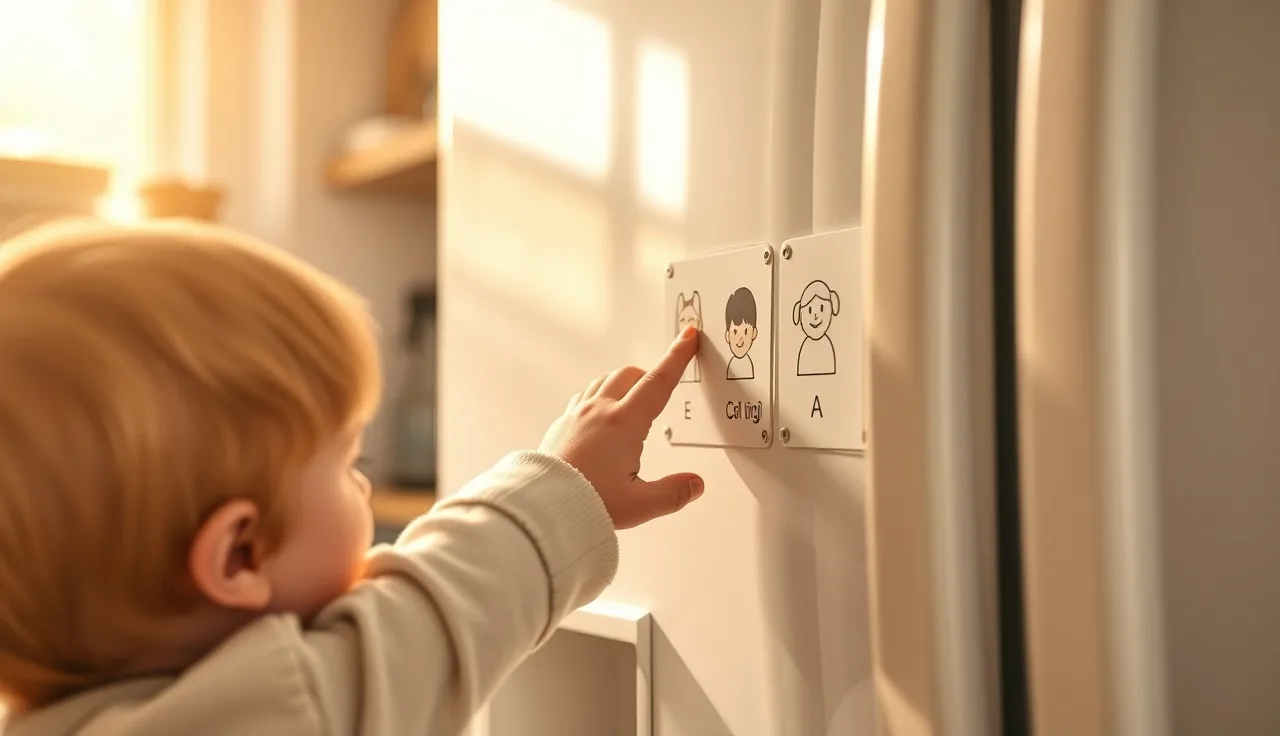
Put symbols where communication actually happens, not where they're easiest to store. A board in a drawer isn't really a board. The idea from AAC research and clinical practice is simple: bring the vocabulary to the moment [6]. In the kitchen, that means a core board on the fridge at the child's eye level (roughly 2 to 3 feet off the floor for a toddler), with food words like "eat," "drink," "more," and "all done" near the high chair. In the play area, topic boards near preferred activities work well, a train board at the train set, an art board at the art supplies, hung on a Command strip hook so they move easily. At the changing table, a small board with "up," "down," "stop," and "help" cuts down on dressing battles. In the car, a mini board laminated and clipped to the back of the front seat, with three to five symbols and no more. In the bedroom, a bedtime routine board covering the sequence (bath, pajamas, book, sleep) helps, even though routine boards work a little differently from communication boards despite using the same materials. Little Words (littlewords.ai) has a free quiz that helps parents figure out which vocabulary categories fit their child's daily routines before building anything, worth doing before you print 40 symbols you may never use. And it helps to write each board's location on the back ("kitchen," "car"), obvious as that sounds. It saves time once boards start migrating around the house.
What the research says about toddler AAC and language development
AAC does not stop a toddler from learning to talk. That's a persistent myth, and the evidence points the other way. A 2019 review in the Journal of Autism and Developmental Disorders on early-childhood AAC concluded that AAC use does not suppress speech development and is tied to gains in both symbolic communication and verbal output in many children [8]. ASHA's evidence backs early AAC too, holding that it should be considered for any child who cannot meet daily communication needs through natural speech alone, regardless of age [1]. The National Institute on Deafness and Other Communication Disorders (NIDCD) notes that language develops fastest in the first three years of life, which is exactly why early access to any working communication method, low-tech AAC included, matters [9]. For children in early intervention under IDEA Part C (birth to age 3), AAC is an appropriate and covered area of intervention, and families can request a free evaluation through their state's early intervention program [10]. Nobody has clean long-term data on exactly which children benefit most from which type of AAC. The most consistent finding is that access and how often the system gets modeled predict outcomes more than the format itself. Good news if you're making your own: a well-used homemade board beats a perfect unused one every time.
When to bring in a speech therapist
Call a speech-language pathologist when your homemade board isn't getting traction after weeks of modeling, when you're stuck on vocabulary or layout, or when you're weighing a high-tech device. DIY is a fine place to start, but a few situations call for professional guidance: your child hasn't touched the materials after several weeks of steady modeling, you're unsure which vocabulary to prioritize or how to lay out the board, your child has a motor-planning diagnosis like apraxia of speech that affects how they point or reach symbols, you're considering a high-tech device and need an AAC evaluation, or you have concerns beyond communication, like social patterns that might point to autism. SLPs who specialize in AAC run formal feature matching, fitting a child's motor, cognitive, and language profile to the right system. That matters most for high-tech systems, but even on a simple board, a trained eye catches things parents miss. If cost is the barrier, online speech therapy has widened access a lot since 2020. Telehealth sessions often cost less than in-person visits and work well for parent coaching on AAC, which is often more useful than direct child therapy at the toddler stage anyway. The Little Words app can also support parents between sessions, with guided prompts and vocabulary suggestions built around each child. Early intervention services for children under 3 are free through the federal IDEA program. Ask your pediatrician for a referral, or contact your state's Part C program directly [10].
Making AAC materials at home: common questions
The cheapest route is printing symbols on cardstock, laminating them in 5-mil pouches with a $25 to $35 laminator, punching rounded corners, and linking the pages with binder rings. A first core board costs $10 to $20 total, laminator included, if you already have a printer. Symbols are free from ARASAAC or Mulberry Symbols, so laminate and rings are really the only expense.
On laminate thickness: 5-mil is the minimum for cards a child handles every day, and 10-mil holds up better for full communication boards. Most home laminators only take 5-mil pouches, so check your machine's rating before buying 10-mil ones. Running a card through twice, turning it 90 degrees for the second pass, gives a tighter seal on standard 5-mil pouches. If peeling is a problem, print on cardstock or photo paper rather than plain paper, round the corners right after laminating, and do that double pass. In spots that see a lot of drool or humidity, a thin line of Mod Podge along the sealed edge adds extra protection. For a child who drools heavily, print on water-resistant inkjet or glossy photo paper, laminate in 5-mil pouches, seal the edges with clear craft glue, and add a layer of clear contact paper on top. Items that will get genuinely wet do better as epoxy resin tiles poured in silicone molds. Uncoated inkjet ink smears the second it gets wet, so coating or laminating isn't optional.
Whether to use photos or drawings depends on the child. Some children, autistic children in particular, connect faster with real photographs than with line drawings. Others generalize better from a consistent line-drawn set like PCS or ARASAAC pictograms, since the symbol looks the same regardless of which specific item it represents. Ask your SLP, or just try both and see which ones your child actually points to.
Start a first board small: 9 to 16 symbols in a simple grid is plenty, since too many choices overwhelm a child who's still figuring out what AAC even does. Core words like go, more, stop, help, want, no, and yes earn their keep faster than a board full of nouns. Add more once your child is using the first set consistently. Symbols should measure at least 2 by 2 inches, or 3 by 3 inches for a toddler just learning to point or a child with motor difficulties, since small targets demand precision many toddlers don't have yet. You can shrink the layout as pointing skills and AAC experience build.
No, AAC doesn't get in the way of a toddler learning to talk. A 2019 review in the Journal of Autism and Developmental Disorders found that AAC use does not suppress speech development and is tied to gains in verbal output in many children. ASHA's position is the same: AAC should be available to any child who can't meet communication needs through natural speech, at any age. Early access tends to support spoken language rather than replace it.
Boards only get used if they're where communication actually happens: at the child's eye level on the fridge, near the high chair, in the play area next to favorite toys, clipped to the back of the front car seat. A board in a drawer is a board nobody touches. Making two identical core boards, one for the kitchen and one for the living area, is one of the more useful things you can do to get daily use out of it.
You don't need a laminator at all. Self-laminating peel-and-stick pouches run about $8 to $12 for a 50-pack and work fine for light use, though they're thinner and peel sooner than heat-laminated ones, so expect to replace them more often. You can also just slide printed symbols into thick page protectors and bind them in a D-ring binder: less durable, but it works.
DIY materials are genuinely enough for exploring vocabulary and starting communication in the early stages. Professional products or dedicated speech-generating devices matter more once a child needs a larger, more complex vocabulary, or when motor access like eye gaze or switch scanning calls for purpose-built hardware. An SLP who specializes in AAC can help you figure out when that shift makes sense.
For free symbols, ARASAAC (arasaac.org) and Mulberry Symbols (on GitHub under a Creative Commons license) both offer printable libraries, and ARASAAC has an online board builder built in. For real-photo symbols, Google Images or your own photos work well. Boardmaker and SymbolStix are the standard clinical libraries, but both require paid subscriptions.
If your child is under 3, early intervention services, including AAC support, are free under IDEA Part C: any child from birth to age 3 is entitled to a free evaluation and, if eligible, free services. Contact your state's Part C lead agency or ask your pediatrician for a referral. Eligibility rules vary by state, but a speech or developmental delay generally qualifies, and services happen in the child's natural environment, usually home.
Teaching a homemade board comes down to modeling, not demanding. Touch the symbols yourself while you talk through ordinary routines: "You want MORE? I want MORE too." That's aided language stimulation, the main strategy SLPs recommend for early AAC learners. Don't force a child's hand to a symbol. Steady, low-pressure modeling over weeks is what actually builds understanding.
None of this replaces an individualized assessment from a speech-language pathologist, so treat it as a starting point rather than a diagnosis or treatment plan.
Sources
- ASHA, Augmentative and Alternative Communication overview: ASHA defines AAC as any method supplementing or replacing verbal speech and supports early AAC for children who cannot meet communication needs through natural speech alone
- ASHA, Augmentative and Alternative Communication Practice Portal: Low-tech AAC boards are an appropriate clinical recommendation alongside high-tech options for toddlers with motor-speech differences
- Fellowes laminator and pouch product specifications, laminate pouch mil ratings: Standard home laminators ship with 3-mil pouches; 5-mil pouches are recommended for heavier daily handling
- Mirenda, P. (2003). Toward functional augmentative and alternative communication for students with autism. Language, Speech, and Hearing Services in Schools, 34(3), 203-211.: Some children with autism associate meaning more readily with photographs than with abstract line drawings
- Boenisch, J. & Soto, G. (2015). The oral core vocabulary of typically developing English-speaking school-age children. Augmentative and Alternative Communication, 31(1), 77-84.: Core words make up the vast majority of language used daily, supporting core-first AAC instruction
- Light, J. & McNaughton, D. (2014). Communicative competence for individuals who require AAC. Augmentative and Alternative Communication, 30(1), 1-18.: Access from multiple environments and high modeling frequency are correlated with increased AAC use in toddlers and young children
- Drager, K. et al. (2006). The impact of aided language modeling on symbol comprehension and production. American Journal of Speech-Language Pathology, 15(2), 112-125.: Aided language stimulation (adult touching symbols while speaking) teaches children what AAC symbols mean
- Lerna, A. et al. (2019). Journal of Autism and Developmental Disorders, review of AAC and speech development: AAC use does not suppress speech development and is associated with gains in verbal output in many children with autism
- NIDCD, Speech and Language Developmental Milestones: Language development is most rapid in the first three years of life, supporting early communication intervention
- U.S. Department of Education, IDEA Part C Early Intervention Program: Under IDEA Part C, children birth to age 3 are entitled to free evaluation and early intervention services including AAC support
- ARASAAC, free AAC symbol library and board builder: ARASAAC provides a free online pictogram generator and board-building tool for AAC symbol creation
- ASHA, reimbursement and IDEA early intervention guidance: AAC is an appropriate and covered area under IDEA Part C early intervention services for eligible children under age 3