Last updated 2026-07-10
Modeling language means narrating, labeling, and commenting around your child without asking them to repeat anything back. ASHA guidance and peer-reviewed AAC studies show that low-demand, high-input environments produce faster language gains than approaches built around questions and prompts. You can start today, at breakfast or in the bath, and you don't need any special equipment.
What modeling actually means
Language modeling is saying words or phrases your child isn't using yet, in context, without expecting them to say those words back. You provide the input. You don't ask for output.
The American Speech-Language-Hearing Association describes aided language stimulation as a technique where a communication partner "models the use of symbols on a communication display while simultaneously speaking the corresponding words" [1]. The same idea holds when there's no device involved: you give a live demonstration of language, attached to something your child is already looking at.
This isn't drilling. Drilling is "say 'more,' say 'more'" until the child gives in. Modeling is pouring juice and saying "more juice" once, clearly, then moving on. It works because children take in enormous amounts of language before they ever produce a word themselves. That's true for every typically developing child, and even more true for late talkers and autistic kids whose expressive language often lags well behind what they understand [2]. Your child doesn't have to earn language. You just give it.
Why pressure backfires
When a child feels tested, stress kicks in, and that stress competes with language processing. The brain struggles to do both at once, and for many neurodivergent kids the stress response runs stronger and longer than it would for a neurotypical peer.
Research on demand avoidance shows that directive, high-expectation communication styles can actually increase withdrawal in autistic children rather than draw speech out [3]. Even kids without any diagnosis shut down when an adult asks "what's that called?" or "can you say ___?" on repeat. Those questions read as evaluation, and kids feel it. The AAP's 2020 clinical report on autism management notes that naturalistic, child-led approaches consistently beat adult-directed drilling on measures of spontaneous language use [4]. Spontaneous is the key word. The goal isn't a child who performs on command, it's a child who communicates because they want something.
Taking away pressure doesn't mean taking away structure. It means your child gets to notice that talking, or pointing, or hitting a symbol on an AAC device, gets them things they actually want. That's a very different motivation than working for your approval.
Techniques worth trying at home
Speech-language pathologists working in naturalistic models lean on a handful of overlapping strategies. You don't need to use all of them right away. Pick two, get comfortable, then build from there.
With parallel talk, you narrate what your child is doing as it happens: "You're rolling the car. Fast car. It fell off. Uh oh." No questions, just a quiet, accurate commentary matched to whatever they're already experiencing. Self-talk works the same way but from your point of view: "I'm washing the dishes. Soap. Bubbles. I'm scrubbing the pan." It's handy for moments when your child is watching you instead of playing themselves.
Expansion means that when your child says "ball" or communicates at their current level, you say back the next step up: "big ball" or "roll the ball." You're not correcting them, just modeling a slightly more complex version. Yoder and Warren found that conversational recasting, a close cousin of expansion, significantly increased spontaneous communication in children with language delays [5].
Related to this is modeling one level above, sometimes called MLU+1: mean length of utterance is the average number of words or morphemes in your child's phrases, so if they're using single words, you model two-word phrases; if they're at two words, you model three. Not full sentences, just one step ahead [6].
Try swapping questions for comments. Instead of "what color is that?" say "that's a red one." Instead of "what do you want?" try "I see you looking at the crackers. Crackers. You want crackers." Comments hand over language for free; questions put your child on the spot.
After you model something, wait. A real pause, not a half-second: five to ten seconds of calm, non-staring wait time that tells your child you're available if they want to respond, without demanding it.
Some parents also engineer the environment a little: putting a wanted item just out of reach, or giving small amounts so a child needs to ask for more. These aren't tricks, they're invitations. When your child reaches, looks at you, or makes a sound, name what they want before handing it over: "More crackers. Here you go."
And when your child makes a sound or bangs the table, copy it. This is contingent imitation, and it builds joint attention, the shared focus between two people that sits under nearly all early language [7]. Joint attention isn't automatic for late talkers or autistic kids. You build it on purpose.
How this differs from everyday talking
Most parents already talk to their kids plenty. What sets modeling apart is the intentional structure behind what you say, and just as much, what you don't demand back.
In ordinary parent-child conversation, adults ask a lot of questions: "What's that?" "What color?" "Can you say thank you?" Observational work on late talkers suggests parents of children with delays often use more test questions than parents of typically developing kids, probably because they're trying hard to pull speech out [8]. It tends to backfire: more questions, more pressure, less spontaneous talk. Modeling tips the balance toward input over evaluation. You act less like a teacher running a quiz and more like a sports commentator, describing what's happening and what things are called without stopping for a grade. It also means working at your child's level, which takes attention: a parent of a non-speaking child shouldn't model full sentences, and a parent of a child using two-word phrases shouldn't expect three words before modeling them dozens of times first.
Does this work for non-speaking and AAC users?
Yes, and for AAC users it even has a name: aided language stimulation (ALS) or aided language modeling (ALM). You use the device alongside your child, touching the symbols as you say the words, showing how to communicate with it before expecting your child to do it alone [1].
The research here holds up well. A systematic review by Snell, Chen, and Hoover found consistent evidence that aided language stimulation increases symbol use in children with complex communication needs [9]. The finding that matters most: children needed to watch adults use AAC before they could use it themselves. Handing a child a device without modeling first doesn't lead to fluency.
For non-speaking children who don't yet use AAC, the same ideas apply: narrate, label, comment, wait. You're building receptive language even when nothing expressive shows up yet, and receptive vocabulary almost always runs ahead of expressive output, sometimes by years, in late talkers and autistic children.
If your child uses aac devices, the best thing you can do at home is pick up the device yourself and use it during everyday routines like mealtimes, bath, and play. Even ten minutes a day of steady ALM over a few months shows measurable gains in most published studies.
For children showing signs of apraxia of speech, modeling still matters but the approach shifts slightly: slow, clear, consistent models with reduced overall demand get emphasized, since the motor planning challenge is separate from the language input piece. A speech therapist can help you calibrate this.
How much and how often
There's no single agreed dose, and that's the honest answer. Most naturalistic intervention studies use parent-implemented sessions of 15 to 30 minutes, two to five times a week, as the treatment condition [5]. But the real goal is folding modeling into what you already do. Breakfast, bath time, the walk to the car, the grocery store: all of these are chances to model. A parent who spends five focused minutes modeling during meals and another five during play has done more useful work than one who runs a formal 30-minute "session" and then spends the rest of the day saying "say it again, say please, what do you want?"
Consistency across settings beats duration. Language sticks when the same words show up in different places from different people, so it helps to share these strategies with anyone who spends real time with your child: grandparents, daycare staff, older siblings.
What common mistakes undo the modeling work you've done?
The biggest one: following a model with a test. You say "ball" and then look expectant and add "can you say ball?" That turns a no-pressure model into a demand, and the model is erased.
The second: inconsistency. Modeling on Monday and drilling on Tuesday sends mixed signals. Kids learn from predictable, reliable input.
Third: correcting errors. If your child says "buh" for ball and you respond with "no, say it right, ball, BALL," you've dropped negative feedback into what should be a positive, exploratory space. Expansion handles errors on its own; you say back the correct form as a comment, not a correction. "Yes, ball! Big ball!"
Fourth: expecting results too fast. Language acquisition is slow even in typical development. A child's first word appears around 12 months on average, after roughly 12 months of soaking up input first [10]. For a late talker who starts getting consistent modeling at age two or three, expect a lag of weeks to months before expressive output shifts visibly. The receptive gains arrive first, and they don't show.
Fifth: stopping because your child seems unresponsive. Many late talkers and autistic children process language while looking like they're not listening. They may be watching from the corner of their eye, playing in parallel, or processing with a delay. Keep modeling anyway.
Do you need a speech therapist to do this?
You can start today without one. The core techniques, parallel talk, self-talk, expansion, commenting, waiting, are parent-friendly and laid out in free resources from ASHA and the Hanen Centre [6].
That said, a speech therapist does things you can't do alone: pinpoint exactly where your child is, set specific language targets, rule out motor speech disorders like childhood apraxia of speech, and coach your modeling in real time. Parent coaching by an SLP, where the therapist watches you interact with your child and gives feedback, consistently shows stronger outcomes than therapist-only sessions [5].
If your child is under three, early intervention services through your state's Part C IDEA program offer free evaluations and therapy, and you don't need a doctor's referral, just contact your state's program directly [11]. If your child is school-age, the district must evaluate for free under Part B.
Families without easy access to in-person care can look at online speech therapy: ASHA recognizes telepractice as equivalent to in-person services for many communication goals [12].
And if you want guided daily practice between sessions, an app like Little Words is built around this exact kind of low-pressure, high-input modeling inside daily routines. It's worth a look if you want structure without another appointment on the calendar. Take the quiz to see if it fits your child's profile.
What does the research actually say about outcomes?
The evidence for naturalistic, low-demand language modeling is solid, though most studies are small enough that "definitive" would overstate things.
Yoder and Warren's 2002 trial found that milieu teaching, a naturalistic approach built on modeling and responsive interaction, produced significantly greater gains in spontaneous communication for children with developmental delays than a comparison condition [5]. That study enrolled 58 children and is one of the better-controlled trials in this area.
The Hanen Centre's More Than Words program, which teaches parents naturalistic modeling strategies, has been evaluated several times. A randomized trial by Carter and colleagues found significant gains in initiated joint attention and functional play in children whose parents ran the program, compared to controls [7].
For autistic children specifically, work by Aldred, Green, and Adams found that parent-mediated social communication interventions, which include modeling techniques, were tied to increased child initiations and communication [3].
Nobody has a single perfect large-scale trial on language modeling as an isolated variable, because you can't fully separate it from the other naturalistic strategies it travels with. What exists is consistent directional evidence: low demand, high input, responsive interaction beats high demand, low input, directive teaching for spontaneous communication. Effect sizes are modest to moderate. Real, not miraculous.
For autism spectrum work specifically, current evidence-based practice guidance points to naturalistic developmental behavioral interventions (NDBIs) as having the strongest support, and language modeling is a core piece of every NDBI [4].
What about a child who uses echolalia?
Echolalia is repeating heard phrases rather than generating new language, and it's common in autistic children and some late talkers. It's not random noise. It's often communicative, and it's always a sign of strong auditory memory and active language processing [13].
Modeling works differently here. The goal isn't to stop the echolalia, it's to expand it. If your child echoes "do you want a cookie?" to mean yes, you can model the functional phrase: "want cookie. Yes, want cookie." Over time, with steady modeling of the shorter, first-person, functional form, many children move from echoed language toward more flexible language.
Be careful with interpretation. Some echolalia is immediate (right after hearing something) and some is delayed (a line from a movie used hours or days later in a new context). Both can carry meaning. Our full article on echolalia goes deeper into what it communicates and how to respond.
The no-pressure rule still holds. Don't correct the echo. Don't demand a "real" answer. Model the target, accept what comes back, keep it positive.
What do you actually say? Scripts for everyday moments
Parents often get the theory and then freeze when they sit down to do it. Here are concrete examples across common daily moments.
At the snack table: "Crackers. I'm opening the crackers. One for you. One for me. Crunchy. More? More crackers. All done."
During bath: "Warm water. Soap. Wash your arm. Splash! Wet. Towel. Dry."
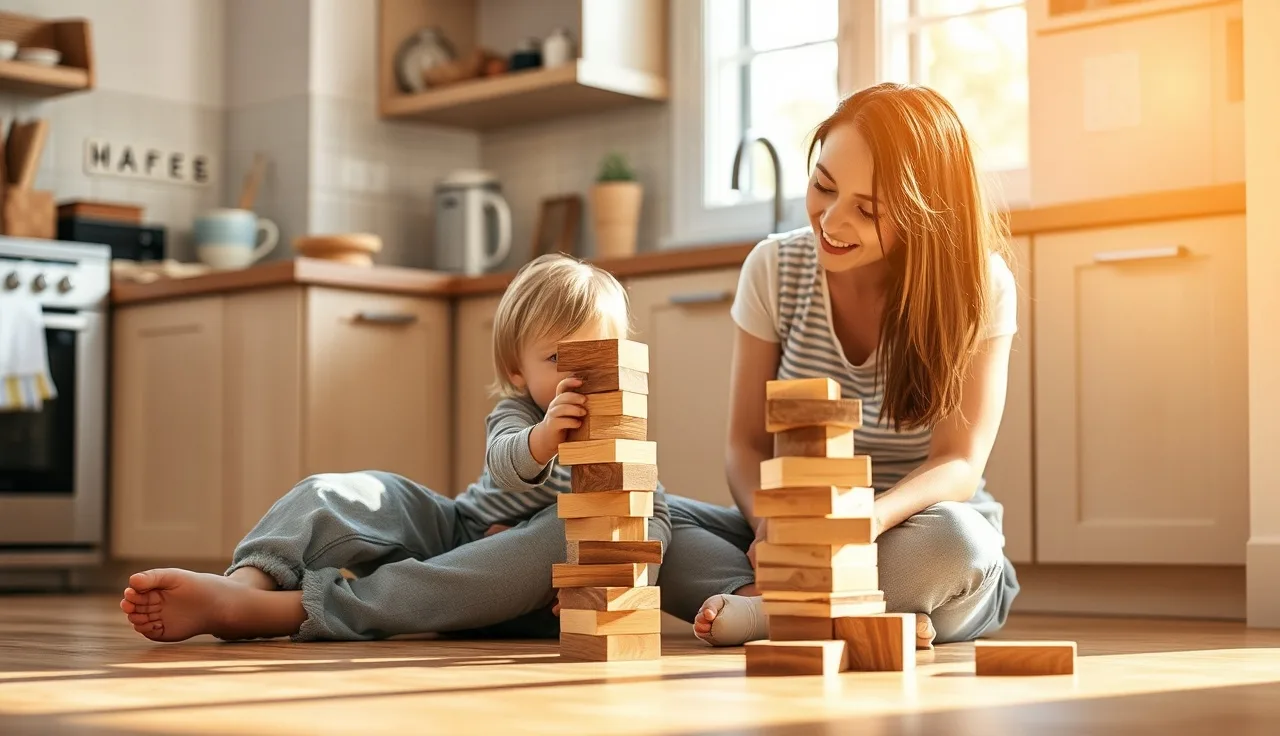
Building blocks: "Big block. Put it on. On top. It fell! Uh oh. Try again. One more."
Reading a book: Skip the comprehension quiz. Instead: "Dog. Silly dog. Dog is running. Oh no, he's stuck. He got out. Happy dog."
In the car: "Green light. We're moving. Fast. Red light. Stop. I see a truck. Big truck. Vroom."
Notice the pattern: short phrases, present tense, concrete words tied to what's happening right now. No questions. No "can you say." No waiting with raised eyebrows for a repetition. Just words, given freely.
You don't have to narrate every second, either. Natural quiet during play matters, because it gives your child space to start something. The modeling lives alongside genuine quiet time. It doesn't replace it.
Frequently asked questions
How do I model language without feeling like I'm just talking to myself?
It feels strange at first, especially when your child doesn't respond visibly. But remember that understanding almost always develops ahead of speaking, so you're filling a tank that eventually overflows. Most parents say it starts to feel natural within two to three weeks of steady practice, and that's usually around when they start catching small responses: more eye contact, a reached hand, a vocalization. Those are proof your child is listening.
Should I stop asking my child questions entirely?
Not entirely, but cut way back on test questions like "what's that called" or "say this." Choice questions carry less pressure ("crackers or banana?"), and open-ended ones that welcome any answer work well too ("what happened?" beats "what color is that?"). A rough target many SLPs suggest is one question for every four or five comments, rather than the four questions per comment most parents default to.
My child is 18 months and not talking yet. Is it too early to worry?
At 18 months, children typically have several words and are starting to combine them. If your child has fewer than five words or isn't pointing to show you things, mention it to your pediatrician and request an evaluation. Early intervention services for children under 3 are free through federal IDEA Part C funding, and earlier intervention consistently produces better outcomes than waiting.
What's the difference between modeling language and narrating everything obsessively?
Narrating nonstop, with no pauses or silence, can overwhelm a child's processing. Good modeling is targeted: short phrases, tied to what your child is focused on, with genuine pauses built in. Think punctuated narration, not a running monologue. If your child looks away, stops, or gets agitated, that's a signal to pull back on verbal input, not add more. Watch their cues and match their pace.
Can I model language using sign language or pictures even if my child isn't deaf?
Yes. Many SLPs recommend pairing spoken words with a consistent gesture or sign, especially for children who aren't talking yet. Signs don't delay speech; research shows manual signs used alongside spoken words support verbal development rather than replace it. Pictures and simple symbol boards do the same job, and they introduce the idea of AAC in a low-tech way before any device ever shows up.
How is language modeling different from the Hanen 'It Takes Two to Talk' program?
It Takes Two to Talk is a parent-implemented program from the Hanen Centre that teaches many of the same strategies: following the child's lead, observing before interacting, modeling one level above, replacing questions with comments. It's a structured group program for parents of late talkers, usually run by a certified SLP. Language modeling is the underlying strategy; Hanen is one structured way to learn and practice it with professional coaching.
My child uses an AAC device. How do I model language on it without it feeling forced?
Start during routines where your child is already motivated: mealtimes, favorite play, getting dressed. Pick three to five high-frequency, high-motivation words and model those consistently before branching out. Touch the symbols as you speak the words, at a comfortable pace. You don't need to touch every word in a sentence, just the core ones. Aim for density (many models of a few words) over variety at first.
Does language modeling help with sentence structure, or just vocabulary?
Both. Early modeling builds vocabulary because you're labeling the world, but the MLU+1 principle (modeling one phrase length above your child's current level) gradually brings in grammar too. When you expand "more" into "want more juice" or "go" into "you want to go outside," you're modeling syntax. Over many exposures, children pick up the patterns without any explicit grammar lesson.
What if my child's other parent or caregiver refuses to do this and keeps demanding speech?
This is genuinely hard. You can't force another adult, but you can share a short resource (ASHA's parent handouts are free and credible) and frame it as strategy rather than criticism. Some families find it helps to have a speech therapist explain the reasoning to all caregivers together, since hearing it from a clinician lands differently than hearing it from a partner. Partial consistency still beats none.
How long before I see results from language modeling?
Most researchers and clinicians describe a window of several weeks to a few months before expressive changes become obvious, though understanding often improves sooner. Yoder and Warren's 2002 trial used a 6-month intervention window and found significant gains by that point. Don't expect overnight results: track small things like whether your child looks at you more, vocalizes in response, or reaches and waits. Those are early signs it's working.
Is there a risk of modeling the wrong words or phrases?
The risk is low. You're aiming for words your child is likely to need: names of favorite objects, actions, social routines. If you happen to model a word they're not ready for, nothing is lost; they just ignore it. Focus on functional words first, things like want, more, go, stop, help, mine, no, yes. These carry the most communicative weight early on.
Can I model language during screen time or video calls?
Live video calls (FaceTime with a grandparent, a telehealth session) count as interactive input, though research suggests children under 2 learn less from screens than from in-person interaction. Passive viewing is a poor modeling context because there's no response back to your child. If your child does watch videos, sit alongside and comment on what's happening; that adds live modeling on top of the content.
My child ignores everything I say. Should I still model?
Yes. Children who seem to be ignoring you often process language peripherally. Autistic children in particular may be listening closely while looking elsewhere, sometimes to reduce sensory or social load. Keep the models short, keep them tied to what your child is actually doing right then, and resist the urge to crank up volume or frequency. Calm consistency is the goal.
Sources
- ASHA, Augmentative and Alternative Communication (AAC) overview: Aided language stimulation defined as modeling symbol use on a communication display while simultaneously speaking corresponding words
- ASHA, Late Language Emergence practice portal: Expressive language in late talkers frequently lags behind receptive comprehension; input-focused approaches are supported
- Aldred C, Green J, Adams C. A new social communication intervention for children with autism. Journal of Child Psychology and Psychiatry, 2004: Parent-mediated social communication interventions associated with increased child initiations and communication acts in autistic children
- AAP, Autism Spectrum Disorder Clinical Report, Pediatrics 2020: Naturalistic, child-led intervention models outperform adult-directed drill formats on measures of spontaneous language use in autistic children
- Yoder P, Warren SF. Effects of prelinguistic milieu teaching on the syntax of toddlers with developmental disabilities. Journal of Speech, Language, and Hearing Research, 2002: Milieu teaching produced significantly greater gains in spontaneous communication for children with developmental delays; 6-month intervention window used
- Hanen Centre, It Takes Two to Talk program: MLU+1 strategy (modeling one phrase length above child's current level) described as core technique in Hanen parent programs
- Carter AS et al. A randomized controlled trial of Hanen's 'More Than Words' in toddlers with early autism. Journal of Child Psychology and Psychiatry, 2011: Parent-implemented More Than Words program produced significant gains in initiated joint attention and functional play versus controls
- Hadley PA, Rispoli M, Holt JK. Input subject diversity accelerates the acquisition of verb morphology. Journal of Child Language, 2017: Observational data on question patterns in parent input to children with and without language delays
- Snell ME, Chen LY, Hoover K. Teaching augmentative and alternative communication to students with severe disabilities. Research and Practice for Persons with Severe Disabilities, 2006: Systematic review found consistent evidence that aided language stimulation increases symbol use in children with complex communication needs
- CDC, Developmental Milestones, Learn the Signs Act Early: First word typically appears around 12 months after approximately 12 months of language input
- IDEA Part C, Early Intervention Program for Infants and Toddlers with Disabilities, U.S. Department of Education: Parents can contact state Part C programs directly to request free evaluation without physician referral; services free for children under age 3
- ASHA, Telepractice practice portal: ASHA recognizes telepractice as equivalent to in-person services for many communication goals
- Prizant BM, Duchan JF. The functions of immediate echolalia in autistic children. Journal of Speech and Hearing Disorders, 1981: Echolalia in autistic children is often communicative and reflects strong auditory memory and language processing, not random behavior