Last updated 2026-07-11
TL;DR
Low-tech AAC materials (communication boards, PECS cards, core word books) get lost because they travel everywhere a child goes. The fix pairs physical organization (carabiners, binders, bright zipper pouches) with digital backup (photograph every board) and a placement routine every adult follows. When something disappears, a printed backup or a home-laminated replacement can be ready in under 15 minutes.
Low-tech AAC goes missing because it goes everywhere your child goes: home, school, therapy, grandma's house, the cereal aisle. Every setting is one more chance for a board to slip out of a bag or hide under a couch cushion. You're not disorganized. These materials are just built to travel, and travel is exactly when things get left behind.
The American Speech-Language-Hearing Association defines low-tech AAC as any non-electronic communication support, including picture symbols, communication boards, PECS cards, and core word books [1]. These things are light, small, and usually attached to nothing. A laminated card that slips out of a backpack doesn't set off an alarm the way a dropped tablet would. It just quietly stays behind.
Part of the problem is that home, school, and therapy each run on their own habits. A folder with a tidy home in the speech room might have no assigned spot at all once it lands on your kitchen counter Friday afternoon. Before buying any organizing supplies, figure out where things actually go missing. Three culprits show up again and again: no designated spot in each environment, materials that blend in with every other folder and paper, and no backup copy anywhere.
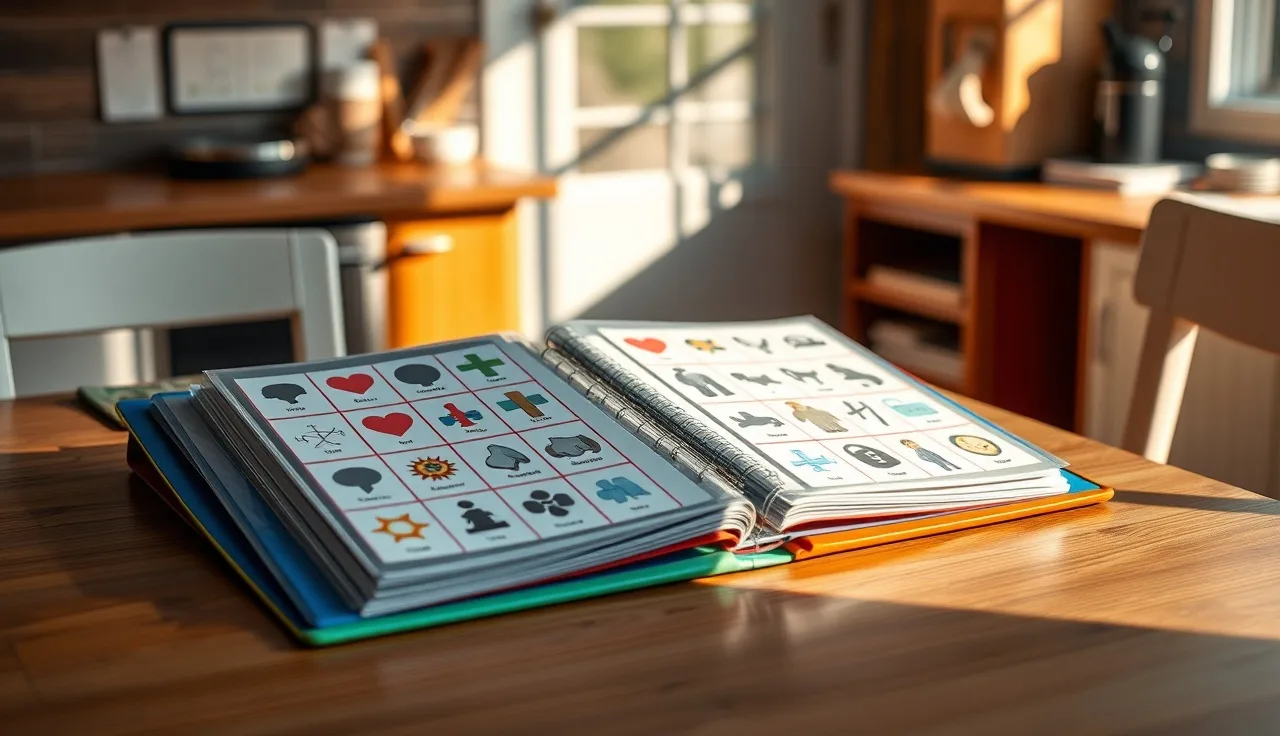
The systems that actually work make the material physically hard to lose, which rules out most loose-folder, good-intentions approaches that quietly fail by October. A half-inch three-ring binder with heavy-duty clear page protectors holds boards flat and visible, costs under five dollars at any office supply store, and is hard to mistake for random paper (label the spine with your child's name and "Communication Book" in big print). For single cards or small boards, a carabiner clipped to a backpack zipper pull keeps the card attached to the bag; lanyards work for adults and older kids but skip them for young children, since the American Academy of Pediatrics warns against neck cords for young children because of strangulation risk and recommends a breakaway safety feature whenever a neck attachment is used [2]. A zipper pouch in one loud color (neon orange, say) used for all AAC materials in every setting takes the guesswork out for teachers, aides, and grandparents: see orange, put it back in the bag. A strip of industrial velcro on the fridge, a classroom wall, or a therapy table gives the board a home base that's always in view, and an empty strip tells everyone instantly that something's missing. For kids who move through a lot of settings, a communication vest or apron with velcro panels keeps symbols on the child's body, which mostly kills the "left it on the table" problem; AAC-specialized classrooms rely on these constantly. None of this costs much. A binder, a few zipper pouches, and a roll of velcro run under fifteen dollars combined. The real investment is setting it up the same way every time.
Back up every board digitally
A photo on your phone is the fastest backup you'll ever make. Spend ten minutes shooting every board, every card set, and every communication book your child uses, then drop them into a phone album called "AAC Backup" and share it with the school SLP and any regular caregiver.
If you built boards in a program like Boardmaker, keep the source file in a cloud folder, Google Drive, iCloud, or Dropbox. Don't trust a single local copy sitting on one laptop. For PECS-style cards, photograph each one against a plain background; if a card goes missing, you can print a replacement from the photo, laminate it with a home laminator (roughly $25 to $40 at most stores), and have a working card the same day. Some families set up a shared Google Drive folder with the school so any staff member can print a replacement without waiting on a parent's email. It's worth doing at the start of each school year. Ask your child's speech therapist what file format they use for the boards so you're holding the editable version rather than just a screenshot. And back up after every update: boards change as kids grow and add words, and an outdated backup can genuinely confuse a child, so treat backing up as part of the routine whenever you add or swap a symbol.
Label so materials find their way home
Label everything with your child's name, a phone number, and the words "Communication Device, Please Return." That last line does most of the work, since most people who find a laminated picture board have no idea what it is. Tell them it's a communication tool someone needs back, and the odds of it coming home go way up.
Put labels on the back of each card, inside the front cover of a binder, and on the outside of any case. Permanent marker on wide masking tape works fine; printed adhesive labels look neater but aren't necessary.
Schools have a stake in this too. The Individuals with Disabilities Education Act (IDEA) requires that schools provide assistive technology devices and services when an IEP team decides they're necessary for a child to receive a free appropriate public education [3]. Low-tech AAC provided through an IEP is school property as much as it's your child's tool, so the school has its own reason to keep track of it. Ask your case manager whether the materials are logged in the district's assistive technology inventory; if so, the school likely already has a labeling and tracking policy you can piggyback on. For anything you make at home, keep a running inventory list in the cloud and update it whenever you make something new, so you always know exactly what exists and what you'd need to rebuild.
Get everyone following the same placement rule
Placement routines work when every adult in every setting knows the rule, and the rule is simple enough to follow half-asleep. That's the whole trick. A good rule sounds like: "The communication book lives in the front pocket of the backpack when traveling, and on the kitchen table at home." Write it down, tape a copy inside the backpack, post one at school, and hand one to every therapist and caregiver. When everyone runs the same rule, the book is almost always in one of two places. Families using early intervention services should set these habits early, ideally before the transition to school-based services around age 3, since routines built early tend to stick with the child.
End-of-day handoffs are a classic failure point: materials get left on desks and in cubbies right at pickup, when everyone's rushed and half out the door. The fix is simple: add "communication book in backpack" as the last item on the child's visual end-of-day checklist. A classroom aide can support that kind of checklist without any special training. Therapy-to-home handoffs fail the same way, so ask your SLP to make "materials in bag" an explicit step at the end of every session rather than assuming it happens on its own.
Keep a spare copy at every location
Yes, almost always keep spares. A second set of core boards at school and another at home turns a lost card into a minor annoyance instead of a communication breakdown. Research on AAC implementation keeps naming "lack of access to the device" as one of the main barriers to AAC use across settings [4], and a spare copy removes that barrier for routine situations. It costs a few sheets of cardstock, some laminating pouches, and maybe an hour. For a child using a core vocabulary board, print a second laminated copy and keep it in the classroom full-time, separate from the one that travels back and forth (the traveling copy is the one that tends to vanish). For PECS systems, a full duplicate set in a labeled bag at school is a common recommendation; Pyramid Educational Consultants, who developed the PECS protocol, advise having materials available in every environment where communication is expected [5]. Spares need upkeep too. Update the original, then update the spare. A stale spare with words your child moved past months ago can confuse a communication partner or dent a child's motivation to use it at all.
A board can survive being dropped, sat on, and rained on and still end up left on a bus. Durability and loss prevention are two different problems, but the materials that hold up physically are worth the effort anyway, because they last once they do come back. Laminated cardstock is the baseline for a reason. Standard 5-mil laminating pouches (roughly $15 to $25 for 100 in bulk) give cards enough stiffness to grab easily and enough body that they don't fold invisibly into a backpack corner. Go up to 10-mil pouches for boards that take daily abuse; the extra stiffness is noticeable. Boardmaker symbols printed on cardstock, laminated, then backed with adhesive velcro remain the workhorse of most clinic systems: cheap to replace, sturdy enough for daily use.[6] For boards facing heavier use, print on photo paper before laminating: the surface is smoother, colors are sharper, and a child spots the symbol faster. If your child has outdoor recess or does therapy in the community, waterproofing is worth thinking about too. A fully laminated board tucked into a ziplock bag inside a backpack pocket survives most weather, and it's not overkill. A loud, distinctive color helps as well, indirectly: a neon yellow board rarely disappears under a stack of manila folders the way a white one does. When something does go missing, the priority is that the child never goes without a way to communicate. If you have a photo backup, print it immediately, even on plain paper with no lamination, and hand it over. A crumpled printout that works beats a laminated one sitting at home. Kids who use AAC devices alongside paper often lean on the device to bridge the gap while you replace the low-tech materials; running low-tech and high-tech systems in parallel pays off exactly on days like this. For children in autism spectrum speech therapy, a break in routine is already hard, and a sudden switch to unfamiliar-looking materials piles frustration on top. A backup that closely resembles the original softens that, which is why it's worth photographing your boards at full resolution from the start. And tell the school the same day something goes missing: under IDEA, if AAC materials are part of the IEP, the school must ensure access to needed tools during the school day,[3] and they may have a replacement process or materials library you don't know about. Teachers and aides lose AAC materials for the same reason parents do: no assigned spot, and everyone's rushed. The fix is the same too, a permanent location and a shared routine, but getting a school to follow it takes clear communication from you. At the IEP meeting, ask that the storage location and handoff procedure go into the accommodations section. It doesn't need to be elaborate: "Communication book stored in [specific location] at all times; placed in front pocket of backpack at end of day" covers it, and once it's written into the IEP it's a documented expectation rather than a hallway request. Ask specifically who's responsible for the materials during gym, art, and music, since those transitions are common loss points when the usual aide doesn't follow the child into the room. A one-page sheet on how to use and store the child's system, tucked inside the communication book, saves substitutes and new aides a lot of guesswork; your child's SLP may write one for you, and ASHA's AAC guidance calls for all communication partners to be trained in both use and care of AAC systems.[1] A good relationship with the classroom aide matters more than people expect. Aides who feel some ownership over a child's tools are simply more careful with them, so tell them why the materials matter and thank them on the days everything comes home. A few free and low-cost apps can bridge the gap when physical materials go missing: LetMeTalk (free, Android), Snap Core First (subscription, iOS and Android), and CoughDrop (subscription with a free tier) all offer core vocabulary boards pullable up on a phone or tablet in minutes. For families wanting something built around neurodivergent kids' communication patterns, Little Words (littlewords.ai) is an AI speech companion that adapts to a child's vocabulary and style; it won't replace a therapist-designed low-tech system, but it can take the edge off a missing board on a hard day. One honest caution: an app on a parent's personal phone has its own access problem at school, since many schools restrict personal devices. If you want a digital backup that actually works in the classroom, ask the SLP whether the school has a loaner tablet or whether the app can go on school-owned hardware. ASHA treats low-tech and high-tech AAC as complementary rather than competing approaches,[1] and kids often learn faster with access to both, so having a digital option ready keeps practice going instead of stalling it when paper goes missing. A full loss-prevention system really only has three jobs: physical organization that makes loss less likely, digital backup that makes replacement fast, and a routine every adult actually follows. Here's what that tends to look like in practice. At home, the communication book lives in one named spot, maybe the kitchen table or a designated hook, and a second laminated copy of core boards sits in a drawer as backup; every board gets photographed and stored in a cloud album shared with the school SLP. In transit, the book always rides in the front pocket of the backpack, clipped to the zipper pull with a carabiner, and the backpack itself is a bright, easy-to-spot color. At school, a classroom set of core boards stays on a velcro strip on the child's desk and never travels home, the storage location and end-of-day handoff are written into IEP accommodations, and the SLP holds the editable source file for every board. At therapy, the therapist keeps a current copy of the child's boards and can print replacements in-office if needed. Setting this up takes a few hours at the start of the school year, and maintaining it runs maybe 30 minutes a month if you keep things current. Do that, and a lost card becomes a small annoyance instead of a communication crisis. If you're new to AAC and drowning in logistics, your child's speech therapist is the right person to build a system around your specific child and settings; they've seen what holds up in real houses and what falls apart. Consistent access to AAC isn't a small thing. A 2019 systematic review in the American Journal of Speech-Language Pathology found AAC intervention effective for children with autism spectrum disorder across communication outcomes, and named consistent access to materials as a key implementation variable.[7] The reverse holds too: when a child's system disappears, even briefly, it can dampen the motivation to communicate and push frustration into behavior instead. For a child already working hard to be understood, losing their tools isn't neutral. ASHA's AAC practice portal states that individuals who use AAC should have access to their systems at all times, and that interruptions in access are a documented barrier to communication development,[1] which is a firm stance from the field's largest professional body. For children served under IDEA Part C (early intervention, birth to age 3) or Part B (school-age services), assistive technology including AAC is addressed directly in federal law, which requires that these devices and services be provided when needed as part of a child's special education, related services, or supplementary aids.[3] So keeping AAC materials available isn't just tidy organization. It's a clinical, and sometimes legal, matter that shapes how well a child communicates and builds language over time. The hour you spend setting up a backup system is genuinely speech therapy infrastructure. As always, this is general information rather than advice for your specific child, so loop in your SLP for anything that needs tailoring to your situation.Frequently asked questions
How often should I update my digital backup of AAC boards?
Update it every time you change or add a symbol. A backup that's even a few months old can be missing words your child now uses every day. A simple habit that works: photograph the updated board the same day you laminate it, before it goes in the bag. Shared cloud albums make this quick since you just add photos from your phone in seconds.
What's the cheapest way to replace a lost AAC board fast?
Print the photo backup on plain paper, tape it to cardstock, and it'll work within minutes. If you have a home laminator, a pouch and about five minutes gets you close to the original. For symbol sets made in free tools like Boardmaker Access or SymbolStix, reprinting from the source file costs only paper and laminating supplies, usually under a dollar per board.
Should AAC materials travel everywhere, or is it better to keep separate sets in each place?
Both, ideally. A traveling set goes everywhere with the child, while a stationary set stays permanently in each main environment, home or classroom, and never leaves. That stationary set is what prevents communication gaps when the traveling one gets lost. For most families, one traveling binder plus one laminated backup set per setting is the right balance of cost and coverage.
Can the school be required to replace AAC materials lost at school?
If the materials are listed in your child's IEP as necessary assistive technology, the school has an obligation under IDEA to keep the child's access to those tools going during the school day. Whether the replacement cost falls on the school or the family depends on who originally provided the materials and what the IEP says, so it's worth clarifying with your case manager in writing at the IEP meeting.
What's the safest way to attach AAC cards to a young child without a lanyard?
Skip neck lanyards for children under 5 because of strangulation risk. Better options include a carabiner clipped to a backpack zipper, a velcro strip on a belt or waistband, or a small apron-style pouch the child wears. Communication vests with velcro panels are made for exactly this, and they keep cards on the child's body without any cord near the neck.
How do I get a teacher's aide to consistently put AAC materials back where they belong?
Write the storage location and handoff procedure into the IEP accommodations so it's a documented expectation, then tape a laminated instruction card inside the communication book. Short, visual instructions work better than verbal reminders. Acknowledge it when things go right, and if you can, connect the aide with your child's SLP for even a brief explanation of why the materials matter. Context tends to make people more careful.
My child chews or destroys AAC cards. How do I make them tougher?
Use 10-mil laminating pouches instead of standard 5-mil ones. They're noticeably thicker and harder to tear or puncture. Some families add a second round of lamination for cards that get heavy use, and symbols printed on photo paper before laminating hold up better than plain printer paper. If the chewing is frequent and significant, ask your child's occupational therapist whether a separate chew tool might help.
Are there free apps that can stand in for low-tech AAC materials temporarily?
LetMeTalk is free on Android and offers a basic core vocabulary system. CoughDrop has a free tier with cloud-based boards. Symbol libraries like Mulberry and ARASAAC are free online too, so you can print replacements from them. These work as bridges, not permanent substitutes for a therapist-designed system, but they can get you through a morning while you reprint a lost board.
What file format should I ask my SLP to use so I can reprint boards myself?
Ask for the source file in whatever program they use (Boardmaker saves as .bm2 files; other tools export as PDF or PNG). A high-resolution PDF prints most reliably on any computer, and a PNG or JPEG photo works fine as backup if the source file isn't available. The goal is being able to reproduce the board at its original size without needing the SLP present.
How do I explain to grandparents or other caregivers why AAC materials need to come home?
Keep it simple and specific: "This book is how she tells us what she wants and how she feels. If it stays at your house, she can't use it tomorrow at school." A note inside the front cover with your phone number and the words "Please return, this is a communication tool" helps anyone who handles the book understand without needing a full explanation.
How many backup copies of AAC materials is too many?
There's no hard ceiling, but the real limit is how much effort it takes to keep every copy current. Most families manage two physical copies (one traveling, one stationary per setting) plus a digital backup. If copies multiply without getting updated, you end up with outdated vocabulary scattered across settings, which confuses communication partners and slows a child's progress.
What's the best container for carrying AAC materials in a backpack?
A rigid, bright-colored pencil case or zipper binder pouch works well: rigid keeps boards flat and visible, and bright color makes it easy to spot in a bag full of neutral folders. A clear front panel so anyone can see the symbols inside is a nice bonus. Avoid soft fabric pouches, where materials fold and get buried. Most families find the front exterior pocket of a backpack is the most consistent spot to use.
Sources
- American Speech-Language-Hearing Association (ASHA), Augmentative and Alternative Communication Practice Portal: ASHA defines low-tech AAC, states that individuals who use AAC should have access to their systems at all times, and notes that all communication partners should receive training in use and care of AAC systems.
- American Academy of Pediatrics (AAP), Choking Prevention: AAP guidance recommends avoiding neck cords for young children due to strangulation risk; breakaway safety features are recommended when neck attachments are used.
- U.S. Department of Education, Individuals with Disabilities Education Act (IDEA), 20 U.S.C. § 1401: IDEA requires that assistive technology devices and services be provided to children when the IEP team determines they are necessary for a free appropriate public education; schools must ensure access during the school day.
- Baxter S et al. (2012), International Journal of Language and Communication Disorders, "The Barriers and Facilitators to AAC Use": Lack of access to the AAC device is consistently identified as one of the main barriers to AAC use across settings in the research literature.
- Pyramid Educational Consultants, PECS Implementation Guide: PECS-trained practitioners recommend having materials available in all environments where communication is expected, including duplicate sets.
- Ganz JB et al. (2019), American Journal of Speech-Language Pathology, "Systematic Review of AAC Intervention for Autism Spectrum Disorder": A 2019 systematic review found AAC intervention effective for children with ASD across communication outcomes, with consistent access to materials identified as a key implementation variable.
- U.S. Department of Education, IDEA Part C Early Intervention Regulations: IDEA Part C covers assistive technology for children from birth to age 3 in early intervention programs.
- Alzrayer NM et al. (2017), Research in Autism Spectrum Disorders, "Teaching iPad skills and AAC use to children with ASD": Research supports that low-tech and high-tech AAC systems are complementary rather than competing approaches, and parallel use supports communication development.
- ASHA, AAC Practice Portal, Access and Participation: ASHA states that interruptions in AAC access are a documented barrier to communication development, and individuals should have access to their AAC systems at all times.