Last updated 2026-07-10
TL;DR
You can raise your child's daily communication chances with small, deliberate changes at home: put desired items out of reach, build in choices, cut background noise, and follow your child's lead in play. ASHA recommends these environmental strategies, and naturalistic language research backs them up. They work alongside formal speech therapy, not instead of it.
Why does your home environment affect how much your child communicates?
Most of the words a young child learns don't come from structured therapy sessions. They come from hundreds of small moments scattered across a regular day: asking for a snack, pointing at the dog, handing you a broken toy. Your home either sets up those moments or quietly prevents them.
Research on naturalistic language intervention has found again and again that building communication opportunities into daily routines produces strong vocabulary and language gains, especially for children with language delays [1]. ASHA's clinical guidance on late language supports "arranging the environment to increase communication temptations" as a core strategy for parents working with late talkers and children with developmental language differences [2].
The catch is that most homes are set up for a child's independence, not their communication. Snacks are within reach. Toys sit in open bins. The TV runs in the background. Each of those conveniences quietly removes a reason for your child to say something to you. That's not a parenting failure. It's just useful to know, because it means the fix is genuinely simple.
What is a "communication temptation" and how do you create one?
A communication temptation is any setup that gives your child a reason to communicate. The idea comes from the Hanen Centre's More Than Words program and shows up across naturalistic language research under different names: engineered environments, communication opportunities, language facilitation strategies [3].
Here's what that looks like in practice.
Put desired things just out of reach. Crackers on a shelf they can see but not touch. Bubbles in a container they can't open alone. A favorite toy on top of the fridge. This is called "sabotage" in the research literature, and it sounds crueler than it is. You're not withholding things to frustrate your child. You're creating a moment where they need to involve you.
Give small amounts and wait. Instead of filling the cup, give one sip and pause with an expectant look. Wait at least 5 seconds, which research calls a "time delay" strategy. Children given longer wait times produce more spontaneous communication than children who get an immediate response [1].
Break something on purpose. Wind up a toy and let it run down. Then look at your child and wait. Hand them a container with the lid on too tight. These are classic temptations because they create a real, felt need.
Set up incomplete routines. If you always start bath time by running the water, then turning on the light, then getting the towel, one night stop after the light and wait. Kids who know a routine notice when you break it.
Which rooms in your home have the most communication potential?
Every room is different. Here's an honest breakdown of where your time is best spent.
| Room | Highest-yield strategy | Common mistake to fix |
|---|---|---|
| Kitchen | Give small amounts, wait for requests | Anticipating every need before they ask |
| Living room | Follow your child's lead during play | Leaving TV on as background noise |
| Bedroom | Narrate the bedtime routine, pause it | Rushing through steps without pausing |
| Bathroom | Sing and pause bath songs, sabotage the soap | Making it fully independent too fast |
| Backyard/hallway | Comment on what they notice, don't quiz | Asking "what's that?" instead of modeling |
The kitchen is usually the single highest-value space. Kids spend real time there, there are dozens of natural requesting moments every hour, and snacks motivate almost everyone. Put desired foods at child eye level but behind a closed container or a door that needs your help. Keep a small bin of request items (a favorite cracker, a squeezy yogurt pouch) visible but not reachable without asking.
The living room wastes the most potential. Background TV is the single most studied environmental variable in early language, and the findings aren't good [4]. A JAMA Pediatrics study found that for every hour of adult-directed TV playing in the background, children heard fewer words from caregivers and produced fewer vocalizations themselves [4]. Turn it off during play. That one change, with nothing else touched, adds communication opportunities back.
How does reducing background noise increase communication?
Children with language delays, and many autistic children, process sound differently than neurotypical kids. Background noise (TV, music, running appliances) competes directly with the speech signal they're trying to parse [5].
The American Academy of Pediatrics recommends zero background TV for children under 18 months and limited, intentional media from 18 to 24 months, because passive media crowds out the back-and-forth that builds language [6]. For kids already showing delays, that recommendation matters even more.
What to actually do: turn off the TV during meals and floor play. Run a white noise machine in the bedroom at night only, not all day. If you play music, choose it on purpose and make it a communication tool. Pause a favorite song and wait for a request to restart it, rather than letting it hum in the background.
One thing nobody talks about enough: noisy toys. Toys that play songs, make sounds on their own, or react to any touch teach kids that the toy does the communicating for them. Low-tech toys (blocks, play dough, simple vehicles, bubbles) need your child to involve you to make anything interesting happen. That's the point.
What does "following your child's lead" actually look like at home?
"Follow your child's lead" is one of those phrases speech therapists say so often it starts to mean nothing. Here's what it means in a physical space.
Get on the floor. Literally. Eye level changes the interaction from adult-directing to side-by-side. When you're down at your child's level, you naturally comment on what they're looking at instead of steering them toward what you think they should look at.
Wait before you speak. When your child picks up a toy, resist the urge to name it or ask about it right away. Watch their face. Wait for them to do something with it. Then comment on what they actually did: "Oh, you're stacking it." Not "What color is that?"
Imitate before you model. If your child makes a sound, make the same sound back. If they bang the block, you bang a block too. This is called contingent imitation, and it produces fast increases in the number of sounds and words children direct at caregivers [3]. It feels odd at first because it's not how adults usually interact. Kids respond to it quickly anyway.
Drop the quiz. Questions like "What's that?" and "What color is it?" are actually harder for late talkers than comments and models. Questions demand a specific answer. Comments invite one. A child who won't answer "What is that?" will often label something on their own after you've commented on it twice with no pressure at all.
This is exactly the kind of strategy a tool like Little Words is built around, prompting parents with real-time coaching cues during daily routines so the approach becomes automatic instead of something you have to keep remembering.
How should you organize toys to increase communication?
Toy organization is one of the most actionable changes you can make this week, and it costs nothing.
Rotate and limit. When everything is out all the time, nothing is exciting and nothing prompts a request. Put two thirds of the toys away and swap them out every one to two weeks. Novelty stays high, which drives language, because children comment more on things that surprise or delight them.
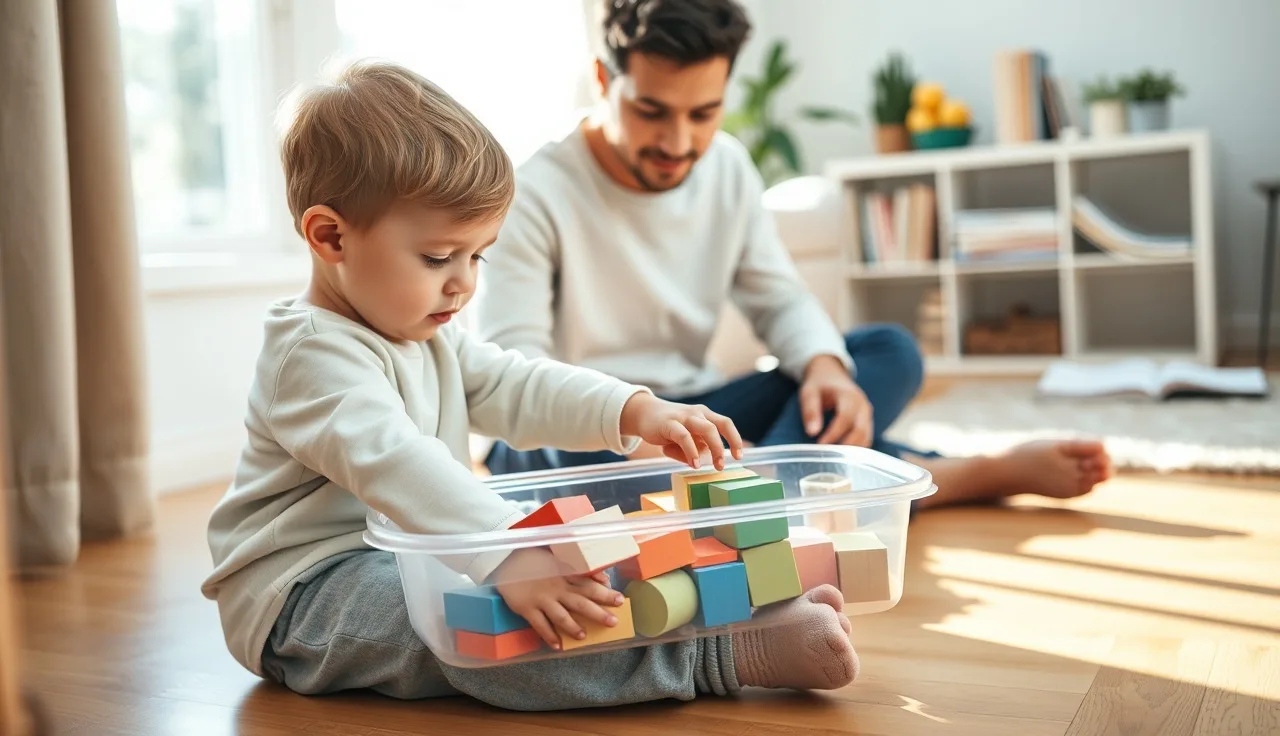
Use clear containers with lids. Open bins are convenient, but they remove the need to ask. A clear container your child can see into but can't open alone creates dozens of requesting moments a day. You can buy these for a few dollars, or reuse old jars and boxes.
Keep the most motivating items in a special spot. One or two of the most desired things (the tablet, the sensory fidget, the slime kit) should live somewhere your child can see but not reach without help. These are your highest-value triggers. Don't use them as rewards. Use them as reasons to start a conversation.
Keep duplicates of a few items. If you have two identical small cars, you can take one while your child plays with the other. That creates an immediate reason to communicate. Speech-language research calls this "withholding a turn," and it reliably increases requesting in children at the one-word stage [1].
If your child uses an AAC device or picture exchange, physical organization matters even more. The AAC device has to be as reachable as the toys it refers to. Always within arm's reach, never stored away.
How can daily routines become language-building moments?
Routines are your most underused tool. A predictable routine hands your child the script, so they know what comes next. Then you pause right before the expected thing, and they fill in the blank. That's not a trick. That's how language acquisition actually works.
Meals: name foods before you give them. Give one bite, then wait with an expectant face. If your child points or vocalizes, say the word before you hand the food over, not instead of handing it over. You want to pair communication with getting what they want, never to use food as a bargaining chip.
Bath time: most kids could run their bath routine in their sleep. Use that. Start the water, get the towel, reach for the shampoo, then stop. Hold the shampoo up and wait. If they've heard you say "shampoo" thirty times, some part of their brain knows that word. The pause gives them a window to use it.
Getting dressed: narrate as you go. "Sock. Sock on. Other sock." Pause after each step. Hand them the sock and wait before helping. Offer a choice when you can: hold up two shirts, name the color of each, and wait for any gesture, point, or sound before you dress them.
Car rides: underrated. The car is one of the few places where you're both stuck for a while. You're side by side rather than face to face, and side-by-side attention works fine. Keep a small bag of favorite objects in the car just for labeling and requesting. Comment on what you see out the window without turning it into a quiz.
For children in early intervention programs, a good speech-language pathologist will help you map specific language targets onto the routines you already have. If yours hasn't done that yet, ask.
Does the physical layout of your home actually matter?
It does, more than most parents expect.
Small, defined play spaces work better than large open rooms for children with language delays. A small space keeps you and your child physically close, which increases joint attention, which is the precursor to shared language [7]. In a big living room where a child can roam far from you, the odds that you're both looking at the same thing at the same time drop.
Use furniture to make cozy nooks. A blanket draped over a table, a corner walled off by a bookshelf turned sideways, a pop-up tent. These do more than look cute. They pull play into a small shared space. The joint attention literature keeps showing the same thing: proximity and shared focus are the two conditions communication needs [7].
Mirrors are genuinely useful, especially for kids working on speech sounds or kids who lean on visual feedback. A small mirror at floor level in the play area gives them visual access to their own face during play without any adult prompting. For children with apraxia of speech, watching mouth movements can support motor learning.
One more thing: your phone. The single most powerful change most parents can make is putting their own phone in a drawer during floor play. A 2019 JAMA Pediatrics study found that caregiver phone use during parent-child interaction was associated with reduced verbal responsiveness and fewer conversational turns [8]. This isn't a guilt trip. It's one of the most evidence-backed changes available to you, it's free, and it's hard.
What about children who use AAC or are minimally verbal?
Everything above still applies. The environment setup matters even more for children who are minimally verbal or who rely on AAC devices or picture communication.
The core principle doesn't change: create a reason to communicate, then wait. What changes is how communication happens. For a child using a speech-generating device, that device has to sit where they can reach it as easily as their toys. If it's across the room, charging, or zipped in a bag, it's not a communication tool. It's a paperweight.
For children using picture exchange or low-tech AAC boards, make the pictures part of the room. Post a small choice board on the fridge with pictures of common snacks. Keep a core vocabulary board on the coffee table during play. Put a visual schedule on the wall at your child's eye level. These aren't only supports for the child. They're conversation starters.
For minimally verbal children, including autistic kids who communicate mostly through behavior or gesture, the goal is not to force words. It's to respond to every communicative act as if it counts, because it does. A point is communication. A pull on your sleeve is communication. Reaching is communication. When you respond to those acts reliably and fast, you teach your child that communication works, which is the base everything else gets built on [9].
Research on autism spectrum speech therapy keeps showing that responsiveness to a child's communicative intent, not correction or prompting, is the variable tied most strongly to language growth in autistic children [9].
How long does it take to see results from environmental changes?
Honestly, it varies a lot, and nobody has good individual-level prediction data. What the research does show: parents trained in naturalistic language facilitation, which includes arranging the environment, change their interaction style within a few weeks, and children show measurable increases in communication attempts within 8 to 12 weeks of consistent use [1][3].
The Hanen More Than Words randomized controlled trial found significant gains in joint attention and communication in children whose parents completed the full parent-training program, which centers on environmental setup and responsive interaction, compared to a waitlist control group [3].
Two things slow results down. The first is inconsistency. These strategies work through repetition. Create a communication temptation three times one day and then forget for four days, and the signal is too weak to matter. Aim for steady use during two or three specific daily routines rather than trying to do everything all the time.
The second is mismatched expectations. A currently nonverbal child will not start producing words in 8 weeks because you rotated the toy bins. What they might do is make more eye contact, point more, vocalize more, and reach for their AAC device more. Those are real gains. They usually come before words, and they count.
When should you call a speech-language pathologist instead of just changing the environment?
Environmental changes supplement professional evaluation and therapy. They don't replace it. If you're worried about your child's communication, get a formal evaluation from a certified speech-language pathologist (CCC-SLP) and start environmental strategies at the same time. One does not stand in for the other.
The AAP's developmental milestones include specific red flags at 12, 18, and 24 months [6]. No babbling by 12 months, no single words by 16 months, no two-word phrases by 24 months, or any loss of language already learned at any age. All of those call for immediate evaluation. None of them are "wait and see" situations.
ASHA's public guidance on late talking notes that children who don't catch up on their own by age 3 face a higher risk of ongoing language difficulties and reading problems [2]. Early evaluation opens the door to early intervention services, provided free or at reduced cost under the Individuals with Disabilities Education Act (IDEA) for children under age 3 in the US [10].
A good speech therapy program will give you a specific home program tied to your child's actual targets. The setup strategies in this article are general, evidence-based, and safe for any child. They work best paired with individual guidance from someone who has assessed your specific child.
If in-person therapy isn't reachable where you live, online speech therapy has a growing evidence base, especially for parent coaching models where the SLP watches you interact with your child and gives feedback in real time.
Frequently asked questions
How do I create communication opportunities for a toddler who doesn't talk yet?
Start by putting desired items just out of reach, giving small amounts of food or drink and waiting, and imitating any sound or gesture your child makes. These are called communication temptations, and they work before words develop because they treat pointing, reaching, and vocalizing as real communication. ASHA recommends these environmental strategies specifically for pre-verbal children.
How much background TV is too much for a late talker?
Any background TV during active play or meals is likely cutting into communication. A JAMA Pediatrics study found that every hour of background TV was associated with measurable drops in caregiver word count and child vocalizations. The AAP recommends avoiding background TV for children under 18 months. For late talkers of any age, off during floor play is the practical goal.
What toys are best for encouraging speech at home?
Low-tech toys that need adult involvement beat battery-powered toys that respond on their own. Bubbles, simple vehicles, blocks, play dough, and books with few words work well because they give you a role in making them interesting. Open-ended materials with no built-in sound responses mean your child has to involve you to make anything happen, which creates communication.
How do I use mealtimes to encourage communication?
Give small amounts and wait before refilling. Name each food before you hand it over. Offer two choices and hold them up while naming each one. Put preferred items in sealed containers your child can see but not open. Sit at eye level if you can. The goal is to turn every snack into a requesting moment without making meals feel like a test.
What is a communication temptation, and is it the same as withholding things from my child?
A communication temptation is a setup that gives your child a real reason to communicate: putting things out of reach, offering small amounts, or pausing a routine. It is not withholding to punish or frustrate. You respond right away when they communicate in any way, including pointing or vocalizing. You're creating the opportunity, not creating distress.
Do I need special materials or equipment to set up my home for communication?
Almost none. The most effective moves (putting items out of reach, giving small amounts, pausing routines, imitating your child) cost nothing. The one purchase worth considering is a set of clear lidded containers to replace open toy bins. If your child uses AAC, the device should be reachable at all times, but that's a positioning change, not a purchase.
How do I encourage communication during play without turning it into a therapy session?
Follow your child's lead instead of directing the play. Comment on what they're doing rather than asking questions. Imitate their actions and sounds. Get on the floor at their level. When you stop quizzing and start narrating, the interaction feels like play to your child while staying full of language input. Most children quickly tune out anything that feels like a drill.
My child is autistic and mostly nonverbal. Do these strategies still work?
Yes, with the right expectations. For minimally verbal autistic children, the goal is to increase any communicative act (pointing, reaching, vocalizing, or using AAC), not to produce words right away. Respond to every attempt quickly and warmly. Research on autism and naturalistic intervention shows that caregiver responsiveness to communicative intent is the variable tied most strongly to language growth, regardless of starting point.
Where in the house should I keep my child's AAC device?
Wherever your child spends time, that's where the device goes. It should be as easy to grab as their favorite toy. During meals, it sits on the table. During play, it's on the floor. A device that lives in a bag or charges in another room won't get used spontaneously. Accessibility is the single biggest factor in whether a child actually uses their AAC system.
How long should I wait after creating a communication opportunity before helping my child?
Research on time delay strategies suggests waiting at least 5 full seconds with an expectant face before prompting or helping. That's longer than it feels. Count silently. Children with language delays often need more processing time than neurotypical peers, and jumping in too fast removes the opening they needed to start. Stretch the wait as your child gets used to the expectation.
What daily routines have the most communication potential?
Mealtimes and snacks rank highest because food motivates almost everyone and the sequence is predictable. Bath time is close behind for the same reasons. Getting dressed offers natural choice moments. Car rides work well because you're both stuck and nothing else competes for attention. Bedtime routines with predictable songs and books that pause mid-phrase are strong too.
Should I correct my child when they say a word wrong, or just respond to what they meant?
Respond to what they meant, then model the correct form naturally without making correction the point. If your child says "buh" for ball, say "Yes, ball! You want the ball." This technique is called recasting, and it's among the most studied language facilitation strategies in the literature. Direct correction, especially repeated correction, tends to reduce how often a child communicates over time.
At what age should I be worried about my child's communication and get an evaluation?
AAP guidelines flag specific milestones: no babbling by 12 months, no single words by 16 months, no two-word phrases by 24 months, or any loss of language at any age. If you notice any of these, get an evaluation from a certified speech-language pathologist rather than waiting. IDEA provides free early intervention for children under 3 in the US, so cost should not be a barrier.
Sources
- Journal of Speech, Language, and Hearing Research: Kaiser & Roberts (2013) review of naturalistic language intervention: Embedding communication opportunities into daily routines produces strong vocabulary and language gains for children with language delays; time delay strategies increase spontaneous communication
- ASHA: Late Language Emergence clinical practice guidance: ASHA recommends arranging the environment to increase communication temptations as a core parent strategy for late talkers; children who do not catch up by age 3 are at higher risk for ongoing language and reading difficulties
- Hanen Centre: More Than Words program research summary and Aldred et al. RCT evidence: Parents trained in naturalistic language facilitation including environmental arrangement showed significant gains in joint attention and communication in children compared to waitlist controls; contingent imitation increases vocalizations directed at caregivers
- JAMA Pediatrics: Christakis et al. (2009), background television and parent-child interaction: For every hour of adult-directed background TV, children heard significantly fewer words from caregivers and produced fewer vocalizations
- American Journal of Audiology: research on background noise and speech perception in children with language disorders: Background noise competes directly with the speech signal in children with language delays and auditory processing differences
- American Academy of Pediatrics: Media and Children communication toolkit and developmental milestones guidance: AAP recommends zero background TV for children under 18 months and limited intentional media from 18-24 months; developmental red flags include no single words by 16 months and no two-word phrases by 24 months
- Journal of Child Language: Tomasello & Farrar (1986) on joint attention and language acquisition: Proximity and shared visual focus (joint attention) are the two preconditions for early communication and are consistently linked to language outcomes
- JAMA Pediatrics: Radesky et al. (2019) on caregiver smartphone use and parent-child interaction: Caregiver phone use during parent-child interaction was associated with reduced verbal responsiveness and fewer conversational turns
- Journal of Autism and Developmental Disorders: Kasari et al. research on responsiveness and language in minimally verbal autistic children: Caregiver responsiveness to communicative intent is the variable most strongly associated with language growth in autistic children, more so than prompting or correction
- U.S. Department of Education: IDEA Individuals with Disabilities Education Act, Part C early intervention: IDEA Part C provides free or reduced-cost early intervention services for children under age 3 in the United States
- ASHA: Augmentative and Alternative Communication (AAC) overview and clinical resources: AAC device accessibility is a core implementation variable; devices must be available at all times for functional communication to develop
- Journal of Speech, Language, and Hearing Research: Camarata (2010) on recasting as a language facilitation strategy: Recasting (responding to meaning then modeling correct form) is among the most studied and effective language facilitation strategies; direct correction tends to reduce communication attempts