Last updated 2026-07-11
TL;DR
Teaching 'more' and 'finished' hands a child their first real tool for controlling what happens to them. Start with whatever mode your child can already manage, whether that's speech, sign, a picture card, or an AAC button, then prompt, wait, and reward right away. Most kids settle into consistent use within two to four weeks of daily practice spread across settings.
Why start with 'more' and 'finished'
These two words matter less as vocabulary and more as self-advocacy. A child who can say 'more' can ask for something they want. A child who can say 'finished' can end something that's become too much. Together they cut down a lot of frustration meltdowns, because the child has a way to signal a need before it boils over.
The American Speech-Language-Hearing Association (ASHA) describes early functional communication as targeting words and symbols that are immediately useful in a child's daily life [1]. 'More' and 'finished' fit that exactly. They come up at every meal, every play routine, every therapy session.
Research on early AAC intervention shows children pick up communication faster when the target words are high-motivation and high-frequency [2]. 'More' checks both boxes: a child who wants more crackers is already motivated, so you don't have to manufacture a reason to practice.
'Finished' matters just as much, especially for autistic children or sensory-sensitive kids who need a reliable, socially acceptable way to exit an activity. Without it, they exit by crying, pushing, or shutting down. With it, they exit by communicating.
Speech, sign, or AAC?
Use whichever mode your child can do right now, today.
If your child has some verbal ability but inconsistent output, start with spoken approximations. 'Muh' for more is fine. 'Duh' for done is fine. Accept and reward the approximation, then shape it toward the full word over time. This is called successive approximation, and it's a core principle of behavior-based speech instruction [3].
If your child has motor speech difficulties, such as childhood apraxia of speech, spoken words may not be the right starting point at all, and signs or a device may actually get results faster. Our guide to childhood apraxia of speech covers motor planning and how it affects word learning.
Sign language works well for many pre-verbal children. The ASL sign for 'more' (fingertips together, tapping) is one of the most commonly taught early signs, and multiple studies show it doesn't delay speech and often precedes or accompanies verbal development [4]. 'Finished' in ASL (hands open, palms in, then rotate out) is also easy to prompt physically.
AAC devices, from a simple two-button GoTalk to a full speech-generating device, are another strong option. The research is clear that AAC doesn't suppress speech development and in many cases supports it [2]. If a pediatrician or team member has raised concerns about AAC, it's worth sharing this with them, since the evidence doesn't support withholding it. Our overview of aac devices goes into more detail.
You don't have to pick just one. Model the word, show the sign, and tap the button all at once. Multimodal input just gives the child more routes to the same concept.
Teaching 'more' step by step
This sequence works across speech therapy approaches, whether you lean toward ABA, PECS, or naturalistic developmental behavioral intervention (NDBI).
Start by picking the right moment: choose a food or toy your child genuinely wants, something you can dole out in small amounts. Snack time is ideal. Blueberries, goldfish crackers, bubbles, a spinning top all work well.
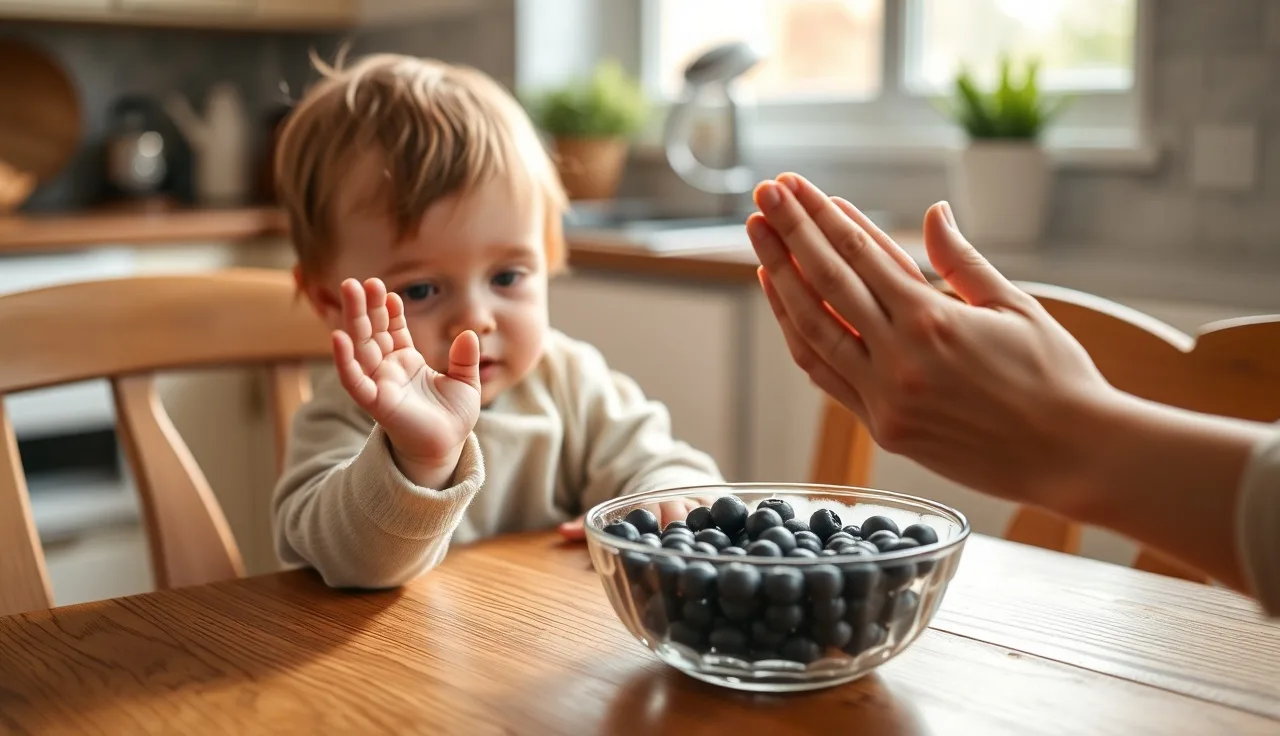
Give a small amount, then pause. Three blueberries, not a full bowl. The pause is what creates the opportunity to communicate. If you meet the need before they ask, they have nothing to request.
After a few seconds of waiting, prompt in whatever mode you're targeting. For speech, say 'more' clearly. For sign, take their hands gently and model it. For AAC, tap the 'more' button yourself so they see the model. This is a time delay prompt with a model [3].
Then wait again, three to five seconds. This is the hardest part for most parents. The silence feels uncomfortable. Sit with it anyway, because waiting is what teaches the child they need to do something.
The instant they approximate the word, sign, or button tap, reward it. Give more, right away, no delay, no long praise speech. Just "yes! more!" and the item. The reinforcer needs to land within about two seconds for the association to form [3].
As your child catches on, start fading the prompt: wait longer before prompting, then switch to a gestural cue like pointing at their hands instead of a physical one, then just the expectant pause. Prompt fading is how independence happens.
Run several short sessions daily rather than one long one. Five minutes, three times a day, beats fifteen minutes once.
Teaching 'finished' step by step
'Finished' runs on the same framework, but relief drives it instead of gain. The child wants to stop, and that desire is what you build on.
Pick an activity the child tolerates but doesn't love: teeth brushing, a puzzle they're bored of, tummy time for a younger child. Aim for mild discomfort, not distress. This isn't about pushing a child past their limit.
Run the activity briefly, then prompt. After 30 to 60 seconds, before the child melts down, hold your hands open (the 'finished' sign) and say 'finished' clearly, or tap the button if you're using AAC.
End the activity immediately when they respond. This is the payoff: the moment they sign, say, or tap 'finished,' stop, clean up, and move on. The child learns that this signal ends things, and that's powerful.
Practice in preferred activities too. If 'finished' only ever means escaping something bad, the child may not generalize it to ending things they like on their own terms. Try it at the end of a snack, the end of a TV show, the end of a bath they enjoy, saying "all finished!" and modeling it there as well.
Some children protest hard when you introduce a structured end to a preferred activity, and that's normal. Keep sessions short and end them before protest erupts whenever you can. The sign should feel like a tool, not a punishment.
What if my child won't imitate at all?
Imitation underlies a lot of speech learning. If your child isn't imitating gestures or sounds yet, targeting 'more' verbally may be jumping ahead.
Start with object imitation: roll a car back and forth, tap a drum twice, stack a block. If that goes well, move to gross motor imitation like clapping, waving, or stomping, then oral motor imitation like blowing, kissing, or clicking the tongue, then sounds, then words.
If imitation is genuinely absent, that's a signal to loop in a speech therapy speech therapist for an evaluation. ASHA recommends evaluation by 18 months if a child has no words and no gesture use [1]. The early intervention system (Part C of IDEA, for children under 3) provides free evaluations and therapy if your child qualifies [5].
For children who have some gesture and some sound but are stuck, work on 'more' via physical prompting with the sign, then fade slowly. The sign for 'more' is motor-learnable even when verbal speech isn't available yet.
How long does this actually take?
No single study gives a clean timeline for these two specific words, so here's the honest range.
For typically developing children who are just late talkers, a few days to two weeks of consistent practice is common. The concept is simple and motivation is high.
For autistic children or children with significant speech delays, expect a wider range: two to eight weeks for consistent, independent use is reasonable when practice happens multiple times daily [3]. Some children need months if imitation skills are still developing.
Consistency across people and settings speeds things up a lot. If mom practices at snack, dad practices at dinner, and the daycare teacher does it during circle time, the child gets far more learning trials per day, and generalization happens faster.
If eight weeks of daily structured practice brings no response, that's a conversation for a speech-language pathologist, not a reason to push harder on your own.
Should you use sign language, pictures, or a device for a nonverbal child?
If your child has no reliable verbal output, all three are legitimate options, and it helps to know how they actually stack up against each other.
| Mode | Upsides | Limitations |
|---|---|---|
| Sign language | Always available, no equipment, fast to prompt physically | Requires communication partner to know the sign; less legible to strangers |
| PECS (picture cards) | Low cost, portable, widely used | Requires cards to be present; exchange step adds motor demand |
| Speech-generating device (AAC) | Produces speech output; generalizes to all partners | Higher cost; needs charging; some learning curve for setup |
| Vocal approximation | Natural, socially accepted | Not possible for all children; may need motor speech support |
The Frost and Bondy PECS studies found that children often started spontaneously vocalizing during PECS training, something the research team hadn't set out to target [6]. So a low-tech picture system can sometimes feed right back into verbal speech.
Our guide to AAC devices goes deeper on the device options specifically. If your child has already been assessed by a team, they may have a recommendation on file; if not, a school or early intervention SLP can do an AAC evaluation at no cost under IDEA. The American Academy of Pediatrics issued a 2020 policy statement reinforcing that AAC should be offered early and that there's no evidence it harms speech development [7].
Getting other caregivers and teachers on the same page
Consistency matters more than almost anything else in how fast a child picks up a new communication skill. If mom is the only one prompting "more" with the sign, the child learns the sign works at mom's table, not at school.
Write a one-page visual instruction sheet with a photo of the sign or a picture of the AAC button, plus the exact prompt script: wait, say "more," give immediately. Post it wherever it gets used, whether that's the kitchen, the classroom snack area, or the therapy room. Then run a two-minute demo for anyone involved. Skip the theory and just show them: small amount, pause, prompt, reward. Let them try it once while you watch, and that's usually enough.
For school teams, if your child has an IEP, the communication goal can spell out the exact prompt hierarchy and who delivers it. Ask that "more" and "finished" be listed as functional communication targets if they aren't already [5]. Teams working in autism spectrum speech therapy settings are usually already familiar with this approach, so ask your SLP to write the protocol clearly enough that home can mirror school exactly.
Common mistakes parents make teaching these words
The biggest one is prompting too fast. A parent sees the child look at the crackers and jumps in with "do you want more? say more! more!" before the child has done anything at all. No request was needed, so the lesson learned is: look at the crackers and an adult talks a lot.
The second mistake is inconsistent reinforcement. The child signs "more," the parent says "great job!" and then takes ten seconds to actually hand over the item while still praising. Those ten seconds break the association. Reinforce first, praise second.
Third, practicing in only one context. If "more" only ever means crackers, the child may not use it for bubbles or music or swinging, so vary the items and settings starting in week two.
Fourth, not accepting approximations. A child who says "muh" with intent deserves the same immediate reward as one who says "more" perfectly. Holding out for a perfect word teaches the child that communication doesn't work. Shape toward clarity over time, but never let an honest attempt go unrewarded.
Fifth, expecting the child to initiate on their own too soon. Independence comes after a lot of consistent prompted practice, and most children need many prompted trials before they generalize to unprompted use. Three weeks of daily practice is not too long to still be prompting.
Can apps or technology help teach these words at home?
Technology can supplement live, responsive practice, but it can't replace it. The reinforcer that matters is the real item, the actual cracker or bubble wand, and an app can't hand that over.
That said, apps that model language in context can widen a child's exposure to target words across the day, and some AAC apps include "more" and "finished" as core vocabulary buttons because those words belong in every routine. If you want a structured, guided approach to building early communication at home, Little Words (littlewords.ai) offers an AI-guided speech companion that helps parents set up daily practice around core words like these, with coaching on prompt timing and reinforcement. You can start with a quick quiz at littlewords.ai/start to see if it fits your child's profile.
For children who already use an AAC device, practice with the real device inside real routines will always beat an isolated app session. Keep the device within reach during every meal and preferred activity, well beyond therapy time.
When to involve a speech-language pathologist
If your child is 18 months old with no words and no consistent gestures, get an evaluation now rather than waiting a few more months to see what happens [1]. Early intervention under IDEA Part C (birth to age 3) provides free evaluations and, if the child qualifies, free or low-cost therapy [5].
If your child is using signs or AAC but hasn't progressed after two to three months of consistent practice, an SLP can figure out whether a motor planning issue like apraxia of speech, a processing difference, or a prompt hierarchy problem is the holdup.
If things are progressing but you want to move faster, an SLP parent coaching session (often one to two hours) can calibrate your home practice, often for less than a run of weekly one-on-one therapy sessions, and it can move things just as fast. A 2021 ASHA practice advisory noted that parent-implemented intervention in natural environments shows strong evidence for early communication outcomes [8].
You can find a certified SLP through ASHA's Find a Professional tool at asha.org. Telehealth has expanded a lot since 2020 and works well for parent coaching specifically; if in-person access is limited, our piece on what online speech therapy looks like is worth a read. Little Words can also help you organize your questions before that first appointment and track daily practice data so the SLP has real information to work with.
No, and this isn't a new finding. Millar, Light, and Schlosser (2006) reviewed 27 studies and found no evidence that AAC suppresses speech: 89 percent of those studies showed an increase or no change in speech after AAC was introduced [2]. Both the American Academy of Pediatrics and ASHA point to this same body of evidence in their own guidance [7][1]. The worry that signing or a device will make a child "lazy" about talking makes sense on the surface, but the data just doesn't back it up. What actually stalls communication is a child who has no reliable way to get needs met, so they give up trying. Give them a working system, even a nonverbal one, and the motivation to communicate stays alive. That motivation is exactly what speech grows out of. If a pediatrician or relative tells you to hold off on signing because it'll delay talking, ASHA's own guidance states that AAC and sign support communication development across diagnostic groups [1], so it's worth pointing them there. Most kids can say or gesture "more" somewhere between 12 and 18 months. ASHA's milestone guidelines flag two things worth watching: no words at all by 16 months, and fewer than 50 words by 24 months. If your child isn't using "more" or some other reliable way of requesting by 18 months, that's a reasonable moment to mention it to your pediatrician or a speech-language pathologist. If you're using baby sign language, the ASL sign for "more" is simple: bring all four fingertips together on each hand into an O shape, then tap the fingertips together two or three times. It's one of the easier signs for a toddler to approximate, and a rough clapping or pinching motion is worth rewarding before the shape gets refined. "All done" or "finished" starts with both hands up, palms facing you, fingers spread, then rotated outward so palms face away, with a small shake. Some programs simplify this to just pushing an open palm away. Either version works fine, just pick one and stick with it so your child learns a stable form. Word choice matters more than people expect. "All done," "finished," and "done" all mean the same thing, but switching between them while your child is still learning adds noise they don't need. Their brain is trying to lock in a word-concept pairing, so pick one and stay consistent, and once they're using it reliably, they'll pick up the synonyms faster than you'd expect. The same logic applies across settings: if daycare or school uses a different word than you do at home, it can genuinely slow things down early on, so it's worth asking the teacher or IEP team to match the word and sign you're using. Once your child is using the word spontaneously in several places, small variations stop mattering much. The same goes for AAC devices: use whatever word is already programmed into the system. If the device says "all done" but you're saying "finished," you're asking your child to map two signals to one concept, which just slows things down. It's completely normal for a child to sign "more" for everything they want. It's often the first truly functional request, so kids over-apply it to mean something closer to "I want." The fix isn't correction, it's addition: start layering in other request words like "open," "help," or "go" so their vocabulary gets more specific over time. Something similar happens when a child signs "more" not to ask for another helping, but to mean "don't stop." If they sign "more" when a song ends because they want it replayed, that's a reasonable use of the word, just a different function underneath it. Go ahead and honor it, and introduce "again" or "play" later if the distinction starts to matter in your routines. For practice, aim for five to fifteen natural opportunities per word each day. That's less than it sounds: snack time alone can give you ten chances to prompt "more" with small bits of food. Building it into real routines works better than scheduled drills, and most families find their rhythm within a week of paying attention to these moments. You don't need an SLP to get started. Parents are effective communication teachers, and the basic prompt-wait-reward approach is something most caregivers pick up quickly. ASHA's 2021 guidance specifically backs parent-implemented intervention in natural environments as evidence-based. That said, if your child has a diagnosed speech delay, motor speech difficulties, or isn't progressing after six to eight weeks of consistent practice at home, it's time to bring in a professional. If your child is autistic and echoes "more" right back at you instead of using it to request something, that's worth noticing rather than brushing off: echolalia is real communication, not noise, and it may mean they're processing the word rather than requesting with it. Try dialing back your verbal prompt and leaning more on visual or physical cues, like the sign itself or tapping an AAC button, to help shift toward more intentional use. There's more on how this fits into language development in this piece on echolalia. PECS (the Picture Exchange Communication System) is a solid, structured option for teaching both words. In the original Bondy and Frost study from 1994, 76 percent of the 66 preschoolers with autism involved went on to develop speech while using it. For "more," a child exchanges a "more" picture card; "finished" is often taught with a dedicated box or basket where cards get placed once an activity ends.Sources
- ASHA, Early Intervention: ASHA recommends evaluation by 18 months for children with no words and no gesture use; early functional communication targets words and symbols immediately useful in daily life.
- Millar, Light, & Schlosser (2006), American Journal of Speech-Language Pathology, 'The Impact of Augmentative and Alternative Communication Intervention on the Speech Production of Individuals with Developmental Disabilities': 89 percent of 27 studies reviewed showed an increase or no change in speech production after AAC introduction; AAC does not suppress speech development.
- Cooper, Heron & Heward, Applied Behavior Analysis (2nd ed.), Pearson: Successive approximation, time delay prompting, and immediate reinforcement (within approximately 2 seconds) are core principles of behavioral speech instruction.
- Goodwyn, Acredolo & Brown (2000), Journal of Nonverbal Behavior, 'Impact of Symbolic Gesturing on Early Language Development': Teaching sign language to pre-verbal children does not delay speech and often precedes or accompanies verbal development.
- U.S. Department of Education, Individuals with Disabilities Education Act (IDEA), Part C: IDEA Part C provides free evaluations and, if a child qualifies, free or low-cost early intervention services for children birth through age 3.
- Bondy & Frost (1994), Topics in Early Childhood Special Education, 'The Picture Exchange Communication System': In the original PECS study of 66 preschoolers with autism, 76 percent developed speech during or after PECS training; spontaneous vocalizations increased during training even though speech was not a direct target.
- American Academy of Pediatrics, AAC Policy Statement (2020), Pediatrics: The AAP states AAC should be offered early and that evidence does not support withholding it; there is no evidence AAC harms speech development.
- ASHA, 2021 Practice Advisory on Parent-Implemented Intervention: Parent-implemented intervention in natural environments shows strong evidence for early communication outcomes per ASHA's 2021 practice advisory.
- National Institute on Deafness and Other Communication Disorders (NIDCD), Speech and Language Developmental Milestones: NIDCD lists communication milestones and flags absence of words by 16 months and fewer than 50 words by 24 months as concerns warranting evaluation.
- CDC, Learn the Signs. Act Early. Milestone resources: CDC milestone guidance supports early identification and referral for children not meeting communication milestones at expected ages.