Last updated 2026-07-10
TL;DR
Children typically combine two words between 18 and 24 months. To teach two-word combinations, model them constantly, just one word above your child's level, pair words with objects and actions, and use daily routines as practice. If your child isn't combining words by 24 months, talk to a speech-language pathologist.
Most kids start putting two words together somewhere between 18 and 24 months [1]. Before that, they're collecting single words one at a time. The American Academy of Pediatrics expects a 24-month-old to have at least 50 words and to be starting on combinations [2], and that 50-word mark is generally what clinicians want to see in place before combining shows up at all.
These numbers are averages, not deadlines. Some kids hit 18 months and start stringing words together right away. Others stay single-word speakers until 22 or 23 months and then something clicks. Both are normal.
The trajectory matters more than the exact month. A child with 20-plus words by 18 months who keeps adding new ones weekly is likely to reach two-word combinations on their own, maybe with a little support. A child still under 10 words at 18 months, or one whose vocabulary has stalled, is a stronger candidate for early intervention and a look from a speech therapist. Research consistently supports evaluating a child with no word combinations at all by 24 months rather than waiting it out [11].
What a two-word combination sounds like
It's two meaningful words put together to say something more specific than either word alone: "more juice," "daddy go," "big dog," "all done." Real combinations aren't memorized chunks. A child pairs "more" with "cracker" one day and "more" with "bubbles" the next, and that swapping is the tell that they've figured out how combining works rather than repeating a script.
Early combinations tend to fall into a handful of predictable meaning categories [4]:
| Combination type | Example |
|---|---|
| Action + object | "Eat cookie" |
| Agent + action | "Daddy sit" |
| Possessor + possession | "Mama shoe" |
| Attribute + object | "Big truck" |
| Recurrence | "More milk" |
| Negation | "No bath" |
| Location | "Cup table" |
You don't need to teach all seven on purpose. A child who's ready to combine will cycle through most of them once it starts. Your job is to give them plenty of examples across these types so there's material for their brain to work with.
One thing worth knowing: scripted lines from TV, songs, or books, sometimes called delayed echolalia, can look like a two-word combination but aren't. "Ready set go" recited as one block is echolalia. "Go car" said out of nowhere to ask for a toy is a genuine combination. Both are meaningful, but only the second shows the flexible skill you're trying to build.
Why some kids stall at single words
Kids get stuck at single words for different reasons, and some respond fast to home strategies while others need professional help.
The most common reason is simple: not enough single words yet to combine. Research puts the threshold around 50 words before combinations reliably appear [4]. A child with 15 words needs vocabulary building first, not combination drills.
Motor planning can also slow things down. Childhood apraxia of speech is a motor speech disorder that makes it hard for the brain to coordinate the movements speech requires, and kids with it often get stuck at shorter utterances and may need specialized therapy rather than general strategies [5]. Inconsistent errors, a child who seems to grope for words, or a very limited set of vowels are reasons to get an evaluation.
Autistic children may have the words but find the social push toward spontaneous, flexible communication harder. Their route to two-word combinations can look different and may involve AAC tools alongside spoken modeling, and autism spectrum speech therapy is its own area of practice built around that.
And sometimes there's no clear cause at all. The child is simply a late talker with no diagnosis, taking language in normally but producing it slowly, and catching up once they get the right input. This is the group where home strategies pay off most clearly.
The strategy that works best
The best-supported approach is modeling one step above whatever your child is already saying [6]. If they're at single words, you answer in two-word phrases. If they're already combining two, you model three. You're not asking them to copy you on the spot: you're filling their environment with the next target so their brain has thousands of examples to draw from.
Speech-language pathologists call this recasting or expansion, and the American Speech-Language-Hearing Association lists it as a naturalistic intervention with strong evidence behind it for late talkers [3]. It works partly because there's no pressure on the child to perform. You're just handing them a better model and moving on.
In practice: your child holds up a cup and says "juice." You say "More juice. Want juice," and hand it over. No "say more juice," no waiting for a repeat. Or your child points at the dog and says "dog," and you say "Big dog. Dog run," and keep going.
Frequency matters more than technique. Researchers studying parent-run language interventions found that the amount and responsiveness of modeling mattered more than which exact method was used [7]. Fifty small moments of modeling spread through the day during normal routines beats ten reps in a formal sit-down session.
Working it into daily routines
Routines are your best tool because they're predictable (your child already knows what's coming, so they can spend more effort on language) and because they happen every day without any setup.
At meals, every request and transition is a chance to model: "More pasta." "All done." "Want cup." "Hot soup." Slowing the pace a little opens up pauses where your child might attempt a combination before the food arrives.
In the bath, try "Wash hair," "Bubbles pop," "Cold water." Water tends to make kids more alert, and the routine repeats daily, which helps.
Getting dressed gives you body parts and actions for free: "Sock on," "Shoe off," "Blue shirt."
Books carry a lot of weight here too. They let you slow down, repeat the same language across multiple readings, and point to pictures while you model. Look for books with simple, repetitive text and clear action pictures, then narrate the pictures rather than reading the printed words: "Dog runs." "Cat sleeps." "Baby eats."
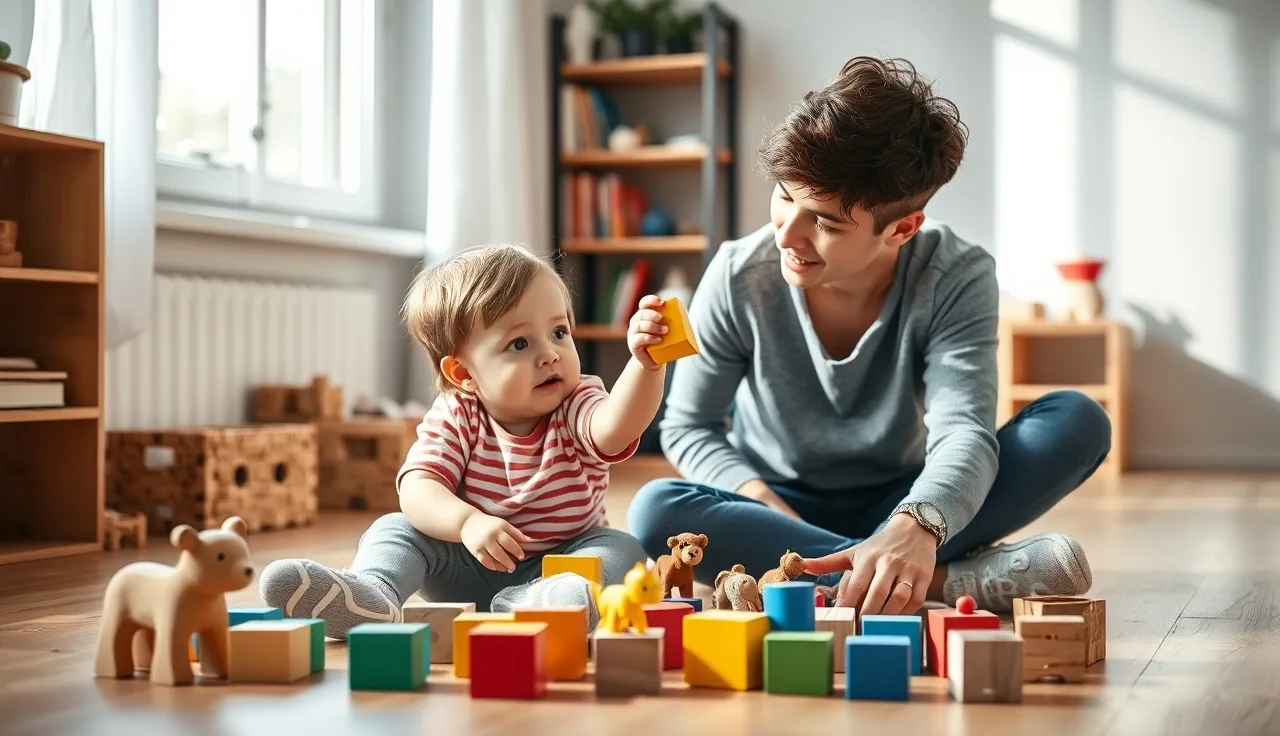
Play works the same way. Follow whatever your child is already doing, narrate it together, and model two-word phrases as you go: "Car go." "Block fall." "Stack high." "Push truck."
One practical note: try not to ask questions. Questions put a child on the spot and usually get you silence or a single word back. Comments and statements create a lower-pressure environment where a child is more likely to try something themselves.
Should you ask your child to repeat phrases back?
This trips a lot of parents up. Imitation drills feel productive because something visible is happening, but the evidence is more mixed than it looks.
For some children, prompted imitation is a useful bridge: if a child can imitate a word or phrase, that shows the motor and phonological pieces are already there, even before the child uses it spontaneously. For many others, especially anxious kids or those who've picked up pressure around talking, prompting backfires. It turns the interaction into a performance, strips out the naturalness, and can teach the child to wait for a prompt instead of starting on their own.
Most of the evidence favors leading with naturalistic modeling and expansion, saving imitation prompts for occasional use only after a lot of no-pressure modeling has happened [6]. If you do prompt, the usual sequence is: model it, wait 5 to 10 seconds, model again if needed, and reward any approximation rather than holding out for a perfect repeat. Don't repeat a prompt more than twice; after two tries, move on, since drilling a child who isn't answering raises stress without speeding anything up.
For children using AAC (augmentative and alternative communication), the same principle applies: model on the device, skip the demand for imitation, and treat any form of communication as a real attempt. Our guide to AAC devices covers more on how these tools work.
What role does vocabulary size play in combining words?
A child usually needs around 50 words before two-word combinations show up on their own [4]. This is one of the best-documented thresholds in early language, and it makes sense when you think about it: you can't combine words you don't have yet.
If your child is below that line, focus on building single words rather than pushing combinations. The same approach applies here: label objects, actions, and things you see throughout the day, use the same simple word for the same thing every time, and cut background noise so your words land clean.
Try counting your child's words over several days. Include words they use consistently on their own, even approximations ("wa" for water counts), and sounds like "uh-oh" or "uh-uh" count too. If you're under 20 words at 18 months, or under 50 words as you near 24 months, mention it to your pediatrician.
Building vocabulary and building combinations aren't really separate stages. You can model two-word phrases all day while you're still working on single words, and the child absorbs both. Just don't push combinations before the vocabulary is there to hold them up.
How long does it take to see progress?
It depends on where the child starts and what's underneath the delay. For a typical late talker with a good vocabulary who isn't combining yet, consistent modeling done many times a day often shows visible results in 4 to 12 weeks. No controlled trial can hand you a precise number for your specific child, and anyone who promises a timeline is guessing. What the research does show is that parent-run naturalistic language interventions produce measurable gains in children's use of target forms, with some studies reporting real improvements over 8 to 12 weeks of steady practice [7].
For children with underlying diagnoses like autism or apraxia of speech, the timeline runs longer and the strategies need a professional's hand. Home practice still matters and speeds things up, but it doesn't replace therapy.
Progress isn't a straight line, either. Many parents describe a plateau followed by a burst: a child might go weeks with nothing new, then produce five new combinations in a single week. That pattern is common, and it doesn't mean the modeling during the flat stretch was wasted. It was being processed.
Write down every new combination you hear. That way you catch progress you'd otherwise forget, and you'll have real data to hand a clinician if you go for an evaluation.
When should you get a professional speech evaluation?
Get an evaluation if your child isn't combining words by 24 months [2]. That's the clearest clinical line, backed by the AAP's developmental surveillance recommendations and ASHA's practice standards.
Consider one earlier if your child has fewer than 10 words at 18 months, has lost words or skills they used to have at any age, is hard for even family to understand at 24 months, shows no interest in communicating (or communicates mostly through gestures and screaming with no word attempts), or has inconsistent sound errors and seems to physically struggle to make sounds.
You don't need a pediatrician's referral to contact a speech-language pathologist directly, though a referral can help with insurance coverage. In the US, children under 3 can get free evaluations through the Individuals with Disabilities Education Act (IDEA) Part C early intervention programs [8]; contact your state's early intervention program, which you can find through the IDEA website.
If your child is 3 or older, evaluations move to Part B of IDEA and run through your local school district. Either way, you have a legal right to request an evaluation at no cost, and online speech therapy has widened access for families in rural areas or with few local options, working well for consultation, parent coaching, and kids who take to video interaction.
Do AAC tools help children learn to combine words?
Yes, and in a real way. There's a stubborn, wrong belief that handing a child an AAC device kills their motivation to talk. The evidence says the opposite: AAC tends to support spoken language, not replace it [10].
For a child who isn't combining words out loud yet, a solid AAC system (a picture exchange system, a speech-generating device, or a core vocabulary board) gives them a way to practice the idea of combining before their speech muscles can pull it off. "More" plus "bubbles" on a device is the same mental combination as saying it aloud.
Modeling on the device matters as much as modeling out loud. If your child uses a speech-generating device, press buttons on it yourself during play and routines, showing them how to put symbols together, rather than waiting for them to use it alone.
Aided language stimulation (also called aided AAC input) has a growing evidence base. A 2014 review in the journal Augmentative and Alternative Communication found that aided input increased symbol use and language complexity in children with complex communication needs [10].
If you're not sure whether AAC fits your child, ask an SLP. It isn't a last resort for kids who've failed at speech. It's a tool you can reach for at any point.
Are there activities that specifically target two-word combinations?
Yes. Beyond general modeling, a few structured play activities make two-word practice feel natural.
Sabotage games work well: hand your child something they can't use without help (a container with a stuck lid, a toy with a missing battery cover) and wait for a communication attempt. When they signal you, model the request: "Open please. Help me." Sabotage creates a real need to communicate, which pulls harder than any drill.
Choice-making is another option. Hold up two items and wait. When the child points or reaches, label it with a two-word phrase: "Red ball. Want ball." If they're ready, hold back a beat and see if they try a word or combination before you hand it over. Don't demand it, just wait.
You can also animate objects: make toys "talk" in short two-word phrases during play. A toy dinosaur that says "Dino eat! More food!" models the target forms in a less direct way that lots of kids take to, especially ones who feel pressure with direct adult interaction.
Song adaptations help too. Take a simple familiar song and drop in pauses for your child to fill: "The wheels on the bus go..." and wait. Once a child can fill in one word, model adding a second: "Go round. Round round."
If you want a structured tool to support this between sessions, Little Words (you can start here) is an AI speech companion app built for neurodivergent kids working on early language goals, including the jump from single words to combinations.
The thread across all of it: keep activities short (5 to 10 minutes), follow the child's interest, and never let the activity turn into a test.
What should you avoid when trying to teach two-word combinations?
A few common mistakes are worth naming outright. Correcting and repeating back errors is one. If your child says "dog big" and you say "no, big dog," you've turned a communication win into a correction. Instead, accept the message and model the target as a natural reply: "Yes, big dog! The dog is big."
Too many questions is another. "What's that?" "What do you want?" "Can you say more?" Questions load a performance demand onto a child who's already working hard to produce language. Statements and comments are your main tool.
Too much input causes problems too. Modeling two-word phrases works because it sits one step above the child's level. If you're speaking in full sentences to a child at single words, the gap between your input and their capacity is too wide. Simplify, and speak in short, clear bursts.
Inconsistency undermines all of it. Modeling every day beats any single perfect session: a parent who does 10 minutes daily will see more progress than one who does an hour every Saturday. And don't wait for the "right" moment. Every moment is a teaching moment: bath, car, snack, waiting in line. The child's brain is always on.
Frequently asked questions
My 2-year-old says words but won't put them together. Is that a speech delay?
If your child is 24 months and not combining any words, that meets the clinical threshold for a language delay and warrants a speech-language evaluation. The AAP recommends children combine two words by 24 months. A single-word vocabulary under 50 words at 24 months is also a red flag. Earlier evaluation leads to earlier support, which consistently produces better outcomes.
How many words does a child need before combining?
Research consistently puts the threshold at around 50 words. Children rarely begin combining on their own before reaching that single-word vocabulary size. If your child is under 50 words, build vocabulary first using the same naturalistic modeling strategies. Once words are accumulating regularly, two-word combinations usually follow within weeks to months.
Is it okay to use baby sign language to encourage two-word combinations?
Yes. Sign language, picture symbols, and gesture systems all support language development and don't delay speech. Using two-sign combinations alongside spoken two-word phrases gives the child more channels to receive and express the same meaning. Several studies have found that signing children reach spoken language milestones at rates comparable to non-signing peers.
What is the 'say it one level up' strategy and does it work?
This strategy, called expansion or recasting, means consistently modeling speech one step longer than your child's current output. If they say one word, you say two. If they say two, you model three. The American Speech-Language-Hearing Association lists it among naturalistic language intervention strategies with strong evidence for toddlers with language delays. It works best done frequently and without pressure to imitate.
My child repeats phrases from TV but won't make up their own. What's going on?
This is echolalia, common in autistic children and some other developmental profiles. Scripted phrases aren't the same as spontaneous two-word combinations, even at the same length. The priority is building flexible, generative language. Work with a speech-language pathologist who understands echolalia. There's more in our guide to echolalia meaning.
Can I teach two-word combinations without a speech therapist?
For many late talkers without underlying diagnoses, parent-run strategies produce real gains. Naturalistic modeling, routine-based practice, and play-based language exposure are all evidence-based and doable at home. An SLP evaluation is still worth pursuing if your child is approaching 24 months without combinations, so you know what you're working with and whether specialist support is needed.
How often should I practice two-word phrase modeling with my child?
Every interaction, all day. That sounds exhausting, but the technique is simple: rephrase what your child says into a two-word version. No setup required. Research on parent-run language interventions shows frequency and responsiveness matter more than structured session length. Ten intentional minutes in a formal activity counts for less than steady modeling across 50 natural interactions.
Do bilingual children take longer to start combining words?
Bilingual children follow the same overall trajectory for two-word combinations but may have a smaller vocabulary in each single language. Their combined vocabulary across both languages usually falls in the normal range. Evaluations should count words across all languages a child hears. Bilingualism doesn't cause language delay, and evaluations should account for bilingual development.
My child uses two-word phrases sometimes but not consistently. Is that a problem?
Variable use is normal during the emergence phase. Children often produce a new form in one context before it spreads to others. Keep modeling, keep tracking what you hear, and watch the trend over weeks rather than days. If you see no new combinations over a month or two of consistent modeling, mention it to a clinician.
Can a child learn two-word combinations through an app or screen?
Passive screen time alone isn't an effective way to build early language. Responsive, contingent interaction with a real person (or an interactive tool built around the child's specific responses) is what drives language learning. Some AI-powered speech tools give responsive practice that supplements what parents do, but watching screens without interaction has little demonstrated benefit for toddler language.
What types of two-word combinations should I model first?
Start with the ones most useful to your child right now: recurrence (more + noun), action requests (verb + object), and rejection (no + noun). These map onto real wants and happen constantly all day. Once those are emerging, move to agent-action pairs ("Daddy go") and attribute-object pairs ("big truck"). Follow what your child cares about most rather than a strict order.
Does early intervention actually make a difference for late talkers?
Yes. Children who get speech-language services during the toddler years consistently show better outcomes than those who wait. Part C of IDEA provides free evaluations and services for children under 3 in all US states. Research shows language interventions begun before age 3 have stronger effects than the same interventions started later, which is why the 24-month evaluation threshold matters.
Sources
- CDC, Developmental Milestones: 24 Months: Children typically produce first two-word combinations between 18 and 24 months
- American Academy of Pediatrics, Developmental Surveillance and Screening Policy: AAP recommends children use at least 50 words and two-word combinations by 24 months
- American Speech-Language-Hearing Association, Late Language Emergence Evidence Map: ASHA identifies expansion and recasting as naturalistic language intervention strategies with strong evidence for late talkers
- Fenson et al. (1994), MacArthur Communicative Development Inventories, Monographs of the Society for Research in Child Development: Children typically need a vocabulary of approximately 50 words before two-word combinations emerge; data on semantic categories of early combinations
- ASHA, Childhood Apraxia of Speech (Practice Portal): Children with childhood apraxia of speech have difficulty with motor planning for speech and often get stuck at shorter utterances
- Yoder & Warren (2002), Effects of prelinguistic milieu teaching and parent responsivity education on dyads involving children with intellectual disabilities, Journal of Speech, Language, and Hearing Research: Modeling at one level above the child's current output is a core evidence-based naturalistic language intervention strategy
- Roberts & Kaiser (2011), The effectiveness of parent-implemented language interventions: A meta-analysis, American Journal of Speech-Language Pathology: Parent-implemented naturalistic language interventions produce measurable gains in language outcomes; some studies show significant improvements in 8-12 weeks
- US Department of Education, IDEA Part C Early Intervention Program: Children under 3 in the US are entitled to free evaluations and early intervention services under IDEA Part C
- ASHA, Augmentative and Alternative Communication (Practice Portal): AAC tools support spoken language development, are appropriate at any point, and aided input increased symbol use and language complexity in children with complex communication needs
- Rescorla (2011), Late talkers: Do good predictors of outcome exist?, Developmental Disabilities Research Reviews: Children who are not combining words by 24 months should be evaluated rather than monitored indefinitely