Last updated 2026-07-10
Teach one greeting at a time, model it without demanding anything back, and pair the word with a wave every single time so your child has two ways to answer instead of one. Practice first in moments with zero stakes, before you ever need it in front of Grandma. Most late talkers pick up a greeting faster when adults model it roughly ten times for every one time they expect it back, and kids who use AAC devices learn the same way, just with a greeting button parked on the home screen instead of a spoken word.
A greeting looks simple from where you stand, but for a late talker it's a small performance done live, under watching eyes: recognize the person, sense that a response is expected, find the right word or gesture, and produce it right then. That's a lot to ask in two seconds, and being watched tends to make it harder, not easier.
The American Speech-Language-Hearing Association treats social communication, greetings included, as its own area of pragmatic language, one that many children with communication delays need direct, structured support to build [1]. A greeting isn't really vocabulary. It sits at the crossing point of language, social thinking, and motor output, which is why a child might say "ball" all day at home and go completely silent the second Grandma walks in.
For autistic children the challenge often runs a layer deeper, because a greeting is an arbitrary convention: there's no logical reason "hi" means anything, and many kids need to understand what a greeting is actually for before they'll offer one unprompted. Research on social communication in autism consistently finds that teaching these routines directly works better than hoping a child absorbs them through exposure alone [2]. None of this means your child is being stubborn or rude. Greeting is a skill you teach, not a manner you can just expect to appear.
Start with one greeting, modeled without pressure
Pick a single greeting and stay there. Parents often try to teach "hi," "bye," "hello," waving, and the child's own name all at once, and that spreads practice too thin to stick. Choose whichever greeting your child meets most often, usually a plain "hi" or a wave, and stick with just that one for two to four weeks before adding anything else.
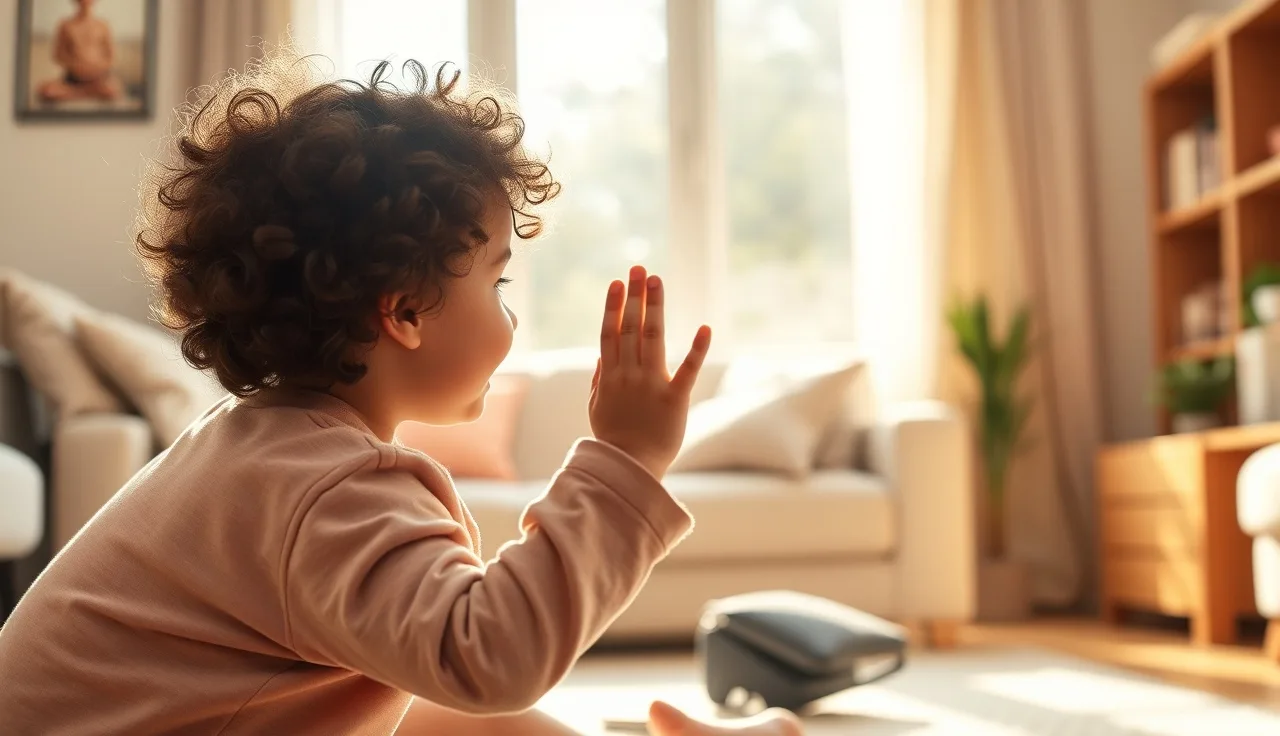
Pair the word with the gesture every time: say "hi" while you wave, always both together, never just one. That gives your child two channels to respond through, and plenty of late talkers find the wave easier to produce than the spoken word. It also helps to model in low-stakes moments before high-stakes ones: greet the dog, greet a stuffed animal, wave at your own reflection in the mirror. These play greetings strip out the social pressure entirely and let the motor-vocal pattern form while nobody's watching.
Watch out for the question trap. "Can you say hi to Grandma?" puts your child on the spot and builds in a failure if nothing comes out. Model it yourself instead: say hi to Grandma, glance at your child warmly, and move on. No stated expectation, no loaded silence. Over weeks your child starts reading the moment on their own, learning that this is where a greeting goes.
The clinical term for this is aided language stimulation, or just modeling, and it's one of the better-supported strategies in early speech-language intervention [3]. Children learn language by hearing it used correctly in context far more than by being asked to produce it on demand. Clinicians often aim for roughly ten models per expected production, though there's no single clean study that pins down that exact ratio.
In practice, that means every time a greeting moment comes up, you say it clearly and warmly with no expectant pause: "Hi, Ms. Maria!" and then you keep moving, no raised eyebrows aimed at your child. You're narrating the social world as it happens, not quizzing anyone. After a few weeks many late talkers start joining in unprompted, sometimes with a rough approximation like "ah" for hi, sometimes just a wave, sometimes the full word. That first spontaneous try is worth a brief celebration, brief enough that it doesn't turn into a spotlight your child dreads next time. And once a greeting does come out, leave the articulation alone. A mumbled "hi" is a win; cleaning up the sound is a job for later, once the routine itself is solid.
Greetings for nonverbal and minimally verbal kids
If your child isn't using words yet, greetings don't have to wait. A wave, a raised hand, a nod, even a brief smiling glance, all of these count as real greetings and build the same social groundwork. You can teach the wave as its own motor skill by gently shaping your child's hand into a wave while saying "hi" during calm moments at home, then fading the physical help as it starts happening on its own.
For kids using AAC devices, a greeting is usually one of the first things a speech-language pathologist programs in, and it belongs on the home page, not two screens deep. If it takes four taps to reach "hi," your child won't manage it in a fast-moving hallway or doorway.
Kids who use echolalia can surprise people here: many children who repeat lines from shows or books will produce a greeting lifted from a familiar context, like a TV intro, before they can generate one from scratch. That's a legitimate starting point. A speech therapist can help map that echoed phrase onto real greeting moments so the word starts doing actual work, and our piece on echolalia covers how that shift tends to happen.
Children with apraxia of speech are managing motor planning on top of everything else, which is actually why "hi" makes such a good target: one syllable, high frequency, simple to say. Many SLPs open a motor-speech program with this exact word. If apraxia is suspected, though, the specific cueing should come from a clinician rather than general advice online.
Keeping practice from feeling like a test
This is where most parents trip up, understandably: you want your child to succeed, so you stage an obvious practice moment, your child senses the setup, and clams up worse than they would have naturally. A few ways around that. Anchor the greeting to something already on the schedule, like saying "Good morning!" every day when you open the curtains, or greeting the teacher first, warmly, every single time at daycare pickup. Predictable routines help most kids, and especially autistic children who lean on structure to feel steady.
Short clips of characters greeting each other, pulled from shows your child already loves, can prime the pattern with zero demand attached; a meta-analysis of video modeling for social skills in autistic children found meaningful effects on greeting behavior specifically [4]. It's not magic, but it's another way the pattern gets in. A short social story, three to five illustrated pages written in first person, can also walk a child through why we greet and what to do, which helps kids who need the logic spelled out before the behavior follows; the Gray Center's guidelines are the standard reference for writing these [5]. And if another child your late talker likes will greet people during structured play, that's peer modeling, and kids often watch other kids more closely than they watch adults.
None of this replaces speech-language therapy. It's the work that happens between sessions that makes the therapy actually hold.
When greetings should show up on their own
Most typically developing children start waving and using social words like "hi" and "bye" between 9 and 12 months, with consistent, spontaneous use usually settling in closer to 18 months [6]. By age 2, most children without a communication delay will greet familiar people at least some of the time without being prompted.
If your child is 2 or older and using no greeting at all, verbal or gestural, mention it to your pediatrician. That alone doesn't point to a diagnosis, but it's a real data point in the bigger picture of communication. The American Academy of Pediatrics recommends developmental surveillance at every well-child visit and formal screening with a validated tool at 18 and 24 months [7]. If concerns come up, a speech-language evaluation is the right next step, and early intervention services for children under 3 are free under IDEA Part C; in most states a parent can request an evaluation directly, without a doctor's referral [9].
The honest answer about what's "normal" is that the range is wide. But waiting past age 2 to see if greetings show up on their own, with no structured support in the meantime, tends to go slower than practicing actively would.
If your child clams up when someone says hello, the worst thing you can do is push. Forcing a greeting, physically prompting it in front of others, or letting your disappointment show on your face almost always backfires, and it attaches stress to the whole moment, which makes the next greeting even harder. Better to stay calm, greet the person yourself, and give your child an easy out. Something plain like "He's warming up" or "She might say hi in a bit" tells the other adult what's going on without putting your child on the spot. Later, at home, you can mention it briefly in a way that looks forward instead of back: "Grandma was so happy to see you today. Next time we might try waving." Then leave it alone. A lot of this anxiety has a sensory or processing root. Suddenly having to shift attention to a new person's face is a lot to take in, and a few seconds of warning, something like "Uncle Dave is coming in soon," softens the surprise and often changes how a child responds. If refusal is constant, intense, and comes with other signs of anxiety or social communication differences, a full evaluation is worth pursuing: a speech-language pathologist can look at the pragmatic side of things, and if anxiety seems to be driving it, a psychologist or developmental pediatrician can help too. Saying your own name as part of a greeting, as in "I'm Jamie," is harder than just saying "hi," and it usually shows up later, somewhere between 2.5 and 4 years in typically developing kids. Plenty of late talkers know their name well before they can say it: they'll turn when called long before the word comes out of their mouth. Two things have to be in place first: recognizing the name when it's called, and being able to produce it as a label. Start with the label piece. During play, model the name in third person: "Jamie's block. Jamie's cup." That builds the idea of the name as a label without asking your child to say anything yet. From there, try simple name games, pointing to yourself and asking "Who am I?" ("Mommy"), then pointing to your child. Offer a prompt if they get stuck, but don't push for one. Once your child can say or approximate their own name in relaxed moments, work it into a greeting during practice: "Hi, I'm Mommy," said by you, then a pause to see what happens. Celebrate any attempt, and if there isn't one, just offer another quiet model and move on without comment. For kids using AAC, the name should have its own symbol or button, and phrases like "I'm [name]" or "my name is [name]" are worth programming in if your SLP agrees it's a reasonable goal. A speech-language pathologist usually starts with a pragmatic language assessment, looking at how your child uses language socially rather than just counting vocabulary, and that shapes the therapy plan from there. For children under 3, therapy often uses naturalistic developmental behavioral interventions (NDBIs), which work greeting goals into play instead of drilling them at a table. These approaches have a strong evidence base for early communication in autism and general language delays [8]. For school-age kids, SLPs lean more on role-play, video modeling, and social scripts, and some children do best learning one set phrase first, like "Hi, my name is Sam," before stretching it to new situations. Should you get an evaluation? If your child is a late talker without a diagnosis, yes. Most states cover speech-language evaluations for diagnostic purposes through insurance, and for children under 3, early intervention evaluations are free. You don't need a diagnosis to qualify for early intervention: a developmental delay is enough [9]. While you're waiting for services to start, or between appointments, the Little Words app supports this kind of modeling-based practice, with guided prompts for parents working on social communication at home, and you can take the quiz to see if it fits your child's profile. If in-person services are hard to reach, online speech therapy is a real option with a growing evidence base behind telepractice, and if autism is part of the picture, we cover that in autism spectrum speech therapy. Getting a greeting to show up in new places is the hard part. A child waves confidently at home, then freezes at the grocery store, and that's not backsliding, it's just how motor and social learning work: new settings add cognitive load, leaving less bandwidth for the greeting itself. The fix is slow, deliberate exposure across settings, moving roughly in this order: home first, since it's lowest demand, then familiar people in a familiar place (Grandma at home), then familiar people somewhere unfamiliar (Grandma at a restaurant), then unfamiliar people in a familiar place (a new neighbor on your street), and finally unfamiliar people in unfamiliar places (strangers at the park). Go through that list slowly, spending as long as your child needs at each stage before pushing ahead. Don't skip to strangers at the park just because that's the end goal: every stage along the way is real progress. Prime your child before a new situation with a short, calm heads-up: "We're going to the library. Ms. Rosa works there. You might wave to her." Knowing what's coming softens the surprise. When a greeting does happen somewhere new, name it clearly afterward: "You waved to Ms. Rosa at the library. That was a greeting." That kind of labeling helps some kids connect the behavior to the idea across different settings. Greeting skills in late talkers tend to develop in a fairly predictable order, and knowing that order helps you spot progress that might otherwise seem too small to count.| Milestone | What it looks like | Typical sequence position |
|---|---|---|
| Tolerates greeting moment | Stays present, doesn't melt down when greeted | Earliest |
| Orients toward greeter | Turns head, makes eye contact briefly | Early |
| Produces gesture | Waves, nods, raises hand | Early-middle |
| Produces vocalization | Any sound during greeting moment | Middle |
| Produces approximation | "Ah" for hi, "bah" for bye | Middle |
| Produces the word | Clear "hi" or "bye" | Middle-late |
| Uses greeting spontaneously | Initiates without a model | Late |
| Generalizes to new people | Uses greeting with unfamiliar adults | Latest |
Frequently asked questions
My 2-year-old waves but won't say hi. Is that okay?
Yes, for now. A wave is a real greeting, and for many late talkers the gesture beats the word by weeks or months. Keep pairing "hi" with the wave every time you model it. If your child still isn't producing any speech approximation by 30 months, ask your pediatrician for a speech-language referral. The AAP recommends developmental screening at 18 and 24 months.
Can an autistic child learn to greet people?
Yes, with explicit teaching. Autistic children often need the purpose of a greeting explained more than the behavior modeled. Social stories, video modeling, and consistent structured practice across settings all have evidence behind them for autistic kids. Some children use a scripted phrase as their greeting permanently, and that's a valid communication strategy, not a failure.
Should I force my child to say hi when they refuse?
No. Forcing a greeting welds the moment to stress and tends to increase avoidance over time. Model the greeting yourself, give your child a face-saving out with the other adult, and move on calmly. Revisit the practice in a low-stakes way later at home. Consistency in modeling matters more than compliance in any single moment.
How many times a day should I practice greetings?
Use every natural greeting that comes up, and skip the manufactured drill sessions that feel fake. Real moments (morning hellos, arrivals, departures, passing a neighbor) are the best practice because they carry actual communicative function. Aim for multiple genuine opportunities a day rather than timed practice at a table.
What if my child only greets with echolalia from a TV show?
That's a real starting point, not a problem. Echoed greetings show your child understands that certain sounds belong in greeting contexts. Work with a speech-language pathologist to map the echoed phrase onto actual greeting moments on purpose. Over time, many children shift from purely echoed greetings toward more flexible social language. For more, read our piece on echolalia.
My child's speech therapist says to work on greetings at home. How do I do that without making it weird?
Anchor greeting practice to predictable daily moments: morning routines, arrivals home, video calls with grandparents. Model the greeting yourself first every time, without requiring your child to follow. Keep anything structured under two minutes. The goal is many brief, positive exposures across the day, not one focused drill.
Is it okay if my child greets with AAC instead of speaking?
Absolutely. An AAC greeting is a real greeting. ASHA's evidence maps hold that AAC does not inhibit speech development and that all modes of communication should be supported. Put the greeting symbol on your child's home screen for quick access. If it's buried, it won't get used in fast social moments.
Why does my late talker greet some people but not others?
Familiarity, predictability, and comfort all change how much bandwidth a child has for a greeting. Your child might greet you reliably (high familiarity, low pressure) but freeze with a neighbor (low familiarity, high demand). This is normal. Generalize systematically: familiar people in new places before unfamiliar people in familiar places.
At what age is not greeting people a red flag?
By 12 months, most children wave. By 18 months, most use at least one social word like "hi" or "bye." If a child past 18 months shows no gestural or verbal greeting and doesn't respond to their name reliably, mention it at the next pediatrician visit. This is one of several early social-communication markers pediatricians screen for in autism evaluations.
How do I explain my child's greeting challenges to family members?
Keep it short and give a clear instruction: "He's working on greetings with his speech therapist. The most helpful thing you can do is greet him warmly yourself and give him a few seconds without pressure. He may not respond right away, and that's okay." Most family members want to help. They just need a specific direction, not a general explanation.
Can early intervention services help with greetings specifically?
Yes. Early intervention under IDEA Part C serves children birth to 3 with developmental delays and often includes speech-language therapy that targets pragmatic skills like greetings. EI evaluations are free, and in most states a parent can request one without a doctor's referral. Services happen in natural environments, meaning your home or childcare setting.
My child has childhood apraxia of speech. Is 'hi' a good first greeting target?
"Hi" is one of the most SLP-recommended early targets for apraxia because it's one syllable, high frequency, and simple to produce. That said, the specific cueing approach for apraxia (DTTC, Nuffield, ReST) should come from a clinician trained in motor-speech disorders. Don't try to shape the motor pattern through general advice alone.
Sources
- ASHA, Social Communication (Pragmatics): Social communication skills, including greetings, are a distinct area of pragmatic language requiring explicit support for children with communication delays.
- Ganz et al. (2012), Focus on Autism and Other Developmental Disabilities – social communication intervention review: Explicit teaching of pragmatic routines including greetings produces better outcomes than incidental exposure alone for autistic children.
- Romski & Sevcik (2005), American Journal of Speech-Language Pathology – Augmentative Communication and Early Intervention: Aided language stimulation (modeling) is one of the most evidence-backed strategies in early speech-language intervention.
- Bellini & Akullian (2007), Exceptional Children – Video modeling meta-analysis for autism social skills: Video modeling shows meaningful effects on greeting behavior specifically in children with autism spectrum disorders.
- The Gray Center, Social Stories guidelines: Social stories are a structured, visual narrative approach to teaching social routines including greetings to autistic children.
- CDC, Developmental Milestones – 12 months: Most typically developing children start waving and using social words like hi and bye between 9 and 12 months.
- AAP, Developmental Surveillance and Screening Policy: The AAP recommends developmental surveillance at every well-child visit and formal screening at 18 and 24 months.
- Schreibman et al. (2015), Journal of Consulting and Clinical Psychology – Naturalistic Developmental Behavioral Interventions: Naturalistic developmental behavioral interventions (NDBIs) embed communication targets into play-based activities and have a strong evidence base for early communication in autism.
- IDEA Part C, U.S. Department of Education: Early intervention services for children under 3 are free under IDEA Part C and can be requested by a parent directly without a physician referral in most states.
- ASHA, AAC Evidence Maps: ASHA's position is that AAC does not inhibit speech development and that all modes of communication should be supported.