Last updated 2026-07-10
PECS (Picture Exchange Communication System) teaches kids to request by handing over a picture card in exchange for whatever they want. Andy Bondy and Lori Frost built it in 1985 at the Delaware Autism Program, and it runs on six phases, starting with a plain physical exchange that needs no speech at all. Depending on the child, it can take anywhere from a few weeks to several months. Peer-reviewed research shows it increases spontaneous communication, and for a lot of kids it seems to support spoken language right alongside it rather than getting in the way.
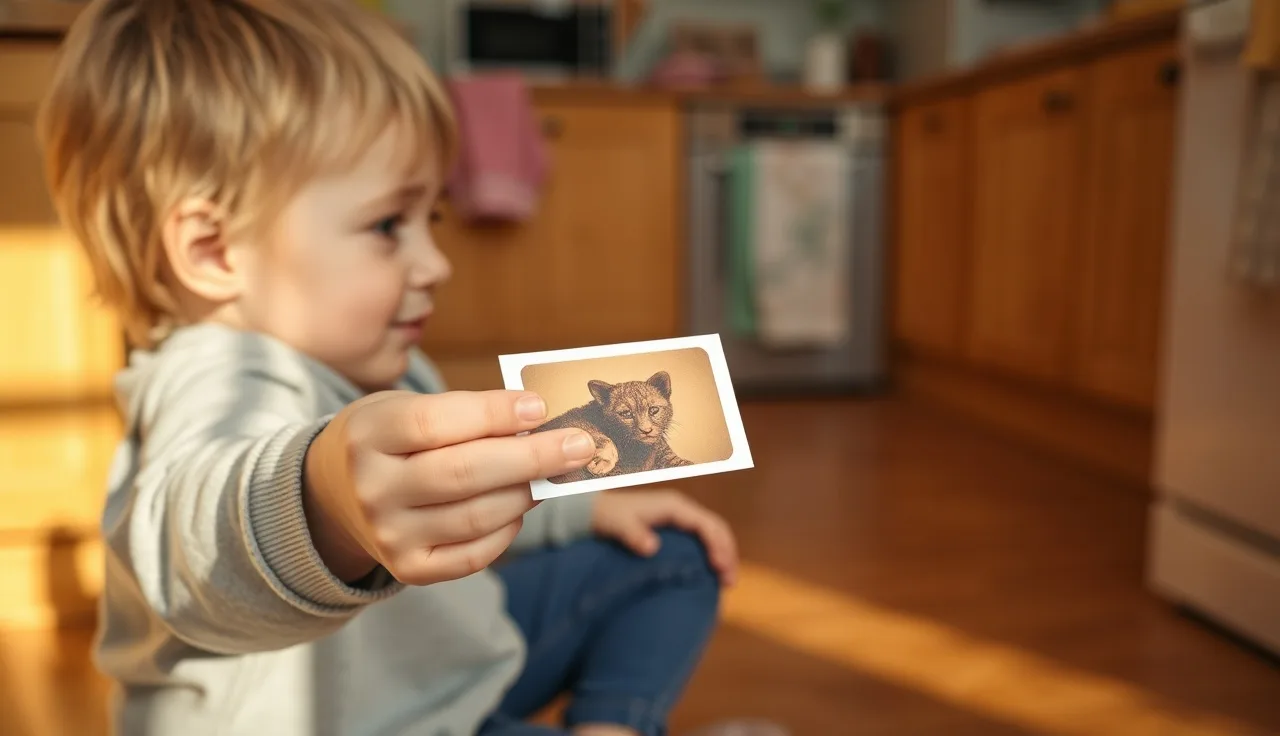
The mechanics are almost mechanical on purpose. Your child picks up a picture of something they want and physically hands it to a communication partner, who then hands over the real thing. There's no pointing, no looking at a board and hoping someone notices. The child starts the interaction, and that's the whole point: spontaneous, child-initiated communication is exactly what trips up a lot of late talkers and nonspeaking kids, and this system builds that habit from the very first trial.
A common misread is that PECS is some kind of last resort for children who will never speak. The original research, published in the Journal of Applied Behavior Analysis, found that many children who learned PECS also developed or increased spoken words alongside it [1]. Nothing about it closes off speech; if anything, it opens a channel. The American Speech-Language-Hearing Association (ASHA) describes it as an augmentative and alternative communication (AAC) strategy with a strong evidence base for children with autism and other developmental differences [2]. It won't be the right fit for every child, but the research behind it is solid.
Which kids tend to do well with it
PECS was built with nonspeaking and minimally verbal children in mind, especially kids on the autism spectrum, though speech-language pathologists also use it for other diagnoses, including developmental delays and apraxia of speech.
Good candidates tend to have little or no functional speech (under 20-30 spontaneous words), can physically pick up and hand over a small card, clearly want specific things (food, toys, videos, sensory items), and aren't yet pointing or gesturing reliably to request. Age isn't really a cutoff: it's been used with toddlers as young as 18 months and with older kids and adults who haven't found another AAC system that clicks. Starting sooner helps, though, since early intervention catches more of those critical developmental windows.
Kids who already have some words can use it too. This isn't about replacing speech, it's about giving a child a dependable way to communicate while their speech keeps developing. A child who says "buh" for ball might still be taught to exchange the ball picture, and often the word itself gets clearer over time as the child links the picture, the word, and the result. If your child has echolalia or leans on scripted phrases without requesting spontaneously, this approach can sometimes bridge that gap by teaching the basic logic of communication: I give you something, I get something back.
The six phases, in actual detail
Bondy and Frost laid out six phases, and most summaries online gloss over the parts that actually matter, so here's what each one really involves.
Phase 1 is the physical exchange itself, and it's where every child starts. The child learns to pick up a single picture card and place it in the communication partner's open hand. You need two adults at first: one sitting across from the child holding the desired item, and one sitting behind the child giving silent physical prompts, guiding the child's hand to the card and then to the partner's hand. The partner hands over the item right away and says something like "Oh, you want the cracker!" No verbal prompts trigger any of it. You're aiming for 80 percent independent exchanges across several trials before moving on.
Phase 2 adds distance and persistence. The child now has to travel to reach the picture, and the partner is farther away or not immediately visible. This teaches the child that communicating means seeking out a partner rather than waiting for one to show up, and it's a surprisingly tough phase for a lot of kids since it demands initiation across space.
Phase 3 introduces picture discrimination. Multiple pictures come into play, and the child has to pick the correct one from an array. You start with two, one clearly preferred item and one neutral or even aversive, then add more gradually. This is where the PECS binder with picture strips becomes essential, and errors here get a specific four-step error correction procedure rather than just a re-prompt.
Phase 4 is sentence structure. The child builds a simple sentence on a sentence strip: "I want ___," attaching the "I want" card and the item picture before handing the whole strip over. A lot of SLPs consider this the biggest functional leap in the whole protocol, since the child is now generating a two-part communicative act.
Phase 5 teaches the child to respond to "What do you want?" Up to this point everything has been spontaneous and child-initiated, so this is a genuinely different skill: a discriminated response instead of an initiation, even though it looks simple on paper.
Phase 6 is commenting, where the child uses sentence starters like "I see," "I hear," or "I have" to talk about things around them. This is where the system moves past requesting into broader communication. Plenty of kids in therapy never formally finish Phase 6, and that's fine: Phase 4 alone produces meaningful functional gains [3].
The published PECS training manual by Bondy and Frost (Pyramid Educational Consultants, 2002) is the primary source for this protocol, and it's worth buying if you're running a home program without an SLP guiding you.
What you actually need to get started at home
The barrier to entry is low here; you don't need expensive technology. The core materials are laminated picture cards (photos or line drawings), a simple binder or book with velcro pages, a sentence strip for Phase 4, an "I want" card, and access to items your child genuinely wants.
The official PECS symbols are sold by Pyramid Educational Consultants, but plenty of SLPs use Boardmaker symbols, photos pulled from Google, or even pictures taken around your own house. Real photos of the exact cracker your child eats or the specific toy they're after tend to work better early on than abstract drawings, especially for kids still building symbolic understanding. Free or cheap symbol sources include the Lessonpix website, Teachers Pay Teachers PECS packs, and plain Google image searches. You don't need the official symbol set to run something functional, though the official materials are well organized.
If you're also looking at AAC devices or apps, keep in mind PECS is fundamentally paper-based. A few apps, like TouchChat and Snap Core First, use similar exchange-based logic, but the physical act of handing over a card is what trains the initiation behavior in early phases. Digital versions can work, though the prompting strategy usually needs some adapting.
What an actual session looks like
A single Phase 1 trial takes maybe 15-30 seconds when things are going smoothly. The item the child wants sits in clear view but slightly out of reach, with the picture card between the child and the item. A second adult kneels or stands directly behind the child, while the partner across the table holds out an open hand and says nothing.
If the child doesn't reach for the card within 3-5 seconds or so, the adult behind them gives a full physical prompt: hand-over-hand, guiding the child's hand to the card, picking it up, placing it in the partner's hand. The partner delivers the item right away with a brief, natural comment ("Ball! You want the ball.").
You repeat this 5-10 times per session, across several sessions a day. Some programs suggest 20-30 trials daily spread across natural moments like snack time, play, or transitions. That sounds like a lot until you realize that with the right setup, opportunities keep popping up on their own.
The goal is to fade the physical prompt as quickly as the child allows: full physical prompt, then partial (a tap on the wrist), then a hovering hand nearby, then nothing. How fast that fading happens varies wildly. Some kids are exchanging independently within a day; others need weeks of full prompting before they start initiating on their own.
The two-adult setup in Phase 1 isn't really optional in the official protocol. One adult trying to both hold the item and deliver the prompt tends to produce exchanges that stay prompt-dependent rather than becoming spontaneous. If a second adult truly isn't available, some SLPs adapt the procedure, but progress is usually slower and prompt dependency more likely.
There's no fixed timeline, and anyone who gives you an exact number of weeks is guessing. The closest thing to hard data comes from a 2002 study by Charlop-Christy and colleagues in the Journal of Applied Behavior Analysis, which found children reached Phase 3 discrimination in an average of 14 to 20 sessions, though the range was wide [1]. A systematic review by Flippin, Reszka, and Watson in the American Journal of Speech-Language Pathology found real communication gains for children with autism using PECS, but over intervention periods anywhere from 5 weeks to several months [4]. Speed depends on how strong and consistent the child's preferences are, whether they can handle small cards without a struggle, how quickly adults fade their prompts, how often the child practices, and where they sit developmentally in terms of symbolic understanding. The table below lays out what tends to help versus hinder progress.| Factor | Faster progress | Slower progress |
|---|---|---|
| Motivation | Strong, consistent preferences | Highly variable or low interest |
| Fine motor | No difficulty manipulating cards | Difficulty picking up small items |
| Prompt fading | Partners fade quickly | Partners over-prompt |
| Consistency | Daily practice, multiple partners | Sporadic sessions |
| Cognitive level | Higher symbolic understanding | Early symbolic stage |
Does PECS help kids talk, or replace speech?
This is the worry parents bring up most, and the evidence actually points the other way. A 2004 study by Ganz and Simpson in the Journal of Autism and Developmental Disorders found that children learning PECS showed increases in spontaneous speech alongside their gains in picture exchange [5]. The Flippin review backs this up, noting speech gains linked to PECS use across several studies, though the effect sizes varied [4].
There's a logical reason for this: PECS teaches a child that communication produces outcomes. Once a child understands that handing you something gets them something back, the motivation to communicate through any channel, including speech, tends to climb. Many SLPs have watched children move from silently exchanging cards, to vocalizing during the exchange, to approximating the word, to eventually saying it clearly.
Still, PECS isn't a speech therapy technique in the traditional sense. It doesn't target articulation or phonology directly. If your child has childhood apraxia of speech or another motor speech disorder layered on top of a language delay, PECS handles the communicative side, but you'll still need direct speech therapy aimed at motor planning.
ASHA's position on AAC, PECS included, is straightforward: "AAC use does not impede speech development and may actually support it" [2]. That statement covers AAC broadly, and PECS fits under that umbrella. Starting PECS isn't giving up on speech. It's building communication, and communication tends to spread across channels once it takes hold.
Common mistakes parents make teaching PECS
A handful of errors show up again and again in home programs. Verbal prompting during Phase 1 is probably the most common one: saying "Give me the picture" or "What do you want?" before the exchange teaches the child to wait for your cue instead of initiating on their own, which undoes the point of the phase. Silence is the protocol.
Skipping the two-adult model is another. One adult juggling the item, the card, and the physical prompt at once almost always creates confusion. If a second adult isn't available, use the item itself as the partner (keep it slightly out of reach) and give physical prompts only from behind. Not ideal, but better than a one-person Phase 1 turning into chaos.
Parents also tend to rush the phases. It's understandable, everyone wants to see progress, but if a child hasn't hit 80 percent independent exchanges in Phase 1 before moving to Phase 2, they'll struggle with the added demand of distance. The criterion exists for a reason.
Another trap: running PECS only during structured sessions. The whole system works because the exchange produces something the child actually wants. Practice only at a table with flashcards, and the child learns a table behavior, not a communication behavior. Work it into snack time, toy requests, and transitions instead.
Keeping too few pictures on hand is a quieter mistake. Phase 3 requires discrimination, which means the child needs several pictures for different items available at once. A binder with only one or two cards doesn't teach choice, it just teaches a single motor routine.
Last thing: pair the exchange with speech. Even in early phases, the communication partner should say a short, natural phrase when handing over the item. That models spoken language even when you're not requiring it from the child yet.
How does PECS compare to other AAC options?
PECS is one tool in a wider AAC toolkit. AAC devices like speech-generating devices (SGDs) offer dynamic display, voice output, and more room to grow vocabulary. Many SLPs now recommend high-tech AAC as a first option, since it doesn't need a second adult for prompting and can scale as the child grows. The tradeoff is cost (SGDs can run $3,000 to $8,000 or more without insurance) and a learning curve for both child and family.
PECS has real strengths: it's cheap (under $200 for a full starter kit, often less), nothing needs charging or troubleshooting, handing over a card is motorically simple, the research base for early requesting is solid, and it holds up fine on field trips, in restaurants, or anywhere a tablet might get dropped.
It has limits too. The vocabulary ceiling sits lower than most SGDs, the binder gets unwieldy as vocabulary grows, there's no voice output so communication can be missed in noisy settings, and the partner has to be physically present to receive the card.
For many children, especially very young ones or those just starting with AAC, PECS is a concrete, low-tech entry point that teaches the basic behavior of requesting. Once that's established, moving to a higher-tech system tends to go more smoothly, since the child already understands that handing over a symbol gets a result. If you're working with an SLP on an autism spectrum speech therapy plan, ask directly how PECS fits alongside any device recommendations. The two can work side by side.
Getting an SLP involved
Official PECS training for practitioners is a two-day workshop run by Pyramid Educational Consultants, the organization founded by Bondy and Frost. It's built for SLPs, educators, and paraprofessionals rather than parents, though some parents do sit in.
For families, the more practical path usually looks like this: request a PECS consultation with a licensed SLP who actually has PECS experience (ask directly whether they've implemented it before, since not every SLP uses it regularly), then arrange a home visit or coaching session where the SLP runs Phase 1 trials with your child and walks you through the two-adult model, and follow up with check-ins every few weeks as you move through the phases.
If you're in early intervention (services for children under 3 in the U.S. under IDEA Part C), you may be able to get PECS training through your IFSP services at no direct cost [6]. Ask your service coordinator about it specifically. For school-age kids, PECS can be written into an IEP as an AAC strategy.
If in-person SLP services are hard to reach where you live, online speech therapy providers increasingly offer PECS parent coaching by telehealth, and research shows telehealth delivery of AAC coaching holds up comparably to in-person coaching on several measures [7].
Little Words (littlewords.ai) also runs a short quiz at /start that helps pinpoint where your child's communication stands right now and which strategies, picture-based or otherwise, might suit them. It's a starting point, not a substitute for an SLP evaluation, and for a broader sense of what that relationship looks like, our guide to speech therapy and speech therapists covers it.
What does the research say about PECS effectiveness?
PECS has one of the stronger evidence bases in pediatric AAC, though the full picture is more nuanced than a single number can capture.
The often-cited 2002 Charlop-Christy study in the Journal of Applied Behavior Analysis (n=3, single-subject design) showed increases in both PECS use and spontaneous speech [1]. Studies like this one, built around single subjects, dominate the PECS literature because randomized controlled trials are rare in AAC research generally.
The largest RCT to date is the PACT trial (Pickles et al., 2016, Lancet). It tested a broader parent communication training program rather than PECS on its own, but PECS was cited as a component strategy, and the trial showed communication gains that lasted through a six-year follow-up [8].
The National Autism Center's National Standards Project lists PECS as an "established" treatment for autism, meaning there's enough evidence to recommend it with confidence [9]. A review by Flippin, Reszka, and Watson in the American Journal of Speech-Language Pathology found "moderate to strong" effects on how often children communicated, but more variable effects on spoken language [4].
In practice, this means PECS reliably increases how often a child attempts to communicate. Its effect on spoken word development is real but inconsistent, and it doesn't predict which children will go on to develop speech. Where the research is most consistent is functional requesting, which is the skill this article focuses on. ASHA's evidence map on AAC lists PECS under "strong" evidence for communication frequency outcomes in children with ASD [2].
Getting PECS to work beyond the therapy table
Generalization is where home programs often stall. A child who exchanges picture cards perfectly at the kitchen table but never uses them anywhere else hasn't really learned to communicate. They've learned a table game.
A few things help move it past that point. Train multiple partners, dad, grandma, the babysitter, an older sibling all need to know how to receive the exchange and respond correctly, because a child who only exchanges with mom has learned mom-specific behavior rather than communication. Practice in multiple settings too: run trials at the snack table, at the grocery checkout, at the playground, in the car. The picture binder should travel everywhere the child does.
Motivation matters more than people expect. Don't run trials with items the child is only mildly interested in; use what they genuinely light up for, since strong motivation is what drives a child to work for something wherever they happen to be. It also helps to probe regularly: once a week, put the child in a new setting with a new partner and see if they initiate on their own. That tells you whether you've got real generalization or just a conditioned routine.
Finally, resist the urge to schedule PECS into set times. A child shouldn't learn that it only happens at 9am and 3pm. Every natural moment of wanting something, breakfast, snack time, choosing a toy or a video, is a chance to use it. Keep the picture within reach and the preferred item just slightly out of reach, and let the environment do the prompting.
Frequently asked questions
At what age can you start teaching PECS?
PECS has been used with children as young as 18 months, though most published studies involve children between ages 2 and 7. There's no firm lower age limit. What matters is whether the child has identifiable preferences, can physically pick up and hand over a card, and doesn't yet have reliable verbal or gestural requesting. Starting earlier, once those pieces are in place, tends to produce better outcomes.
Does a child need to be diagnosed with autism to use PECS?
No. PECS was originally developed for children with autism but is used by SLPs with any child who has limited functional communication, including those with global developmental delays, Down syndrome, or childhood apraxia of speech. Diagnosis isn't a requirement. What matters is whether the child is a functional communicator, not which label they carry.
How many pictures should I start with in Phase 1?
Just one. Phase 1 is about teaching the exchange itself, not discrimination between pictures, so you start with a single image of one highly preferred item. Discrimination between multiple pictures doesn't begin until Phase 3, and introducing several pictures too soon tends to create confusion and slow down learning of the core exchange.
What if my child just grabs the item instead of exchanging the picture?
This is common, and it usually means access needs to be controlled better. The item should stay visible but physically out of reach, so the picture card is the only thing the child can actually get to. If a child can simply take the item, there's no reason to go through the exchange. Block the grab gently, guide them back to the card with the behind-adult prompt, and keep it low-key rather than turning it into a battle.
Should I use real photos or symbol pictures for PECS cards?
Real photographs of the actual items your child sees every day (the specific cracker brand they eat, the exact toy they love) tend to work better in Phase 1 and early Phase 3 than abstract symbols, especially for children still developing symbolic understanding. As the child progresses, line drawings or standardized symbols become easier to manage in a binder and travel better. Start with photos, and move toward symbols as understanding grows.
How do I handle it if my child refuses to touch the picture card?
Sometimes this comes down to tactile defensiveness or sensory sensitivity to certain textures. Try laminated glossy cards, matte laminated cards, or foam-backed cards to see what the child tolerates, and consider larger cards if pincer grip is an issue. If refusal keeps happening regardless of texture, it's worth checking with an SLP, since the real issue might be low motivation for the item or something else sensory or motor-related.
Can PECS be used alongside a speech-generating device?
Yes, and it often is. PECS teaches the underlying behavior of initiating and exchanging, and that skill transfers well to device use. Some SLPs use it as a bridge into high-tech AAC because the child already understands that handing over a symbol gets a result; others run both systems at once. There's no evidence that combining PECS with a device hurts progress on either.
How do I know when to move from one PECS phase to the next?
The standard benchmark is 80 percent correct, independent responses across at least two to three sessions, ideally with at least two different communication partners and in two different settings, before moving on. Some programs instead use 80 percent across 20 consecutive trials. Advancing too early is one of the most common mistakes parents make; it produces progress that looks real until the demands of the next phase reveal the gaps.
Is PECS covered by insurance or funded by schools?
The materials themselves (binders, cards) are generally inexpensive and often bought out of pocket. SLP services that include PECS as part of therapy may be covered under a health plan's AAC or speech therapy benefit. For school-age children, if PECS is written into an IEP as an AAC support, the district is responsible for providing and funding it under IDEA. For children under 3, early intervention services under IDEA Part C may fund PECS training for families.
What happens if my child gets stuck in Phase 3 (picture discrimination)?
This is a common stalling point. Usually it's because the two items in the array aren't different enough in preference (try pairing something highly preferred with something the child actively dislikes), because the pictures look too similar to each other, or because the error correction procedure isn't being followed consistently. The four-step correction from the PECS manual, point, wait, prompt, re-try, matters a lot here. If things haven't budged after several weeks, bring in an SLP.
Can PECS help a child who already uses some words?
Yes. It isn't only for nonspeaking children. A child who has words but doesn't use them to request spontaneously can still benefit, because PECS builds the intentional act of initiating a request. Many SLPs use it with partially verbal children to increase how consistently and how variedly they communicate on their own. It can also prompt verbalization: when the partner models the word during delivery, some children start approximating it themselves.
How is PECS different from just showing pictures to a child?
The exchange itself is the key difference. Showing a child pictures to label or identify is a receptive task. PECS is expressive and spontaneous: the child initiates, picks up the card, and physically hands it over to get something they want. That direction of action matters, because PECS teaches a child to make things happen by communicating, which is a different skill from recognizing or naming something.
Do I need to buy the official PECS training manual?
If you're running a home program without regular SLP support, it's worth the cost (around $30-50). The manual by Bondy and Frost (Pyramid Educational Consultants) lays out the full protocol, including the four-step error correction procedure, phase criteria, and troubleshooting guidance that online summaries tend to skip over, particularly around prompting and error correction. An SLP who knows PECS well can fill in for the manual, but at that price it's cheap insurance either way.
Research on PECS backs up what a lot of speech clinicians have seen for years: teaching a child to hand over a picture in exchange for what they want doesn't crowd out spoken words, it often brings more of them. In Charlop-Christy et al.'s 2002 study in the Journal of Applied Behavior Analysis, kids reached Phase 3 discrimination after 14 to 20 sessions on average, and spontaneous speech went up alongside their PECS use. Ganz and Simpson found something similar in their 2004 paper in the Journal of Autism and Developmental Disorders: as children got better at exchanging pictures, their spontaneous speech increased too. This matters because plenty of parents worry that handing a child a picture card is somehow a shortcut around talking, or that it'll make talking less likely. The evidence points the other way. ASHA's Augmentative and Alternative Communication evidence map describes PECS as an AAC strategy with strong evidence behind it, and is direct on this point: AAC doesn't get in the way of speech development, and it may actually help it along. The National Autism Center's National Standards Project goes a step further, classifying PECS as an "established" treatment for autism, meaning there's enough evidence to recommend it with real confidence. The American Academy of Pediatrics backs this up too, supporting early AAC intervention as part of a full treatment plan for children with autism or developmental language disorders, according to its policy on identifying and treating autism spectrum disorder in children. The gains also seem to stick. Pickles et al. followed families for six years after parent communication training that included PECS as one component, publishing their results in The Lancet, and the communication improvements were still there at follow-up. And you don't need in-person sessions to get there: Wacker et al., in the American Journal of Speech-Language Pathology, found that coaching parents through telehealth produced outcomes comparable to in-person coaching across several measures. For families of children under 3, this kind of support doesn't have to come out of pocket. Early intervention services under IDEA Part C, run through the U.S. Department of Education, can include AAC and PECS-related parent training at no cost.