Last updated 2026-07-09
Only a licensed speech-language pathologist can diagnose apraxia of speech, and there's no single test that does it. They work through standardized assessments, an oral-motor exam, and repeated speech samples over one or two sessions. No blood test or brain scan confirms it by itself. For young children, tools like the DEMSS and Kaufman Speech Praxis Test carry most of the diagnostic weight. There's no shortcut around a clinical evaluation, and it's not worth looking for one.
What apraxia is, and why testing takes so much care
Apraxia of speech is a motor speech disorder: the brain knows what it wants to say but struggles to send the right movement instructions to the lips, tongue, and jaw. The result is inconsistent errors, sound substitutions, and real trouble stringing syllables together, even when the person understands language fine and has no weakness in the muscles themselves.
That last part is why testing matters so much. Apraxia looks a lot like other speech disorders on the surface. A child who says "buh" for "cup" might have apraxia, a phonological disorder, or a language delay. An adult who slurs after a stroke might have dysarthria instead. The treatments differ, so getting the label right changes what actually happens in therapy.
The American Speech-Language-Hearing Association (ASHA) describes childhood apraxia of speech (CAS) as "a neurological childhood (pediatric) speech sound disorder in which the precision and consistency of movements underlying speech are impaired in the absence of neuromuscular deficits" [1]. That last clause rules out muscle weakness as the cause, and testing has to prove the errors come from planning and programming, not from a weak or paralyzed muscle.
For fuller background before getting into testing specifics, apraxia of speech covers the condition itself, while childhood apraxia of speech goes deeper on what to expect with a pediatric diagnosis.
Who's qualified to test for it
Only a licensed speech-language pathologist (SLP) can diagnose apraxia of speech. Pediatricians, neurologists, and psychologists can refer you and flag concerns, but they don't administer the motor speech assessments a diagnosis requires. If someone other than an SLP hands you an apraxia diagnosis, treat it as a starting hypothesis and get it confirmed.
SLPs who specialize in motor speech disorders are your best bet, though a general SLP with solid training in this area can also do this well. If your child's school SLP hasn't seen many CAS cases, it's fair to ask for an evaluation from a medical or private-practice SLP with more experience instead. These evaluations happen in schools, hospitals, university speech clinics, private practices, or through online speech therapy.
For early intervention services (typically birth to age three in the U.S.), your state's Part C program under IDEA connects you with a team that includes an SLP, and that testing is free [8]. It's worth pursuing early intervention the moment you have a concern. Motor speech therapy started earlier tends to produce faster progress, though nobody has clean data on exactly how much earlier is better. The best available evidence points to the nervous system being most adaptable in the first few years, and waiting carries a real cost.
Signs worth acting on
You don't need to be certain your child has apraxia to request an evaluation. Any significant speech delay is reason enough to refer. But certain patterns show up again and again in CAS and in acquired apraxia in adults, and knowing them helps you describe your concerns clearly to a doctor or SLP.
In children, watch for very limited babbling as an infant, a wide gap between what the child understands and what they can say, errors that are inconsistent (the same word comes out differently each time rather than always the same wrong way), more errors on longer or more complex words, and flat or off-sounding prosody, meaning the rhythm and melody of speech doesn't sound right. Some kids with CAS also lean on echolalia, repeating phrases from TV or books, because those motor sequences are already learned and feel easier than building a new one.
In adults, apraxia usually shows up after a stroke, brain injury, tumor, or neurodegenerative disease. The tells are groping mouth movements (you can watch them search for the right position), more errors on longer words, and inconsistency where the same word comes out differently on repeat attempts.
ASHA's practice portal lists the core features used in differential diagnosis: inconsistency of errors on repeated productions of the same word, lengthened and disrupted transitions between sounds, and inappropriate prosody [1]. If you're seeing two or three of these, a formal evaluation is warranted. Don't wait for a pediatrician to bring it up first.
The standardized tests SLPs actually use
There's no single definitive test for apraxia, which is one of the genuinely frustrating things about this diagnosis. The field has moved toward combining standardized assessments, informal speech sampling, and structured observation instead of relying on any one tool.
The most commonly used tools:
| Assessment Tool | Age Range | What It Measures |
|---|---|---|
| Kaufman Speech Praxis Test (KSPT) | 2-5 years | Imitation of sounds, syllables, and words at escalating complexity |
| Dynamic Evaluation of Motor Speech Skills (DEMSS) | 3-9 years | Motor learning indicators across 40 items |
| Nuffield Dyspraxia Programme (NDP3) | 3-7 years | Oromotor and verbal praxis tasks |
| GFTA-3 (Goldman-Fristoe Test of Articulation, 3rd ed.) | 2-21 years | Articulation accuracy (used alongside, not alone) |
| Assessment of Intelligibility of Dysarthric Speech (AIDS) | Adults | Rate and intelligibility for acquired motor speech disorders |
| Western Aphasia Battery (WAB-R) | Adults | Rules out aphasia alongside motor speech features |
For children under three who can't reliably sit through standardized testing, many SLPs use a dynamic approach instead: they try different cues (visual, tactile, auditory) and watch how fast the child responds and learns. A child who improves quickly with the right cueing is showing a motor learning pattern consistent with CAS [2].
The DEMSS is worth knowing by name. It was built specifically to close the diagnostic gap for very young or minimally verbal children. McCauley and Strand's work on dynamic assessment found these approaches give SLPs more clinically useful information than static tests alone for this population [2].
What actually happens during the evaluation
The SLP starts with a case history: questions about birth history, early milestones, family history of speech or language disorders, and any prior therapy. If you're the adult being tested, they'll ask when the symptoms started and what changed. Bring videos if you have them, since home footage from before the regression or delay is genuinely useful diagnostic material.
Next comes the oral-motor exam. The SLP looks at the structure and function of the mouth, lips, tongue, and palate, both at rest and during movement. This rules out structural issues like a submucous cleft and the muscle weakness that would point to dysarthria instead.
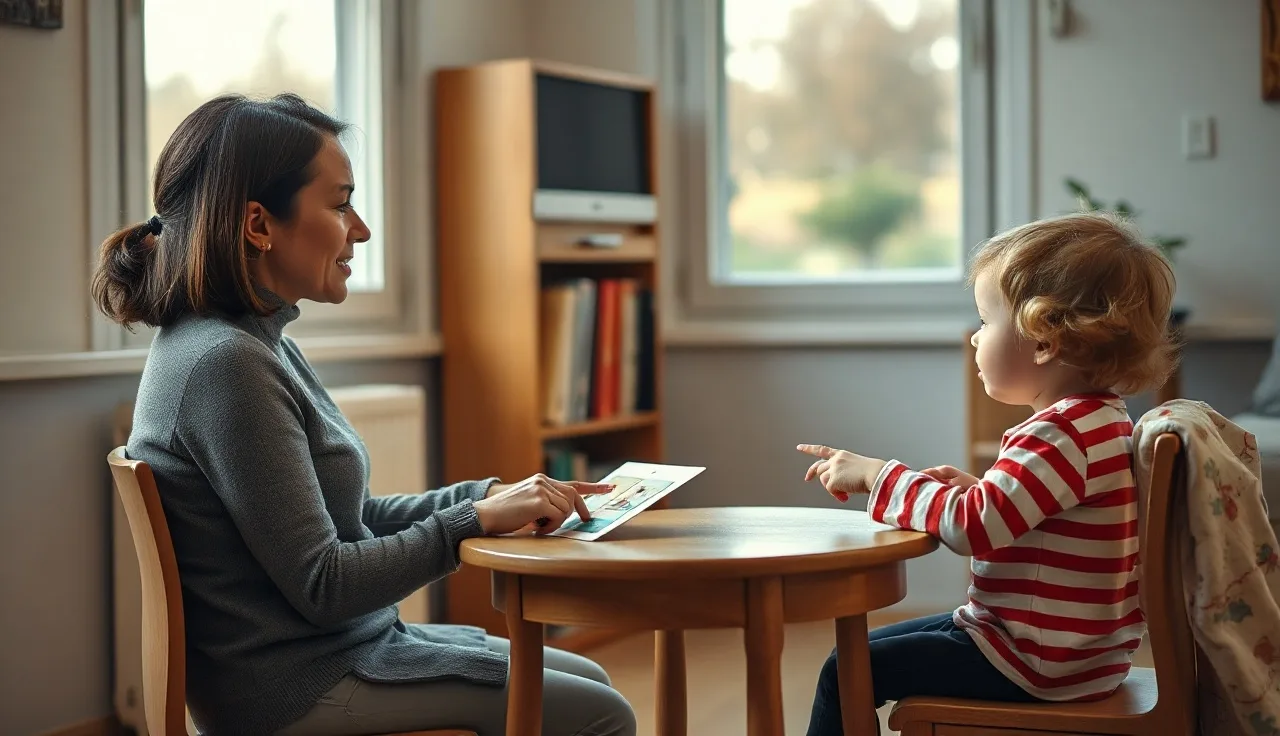
Then comes the actual speech assessment: single-word naming tasks with pictures or objects, repetition of words and nonwords at increasing length ("puh," "puhkuh," "puhkuhtuh"), connected speech or conversation samples, and stimulability probes where the SLP tries different cues to see how the child responds.
Throughout all of this, the SLP is listening and watching for the core markers: inconsistency across attempts, groping behavior, prosody errors, and worse performance on longer versus shorter words. Many also track how the child responds to feedback and cueing, since CAS shows a specific pattern of motor learning difficulty [3].
A full evaluation usually takes 60 to 90 minutes across one or two sessions. You'll get a written report with findings, any diagnoses, and recommendations for therapy frequency and approach. If the SLP is uncertain, which is honest and appropriate for very young or minimally verbal kids, they may recommend a trial of motor speech therapy and re-evaluate after six to eight weeks.
Why brain scans and genetic tests aren't the answer
There's no imaging or blood test that diagnoses apraxia of speech on its own. MRI or CT scans can show structural brain differences or lesions in some people with acquired apraxia (after stroke, for example), and certain genetic conditions like FOXP2 mutations are linked to severe speech and language impairment including apraxia-like features [4]. But a child can have childhood apraxia of speech with a completely normal MRI, and a normal MRI doesn't rule CAS out either.
Neuroimaging gets ordered to look for an underlying cause, not to confirm the speech diagnosis itself. If your child's pediatrician or neurologist recommends a brain MRI, it's usually to check for structural differences, epilepsy, or a progressive neurological condition, which is a reasonable step in a broader medical workup. The speech diagnosis still comes from the SLP's clinical assessment.
Genetic testing is more common now when CAS shows up alongside intellectual disability, motor delays, or other developmental differences, because certain syndromes (Down syndrome, galactosemia, CHARGE syndrome) carry higher rates of CAS [5]. Here too, the genetic result fills in the clinical picture rather than replacing the speech evaluation.
How is apraxia different from other speech disorders when it comes to testing?
This is where most misdiagnoses happen, and it's the main reason the evaluation process matters so much.
Phonological disorders come from errors in the rules a child uses to organize sounds, and those errors tend to be consistent: the child always swaps one sound for another. They respond well to minimal pair or phonological contrast therapy. Apraxia works differently. The same word comes out differently each time, and that inconsistency is one of its defining features[12].
Dysarthria involves actual muscle weakness or incoordination, and an SLP can usually spot it in the oral-motor exam through reduced tongue strength, hypernasality, or altered voice quality. It can show up alongside apraxia, especially in people with cerebral palsy or after a stroke, which makes telling the two apart genuinely hard. Both conditions turn up often in autism spectrum speech therapy caseloads.
Language delay or disorder is a different matter altogether, tied to vocabulary, grammar, and comprehension. Some children have both a language disorder and CAS, but they're separate diagnoses with separate treatment targets.
Selective mutism is different still: the child can physically speak but doesn't in certain settings because of anxiety, and their speech sounds normal in comfortable settings.
What really sets apraxia apart in testing is the motor learning profile: inconsistency, more errors on longer words, trouble sequencing syllables, and a specific response to different kinds of cueing. A good SLP checks all of this systematically instead of jumping to a label.
How old does a child need to be for apraxia testing?
There's no firm minimum age, but diagnosis gets more reliable as kids get older, simply because they can take part more fully in standardized tasks. Most specialists feel confident in a CAS diagnosis around age three, once a child has made enough expressive language attempts to show the pattern clearly.
For children under two, SLPs often say "suspected CAS" or describe motor speech concerns rather than giving a confirmed diagnosis. That's not a hedge, it reflects real uncertainty, and it protects the child from a premature label. What matters at that age is that the child gets motor-speech-focused therapy regardless of the label, since the treatment looks the same either way.
ASHA's technical report notes that diagnosing CAS in very young children "requires ongoing observation" and should be revisited as the child develops[1]. An evaluation at age two isn't the final word; follow-up assessments every six months during active therapy are standard practice.
If you're wondering whether to push for an evaluation before age three, push. You can get a diagnosis of "possible" or "suspected" CAS and start treatment right away. Waiting until the picture is clearer is a reasonable clinical stance, but waiting to start therapy isn't. Early intervention services under Part C of IDEA cover children from birth to age three and don't require a confirmed diagnosis to begin, just a developmental delay or an established condition that puts the child at risk[8].
What does testing cost, and does insurance cover it?
A private speech-language evaluation typically runs $250 to $600 out of pocket in the United States. University clinic evaluations often cost less, sometimes $75 to $150, and hospital-based evaluations can run higher[6]. These numbers swing a lot depending on geography and setting.
Most private health insurance plans cover speech-language evaluations when they're ordered or referred appropriately, though your deductible, copay, and whether your SLP is in-network all shape what you actually pay. Medicaid covers speech-language evaluations for children in every state under the Early and Periodic Screening, Diagnostic and Treatment (EPSDT) benefit, which requires coverage of any medically necessary service for children under 21[7].
School-based evaluations under IDEA are free to families. If your child is over three and you suspect a speech disorder affecting their educational performance, you can request a special education evaluation in writing, and the district must respond within a set timeline, typically 60 days from your written request, though it varies by state[8].
The catch with school evaluations is that they're built to decide educational eligibility, not to produce a clinical diagnosis. The report might say "the student demonstrates characteristics consistent with a motor speech disorder" instead of formally diagnosing CAS. If you need a clinical diagnosis on paper for medical, insurance, or treatment-planning reasons, a private evaluation is usually more useful.
If you want a sense of what therapy looks like before or after testing, tools like the Little Words app (littlewords.ai/start) offer a low-cost way to start practicing motor speech patterns at home while you wait for an evaluation slot.
What happens after apraxia is diagnosed?
The evaluation report should spell out specific recommendations for therapy frequency, approach, and goals. For children with CAS, research supports intensive, frequent motor speech therapy, at least two to four sessions a week in the early stages[3]. That's meaningfully more than what's recommended for phonological disorders or language delays, and it's one more reason getting the diagnosis right matters.
Evidence-based approaches built for CAS include the Nuffield Dyspraxia Programme, Rapid Syllable Transition Treatment (ReST), Dynamic Temporal and Tactile Cueing (DTTC), and Prompts for Restructuring Oral Muscular Phonetic Targets (PROMPT)[3]. Not every SLP is trained in all of them, so it's fair to ask your therapist which approach they use and why.
For children who are minimally verbal or whose speech is very hard to understand, AAC devices are often recommended alongside speech therapy, not instead of it. AAC doesn't reduce a child's drive to speak; the evidence consistently shows the opposite[9].
Adults with acquired apraxia follow a similar logic: frequent motor practice, spaced repetition, and augmentative support if intelligibility is severely affected. Speech therapy for adults covers the adult rehab path in more detail.
Parents ask constantly whether there's anything they can do at home between sessions. There is. Motor speech therapy runs on high-repetition practice, and a motivated parent doing structured practice at home, following the SLP's guidance, can sharply increase how many practice trials a child gets each week. Your SLP should hand you specific home targets, not just general encouragement.
Can parents screen for apraxia at home before an official test?
You can't diagnose apraxia at home, and online quizzes (including the ones circulating on social media) aren't validated screening tools. But you can gather information before the evaluation that helps the SLP do a better job.
The single most useful thing you can do is record video of your child speaking in different settings over several weeks, trying to catch attempts at the same words on different days. That gives the SLP real evidence of consistency or inconsistency across attempts, which is one of the hardest things to judge in a single clinic visit with a nervous or uncooperative child.
Note specific patterns too. Does your child do better with short words than long ones? Do they struggle more when excited or tired? Do they ever seem to search with their mouth before a sound comes out? Do certain cues, like you slowing down and mouthing a word, help more than others? These observations matter clinically.
Apraxia Kids (formerly CASANA) offers a parent checklist summarizing the observable signs of CAS[10]. It's not a diagnostic tool, but it's a reasonable way to organize what you're seeing before the evaluation. And if you're wondering whether your observations cross the threshold for concern, here's the honest answer: if you're asking the question, the evaluation is worth doing. SLPs expect referrals at the concern stage, not the certainty stage.
For families who want structured guidance while waiting for an evaluation, the speech therapy speech therapist article explains what to look for in a provider and how to find one fast.
Most SLPs won't put a firm diagnosis on paper until around age three, once a child has enough speech output to actually show the telltale patterns. Below that age, clinicians usually say "suspected CAS" instead, and that's fine: your child doesn't need a confirmed diagnosis to start motor speech therapy. ASHA's own guidance treats an early diagnosis as a starting point, not a final answer, and expects ongoing observation as the child grows. There's no single test that nails down apraxia on its own. SLPs piece it together from standardized tools like the Kaufman Speech Praxis Test or DEMSS, an oral-motor exam, samples of the child's speech, and how the child responds to cueing. It's the pattern across all of that, not any one measure, that leads to a diagnosis. No brain scan or quiz can substitute for it. A full evaluation usually takes one to two sessions of 60 to 90 minutes each, though complicated cases, younger children, or kids with other conditions can take longer. You should get a written report within a week or two of the last session; if three weeks pass with nothing, it's reasonable to follow up. Apraxia and autism get confused in both directions. In early childhood they can look strikingly similar: limited speech, communication frustration, and odd prosody show up with both, and they co-occur more than you'd expect by chance. The clearest picture comes from having both a speech-language pathologist and a developmental psychologist or psychiatrist involved, since one diagnosis doesn't rule out the other. Apraxia and dysarthria get mixed up too, but they're different problems. Dysarthria stems from muscle weakness or poor coordination tied to neurological damage, and an oral-motor exam will usually show reduced strength or range of motion. Apraxia has no muscle weakness behind it: it's a motor planning problem, and its errors are inconsistent and get worse as words get longer and more complex, while dysarthria errors stay fairly steady. A good SLP evaluation sorts out which one you're dealing with. Referrals work differently depending on where you're getting evaluated. Private practices and hospitals often want a pediatrician's referral for insurance, though you can usually still get scheduled without one. School evaluations under IDEA don't need a referral at all: you can request one in writing yourself. For early intervention (birth to three), a doctor's referral can help but isn't always necessary to reach your state's Part C program. Telehealth evaluations for CAS are increasingly common and generally work well. The oral-motor exam is trickier over video, but speech sampling, cueing, and standardized testing hold up fine remotely, with reliability comparable to in-person assessment for most components. For very young children, though, in-person evaluation is still the better choice when you have access to it. For the appointment itself, bring videos of your child talking, especially any from before a regression or from earlier ages, along with notes on words they say consistently versus ones they struggle to attempt. Past evaluations, audiograms, or therapy reports are worth bringing too, and a favorite toy can help a younger child settle in and talk more like themselves. Adults with acquired apraxia, usually after a stroke or brain injury, get tested with tools like the Apraxia Battery for Adults (ABA-2) plus informal tasks checking sequencing, consistency, and cueing response, with dysarthria and aphasia ruled out along the way. Doctors will investigate the underlying neurological cause with imaging, but the speech diagnosis itself comes from the SLP's clinical findings. Schools won't test for apraxia automatically. You need to submit a written request for a special education evaluation, and while schools must evaluate every suspected area of disability, including speech, that evaluation is aimed at educational eligibility rather than a clinical label. The report might describe motor speech patterns without formally naming CAS, so if you need a clinical diagnosis for medical or therapy purposes, a private evaluation is the route to take. Mild cases or very young kids sometimes improve on their own, but once real CAS features are present, the research doesn't back a wait-and-see approach. Motor speech disorders need frequent, targeted practice guided by an SLP, and there's no good evidence that a child who "grows out of it" actually had true CAS rather than a milder phonological delay. If CAS is suspected, it's worth starting therapy rather than waiting. PROMPT (Prompts for Restructuring Oral Muscular Phonetic Targets) is mainly a treatment, not a diagnostic test, though SLPs trained in it sometimes use it during assessment too, since how a child responds to tactile-kinesthetic cueing tells you something: fast motor learning with PROMPT cueing tends to fit a CAS profile. Certification comes through the PROMPT Institute. Worth watching for in a toddler: very little babbling as an infant, a wide gap between what they understand and what they can say, the same word coming out differently every time, more errors on longer words, and speech that sounds flat or oddly rhythmic. Groping mouth movements before a sound comes out are another sign. If two or three of these show up together, that's enough reason to request an evaluation. During active therapy, re-evaluation every six months is standard, and ASHA notes that a CAS diagnosis in very young children requires ongoing observation rather than a one-time verdict. This matters especially under age three: as a child produces more speech, follow-up evaluations confirm or revise the diagnosis and let the SLP recalibrate therapy targets to match actual progress.Sources
- ASHA Practice Portal: Childhood Apraxia of Speech: ASHA defines CAS core features: inconsistency of errors on repeated productions, lengthened and disrupted coarticulatory transitions, and inappropriate prosody
- McCauley & Strand, Dynamic Evaluation of Motor Speech Skills (DEMSS), via ASHA Practice Portal: Dynamic assessment approaches provide more clinically meaningful information than static tests alone for young or minimally verbal children with suspected CAS
- ASHA Practice Portal: Childhood Apraxia of Speech (Treatment section): Evidence-based treatment for CAS includes DTTC, ReST, NDP3, and PROMPT; intensive frequency (2-4 sessions per week) is supported by research
- NIH National Institute on Deafness and Other Communication Disorders: Speech and Language: FOXP2 gene mutations are associated with severe speech and language impairment including apraxia-like features
- ASHA: Apraxia of Speech (acquired and developmental overview): CAS occurs at higher rates in certain genetic syndromes including Down syndrome, galactosemia, and CHARGE syndrome
- ASHA: Find a Certified SLP: Private speech-language evaluations in the U.S. range in cost depending on setting; university clinics tend to charge less than private practices or hospitals
- Medicaid.gov: Early and Periodic Screening, Diagnostic and Treatment (EPSDT): Medicaid's EPSDT benefit requires coverage of medically necessary services, including speech-language pathology, for children under age 21
- U.S. Department of Education: IDEA Individuals with Disabilities Education Act: Under IDEA, public schools must evaluate children for disabilities including speech-language disorders at no cost to families; Part C covers birth to age three
- ASHA Practice Portal: Augmentative and Alternative Communication (AAC): Evidence consistently shows that AAC use does not reduce a child's motivation to speak and often supports verbal development alongside device use
- Apraxia Kids: Signs and Symptoms of CAS: Apraxia Kids offers a parent-facing checklist of observable signs associated with childhood apraxia of speech
- American Academy of Pediatrics: Developmental Surveillance and Screening: AAP recommends developmental surveillance at every well-child visit and formal screening at 9, 18, and 30 months; speech concerns warrant referral to an SLP
- Journal of Speech, Language, and Hearing Research (ASHA Journals): Research confirms that articulatory movement variability across repeated productions is a core distinguishing feature of CAS compared with typically developing peers and other speech disorders