Last updated 2026-07-09
TL;DR
Set the device up with your child's SLP, then model language on it yourself throughout the day, more often than you prompt your child to use it. Keep it within reach at all times and expect slow, real progress. Research consistently shows AAC does not reduce speech development and often supports it.
What an AAC device actually does
AAC stands for augmentative and alternative communication: any tool, from a picture board to a speech-generating device, that helps someone communicate when speech alone isn't enough. [1]
The word "alternative" trips a lot of parents up. They hear it and assume AAC is a last resort, some kind of signal that their child will never speak. That's not what the evidence says. The American Speech-Language-Hearing Association (ASHA) is clear that AAC "does not replace natural speech," and for many kids it actually supports speech development, since it takes the pressure off and gives them a reliable way to get their message across. [1]
Kids who use AAC include those with autism spectrum disorder, childhood apraxia of speech, cerebral palsy, Down syndrome, and other conditions affecting expressive language, as well as late talkers who just need a bridge while their verbal skills catch up. There's no minimum age either; even toddlers under two can start with simple symbol systems. The tools themselves span a huge range. A laminated sheet of pictures costs almost nothing. A dedicated speech-generating device like a Tobii Dynavox or PRC-Saltillo system runs $3,000 to $8,000 before insurance. [2] Tablet apps such as Proloquo2Go, TouchChat, or LAMP Words for Life cost roughly $200 to $300 and are often tried first because the hardware is so much cheaper. [3]
Which one fits your child depends on motor skills, vision, cognition, and daily routines, and that call belongs to a qualified speech therapist, not a search bar.
Getting started
Start with an AAC evaluation from a licensed speech-language pathologist. This isn't a box to check: the SLP looks at your child's receptive language, motor abilities, vision, and communication needs to figure out the right access method (touch, eye gaze, switch scanning) and vocabulary. Without that evaluation, you're guessing at hardware.
If your child qualifies for early intervention (under age 3 in the US) or school-based speech services, an AAC evaluation should be built into that process, so ask for it in writing. Under IDEA (the Individuals with Disabilities Education Act, 20 U.S.C. § 1401), schools are required to provide assistive technology when a child needs it for a free appropriate public education, and that includes AAC devices. [4]
Once you actually have a device or app in hand, a few things need to happen before the first real session. Learn it yourself first: spend 20 minutes clicking through every page and folder, because you can't model what you don't know. Work with your SLP to customize the vocabulary, putting core words like "more," "stop," "want," "help," "no," and "go" on the home screen, with specific nouns (toys, foods) tucked deeper in the system. Set up the physical space so the device is always within arm's reach, not charging in another room. And make sure every caregiver, grandparents and teachers included, understands the basics of when and how to model.
Modeling: the thing every SLP will tell you to do
Modeling means you press the buttons yourself to show how the device works, without asking your child to do anything. You're demonstrating, not drilling. Think about how kids learn spoken language: they hear thousands of words before they say one. AAC works the same way. Narrate your day on the device alongside your speech. Press "eat" when you hand over a snack. Press "go" when you head out the door. Press "stop" when the game ends.
This is sometimes called aided language input, or aided language stimulation (ALgS). A study by Cafiero found that consistent aided language input increased spontaneous communication in a student with autism. [5] The key word there is consistent: modeling once a day won't cut it. It needs to happen across activities, across people, across settings.
Most SLPs push for more models than prompts. If you're asking your child to use the device more often than you're showing them how, the balance is backwards, and all the pressure lands on a child who's still learning the system. One technique worth borrowing: time delay. After you model a message or ask an open question, wait, silently, for a count of ten. That pause isn't awkward. It's processing time, and it often gets a response that immediate prompting wouldn't.
Choosing the vocabulary
This is where a lot of well-meaning setups go sideways. Parents load the device with nouns: ball, juice, dog, Elmo. Those are fringe words. They name things but they don't build sentences. Core vocabulary is the real foundation. Roughly 80% of what people say in daily life comes from about 200 to 400 core words. [6] These are mostly verbs, pronouns, adjectives, prepositions, and function words: "I," "want," "more," "help," "like," "don't," "go," "stop," "that," "big." They work across every activity, every day, which is exactly why they belong on the main screen from day one. Fringe words still matter, especially the ones tied to what your child loves, but they belong on secondary pages.
Here's a practical way to think about the layers:
| Layer | Examples | Where it lives |
|---|---|---|
| Core (high-frequency) | want, more, stop, help, I, no, go, like | Home/main screen |
| Personal core | names of family members, pets | Secondary page |
| Activity fringe | juice, ball, book, outside | Folder per activity |
| Emergent literacy | alphabet, basic spelling | Advanced page (when ready) |
Revisit the vocabulary with your SLP every few months. Kids grow and their interests shift, and a setup that worked at three may not fit a six-year-old anymore. [7]
How much should my child use it each day?
The honest answer is all day, every day, which sounds unrealistic until you break down what it actually means. The device should be present and accessible during every waking hour, the same way a speaking child's voice is always available to them. Limiting it to "AAC time" or therapy sessions is one of the most common and damaging mistakes families make. When the device disappears, so does the child's way of communicating.
You don't need to model every single minute, though. Lean on natural routines: mealtimes, bath time, getting dressed, playtime, watching a show. Pick two or three activities each week to model heavily, and for the rest of the day just keep the device within reach and respond with real interest whenever your child touches it. Quantity matters less than consistency. Research on naturalistic developmental behavioral interventions finds that communication opportunities spread across the day produce stronger language outcomes than concentrated practice sessions. [8] Drilling might feel productive, but generalization comes from real-world practice, not repetition in isolation.
If your child resists the device, look into why rather than pushing through it. Sometimes the vocabulary doesn't match their interests, sometimes the motor demands are too high, sometimes a setting has become associated with pressure. Bring it up with your SLP.
Mistakes that show up again and again
A few patterns come up over and over, and knowing them ahead of time can save months of frustration. There's the "device in the bag" problem: it stays in a backpack or on a high shelf because it's expensive and fragile, the child can't reach it, doesn't use it, and the family concludes AAC isn't working. The device needs to be out in the world. It will get dropped. That's fine. There's prompting instead of modeling: "Say 'more.' Press 'more.' Come on, press 'more.'" Constant prompting teaches kids to wait for a cue instead of communicating on their own, and spontaneous communication is the entire point. There's expecting fast results. AAC isn't a product you install, it's a language system that takes years to learn. Most children need six to twelve months of consistent use before independent use becomes steady, and some take longer. That's normal, not a sign of failure. [7]
There's only accepting "real" requests: some parents light up when a child asks for food but ignore it when the child comments, protests, or just explores the device. All of that counts as communication and deserves a response. And there's dropping AAC the moment speech starts to emerge. If a child begins saying a few words, some families put the device away, assuming the job is done. Don't. Speech and AAC can coexist, and a child who's starting to talk still needs the device for the moments when talking is hard.
How do I respond when my child uses the AAC device?
The short version: respond to every intentional communication act, every single one. Look at your child, acknowledge what they said, and reply the way you would to any spoken message.
If your child presses "more" during lunch, give them more. Don't make them press it three times to prove they mean it. If they press a word that doesn't quite fit the context, honor the attempt and gently expand on it. Say they press "go" during a book-reading session. You might say "go? You want to go somewhere? Okay, let's read one more page and then we'll go." You're not correcting them, you're modeling more language on top of what they gave you.
Expansion like this is one of the most research-supported techniques in language therapy. When a child produces a one or two-word message, you respond with a slightly longer version. They press "want juice," you say "Oh, you want more juice! Here you go." Over time this builds complexity naturally.[9]
Resist the urge to test your child by asking a question you already know the answer to, just to see if they'll use the device correctly. Kids tend to read this as a performance demand and shut down. Ask genuine questions instead. Comment on real things. Communicate for real reasons.
If your child also shows echolalia (repeating words or phrases from TV, conversations, or books), that can coexist productively with AAC. The two aren't in conflict. Our piece on echolalia meaning goes into more detail on interpreting and building on it.
Will using an AAC device stop my child from learning to speak?
This fear stops more families from starting AAC than anything else, and it's understandable, but it isn't supported by the research.
ASHA's position is clear: "AAC does not hinder speech development." A 2006 meta-analysis by Millar, Light, and Schlosser in the American Journal of Speech-Language Pathology reviewed 23 studies and concluded that AAC "did not inhibit speech production and actually facilitated speech in many participants."[10] Across participants, 89% showed maintenance or improvement in speech output after AAC was introduced. The mechanism makes sense once you think about it: AAC reduces the frustration of failed communication, and when a child isn't burning all their energy trying to force out words, they have more room to practice speech. The two systems support each other.
That doesn't mean every AAC user will eventually speak without a device. Some will, some won't. AAC isn't a scaffold that gets kicked away once "real" talking starts. For some people it stays their primary way of communicating for life, and that's a completely valid outcome. The goal is effective communication, not a specific mode of it.
If an SLP or anyone else tells you to hold off on AAC until you've given speech more time, that advice doesn't match current evidence. There's no evidence-based reason to delay AAC.[1]
How does AAC work at school and during speech therapy?
If your child gets school-based speech services, the SLP should be folding AAC into every session rather than treating it as separate. The device should go to school every day and get used in the classroom, at lunch, at recess. Teachers and paraprofessionals need at least basic training on it too.
Under IDEA, the IEP team is responsible for identifying assistive technology needs and writing those supports into the IEP.[4] If your child uses AAC, the IEP should name the device, the vocabulary system, which staff are trained on it, and the specific goals being targeted. Ask to see this in writing if it isn't there already.
For private speech therapy, bring the device to every appointment. A therapist working without it, even when targeting related skills, is missing chances to integrate it. Therapy generalizes best when the same tools travel across settings, and that only happens if the device actually goes with your child.
Home programs are standard practice. Your SLP should be giving you specific activities to do between sessions; if they haven't, ask. Even 10 to 15 minutes of focused, naturalistic modeling during a daily routine matters.[11]
If online speech therapy is your main access point, which is common for families in rural areas or juggling tight schedules, it can absolutely include AAC work. The therapist watches your child use the device over video and coaches your implementation in real time, and that format works especially well for parent training.
Dedicated device or app?
This is one of the first questions families ask, and one of the harder ones to answer without knowing the specific child.
Dedicated speech-generating devices from makers like Tobii Dynavox or PRC-Saltillo are built purely for AAC: durable, long battery life, loud speakers, deep vocabulary systems. They're also expensive, typically $3,000 to $8,000 before insurance.[2] Medicaid covers AAC devices in most states as durable medical equipment, and private insurance coverage is variable but improving under state and federal mandates. A letter of medical necessity from an SLP and physician is usually required for funding.
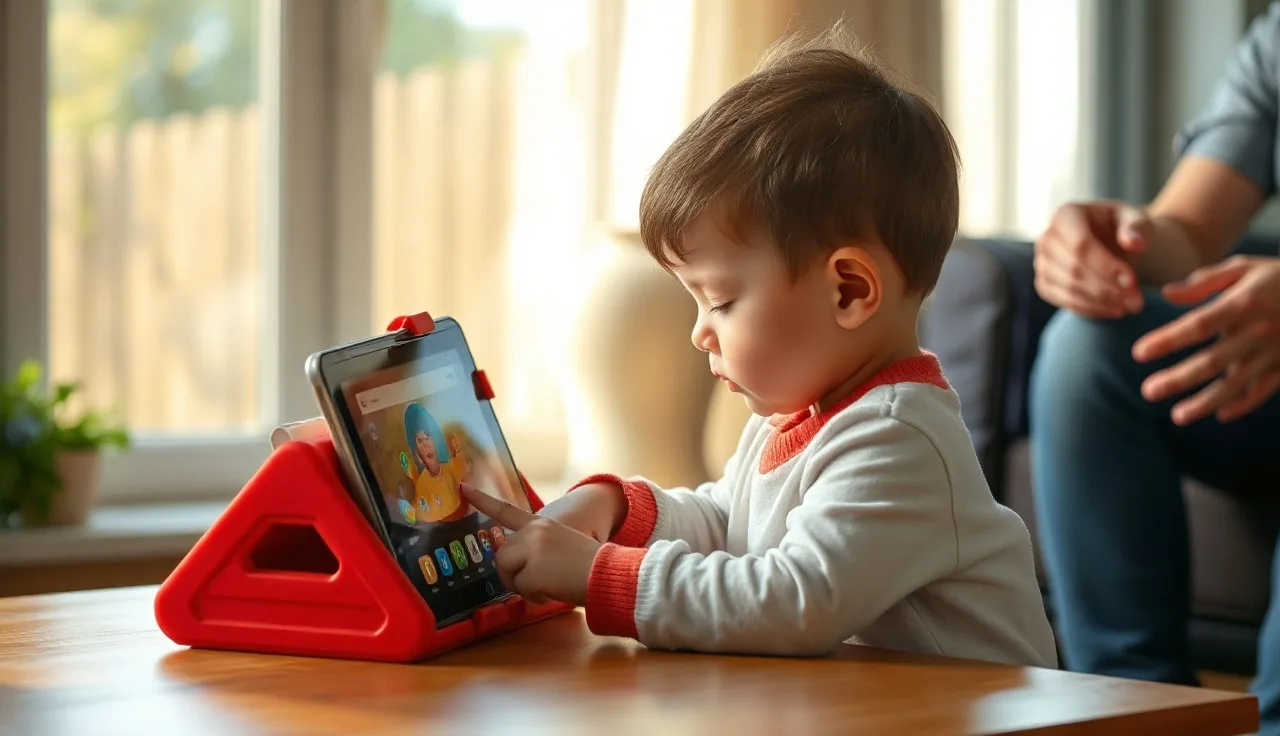
App-based AAC on an iPad costs far less, often under $1,000 total for device and app combined. The tradeoff is that an iPad is also a video player, a game console, and a distraction, and some children struggle to use the same device for AAC that they use for entertainment. Cases and device holders built specifically for AAC (like those from Ablenet or Mount'n Mover) help keep the communication device physically separate from a tablet used for play.
For young children just starting out, many SLPs suggest a low-tech or mid-tech system while funding for a full device is pursued. A printed communication board or a simple 8-cell single-level device in the $50 to $200 range gets vocabulary modeling going right away, without waiting months for insurance approval.
If you want a structured way to build vocabulary and modeling habits between device sessions, Little Words (take the quiz at littlewords.ai/start) is an AI-based speech companion for neurodivergent kids built around the same core vocabulary approach used in clinical AAC practice. It's meant as a supplement, not a replacement for device therapy.
The comparison below shows typical cost and coverage considerations:
What milestones should I expect, and when should I worry?
There's no single timeline that fits every child. That's an honest answer even if it's not a satisfying one. Here's what research and clinical experience suggest.
In the first one to three months of consistent use, most children show more engagement with the device even if they aren't pressing buttons independently yet. They're watching you model, and that's the job right now.
Between three and six months, many children start making intentional selections, often just one or two core words used over and over. "More" and "no" are common first functional words.
By six to twelve months of steady use (device available all day, multiple people modeling, therapy ongoing), most children show some independent, spontaneous use of the device.[7]
If you're a year in with no discernible progress, that's worth a reassessment: the vocabulary might not match your child's interests, the access method might be wrong, or there could be motor barriers nobody's identified. Ask for a full AAC re-evaluation.
Regression happens sometimes and isn't always alarming. Illness, family stress, school transitions, and developmental leaps can all temporarily affect AAC use, and a two or three week dip usually resolves on its own.
Children with apraxia of speech may show a different pattern, since motor planning can affect both spoken word attempts and, sometimes, device navigation. It's worth specifically seeking out an SLP who understands both apraxia and AAC.
If your gut says something's off, bring it to your SLP. You know your child better than any standardized timeline does.
Building AAC into daily life without burning out
Parent burnout is real and rarely talked about in AAC literature. Implementing AAC adds real labor on top of therapy appointments, IEP meetings, and everything else already on your plate.
Start with two or three anchored routines rather than trying to model all day right away. Breakfast, bath, and one play activity is enough. Do those consistently for four weeks before adding more. Consistency in a few settings beats sporadic effort spread across many.
Get everyone in the household doing at least a little modeling. If one parent models constantly while the other never touches the device, that creates inconsistency and dumps extra load on whoever's doing the work. Ten minutes of training for secondary caregivers goes a long way.
Track wins more than deficits. Keep a simple note on your phone: date, what your child communicated, how. Rereading those notes on hard days genuinely helps, and it gives your SLP useful data too.
Little Words (littlewords.ai/start) offers guided prompts and modeling support between sessions, which some families find takes the edge off figuring out what to do during home practice time.
One last thing: you don't have to be perfect. A device modeled imperfectly and inconsistently still beats a device sitting in a bag. Aim for good enough, and keep showing up.
There's no set minimum age for starting AAC. Low-tech symbol systems are regularly introduced to children under 18 months once communication delays show up, and ASHA is clear that there are no prerequisites: a child doesn't need to hit some cognitive or language milestone first. The earlier a device shows up, the better things tend to go. A diagnosis isn't required either. AAC fits any child whose spoken communication isn't meeting their needs, no matter the cause. That said, insurance or school funding usually wants documentation of a communication disability from a licensed SLP (and sometimes a physician), even if a formal diagnostic label isn't a legal requirement. Medicaid covers AAC devices as durable medical equipment in most US states, and private insurance varies by plan and by state law. Either way, you'll almost always need a letter of medical necessity from an SLP and a physician, proof of the communication impairment, and sometimes a trial with the specific device first. Your SLP or the device manufacturer's funding department can walk you through that paperwork. On vocabulary: core words are the small set of high-frequency words, roughly 200 to 400 of them, that carry most daily communication ("want," "more," "go," "stop," "help," "I," "like"). Fringe vocabulary covers the specific nouns tied to one person's life, like family names or favorite foods. Both matter, but core vocabulary should dominate the home screen. If your child throws or avoids the device, that's usually a sign it's become tangled up with pressure, or that the vocabulary doesn't match what they actually care about. Ease off the prompting, ask your SLP to review whether the words on the board are still relevant, and try modeling during favorite activities so the device gets linked to fun instead of demands. Mention what you're seeing to your SLP: it's genuinely useful information for them. AAC works fine alongside speech, too. A child who talks but is often misunderstood, has limited word combinations, or struggles when stressed or overloaded can still benefit from having a device on hand. Plenty of kids mix speech, AAC, and gesture, and using AAC doesn't slow speech development, it often supports it. For iPad apps, the most common choices are Proloquo2Go (symbol-based), TouchChat HD (flexible grid systems), and LAMP Words for Life (motor-pattern based, often used for apraxia). Which one fits depends on your child's motor skills, language level, and learning style, so an SLP who specializes in AAC should trial a few before you commit. Don't pick one off reviews alone. A concept worth knowing is aided language input, sometimes called aided language stimulation: you use the device yourself to model language during everyday activities, without asking the child to respond. That's different from prompting, where you're directing them to produce a message. Research favors leading with input rather than prompting, since heavy prompting can create dependency, where a child waits to be told to communicate instead of starting on their own. The device should also travel everywhere: school, home, stores, appointments, family events. Communication doesn't stop at the school door, and a device parked in a cubby all evening can't help a child tell you about their day. If a school pushes back on this, it's worth raising in the IEP. As for timeline, six to twelve months of consistent, high-quality use is what most clinicians consider reasonable for meaningful independent use to show up. Some kids move faster; kids with more complex motor or cognitive profiles may need longer. "Consistent" means the device is available all day, several people model with it regularly, and the child is working with an SLP experienced in AAC. If your school SLP doesn't know much about AAC, and this happens more than it should, you can ask the school to bring in an AAC specialist for a consultation, which is within your rights under IDEA if the team agrees AAC is warranted. A private evaluation outside of school is also an option. USSAAC and ASHA's ProFind tool can help you track down specialists. AAC and PECS aren't the same thing. PECS (Picture Exchange Communication System) is a specific behavioral protocol where a child hands over a picture card to request something. AAC is the broader category that includes PECS along with speech-generating devices, apps, and communication boards. PECS has its own training protocol and works as an entry point for some kids, but it's not a substitute for a full dynamic display system. And yes, autistic children can use AAC effectively. It's one of the best-researched interventions for autism-related communication differences, with multiple systematic reviews backing its use across ability levels. ASHA recommends considering AAC for any autistic person whose speech isn't covering their daily communication needs, and autistic children who use it often show improved communication and, frequently, more verbal speech over time.Sources
- ASHA, Augmentative and Alternative Communication (AAC) overview: AAC does not replace natural speech and does not hinder speech development; there are no prerequisites for AAC introduction
- ASHA, Augmentative and Alternative Communication practice portal (funding and SGDs): Dedicated speech-generating devices can cost $3,000 to $8,000; Medicaid and private insurance funding pathways described
- USSAAC (United States Society for AAC): Tablet-based AAC apps such as Proloquo2Go and TouchChat are widely used alternatives to dedicated devices
- US Department of Education, Individuals with Disabilities Education Act (IDEA), 20 U.S.C. § 1401: Under IDEA, schools must provide assistive technology, including AAC, when required for a free appropriate public education
- Cafiero, J.M. (2001). The effect of an augmentative communication intervention on the communication, behavior, and academic program of an adolescent with autism. Focus on Autism and Other Developmental Disabilities.: Consistent aided language input increased the rate of spontaneous communication in a student with autism
- Beukelman, D.R. & Mirenda, P. (2013). Augmentative and Alternative Communication: Supporting Children and Adults with Complex Communication Needs. Brookes Publishing.: Approximately 200 to 400 core words account for roughly 80% of everyday communication
- ASHA Practice Portal, Augmentative and Alternative Communication (assessment and intervention): Vocabulary system review every few months recommended; six to twelve months of implementation considered a standard window for observing steady independent use
- Schreibman, L. et al. (2015). Naturalistic Developmental Behavioral Interventions: Empirically Validated Treatments for Autism Spectrum Disorder. Journal of Autism and Developmental Disorders.: Naturalistic communication opportunities distributed throughout the day produced stronger language outcomes than concentrated practice blocks
- ASHA Practice Portal, Late Language Emergence (techniques for facilitating language development): Expansion is a research-supported technique: responding to a child's short message with a slightly longer version builds language complexity over time
- Millar, D.C., Light, J.C., & Schlosser, R.W. (2006). The impact of augmentative and alternative communication intervention on the speech production of individuals with developmental disabilities. American Journal of Speech-Language Pathology, 15(3), 228-237.: Meta-analysis of 23 studies found AAC did not inhibit speech and facilitated speech in many participants; 89% showed maintenance or improvement in speech output after AAC introduction
- American Academy of Pediatrics (AAP): Home programs with 10 to 15 minutes of naturalistic modeling during daily routines are recommended as part of AAC implementation